
Charter School Teacher Certification: What Florida Parents Should Know
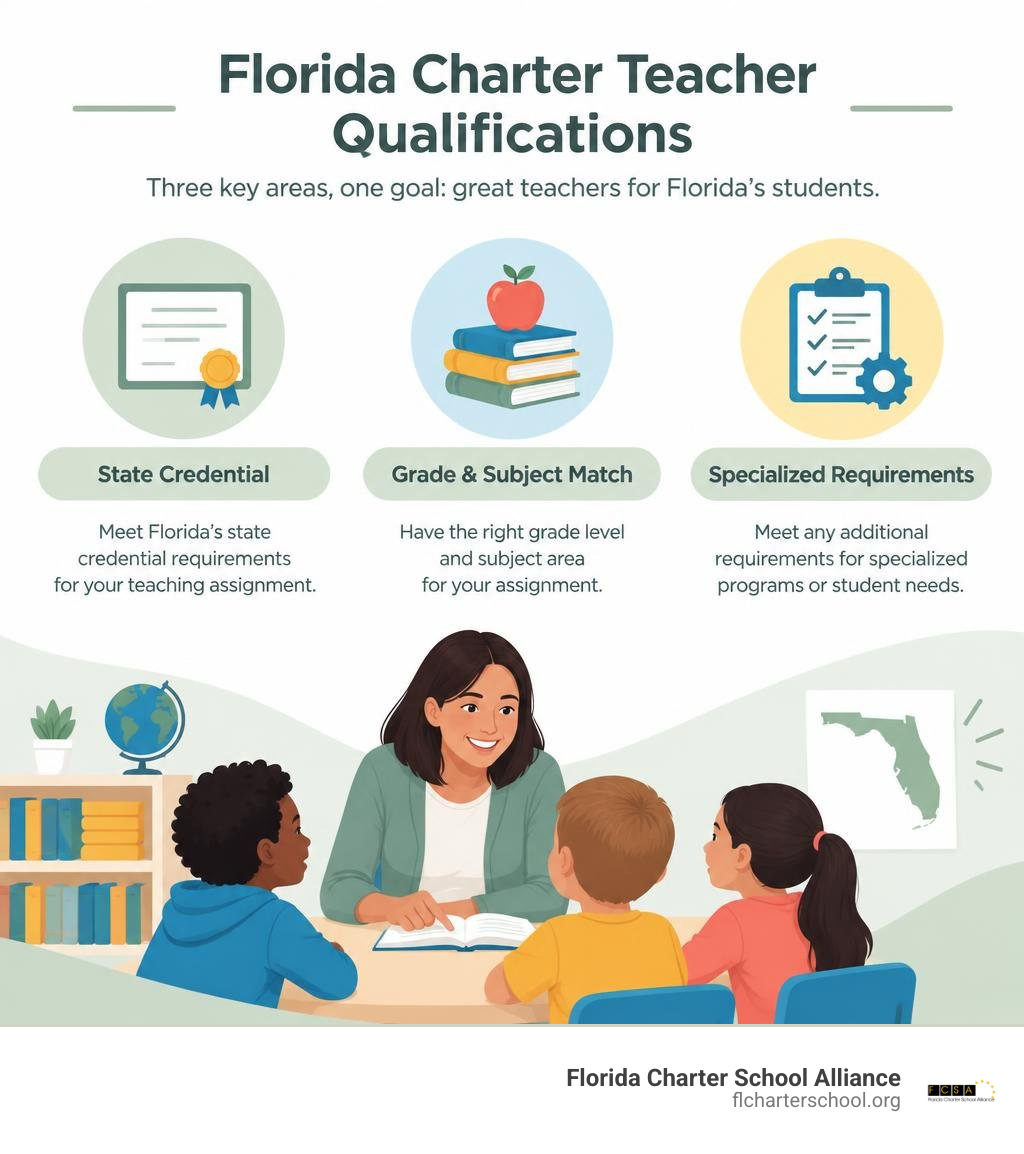
Charter school teacher certification in Florida follows state rules. Public charter school teachers must hold the state credential required for their teaching assignment, including the right grade level and subject area. Parents can ask a school about a teacher’s qualifications and check their credentials with the Florida Department of Education.
A teacher’s credentials are one part of choosing a school. Families can also ask how the school supports teachers, serves students with different needs, and measures student achievement.
I’m Lynn Norman-Teck, executive director of the Florida Charter School Alliance. My work in charter school policy and community engagement helps me explain Charter school teacher certification and why it matters to Florida families.
Handy Charter school teacher certification terms:
Federal and State Standards for Charter School Teacher Certification

When parents explore educational options for their children, understanding who stands at the front of the classroom is often top of mind. Public charter schools are tuition-free, publicly funded institutions designed to foster educational innovation and expand parental choice while maintaining rigorous standards of accountability.
At their core, charter schools operate under a performance contract—or “charter”—with their local school district or state sponsor. However, this operational flexibility does not mean charter schools bypass government oversight. Teacher credentialing in public charter schools represents a balance between federal statutory baselines and state-level authority, as detailed in national comparisons of state charter school policies.
Federal Qualifications Under ESSA and IDEA
Under the federal Every Student Succeeds Act (ESSA), the federal government eliminated the previous “Highly Qualified Teacher” (HQT) mandate of the No Child Left Behind era, returning broad authority to individual states to establish certification standards for public charter school educators. However, ESSA maintains critical consumer-protection measures for families:
- Baseline Degree Requirements: Nearly all public educators must hold at least a bachelor’s degree from an accredited institution.
- Parents’ Right-to-Know: Under ESSA Title I, parents have the legal right to request timely information regarding the professional qualifications of their child’s classroom teachers.
- Mandatory Parent Notifications: If a student is taught for four or more consecutive weeks by an educator who does not meet applicable state certification or licensure requirements, the school must send written notification to the parents.
While ESSA allows states flexibility for general education instructors, the Individuals with Disabilities Education Act (IDEA) maintains a strict federal mandate across every state: all special education teachers serving students with disabilities must be fully certified by the state and hold appropriate endorsements, with no statutory waivers permitted.
Charter Schools vs. Traditional District Credentialing
While traditional public school districts typically require every classroom instructor to complete a standardized, university-based educator preparation path prior to day one, public charter schools leverage state-approved pathways to bring real-world subject-matter experts—such as career scientists, engineers, and published authors—into the classroom.
Recent legislative measures continue to refine these standards, as seen in updates on educator certification statutes.
| Feature | Traditional District Public Schools | Public Charter Schools (Florida Context) |
|---|---|---|
| Licensing Mandate | Full state educator certification required across all subjects | Full state certification required by state law (Fla. Stat. § 1002.33) |
| Alternative Pathways | Standard university tracks and district internships | University tracks, state-approved alternative programs, and direct-entry pathways |
| Subject-Matter Hiring | Often constrained by rigid single-subject credentialing pipelines | Broad flexibility to recruit subject-matter specialists who complete certification on the job |
| Background Checks | Mandatory state and FBI fingerprint screening | Mandatory state and FBI fingerprint screening updated on regular cycles |
| Governing Oversight | County School Board | Independent, non-profit Charter School Governing Board |
State-by-State Licensing Policies: Mandates, Percentage Caps, and Waivers
Across the United States, roughly 7 percent of public school students attend charter schools, and approximately 365,000 students remain on waiting lists nationwide. Because education policy is primarily governed by state law, teacher credential requirements vary significantly across borders. Navigating statutory educator certification guidelines is essential for understanding how states maintain instructional excellence.
Full Licensure Mandates vs. Flexible Percentage Caps
State policies generally fall into two categories: full-mandate states and percentage-cap states.
- 100% Certification States: Florida represents the gold standard of instructional compliance. Under Florida law, all charter school instructional personnel must hold standard Florida educator certification or temporary certification issued by the Florida Department of Education.
- Percentage-Cap States: Several other states grant charter boards statutory leeway to hire non-certified staff possessing specialized professional experience, within strict limits:
- South Carolina: Up to 10% of teachers in conversion charters and 25% in startup charters may be non-certified.
- Indiana: At least 90% of full-time teachers must hold a standard license or be actively enrolled in a transition-to-teaching program.
- Delaware: Up to 35% of teachers may be uncertified, provided they hold a bachelor’s degree in their specific content area.
- Missouri & Mississippi: Missouri allows up to 20% uncertified full-time faculty, while Mississippi allows up to 25%.
- New York & Pennsylvania: New York caps uncertified teachers at 30% or 5 teachers (whichever is less), while Pennsylvania allows up to 25%.
- Connecticut, North Carolina, & Oregon: These states require at least 50% of instructional staff to be fully certified.
State Profile Highlights: Texas, California, Indiana, and Beyond

Examining other major educational landscapes highlights the diversity of charter school policies:
- Texas: As outlined in Texas charter teacher qualification requirements, open-enrollment charter schools generally require instructors to hold a baccalaureate degree, but state certification is only mandatory for special education, bilingual education, ESL, and pre-kindergarten staff.
- California: Governed by Commission on Teacher Credentialing (CTC) regulations, California mandates credentials for charter educators while offering local assignment options and emergency permits, as detailed in California CTC credentialing and charter staffing FAQs.
- Indiana & Wisconsin: Indiana issues dedicated Charter School Licenses valid for three to five years, while Wisconsin provides five-year renewable charter-specific licenses based on demonstrated subject-matter competency via transcripts or Praxis exams.
- Arizona: State statutes exempt general education charter teachers from holding state certification, relying instead on demonstrated subject expertise, though special education credentials remain non-negotiable.
Specialized Subject Areas and Alternative Licensure Routes
Public charter schools frequently lead the nation in STEM instruction, performing arts, and dual-language immersion. To staff these specialized programs, charter operators leverage rigorous, state-approved alternative routes to license professionals who bring valuable industry experience to the classroom.
Alternative Charter School Teacher Certification Pathways
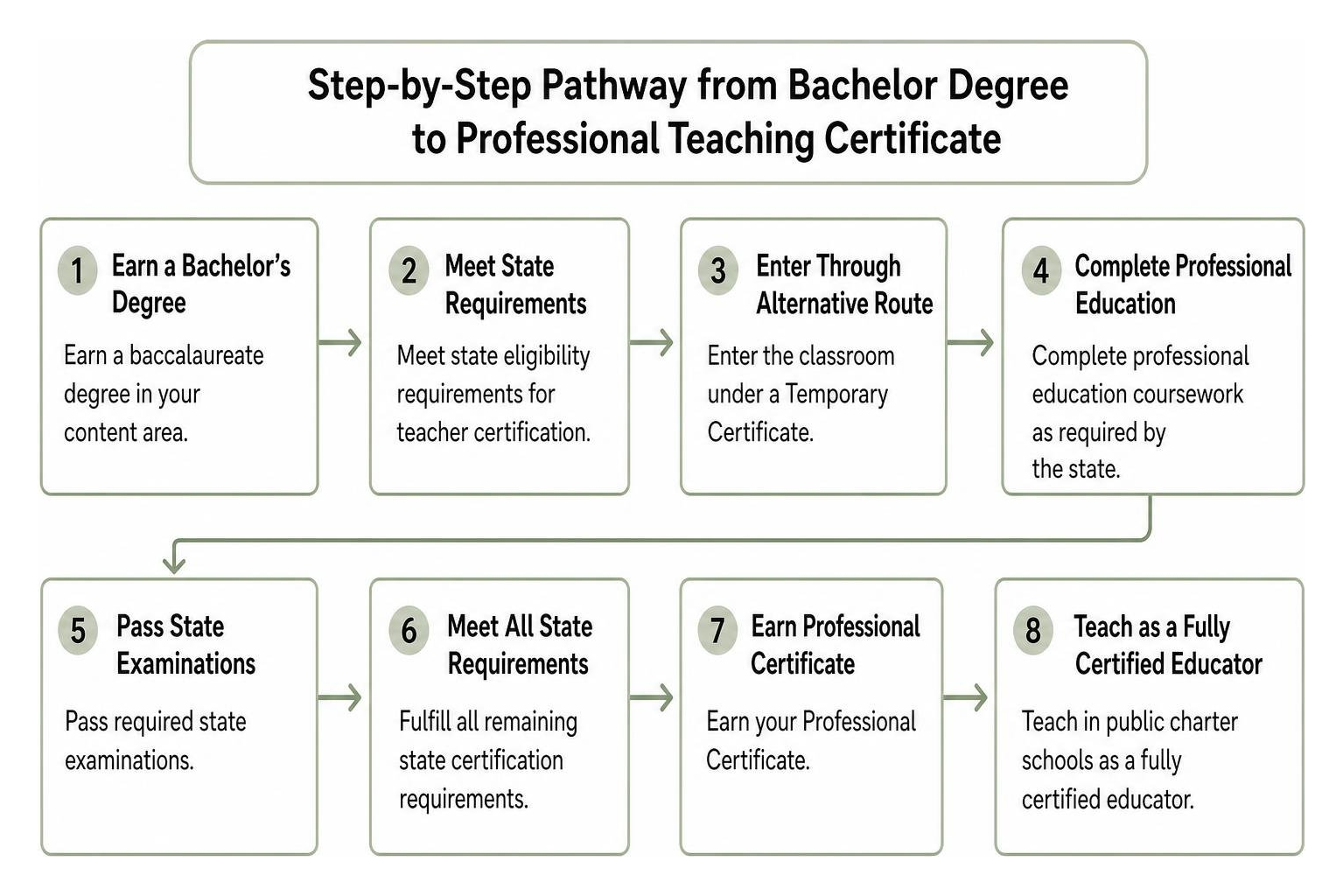
Alternative certification bridges the gap between industry experience and classroom pedagogy. Qualified candidates holding a bachelor’s degree in fields like mathematics, biology, or literature can enter the classroom under a Temporary Certificate while completing professional education coursework and passing state exams to earn their Professional Certificate.
Florida offers robust, state-approved pathways for alternative educator certification. Furthermore, our charter network continually invests in strategic teacher pipeline partnerships to mentor new educators, ensure classroom readiness, and foster long-term retention.
Mandatory Credentials for Special Education, Bilingual, and ESL Teachers
Special populations require specialized instructional methods. Charter schools uphold strict accountability to ensure students with unique learning profiles receive high-quality support:
- Special Education: Teachers must hold specific Exceptional Student Education (ESE) credentials or subject-area endorsements matching the student’s Individualized Education Program (IEP).
- English as a Second Language (ESL/ELL): Educators working with English Language Learners must complete dedicated training hours or earn the ESOL endorsement. We provide comprehensive resources through our guide to ELL training to support educators in meeting these standards.
- Dual-Language and Bilingual Programs: Instructors must demonstrate target-language fluency and hold bilingual education credentials to deliver rigorous dual-language curricula.
Autonomy, Accountability, and Educator Quality in the Classroom
The hallmark of the charter school movement is the fundamental exchange of regulatory freedom for academic accountability. Public charter schools enjoy the flexibility to design specialized curricula and implement student-centered learning models, but they must consistently demonstrate academic excellence to maintain their operating charters.
Weighing the Benefits and Drawbacks of Charter School Teacher Certification
Pursuing and maintaining full educator credentials offers distinct advantages for teachers and schools alike:
- Benefits for Educators and Schools:
- Competitive Compensation: Almost 46% of public charter schools offer performance-based pay incentives, which often add 5% to 10% to baseline salaries for high-performing, certified teachers.
- Instructional Mastery: Certified teachers have demonstrated mastery of classroom management, assessment literacy, and state academic standards, aligning directly with state certification mastery standards.
- Professional Mobility: A standard professional license allows educators to transition seamlessly across schools and leadership roles.
- Considerations:
- Testing and Coursework: Navigating alternative certification exams and pedagogy requirements demands dedicated time and financial investment during an educator’s initial years.
Teacher Performance Evaluation and School Accountability
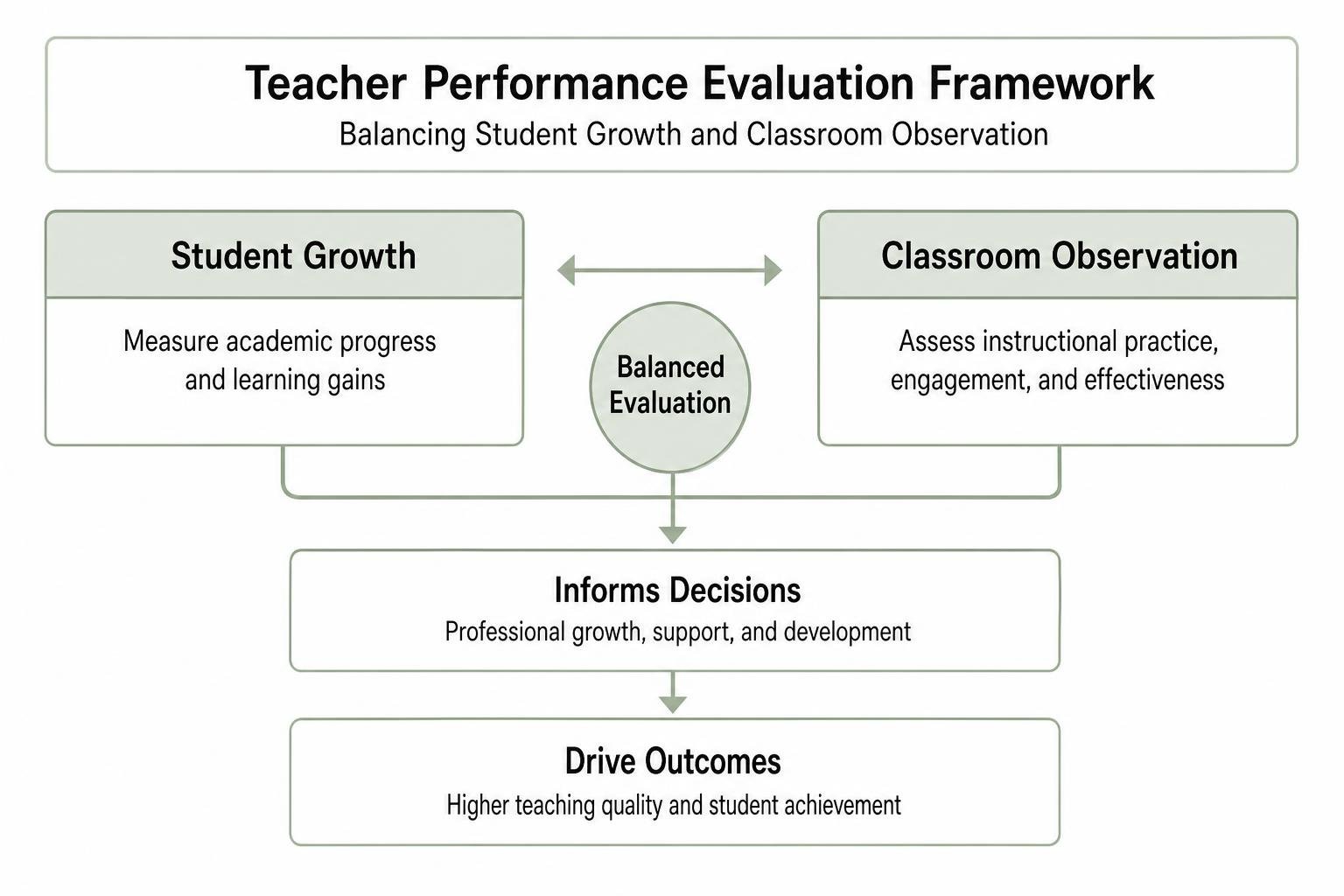
Unlike traditional school environments where salary and tenure can be tied strictly to seniority, public charter schools emphasize student achievement and dynamic instructional delivery. Charter governing boards employ evidence-based evaluation rubrics, frequent administrative observations, and objective student growth measures to evaluate faculty.
School leaders and parents can explore our detailed insights on evaluating teacher performance effectively to see how modern evaluation systems elevate classroom instruction.
Frequently Asked Questions About Charter School Teacher Credentials
Do all charter school teachers need to be certified?
In Florida, yes. Under state statute, all instructional personnel in public charter schools must hold a valid Florida Educator Certificate (Temporary or Professional) or appropriate state credential matching their specific teaching assignment. In certain other states (such as Texas or Arizona), state law grants charter boards flexibility to hire non-certified teachers who demonstrate subject-matter expertise in non-core general education subjects.
How can parents check a charter school teacher’s qualifications?
Parents have multiple transparent avenues to verify teacher credentials:
- State Licensing Portals: Families can search the Florida Department of Education’s public educator database online to view any teacher’s certification status, subject endorsements, and issuance dates.
- ESSA Right-to-Know Requests: Parents can formally contact their charter school’s administration to request information regarding an instructor’s degrees, major fields of study, and licensing standing.
- School Leadership: Charter schools operate under open governing board policies; administrators are readily available to discuss their faculty’s qualifications and professional development programs.
Are special education requirements different in charter schools?
No. Under the federal Individuals with Disabilities Education Act (IDEA), special education certification standards are identical for all public schools. Every charter school educator providing specialized instruction to students with disabilities must hold valid state certification and the appropriate Exceptional Student Education (ESE) endorsement.
Conclusion
Parental empowerment begins with transparent information. As public charter schools continue to drive educational innovation, expand parental choice, and elevate student achievement across Florida, maintaining high standards for educator credentials remains central to our mission.
At the Florida Charter School Alliance, we believe that when passionate, fully qualified educators are paired with innovative, mission-driven school environments, student success naturally follows. We encourage families to actively engage with their local charter schools, ask meaningful questions about classroom instruction, and discover how expanded school choice elevates student outcomes in our communities.