
What You Need to Know About the Florida Charter School Application Process
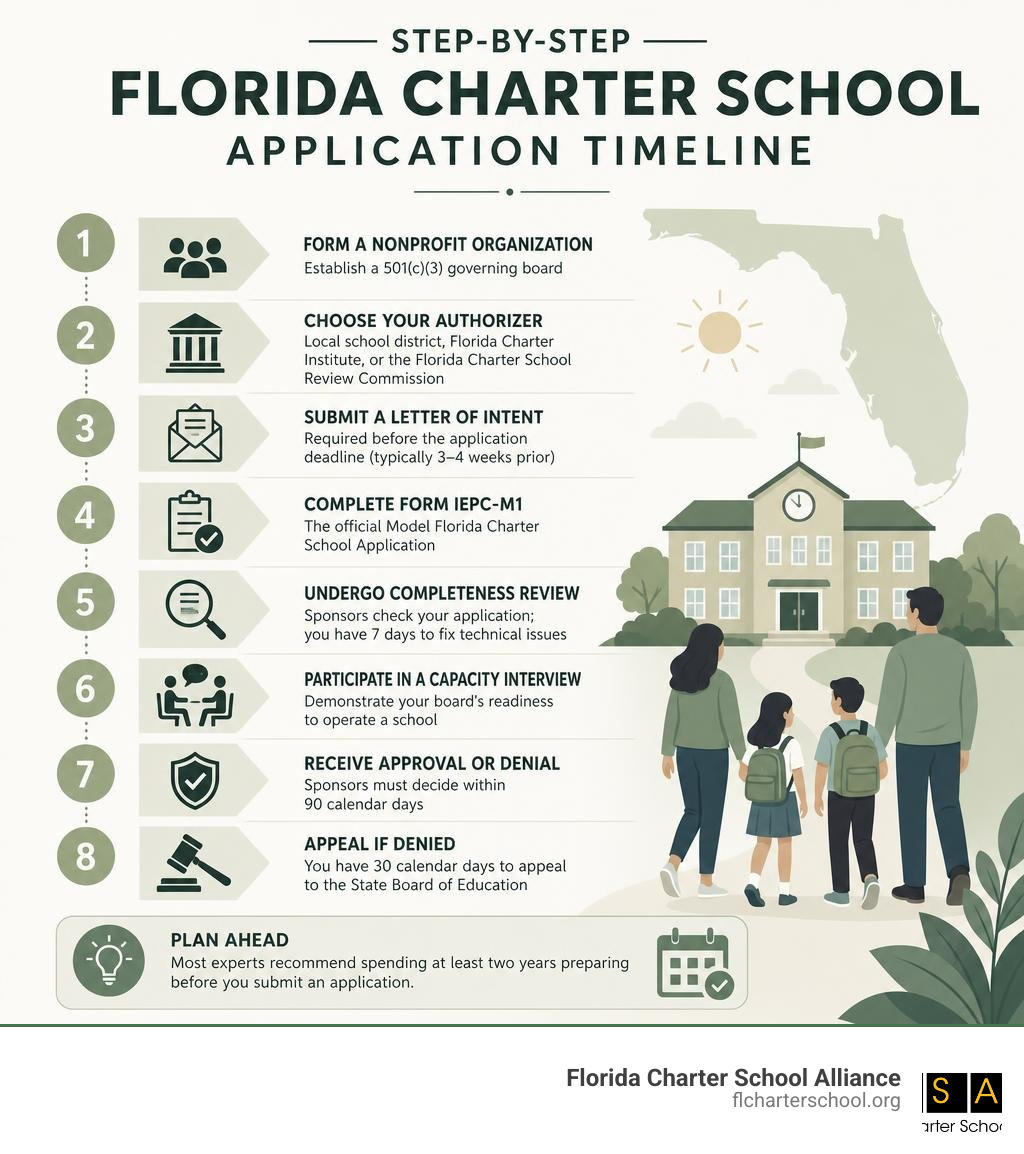
The charter school application Florida process gives educators, parents, and community leaders a real pathway to open a tuition-free public school built around innovation and student achievement. Here is a quick overview of the key steps:
- Form a nonprofit organization – Establish a 501(c)(3) governing board
- Choose your authorizer – Local school district, Florida Charter Institute, or the Florida Charter School Review Commission
- Submit a Letter of Intent – Required before the application deadline (typically 3-4 weeks prior)
- Complete Form IEPC-M1 – The official Model Florida Charter School Application
- Undergo completeness review – Sponsors check your application; you have 7 days to fix technical issues
- Participate in a capacity interview – Demonstrate your board’s readiness to operate a school
- Receive approval or denial – Sponsors must decide within 90 calendar days
- Appeal if denied – You have 30 calendar days to appeal to the State Board of Education
Florida is the second-largest charter school state in the nation, with 732 public charter schools serving more than 400,000 students across 48 counties as of 2024-25. These schools exist because of one simple belief: every family deserves access to a high-quality educational option that fits their child’s needs.
But starting one? That takes serious planning. Most experts recommend spending at least two years preparing before you submit an application. The paperwork, governance requirements, and financial planning are detailed — and the stakes are high.
This guide walks you through every step, from the first form to your first day of class.
I’m Lynn Norman-Teck, Executive Director of the Florida Charter School Alliance, and I’ve spent my career helping educators and community leaders navigate the charter school application Florida process to create innovative, accountable public schools that expand parental choice. In the sections ahead, I’ll share the practical knowledge you need to move from vision to approval.
Understanding the Charter School Application Florida Framework
To build a strong foundation, you must understand the legal and administrative framework that governs public charter schools in our state. First and foremost, all charter schools in Florida are tuition-free public schools. They operate under a performance contract (or “charter”) with an authorized sponsor, such as a local school district, state college, or university.
Under F.S. 1002.33, Florida’s charter school law—originally enacted in 1996—guarantees that charter schools are part of the state’s public education system. These schools are designed to meet high standards of student achievement while offering families increased parental choice. By combining professional opportunities for teachers with innovative learning models, charter schools offer a highly effective alternative to traditional schooling.
Every applicant in Florida must use the official state-mandated template: the Model Florida Charter School Application, also known as Form IEPC-M1. This document is a comprehensive evaluation tool that ensures your proposed school aligns with state educational and financial standards. You can Access Form IEPC-M1 directly from the Florida Department of Education’s administrative rules portal.
Familiarizing yourself with this framework is key to drafting a successful proposal. To dive deeper into the legal guidelines, you can Learn more about Florida Charter School Law to ensure your application meets every statutory benchmark.
Key Steps and Timelines in the Florida Charter Application Process
Navigating the charter school application Florida timeline requires careful coordination. Missing a single deadline can delay your school’s opening by an entire academic year.
The process officially begins with a Letter of Intent (LOI). Most sponsors require this letter several weeks before the formal application window closes. Once you submit the full application, the sponsor conducts a thorough completeness check. If they identify technical or nonsubstantive errors, you have exactly 7 calendar days to submit corrections.
Following this completeness review, the sponsor’s evaluation committee reviews the narrative and invites your governing board to a capacity interview. The sponsor must vote to approve or deny the application within 90 calendar days of receipt, unless both parties mutually agree in writing to an extension.
To help you visualize the process, here is a comparison of the typical school district timeline versus the state-level Commission timeline:
| Phase | Local School District Sponsor | Florida Charter School Review Commission (FCSRC) |
|---|---|---|
| Letter of Intent | Typically 4 weeks prior to submission | Due by April 21, 2026 |
| Application Submission | Dates vary by district | Due by May 12, 2026 |
| District Notification | N/A | Local district must receive a copy within 3 days |
| Completeness Check | 7-day technical correction window | 7-day technical correction window |
| Capacity Interview | Scheduled individually by district | Scheduled for June 22, 2026 (via Zoom) |
| Recommendation | Internal review committee recommendation | FCI recommendation due by July 11, 2026 |
| Final Decision | School Board vote within 90 days of receipt | Commission vote on August 12, 2026 |
For those looking to apply through the state-level pathway, you can Review the Florida Charter School Review Commission steps to apply to ensure you meet all state-level milestones. Because these guidelines are updated periodically, we also recommend that you Read about changes to model forms for charter schools to stay aligned with current requirements.
Preparing Your Charter School Application Florida Submission
The narrative portion of your application is where you articulate your vision for educational innovation. The state-mandated Form IEPC-M1 is divided into three main sections:
- Educational Plan: Mission, vision, target population, curriculum, student performance goals, and plans for exceptional students (ESE) and English Language Learners (ELL).
- Organizational Plan: Governance structure, management team, human resources, and student recruitment plans.
- Business Plan: Facilities, transportation, food service, safety procedures, and a detailed financial budget.
Your written narrative must adhere to strict page limits. A standard application has a maximum limit of 110 pages. If you are replicating an existing high-performing model or partnering with an Education Service Provider (ESP), the limit is extended to 140 pages.
Additionally, you must include required attachments, such as five-year budget templates, curriculum scope-and-sequence charts, and Board Member Information Forms. Plagiarism is strictly prohibited; the evaluation committee expects original language that demonstrates your team’s unique capability to execute the plan.
Navigating Local District Requirements and RFAs
While the state provides a standard model, many local school districts have specific requirements, local Requests for Applications (RFAs), or additional documents.
For instance, if you apply in Pasco County, you must submit three bound physical copies and one electronic copy of your application directly to the district’s charter office. They also require you to attend a local orientation session. You can Review Pasco County Schools application process to see how local districts structure their review.
Other large districts, such as Miami-Dade and Broward County, have their own local timelines and specialized compliance checklists. Navigating these local systems can sometimes present unexpected hurdles. To understand how we work to protect applicants at the local level, you can Read about charter school advocacy in Broward County.
Demonstrating Capacity: Governance, Operations, and Compliance
The capacity interview is the most critical face-to-face step in the charter school application Florida process. It is not a presentation; it is an interview where the sponsor evaluates whether your governing board has the expertise to manage public funds and oversee school operations.
Your governing board must demonstrate a clear understanding of its governance duties, including:
- Financial Oversight: Establishing internal controls, adopting annual budgets, and participating in independent financial audits.
- Conflict-of-Interest Policies: Maintaining an “arm’s length” relationship with any contracted Education Service Provider (ESP) or landlord.
- Operational Compliance: Adhering to Florida’s Sunshine Law, which requires public notice for all board meetings.
- Safety and Security: Meeting state-mandated safety requirements, including appointing a safe-school officer and establishing a functional threat assessment team.
Florida’s strong legal framework is one of the reasons our state consistently ranks among the top charter school systems in the country. To see how our state’s policies compare nationally, you can Read the Florida Charter School Law Rankings Report.
Designing the Educational Plan for Your Charter School Application Florida
Your educational plan must focus on student-centered learning and academic excellence. Sponsors will carefully review your curriculum to ensure it is aligned with state standards and grounded in proven educational research.
Specifically, your plan must address how the school will serve:
- Exceptional Student Education (ESE): Guaranteeing equal access and providing appropriate accommodations, therapies, and specialized instruction as outlined in each student’s Individualized Education Program (IEP).
- English Language Learners (ELL): Implementing clear identification, assessment, and language acquisition plans.
- Reading Instruction: Ensuring that your reading curriculum is grounded in scientifically-validated research.
Business Planning, Facilities, and Financial Sustainability
A brilliant academic plan cannot succeed without a solid business plan. Your application must demonstrate long-term financial viability through realistic enrollment projections and conservative budgeting.
Sponsors evaluate your business plan based on several operational elements:
- Start-Up Funding: Demonstrating sufficient working capital to cover expenses before student enrollment funds (FEFP) begin to arrive in July.
- Facilities Planning: Identifying potential school sites that meet state building codes and zoning requirements, along with realistic backup plans.
- Operations: Outlining scalable plans for student transportation and federally-compliant school food service programs.
By addressing these business elements thoroughly, you demonstrate a commitment to family empowerment and operational sustainability.
Frequently Asked Questions about Florida Charter Applications
What is the page limit for a standard Florida charter school application?
The standard narrative for Form IEPC-M1 is limited to 110 pages. This limit includes the question prompts but excludes the cover sheet, table of contents, and executive summary. If you are submitting a high-performing replication or working with an Education Service Provider (ESP), the limit is 140 pages. Applicants may also include up to 10 pages of additional attachments beyond the state-required forms.
Can a denied charter school application be appealed in Florida?
Yes. If a local sponsor denies your application, they must provide written, legally-sufficient reasons for the denial within 10 calendar days. You then have 30 calendar days from the receipt of the denial to file an appeal with the State Board of Education. The Charter School Appeal Commission will then review the case and make a recommendation before the State Board issues a final decision. For complete details on this appellate process, you can View F.S. 1002.33 Charter Schools.
What post-approval training is required for new charter school leaders?
Once approved, charter school governing boards, principals, and chief financial officers must complete state-mandated training. This training covers financial planning, public records laws, and operational compliance. It must be completed at least 30 days before the school opens to students. High-performing charter school networks may be exempt from certain repetitive training requirements if they meet specific state criteria.
Conclusion
Submitting a successful charter school application Florida package requires a clear educational vision, strong financial planning, and a deep commitment to regulatory compliance. While the path from initial planning to opening day can be demanding, the opportunity to create an innovative, student-centered learning environment makes the effort incredibly rewarding.
At the Florida Charter School Alliance, we advocate for high-quality public charter schools from our offices in Tallahassee and across the state. We provide resources, guidance, and advocacy to help founders turn their vision into a thriving school community.
By expanding parental choice and focusing on student achievement, charter schools continue to play a vital role in elevating public education throughout Florida. To read more about the impact of educational choice in our state, you can Read our opinion on how school choice has put Florida schools head and shoulders above the rest.