
The Question Every Parent Is Asking: Do Charter Schools Improve Student Achievement?
Whether do charter schools improve student achievement is a question you’ve been wrestling with for your own child, or you’re researching it for policy or advocacy purposes, here’s the short answer:
Yes — but it depends on where, how, and for whom.
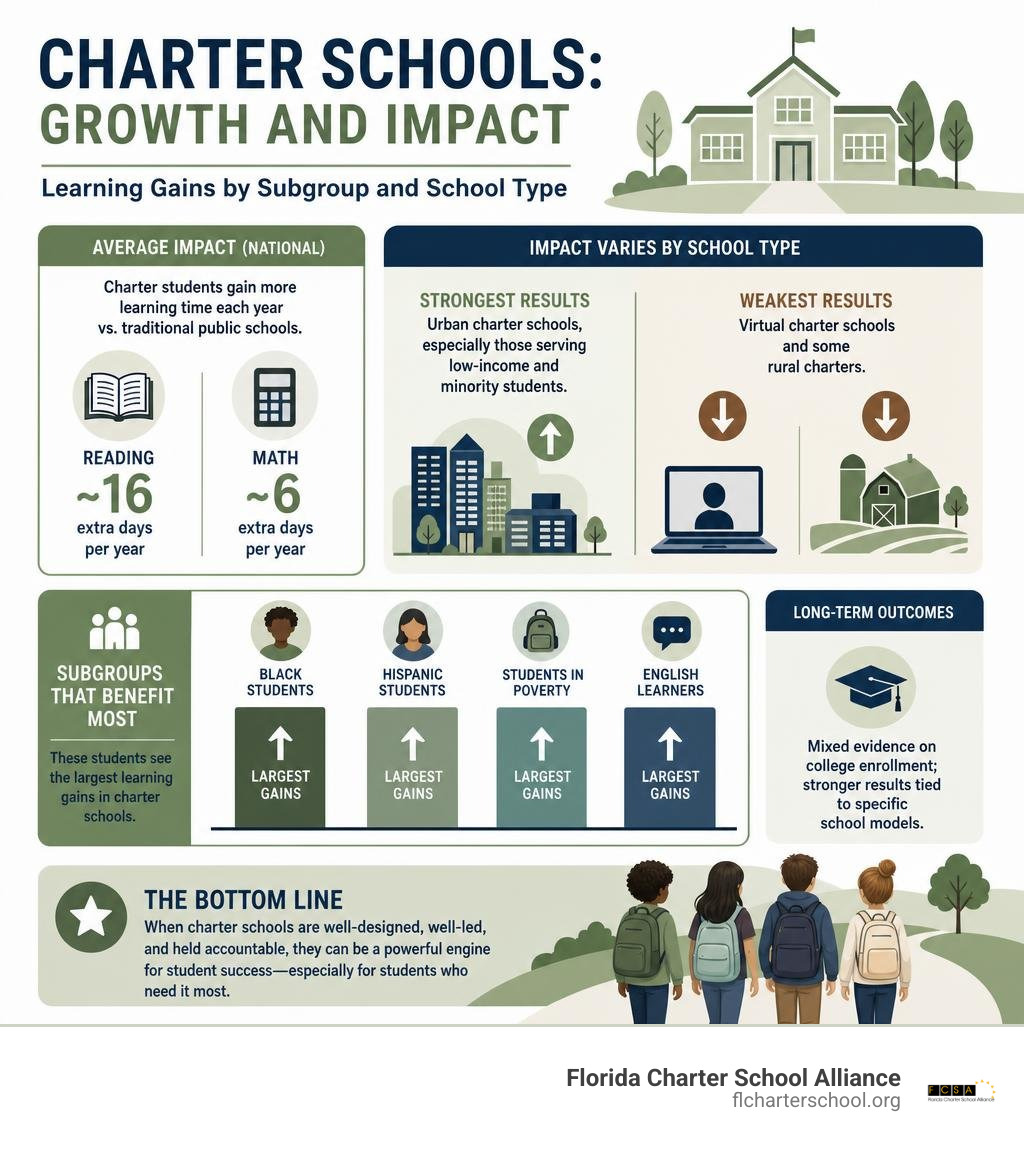
Here’s a quick summary of what the research shows:
| Factor | What the Research Finds |
|---|---|
| Average impact (national) | Charter students gain ~16 extra days in reading and ~6 extra days in math per year vs. traditional public schools |
| Strongest results | Urban charter schools, especially those serving low-income and minority students |
| Weakest results | Virtual charter schools and some rural charters |
| Subgroups that benefit most | Black students, Hispanic students, students in poverty, and English learners |
| Long-term outcomes | Mixed evidence on college enrollment; stronger results tied to specific school models |
The picture that emerges from decades of research is nuanced. A landmark 2023 Stanford CREDO study — one of the largest of its kind, covering 31 states and more than 6.5 million student observations — found that charter students outpaced their traditional public school peers by the equivalent of over two additional weeks of learning in reading each year. For students living in poverty, those gains were even larger.
But not all charters perform equally. The same research found that virtual charter schools produced deeply negative results, while high-performing urban networks consistently delivered some of the strongest academic gains in public education.
The data tells a clear story: when charter schools are well-designed, well-led, and held accountable, they can be a powerful engine for student success — especially for families who have historically had the fewest educational options.
I’m Lynn Norman-Teck, Executive Director of the Florida Charter School Alliance, and I’ve spent my career working directly with public charter schools to advance student achievement and expand parental choice across Florida. My work at the intersection of education policy and school development gives me a front-row view of what it really takes for charter schools to improve student achievement — and I’m here to walk you through what the evidence actually says.
Do Charter Schools Improve Student Achievement? The National Verdict
To understand if public charter schools truly move the needle on academic excellence, we have to look at the long-term trajectory of rigorous research. Over the last three decades, researchers have utilized two primary methodologies to isolate the true impact of charter schools: lottery-based studies (which compare students who won a random admission lottery to those who did not) and value-added studies (which match charter students with “virtual twins” in traditional public schools who share identical demographic and academic baselines).
When the Center for Research on Education Outcomes (CREDO) at Stanford University released its first national assessment, the CREDO 2009 Study, the results were mixed. At that time, across 16 states, charter school students on average showed slightly lower academic growth compared to their traditional public school (TPS) counterparts—equivalent to losing about a week of learning.
However, the charter school sector is built on an evolutionary feedback loop of flexibility and accountability. By the time the landmark CREDO National Charter School Study III 2023 was published, the landscape had shifted dramatically. Today, the national average shows that public charter schools are outperforming traditional public schools.
Specifically, students attending charter schools now advance their learning in math by an additional six days in a year’s time, and in reading, they add sixteen days of learning compared to their peers in traditional public schools.
This dramatic upward trend is corroborated by New Research on Charter School Outcomes, which highlights how the charter sector has steadily refined its practices, closed underperforming campuses, and scaled successful networks to deliver consistent learning gains. Far from a static system, public charter schools have proven to be a highly dynamic sector that gets better with time.
How Do Charter Schools Improve Student Achievement Across Different Grade Levels?
The academic success of public charter schools is not uniform across all grade spans. Research indicates that the positive impacts of charter schools vary significantly depending on whether a student is in elementary, middle, or high school.
According to a comprehensive Meta-Analysis of Charter School Effects, the strongest and most consistent academic gains are concentrated in the middle school grade span. For middle schools, charter schools produce positive and highly significant effects for both reading (an effect size of 0.054 standard deviations) and math (an effect size of 0.097 standard deviations) achievement. To put this in perspective, attending a charter middle school predicts an average gain of 3.2 to 3.9 percentile points in math after just one year.
Certain high-performing charter networks show even more extraordinary results. For instance, KIPP middle schools show estimated annual effect sizes of 0.174 in reading and 0.374 in math. This is enough to move a student initially scoring at the 50th percentile up to the 57th percentile in reading and the 65th percentile in math in a single school year.
In elementary grades, the meta-analysis found positive and significant math gains (0.033 standard deviations), while high school test-score impacts tend to be more neutral on standardized tests. However, as we will explore later, high schoolers benefit in massive ways when we look at long-term metrics like graduation and college enrollment.
In Florida, we see these strong academic foundations pay off early. Our state’s robust charter framework ensures that elementary and middle school students receive targeted, high-quality instruction, explaining why Florida Charter Schools Get an A on state report cards at disproportionately high rates.
Why Do Charter Schools Improve Student Achievement for Disadvantaged Subgroups?
One of the most compelling findings in modern education research is that public charter schools are uniquely effective at closing achievement gaps for historically underserved student populations.
When we look at the data for students living in poverty, the learning gains are profound. According to the 2023 CREDO study, charter students in poverty experience stronger growth equal to seventeen additional days of learning in math and twenty-three additional days of learning in reading than their traditional public school peers in poverty.
This positive trend is further detailed in the Raymond Testimony on Charter Benefits delivered before Congress, which highlighted that Black and Hispanic students, alongside low-income students, show the most pronounced learning gains in the charter sector. In fact, researchers have identified hundreds of “gap-busting” charter schools where minority and low-income students learn at least as much as—and often outperform—their white or non-poverty peers.
Furthermore, public charter schools are making incredible strides with English Language Learners (ELLs). As documented in English Language Learners in Charter Schools, the tailored instruction, flexible scheduling, and intensive language support systems common in charters allow ELL students to progress rapidly.
In Florida, these targeted efforts are yielding historic results. Our public charter schools are designed to meet students exactly where they are, helping to ensure that Florida Students Close Achievement Gaps in core subjects like history and science, proving that parental choice and educational opportunity can change a child’s life trajectory.
Long-Term Outcomes: Graduation, College, and Beyond
While standardized test scores are a valuable diagnostic tool, the ultimate measure of any school’s success is how well it prepares students for adult life. Does the academic excellence fostered in public charter schools translate to long-term success?
The answer is a resounding yes. Research on the market-level effects of charter schools reveals that a robust charter presence benefits entire communities. According to a national analysis published in the Journal of Public Economics on Market-Level Effects of Charter Schools, a 10 percentage point increase in charter school market share in a given district is associated with a 1 to 2 percentage point increase in high school graduation rates district-wide. This suggests that charter schools not only lift up their own students but also introduce healthy competitive pressure that encourages traditional public schools to improve their own outcomes.
In Florida, our commitment to high-quality education and student-centered learning has driven graduation rates to historic heights. Thanks to a diverse ecosystem of educational options, Florida Sets Highest Graduation Rate in the state’s history at 92.2%.
Public charter high schools are a major driver of this success. By offering flexible curricula, career-themed academies, and college-preparatory environments, Florida Charter High Schools Rank Among Best in the state and the nation. These schools consistently dominate national rankings, proving that when families are empowered with parental choice, students thrive.

Operational Secrets: What Drives Academic Excellence in Top-Performing Charters?
Why do some charter schools achieve such remarkable results while others perform on par with traditional models? The secret lies in their operational flexibility. Free from some of the rigid bureaucratic regulations that bind traditional districts, public charter schools can implement innovative learning models and evidence-based operational practices.
Research consistently points to a set of core practices—often associated with the “No Excuses” urban charter model—as the primary drivers of student achievement:
- High Academic and Behavioral Expectations: Creating a culture where college attendance is the goal for every student, regardless of background.
- Extended Learning Time: Longer school days and school years to maximize instructional time.
- Data-Driven Instruction: Using frequent, diagnostic assessments to identify learning gaps instantly and adjust lesson plans accordingly.
- High-Dosage Tutoring: Integrating small-group tutoring directly into the school day.
- Frequent Teacher Feedback: Providing educators with continuous coaching and professional development to elevate classroom instruction.
As the Fordham Institute on Charter School Performance points out, the freedom to hire, support, and retain high-performing teachers—and quickly replace ineffective ones—gives charter schools a distinct advantage. Furthermore, strong authorizer oversight and strict accountability standards mean that low-performing charters are closed, which naturally raises the average quality of the charter sector over time.
These operational strengths do more than just raise test scores; they build stronger, safer, and more vibrant communities. As highlighted in New Charter School Research on Communities, high-quality charter schools act as community anchors, offering families a safe, supportive, and highly accountable educational environment.
To see how these practices compare, let’s look at the operational differences between top-performing charter models and traditional public school systems:
| Operational Feature | Top-Performing Public Charter Schools | Traditional Public School Models |
|---|---|---|
| Governance | Local, autonomous volunteer governing boards | Centralized school district board and administration |
| Curriculum Flexibility | High; can quickly adapt to student and community needs | Low; subject to district-wide adoption timelines |
| Instructional Time | Often extended (longer school days and/or school year) | Standardized district calendar and daily schedules |
| Teacher Support | Frequent feedback, individualized coaching, performance-based incentives | Standardized evaluation cycles, seniority-based steps |
| Accountability | Performance contracts; subject to closure if goals are not met | Rarely subject to closure; funded regardless of performance |
Frequently Asked Questions About Charter School Performance
Are public charter schools tuition-free?
Yes! Public charter schools are 100% tuition-free public schools. They are funded through public education dollars (such as the Florida Education Finance Program) based on student enrollment, just like traditional public schools. They represent a vital pillar of parental choice, ensuring that a high-quality, innovative education is accessible to every family, regardless of income.
Do charter schools cherry-pick their students?
Absolutely not. By law, public charter schools are open to all students. They cannot impose academic admissions requirements or select students based on background, test scores, or special needs. If a charter school receives more applications than it has available seats, it is legally required to conduct a random lottery to ensure fair and equal educational access for every applicant.
How are charter schools held accountable for student success?
Charter schools operate under strict performance contracts with their sponsors (usually the local school district). They are held to the exact same state academic standards as traditional public schools, including participating in statewide assessments and receiving state-issued school grades. However, they face a double standard of accountability: if a charter school fails to meet its academic or financial performance goals, its contract can be revoked, and the school will be closed.
Conclusion
The debate is over, and the data is clear: public charter schools are a highly effective, innovative, and accountable public education option. From the classroom to college graduation, charters are proving that a student-centered learning environment can unlock academic excellence and change a child’s life.
At the Florida Charter School Alliance, we believe that every family deserves the power of parental choice. We advocate daily for the expansion of high-quality educational access, ensuring that Florida remains a national leader in educational innovation.
If you want to dive deeper into the data or find a high-performing public charter school in your area, explore our resources on Charter School Achievement and join us in supporting the future of public education.