
Why Rubrics for Evaluating Teacher Performance Matter in Every Classroom
Rubrics for evaluating teacher performance are structured scoring tools that help school leaders measure, support, and develop teaching quality in a consistent, fair way. Here’s a quick overview of how they work:
- What they are: Scoring frameworks that describe teacher behaviors at different performance levels — from ineffective to exemplary
- What they measure: Planning and preparation, classroom environment, instructional delivery, student assessment, and professional responsibilities
- How they’re used: Throughout an observation and evaluation cycle that includes pre-conferences, formal observations, walkthroughs, and post-conferences
- Who uses them: Principals, assistant principals, instructional coaches, and district administrators
- Why they matter: They replace subjective impressions with clear, evidence-based standards that drive real teacher growth
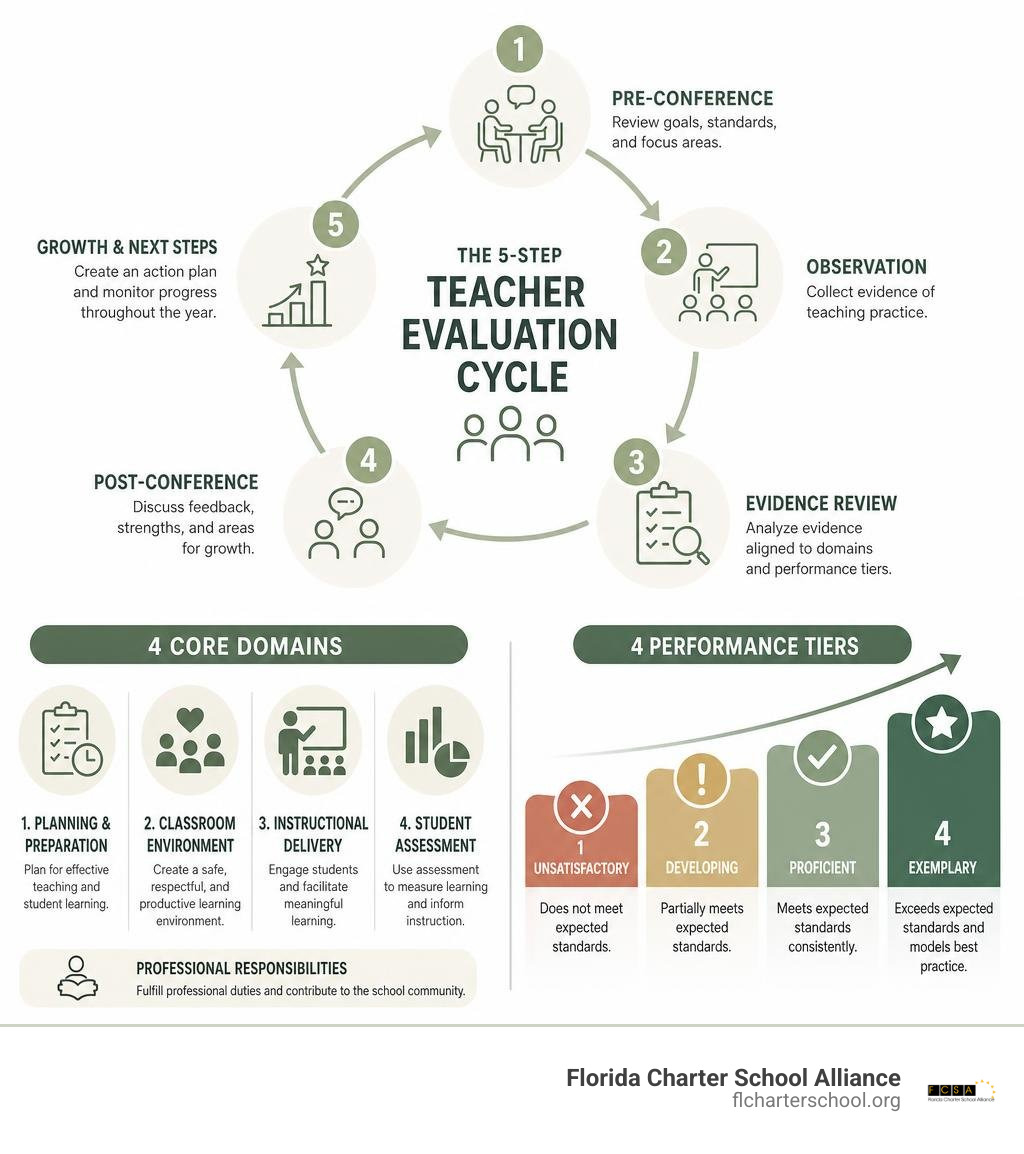
Most rubrics organize teaching into four core domains and rate performance across four tiers — typically ranging from Unsatisfactory to Exemplary (or equivalent labels). The goal isn’t to judge teachers. It’s to give them a clear picture of where they are and a roadmap for getting better.
For charter schools in particular, a strong evaluation rubric is one of the most powerful tools available. It supports accountability, drives instructional innovation, and helps ensure every student — including those in arts programs and other specialized settings — receives high-quality teaching.
I’m Lynn Norman-Teck, Executive Director of the Florida Charter School Alliance, and I’ve spent my career supporting public charter schools in building strong operational and instructional systems, including effective approaches to rubrics for evaluating teacher performance. In the sections below, I’ll walk you through how leading evaluation frameworks compare — and what actually works in practice.
Core Domains in Rubrics for Evaluating Teacher Performance
When you strip away the administrative jargon, most rubrics for evaluating teacher performance reflect a fundamental truth: effective teaching requires both behind-the-scenes preparation and active classroom execution. Across major frameworks — whether rooted in Charlotte Danielson’s Framework for Teaching, Kim Marshall’s 6-domain model, or state-specific models — teacher responsibilities are categorized into core performance domains.
The Framework for Teaching identifies 4 primary domains and 22 components that promote student learning. Across top models, these domains generally cluster into four major areas:
- Planning and Preparation: Demonstrating content knowledge, designing coherent units, structuring standards-aligned learning activities, and building clear student assessments.
- Classroom Environment: Establishing a culture of respect, managing student behavior, maintaining seamless routines, and creating a safe space for intellectual risk-taking.
- Instructional Delivery: Presenting content clearly, using high-level questioning, fostering student engagement, checking for understanding, and differentiating learning.
- Professional Responsibilities: Reflecting on practice, maintaining accurate records, communicating with families, collaborating with peers, and growing professionally.
A well-constructed Teacher Performance Rubric gives school leaders a common vocabulary to discuss practice with educators. In public charter schools, where educational innovation and autonomy drive student achievement, having structured domain expectations helps administrators provide targeted instructional coaching. You can explore how we train school leaders on these operational systems through our Leadership Training for Charter Schools Going Strong program.
Evaluating Instructional Planning vs. Classroom Environment
While planning and environment are inextricably linked, effective evaluation rubrics assess them using distinctly different forms of evidence.
- Instructional Planning happens before a single student enters the room. Evaluators measure planning by reviewing unit designs, daily lesson plans, assessment alignment, and curriculum internalization. High-performing planning criteria look at whether lesson activities demand high cognitive effort (“minds-on” reasoning rather than simple task compliance) and whether formative checks for understanding are built directly into the lesson arc.
- Classroom Environment measures active classroom dynamics. Evaluators observe how routines minimize lost instructional time, how behavior expectations preserve student dignity, and whether the physical and emotional space fosters curiosity.
As highlighted in specialized evaluation models like the Performance Evaluation Rubric for Teachers, strong environment rubrics examine both teacher preventative strategies and observable student responses. In a proficient classroom, management is subtle and preventive; in an exemplary setting, students themselves help hold their peers accountable to community norms.
Assessing Culturally Responsive Teaching and Student Context
A major evolution in evaluation design over recent years is the explicit integration of culturally responsive teaching practices. Modern rubrics no longer treat equity as an optional add-on — they integrate knowledge of student backgrounds, community connections, and differentiated support directly into core performance indicators.
Culturally responsive rubric criteria evaluate whether a teacher:
- Connects academic content to students’ lived experiences, cultural contexts, and community resources.
- Differentiates instruction to accommodate diverse learning styles, language proficiencies, and developmental needs.
- Fosters an inclusive learning environment that active counteracts stereotypes and encourages multi-perspective dialogue.
- Engages families as essential partners in learning rather than passive recipients of report cards.
When evaluation frameworks evaluate how well teachers know and honor their students’ cultural and community backgrounds, schools see stronger student engagement, deeper family trust, and improved academic outcomes.
Comparing Performance Tiers Across Evaluation Models
How do different evaluation frameworks actually score teacher practice? While terminology varies across state frameworks and independent research models, almost all systems use a 4-tier or 5-tier performance continuum.
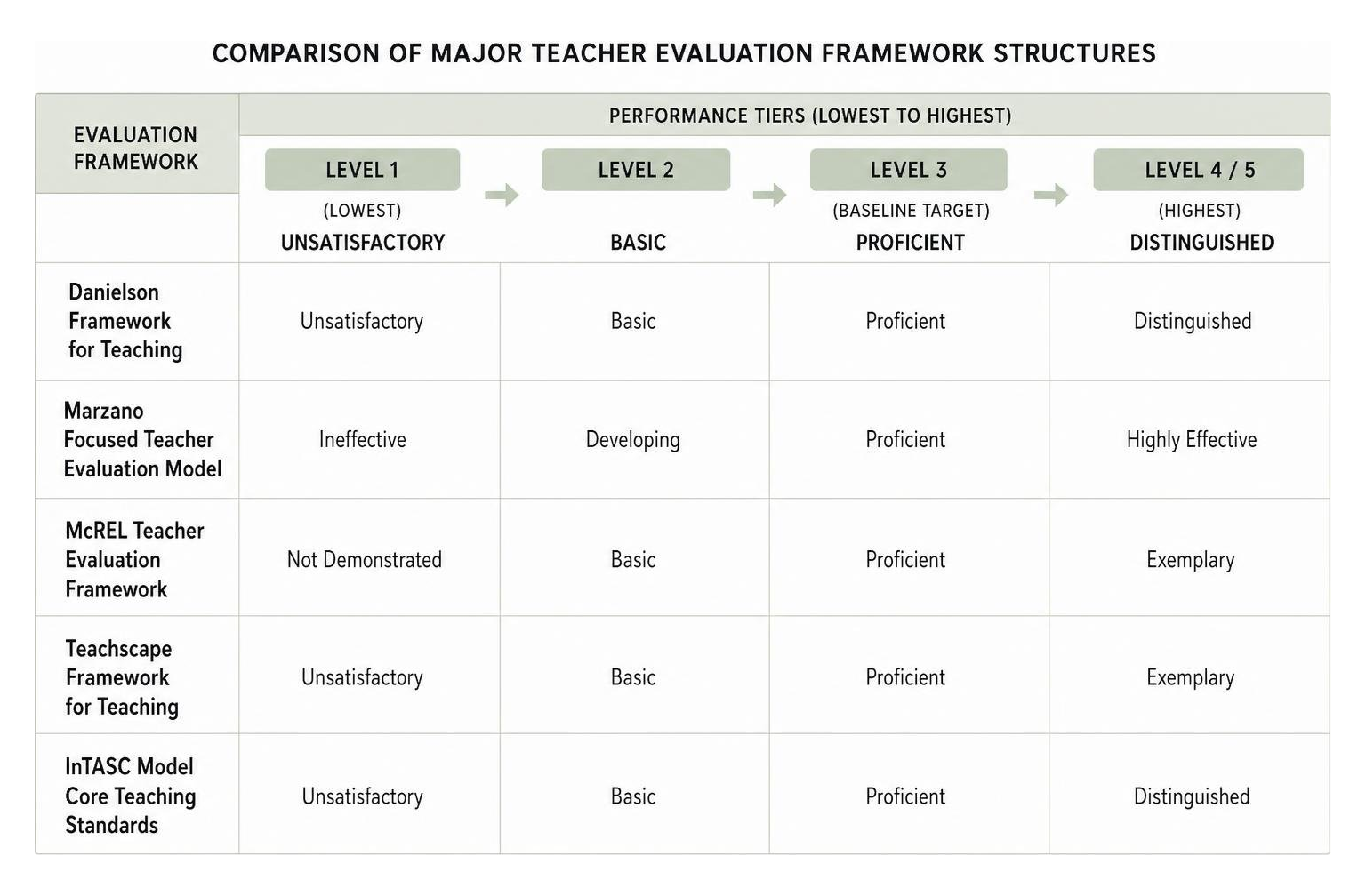
The table below illustrates how different widely recognized rubrics define their performance levels across the continuum:
| Evaluation Framework | Level 1 (Lowest) | Level 2 | Level 3 (Baseline Target) | Level 4 / 5 (Highest) |
|---|---|---|---|---|
| Danielson Framework for Teaching | Unsatisfactory | Basic | Proficient | Distinguished |
| Marshall Teacher Evaluation Rubrics | Does Not Meet Standards (1) | Improvement Necessary (2) | Effective (3) | Highly Effective (4) |
| Louisiana LEADS System | Unsatisfactory (Level 1) | Intermediate (Level 2) | Proficient (Level 3) | Exemplary (Level 5) |
| Santa Fe Indian School Rubric | Emerging | Developing | Accomplished | Exceeding |

Defining Criteria from Ineffective to Accomplished in Rubrics for Evaluating Teacher Performance
The shift between performance levels isn’t just about doing “more” work — it represents a structural transformation in classroom leadership and student agency:
- Level 1 (Unsatisfactory / Ineffective): Teaching is reactive or disorganized. Content contain errors, behavior management is chaotic or punitive, and instruction lacks clear alignment to grade-level standards.
- Level 2 (Developing / Basic): The teacher understands principles of effective instruction but execution is inconsistent. The teacher holds control, but pacing may falter, and checks for understanding are superficial.
- Level 3 (Proficient / Accomplished): Solid, consistent professional practice. This is the expected baseline standard for experienced educators. Lessons are tightly aligned to standards, classroom routines run smoothly, and assessment data drives instructional adjustments.
- Level 4 (Distinguished / Exemplary / Exceeding): Teaching shifts from teacher-centered to student-led. Students actively monitor their own learning, co-design routines, lead discussions, and assist peers. Additionally, as noted in the Massachusetts Classroom Teacher Rubric, top-tier practice often requires that the educator formally or informally models exemplary techniques for colleagues across the school.
The Role of Student Growth Data and Evidence in Teacher Evaluation Rubrics
A comprehensive teacher evaluation rubric cannot rely solely on observer impressions; it must incorporate concrete evidence of student learning.
In standard holistic frameworks, achieving higher performance ratings (such as Skilled or Accomplished) requires analyzing trends across multiple sources of high-quality student data. Evaluators look for evidence including:
- Pre- and post-assessment growth data.
- Student work portfolios and writing rubrics.
- Formative exit tickets and real-time checks for understanding during lessons.
- Standardized growth metrics that demonstrate academic gains over time.
By coupling observable classroom behaviors with student achievement data, charter schools demonstrate how high standards and operational autonomy drive superior student outcomes. For more insights on how data supports academic excellence, read our analysis on The Real Deal on Charter School Outcomes and Student Performance.
Best Practices for the Observation and Evaluation Cycle
Using rubrics for evaluating teacher performance effectively requires treating evaluation as an ongoing growth cycle rather than an annual high-stakes event. Relying on a single scheduled observation once a year to evaluate a teacher’s performance is ineffective and unfair.

Best practices for structuring an observation cycle include:
- Pre-Observation Conferences: Meeting briefly before formal observations to review lesson plans, clarify learning objectives, and identify specific focus areas for observation.
- Frequent Unannounced Mini-Observations: Conducting short, 10 to 15-minute walkthroughs every 2 to 3 weeks. Short, frequent visits capture authentic daily instruction far better than one formal staged presentation.
- Prompt Post-Observation Debriefs: Engaging in face-to-face feedback conversations within 48 hours of an observation to discuss concrete evidence, celebrate strengths, and set actionable growth goals.
- Self-Assessment: Having teachers complete the evaluation rubric independently prior to annual conferences so evaluators and teachers can compare scores page-by-page to build consensus.
School leaders seeking to implement continuous feedback frameworks can utilize our specialized Professional Learning System resources to train observation teams.
Professionalism and Family Engagement in Rubrics for Evaluating Teacher Performance
Evaluation rubrics look beyond classroom delivery to assess a teacher’s overall contribution to the school community. Domains dedicated to professional responsibilities measure:
- Family Outreach: Establishing regular, proactive two-way communication regarding student academic progress and emotional well-being.
- Colleague Collaboration: Working in Professional Learning Communities (PLCs) to analyze student work, share lesson plans, and align interdisciplinary units.
- Professional Ethics and Growth: Demonstrating reliability, adhering to school policies, actively seeking professional development, and applying new learning in the classroom.
The official state guidelines in Resources: Rubrics – Educator Evaluation emphasize that professional culture and family engagement are essential indicators of educator effectiveness that directly influence school climate.
Ensuring Holistic Scoring Accuracy and Observer Reliability
One of the greatest challenges in teacher evaluation is ensuring observer reliability — making sure two evaluators observing the exact same classroom would give the same rubric score.
To maintain fair and accurate scoring across complex rubric criteria, school systems should implement these evidence-based calibration steps:
- Holistic Scoring Over Itemized Checklists: Evaluators should look at patterns of evidence across a domain to select the performance level that best describes overall practice, rather than treating the rubric as a rigid numerical checklist.
- Observer Calibration Workshops: School leadership teams should jointly watch video-recorded classroom lessons, score them independently, and deliberate together to calibrate their ratings against standardized rubric benchmarks.
- Gathering Tangible Evidence: Evaluators must ground every score in specific, observable facts (e.g., “The teacher asked 4 open-ended questions and waited 5 seconds for responses”) rather than subjective judgments (“The lesson felt “).
- Utilizing Rubric Crosswalks: When updating evaluation frameworks, using crosswalk documents ensures observers understand how previous scoring indicators map onto updated performance criteria.
Our Fellowship Program Offers In-Depth Coverage of Standards and Practical Real-World Guidance for charter school administrators looking to master evaluator calibration and leadership practices.
Frequently Asked Questions About Teacher Performance Evaluation Rubrics
How is holistic scoring applied to teacher performance evaluation rubrics?
Holistic scoring means that an evaluator synthesizes all gathered evidence — observation notes, lesson plans, student work, and walkthrough data — to determine the performance level descriptor that best fits the teacher’s overall performance in a domain. Rather than mathematically averaging individual sub-points, the observer evaluates the dominant pattern of evidence against clear rubric benchmarks.
What sources of evidence should evaluators collect during an observation cycle?
Evaluators should gather a broad evidence base, including:
- Pre-conference planning notes and unit lesson designs.
- Scripted observation notes from formal observations and mini-walkthroughs.
- Student assessment results, exit tickets, and work samples.
- Evidence of professional growth, PLC participation, and family communication logs.
How do charter schools use rubrics to foster educational innovation?
Charter schools use evaluation rubrics flexibility to align teaching expectations with their specific educational mission — whether focused on STEM, classical education, or project-based learning. By focusing rubrics on student agency, critical thinking, and measurable growth rather than rigid compliance checklists, charter leaders empower teachers to innovate in the classroom while maintaining high academic standards.
Conclusion
Effective rubrics for evaluating teacher performance are far more than administrative accountability forms — they are powerful blueprints for continuous professional growth and student achievement. When structured around clear domains, grounded in objective evidence, and implemented through frequent mini-observations and constructive coaching, rubrics elevate classroom instruction across every grade level.
At the Florida Charter School Alliance, we believe that empowering teachers with clear standards and strong instructional leadership is essential to expanding parental choice and achieving academic excellence.
To evaluate and enhance your school’s educator evaluation framework, explore our specialized Evaluation Tool for Charter Schools today.