
Why Every Florida Teacher Needs ELL Training Right Now
ELL training for teachers is one of the most in-demand forms of professional development in K-12 education today — and for good reason.
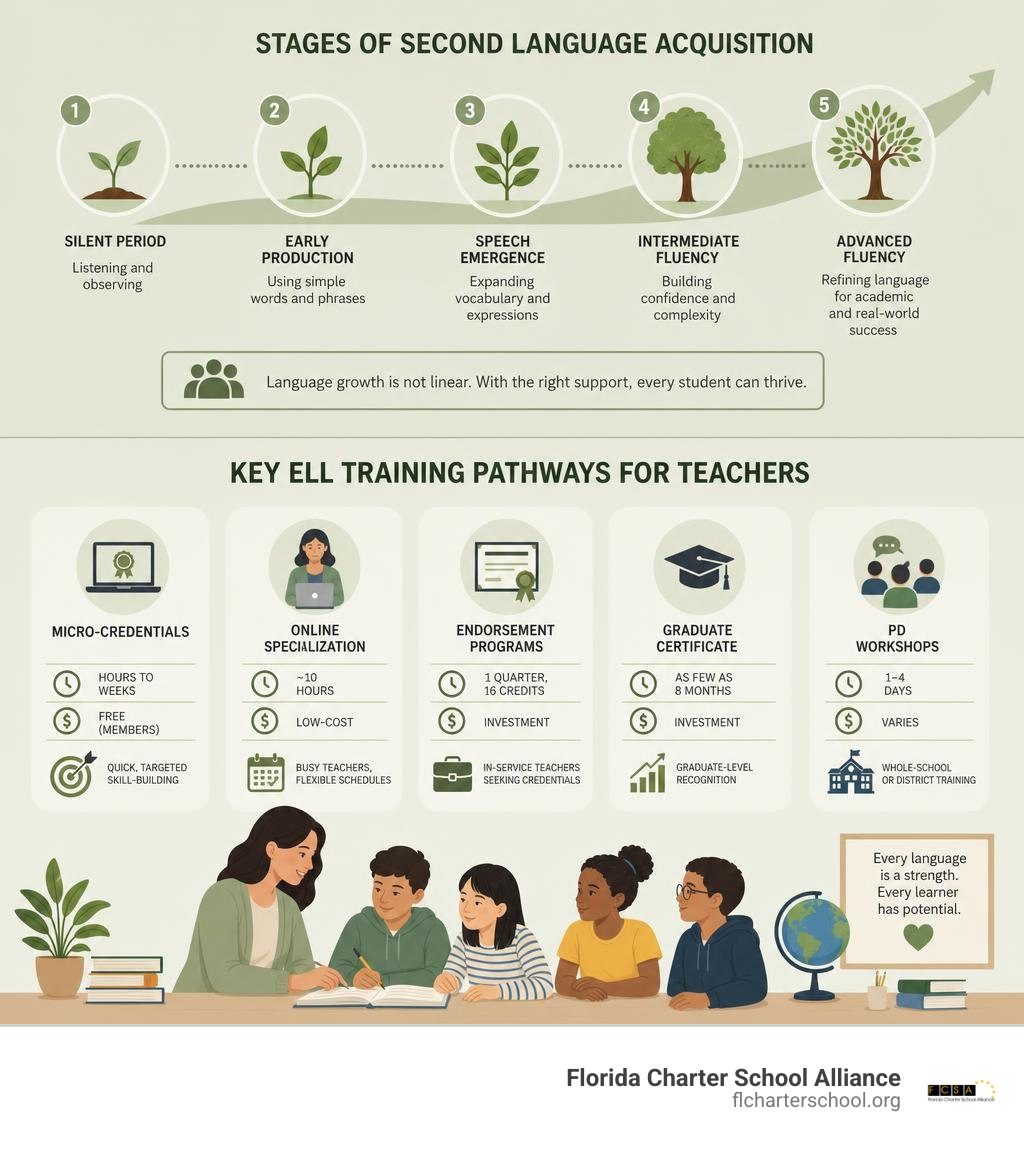
Here are the most common pathways to get started quickly:
| Training Option | Time to Complete | Cost | Best For |
|---|---|---|---|
| NEA Micro-Credentials | Hours to weeks | Free (members) | Quick, targeted skill-building |
| ASU ELL Specialization (Coursera) | ~10 hours | Low-cost | Busy teachers, flexible schedules |
| UW ELL/MLL Endorsement | 1 quarter, 16 credits | ~$6,528 (WA residents) | In-service teachers seeking credentials |
| EWU Graduate Certificate | As few as 8 months | $10,050 | Teachers pursuing graduate-level recognition |
| SIOP-Based PD Workshops | 1–4 days | Varies | Whole-school or district training |
Every K-12 classroom in America now includes students who are developing English proficiency. Yet many teachers — even dedicated, experienced ones — report feeling underprepared to support these learners effectively. The problem isn’t willingness. It’s preparation.
In Florida’s public charter schools, where diverse student populations are the norm and innovation is a core value, this gap matters even more. Charter schools have a unique opportunity to lead on multilingual education — but only when teachers have the right tools.
The research is clear: students who are learning English need more than goodwill. They need teachers who understand language acquisition, can scaffold content meaningfully, and know how to build an inclusive classroom culture from day one.
I’m Lynn Norman-Teck, Executive Director of the Florida Charter School Alliance, and my work supporting high-quality public charter schools across Florida has shown me how critical targeted ELL training for teachers is to improving student outcomes and expanding educational opportunity for every family. In this guide, I’ll walk you through the most effective training pathways, practical classroom strategies, and the tools Florida educators can use right now.
Why Specialized Training is Essential for Multilingual Classrooms
In Florida, our classrooms reflect a beautiful, dynamic tapestry of cultures and languages. To unlock the full potential of every student, we must move beyond the outdated idea that language acquisition happens by osmosis.
When we look at the data on English Language Learners in Charter Schools: A New National Look at Performance and Practice, we see that public charter schools excel when they implement targeted, evidence-based language support. For us, student achievement is not just a metric; it is a promise of educational opportunity.
To deliver on this promise, teachers must understand the fundamental language acquisition theories that govern how students learn. One of the most critical concepts is the distinction between BICS and CALP:
- BICS (Basic Interpersonal Communication Skills): This is conversational, social language. It typically takes about 2 years for an immigrant student to develop. A student might sound completely fluent on the playground or while chatting with peers, which can lead teachers to mistakenly believe they are ready for unassisted academic work.
- CALP (Cognitive Academic Language Proficiency): This is the formal, academic language required for success in content areas like science, mathematics, and social studies. Developing CALP takes 5 to 7 years under ideal circumstances, and can take 7 to 10 years for students with interrupted formal education.
Without structured ell training for teachers, educators may prematurely exit students from language supports or fail to scaffold academic texts, assuming conversational fluency equals academic readiness.
Furthermore, providing this support is not just a pedagogical best practice; it is a legal mandate. The landmark “Castañeda test” (originating from Castañeda v. Pickard) outlines a three-pronged compliance standard to evaluate language programs:
- Sound Educational Theory: The program must be based on sound educational research.
- Effective Implementation: The school must provide adequate resources, trained personnel, and appropriate materials.
- Ongoing Evaluation: The program must undergo continuous evaluation and adjustment to ensure it actually overcomes language barriers.
By prioritizing comprehensive training, public charter schools demonstrate accountability and a commitment to academic excellence, ensuring that every child has equal educational access.
Key Components of Comprehensive ELL Training for Teachers
Effective professional development must move away from dry, abstract theories and instead provide hands-on, experiential learning. When educators undergo training, they should experience strategies as learners first. This shifts the focus from simply “renting” vocabulary definitions to actively “owning” the language.
One of the gold standards in this space is the Sheltered Instruction Observation Protocol (SIOP) model.
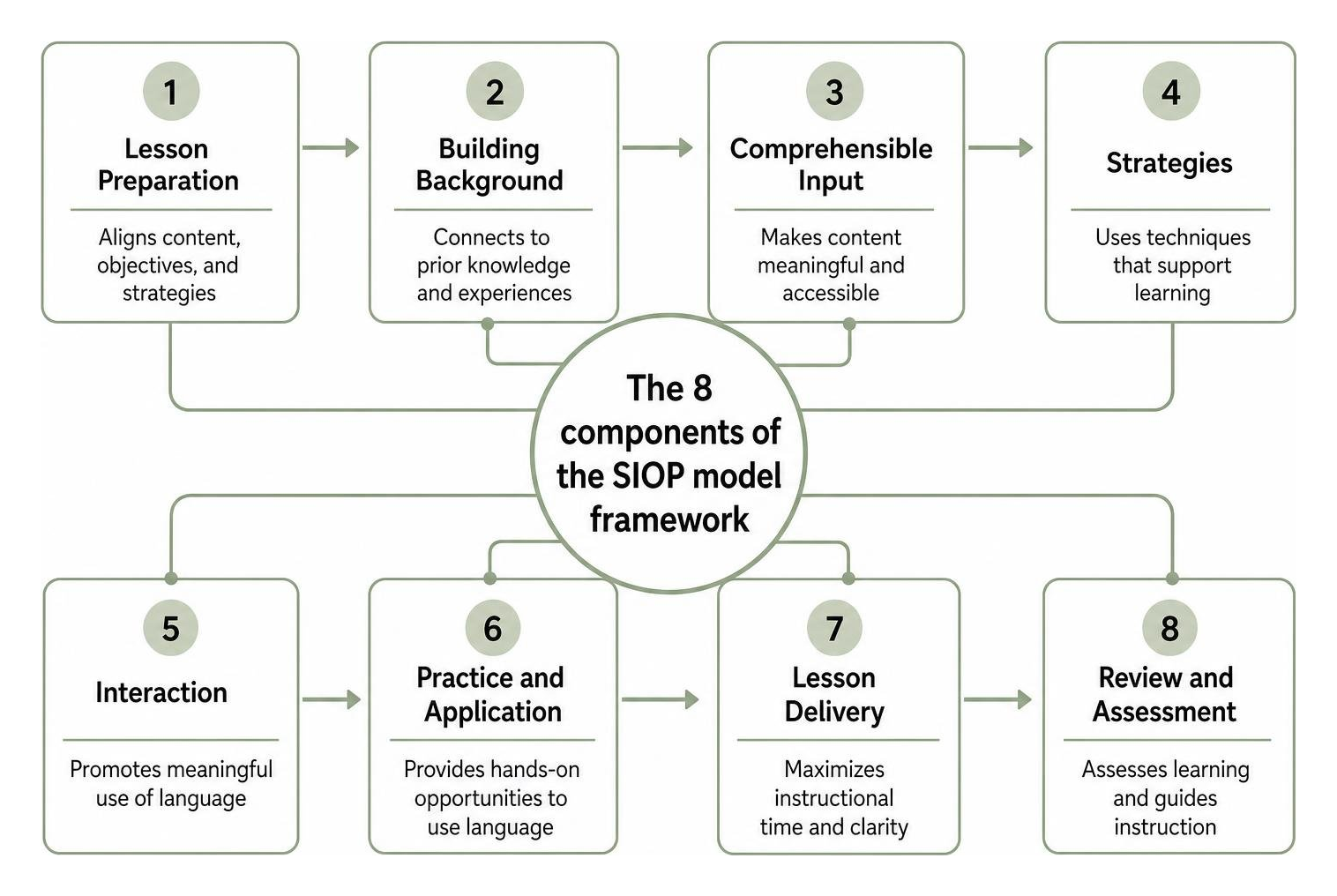
As highlighted in the ELL Training for Educators | ASU Global Launch program, a comprehensive training curriculum must integrate multiple core components:
- Language Acquisition Theory: Understanding the cognitive processes behind bilingualism.
- Culturally Responsive Teaching: Valuing the student’s identity and home background.
- Assessment Modifications: Separating language proficiency from actual content knowledge.
Let’s break down how teachers can implement these key components in their daily planning.
Designing Effective Language Objectives in the Classroom
Every lesson plan requires a clear roadmap. While teachers are highly skilled at writing content objectives (what the students will learn), they often struggle to write language objectives (how the students will use language to learn and express that content).
To drive student achievement, we must integrate language domains—reading, writing, speaking, and listening—into every subject. This approach is central to our work in Events: Aligning Instruction to Drive Student Success Curriculum Mapping.
A strong language objective should target vocabulary growth and academic discourse. For example:
- Weak Objective: Students will learn about photosynthesis.
- Strong Content Objective: Students will identify the key inputs and outputs of photosynthesis.
- Strong Language Objective: Students will orally explain the process of photosynthesis to a partner using the transition words first, next, then, and finally, incorporating the target vocabulary carbon dioxide, oxygen, and chlorophyll.
By explicitly planning for language, content-area teachers in math, science, and social studies ensure that language barriers do not prevent students from mastering standards-based learning.
Culturally Responsive Instruction and Family Engagement
True school success is built on family empowerment. When we engage parents and caregivers, we create a supportive bridge between home and school.
To do this effectively, educators should leverage a student’s “funds of knowledge”—the rich academic, cultural, and practical skills developed within their households. Rather than viewing a student’s native language as a barrier, we should celebrate bilingualism as a cognitive advantage.
Here are practical ways to foster culturally responsive classrooms and home-school collaboration:
- Incorporate Multilingual Resources: Use bilingual books, diverse literature, and multicultural displays to validate student identities.
- Utilize Translation Tools: Send school newsletters and updates in the families’ home languages using apps like Google Translate.
- Provide Local Support: Direct families to helpful community networks, such as those listed in Helpful Resources for English Learners in Florida, to help them navigate the school system and access local literacy programs.
Practical Classroom Strategies and EdTech Integration
When teachers return to their classrooms after professional development, they need practical, evidence-based strategies they can use immediately.

Some of the most effective techniques include:
- Scaffolding: Breaking instruction into manageable chunks and gradually releasing responsibility to the student.
- Sentence Frames and Starters: Providing templates (e.g., “I agree with [Name] because…”) to help students participate in academic discussions.
- Graphic Organizers: Using visual diagrams like Venn diagrams, concept maps, and flowcharts to make abstract concepts concrete.
- Realia: Bringing real-world objects into the classroom (such as showing a physical pinecone during a lesson on conifers) to build immediate background knowledge.
Leveraging Technology in ELL Training for Teachers
Innovative learning thrives in public charter schools, and educational technology (EdTech) offers incredible opportunities to personalize language instruction. Through “app smashing”—combining multiple digital tools—teachers can build customized, interactive lessons that target all four language domains.
For teachers looking to expand their digital toolkit, the Tech with ELL – EdTech PD Courses program provides excellent training on using Chrome extensions, voice-to-text apps, and digital portfolios.
Additionally, the Digital Content Creation for Teachers | ellloclass course teaches educators how to create engaging multimedia assets. By integrating these tools, teachers can:
- Use Audacity or Zengengo to record audio lessons with built-in processing pauses, giving students extra time to digest spoken English.
- Leverage Canva to design highly visual lesson templates.
- Use ChatGPT or Gemini to instantly generate bilingual glossaries, rewrite complex reading passages at different Lexile levels, or create vocabulary puzzles.
- Turn standard videos into interactive listening assessments using tools like Ed-Puzzle.
Formative Assessments and Tracking Progress with WIDA
To ensure student-centered learning, we must regularly track progress using reliable frameworks. In Florida, we utilize the WIDA framework and its corresponding Can-Do Descriptors.
Rather than relying solely on high-stakes standardized tests, which often measure language proficiency rather than actual subject mastery, teachers should use ongoing formative assessments. These might include:
- Observing student interactions during structured peer talk.
- Collecting quick exit tickets with modified rubrics that focus on content understanding rather than grammatical perfection.
- Using WIDA’s Can-Do Descriptors to set realistic, incremental goals that help students systematically “level up” their language skills.
Professional Development Pathways and Certification Requirements
Florida has strict, comprehensive requirements for ESOL (English for Speakers of Other Languages) training, making it vital for teachers to choose the right professional learning pathway.
As state guidelines evolve, staying informed is critical. For instance, keeping up with Updated Educator Certification Bills Take Effect on July 1, 2024 and the Updated Rules for Teacher Certification Mastery for Florida Teachers ensures that charter school administrators and teachers maintain compliance while pursuing academic excellence.
University Endorsements and Graduate Certificates
For educators seeking a formal, academic credential, several excellent university-based programs are available online.
For instance, the Online Graduate Certificate – English Language Learners at EWU is a 30-credit program that can be completed in as few as 8 months for $10,050, offering deep dives into applied linguistics and pedagogical grammar.
Alternatively, the English Language/Multilingual Learners (ELL/MLL) Endorsement | UW College of Education is a fast-track, 1-quarter, 16-credit program costing approximately $6,528 for residents, which combines coursework with a supervised classroom practicum.
Note: Florida educators should always verify with the Florida Department of Education (FLDOE) that out-of-state university coursework aligns with Florida’s specific ESOL endorsement requirements.
Selecting the Right Pathway: ELL Training for Teachers Options
If a university program doesn’t fit your schedule or budget, there are highly flexible, self-paced alternatives:
- NEA Micro-credentials: The National Education Association offers free, competency-based micro-credentials to its members, covering topics like academic language, formative assessments, and family advocacy.
- State-Approved Online Courses: Florida teachers can access self-paced modules directly through portals like ESOL e-Learning to earn required inservice points.
- Collaborative PD Partnerships: At the Florida Charter School Alliance, we actively support innovative training options. For example, the Noble Education Initiative FCSA Join Forces to Provide Professional Development Courses for Educators program offers tailored, high-quality professional development designed specifically to meet the needs of charter school teachers.
Frequently Asked Questions About Multilingual Education

What is the difference between ESL, ELL, and ESOL?
While these terms are often used interchangeably, they have distinct meanings:
- ELL (English Language Learner): Refers directly to the student who is actively acquiring English. This term is growth-oriented and focuses on the student’s potential.
- ESL (English as a Second Language): Typically refers to the instructional program model or the class itself where English is taught.
- ESOL (English for Speakers of Other Languages): The official term used in Florida’s educational and certification systems to describe both the student population and the teacher credentials.
How long does it take for an ELL student to achieve academic English proficiency?
As established by language acquisition research, conversational language (BICS) takes about 2 years to develop. However, academic language proficiency (CALP) requires 5 to 7 years of systematic, scaffolded instruction. This timeline highlights why ongoing ell training for teachers is so critical—every content-area teacher must be equipped to support language development over the long term.
Do teachers need to speak a student’s home language to support them?
No. While bilingual support is incredibly valuable, you do not need to speak a student’s home language to be an effective teacher. By implementing clear visual scaffolds, utilizing translation technology, establishing structured peer discussions, and maintaining a welcoming, warm classroom climate, you can successfully guide multilingual students toward academic excellence.
Conclusion
At the Florida Charter School Alliance (FCSA), we believe that every child in Florida deserves access to a high-quality education that unlocks their full potential. Public charter schools are uniquely positioned to deliver on this promise through educational innovation, accountability, and student-centered learning.
By investing in robust ell training for teachers, our schools not only meet state compliance standards but also foster environments where multilingual students thrive. We encourage all charter school leaders and educators to explore our comprehensive Professional Learning System to find the training courses, resources, and support needed to drive academic success and empower families across our state. Together, we can ensure that parental choice always leads to educational excellence.