
How charter school collective bargaining works
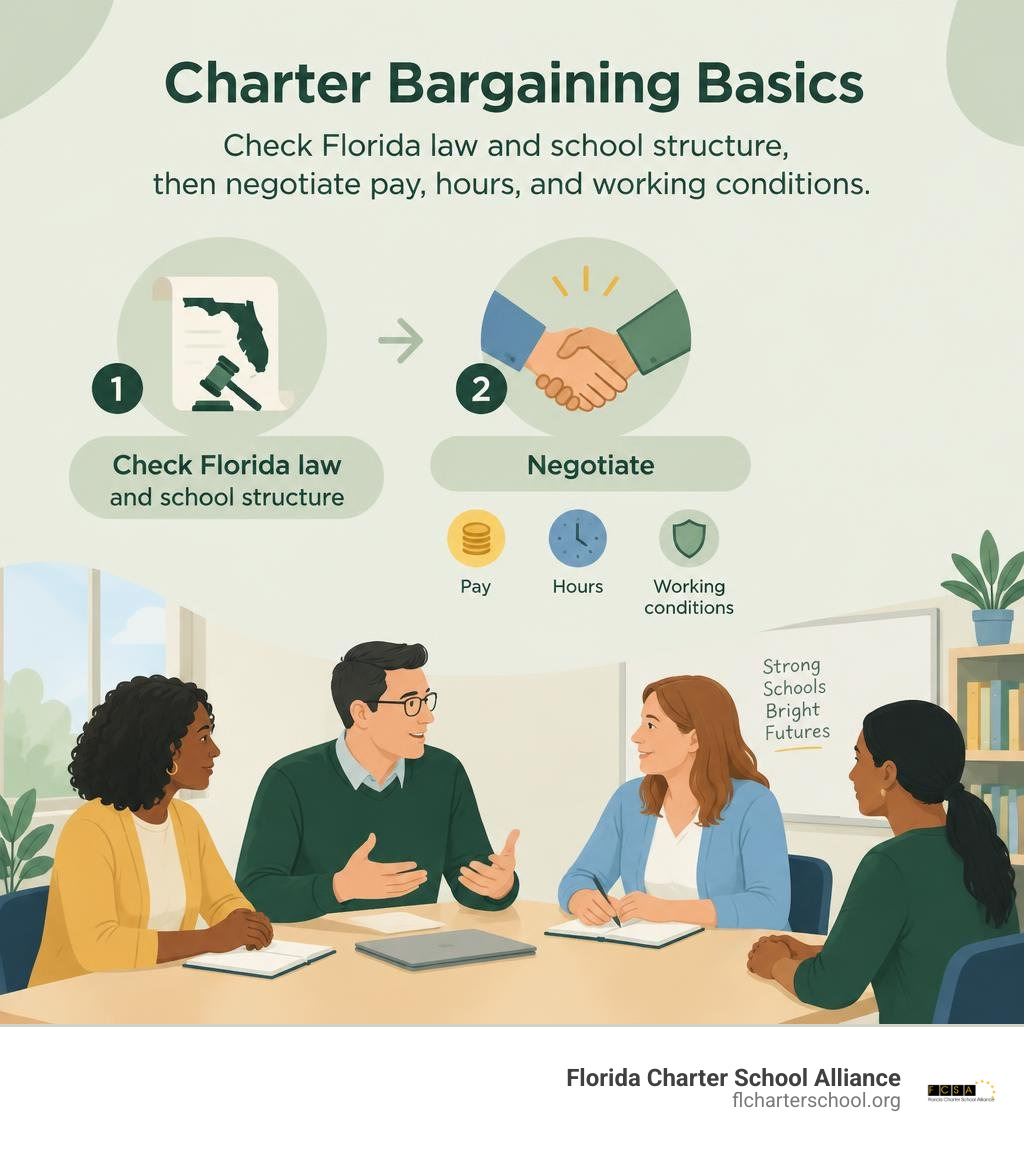
Charter school collective bargaining is the process in which employees, through a union, negotiate with their school employer over pay, hours, and working conditions. In Florida, the rules depend on state labor law and the school’s charter and employment structure. Teachers and school leaders should check which rules apply before organizing or negotiating.
A bargaining agreement can protect staff while leaving room for a school’s teaching approach. That balance matters for programs, including the arts, that need the right staff and resources to serve students well.
I’m Lynn Norman-Teck, Executive Director of the Florida Charter School Alliance. My work in charter school policy and school development helps me explain charter school collective bargaining with a focus on educators, school leaders, and students.
Charter school collective bargaining vocab to learn:
Introduction
Public charter schools were founded on the promise of educational innovation, accountability, and family empowerment. By offering customizable learning models, public charter schools provide dynamic educational access tailored to community needs. Yet, as the sector matures, labor relations and organizational governance have sparked important policy conversations.
At the heart of these discussions is how charter school governance intersects with organized labor. Unlike traditional district schools, which operate under centralized master contracts, charter schools maintain site-level autonomy to design specialized programs. Understanding historical union prevalence, shifting national patterns, and state-level labor structures is essential for school leaders, board members, and educators looking to sustain academic excellence and support their teams.
Current Landscape of Charter School Collective Bargaining
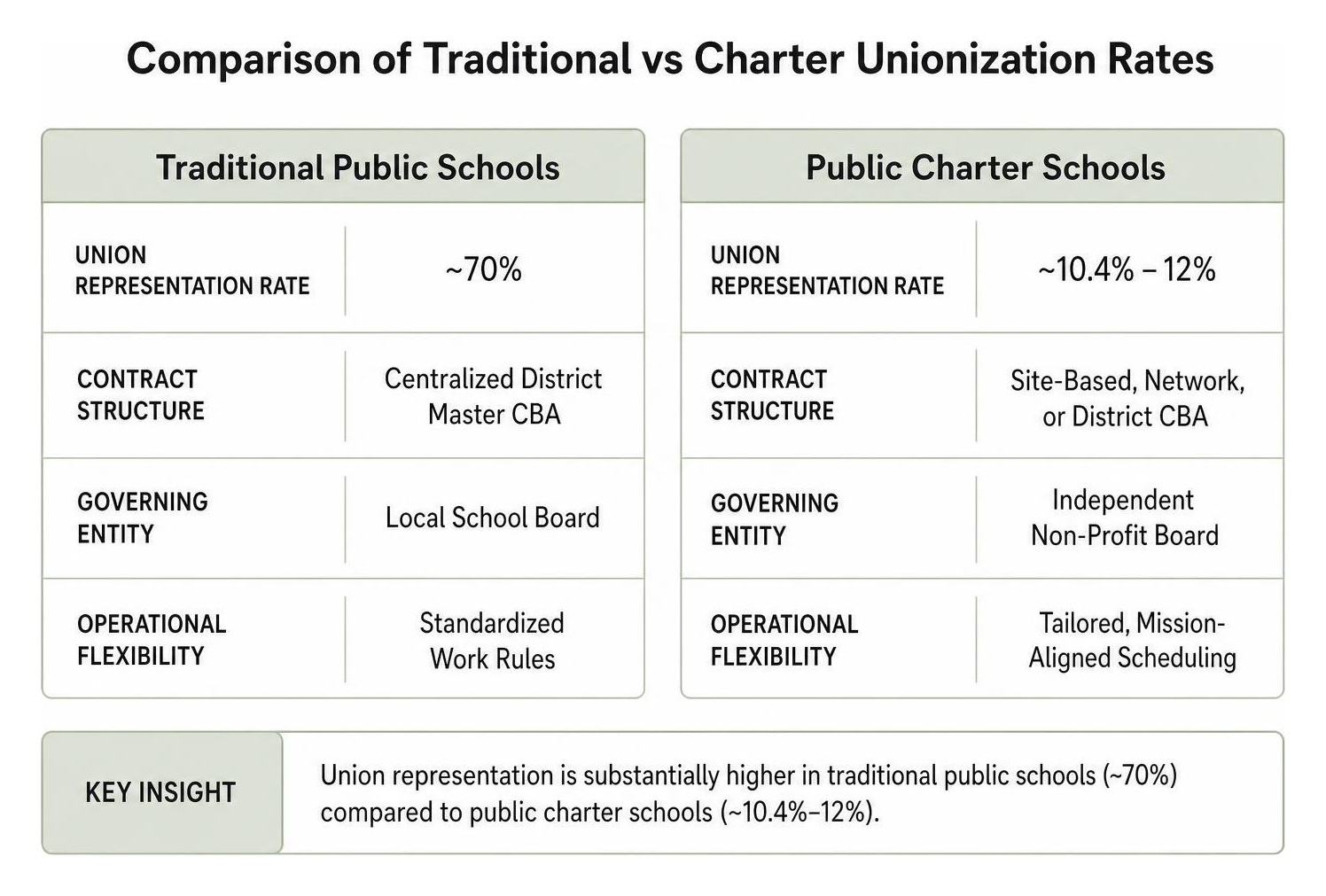
Union representation within public charter schools remains distinctly different from traditional district systems. According to a landmark national study on unionized charter schools, only about 10% to 12% of charter schools operate under collective bargaining agreements. In contrast, traditional public school systems see union representation rates near 70%.
| Sector Metric | Traditional Public Schools | Public Charter Schools |
|---|---|---|
| Union Representation Rate | ~70% | ~10.4% – 12% |
| Contract Structure | Centralized District Master CBA | Site-Based, Network, or District CBA |
| Governing Entity | Local School Board | Independent Non-Profit Board |
| Operational Flexibility | Standardized Work Rules | Tailored, Mission-Aligned Scheduling |
This divergence highlights the distinct statutory designs of public charter schools. While traditional districts rely on uniform personnel policies across dozens of campuses, charter schools are built on flexible, site-based operational models.
National Trends in Charter School Unionization
Over the past decade, national union density in charter schools has experienced a measurable decline rather than an expansion. National dataset analyses indicate that the proportion of unionized charter schools dipped from 11.3% in the 2016–17 school year to 10.4% in 2018–19, with the absolute count of unionized campuses dropping from 781 down to 718.
Union density remains concentrated in specific geographic regions. In 2018–19, five states accounted for 72.4% of all unionized charter campuses nationwide: California (240), Wisconsin (161), Maryland (49), Hawaii (36), and Illinois (34). Major urban hubs like Los Angeles, Chicago, and New York City encompass the vast majority of these campuses. Outside these concentrated urban centers, collective bargaining remains rare across the charter landscape.
State Mandates and Conversion vs. Startup Charters
A crucial driver of charter school unionization is statutory classification rather than grassroots organizing. Nationally, 52.0% of unionized charter schools are bound to collective bargaining agreements by state statute or local district policy rather than by independent staff votes.
This dynamic frequently appears in conversion charter schools—traditional public schools that transitioned into charter status. Conversions account for 27.8% of all unionized charters, compared to just 6.2% of non-unionized charters. In several states, conversion legislation mandates that employees remain covered under the local district master contract. Conversely, independent startup charters typically hire their own staff under customized agreements. When exploring all about charter schools, understanding this distinction between conversion mandates and startup autonomy is vital for evaluating workforce governance.
Legal Frameworks and Jurisdictional Challenges

Labor relations in the public charter sector operate across a complex intersection of federal labor statutes and state public employment regulations. Under Florida Statutes Section 1002.33, Florida charter schools are public schools of choice that operate under an independent governing board. Navigating state charter school law requires understanding whether a school is treated as a private employer or a public political subdivision under labor regulations.
Navigating NLRB vs. PERB Jurisdiction in Charter School Collective Bargaining
A central legal question is whether labor disputes fall under the federal National Labor Relations Board (NLRB) or a state-level Public Employees Relations Commission (PERB/PERC). The NLRB determines jurisdiction using the two-pronged Hawkins County test:
- Was the entity created directly by the state to constitute an administrative arm of government?
- Is the entity administered by individuals who are appointed by and accountable to public officials?
Because most startup charter schools are established by private non-profit corporations governed by self-perpetuating boards, federal labor rulings—such as recent NLRB charter school jurisdiction rulings—have asserted federal jurisdiction over private non-profit operators. Conversely, conversion charters and district-operated models remain under state public employee labor boards. This jurisdictional distinction determines whether federal National Labor Relations Act (NLRA) rules or state-specific public sector collective bargaining laws govern representation elections, unfair labor practice claims, and decertification votes.
Appropriate Bargaining Units and Single-Employer Precedents
Determining what constitutes an “appropriate bargaining unit” is another complex procedural step. In network settings, Charter Management Organizations (CMOs) often debate whether bargaining units should be organized campus-by-campus or across an entire network.
State labor boards evaluate these questions based on functional integration and shared management. For instance, in PERB Decision A491E, administrative judges ruled that bargaining unit appropriateness depends strictly on the organizational facts present at the time a petition is filed, rather than subsequent corporate reorganizations. In other administrative precedents, such as PERB Decision 2484E on virtual charter units, labor boards applied the single-employer doctrine to virtual charter networks, confirming that shared administrative hierarchies and centralized employment policies can establish a unified community of interest across multiple school sites.
How Charter Agreements Differ from Traditional District Contracts
When public charter schools do negotiate collective bargaining agreements, the resulting contracts look substantially different from standardized district agreements. Traditional district contracts often run hundreds of pages, mandating rigid seniority systems, lockstep schedules, and cumbersome transfer rules. In contrast, charter agreements tend to be streamlined, preserving school-level autonomy while establishing clear employee protections.
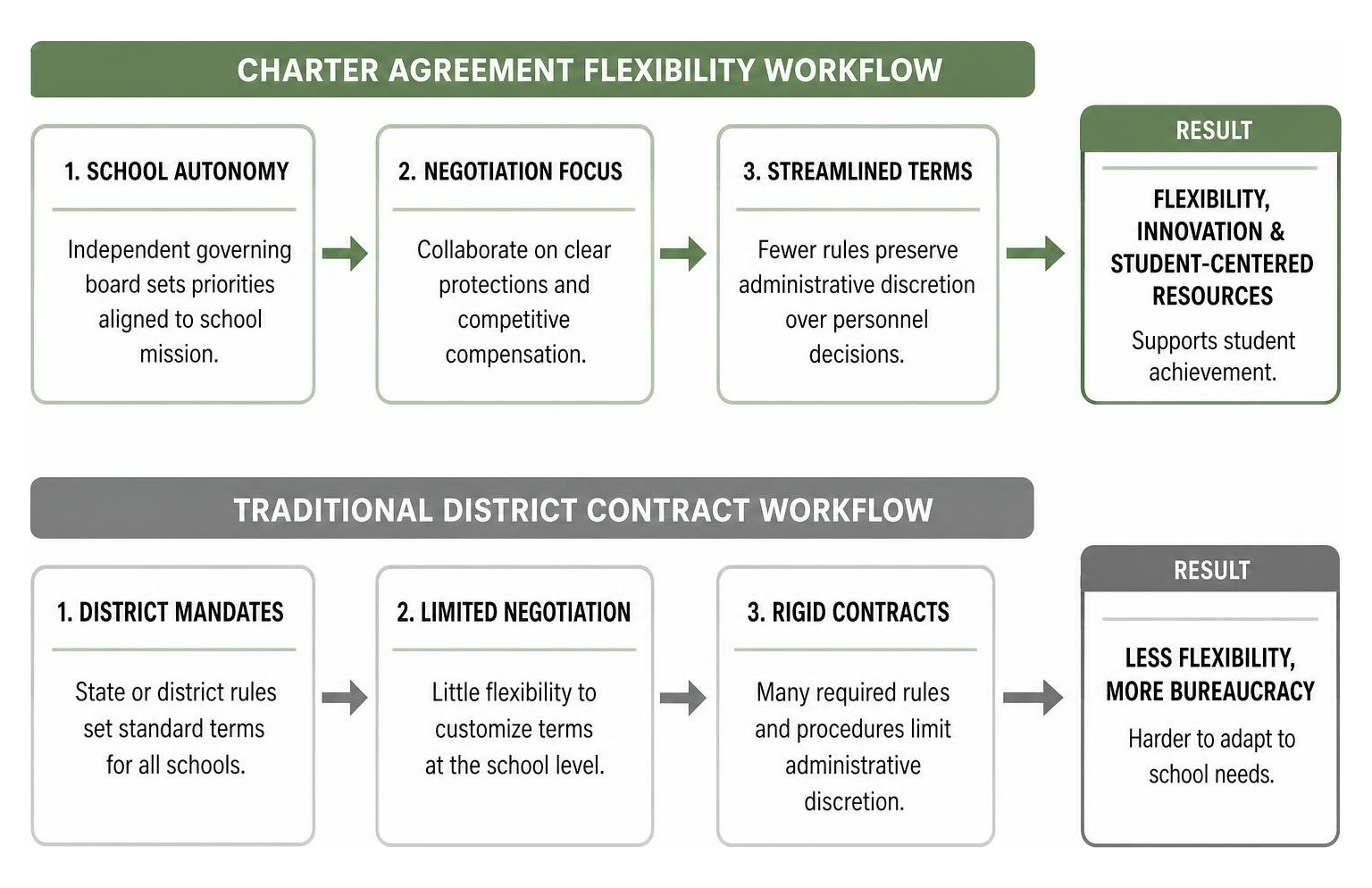
Real-world examples, such as an Arizona charter union agreement case, illustrate how contracts can prioritize student-centered resources—such as dedicated counselors, nurses, and academic interventions—alongside competitive teacher compensation. When operating a charter school, maintaining this mission alignment ensures that workplace agreements actively support student achievement.
Balancing Autonomy, Innovation, and Teacher Protections
The core design of public charter schooling relies on educational innovation and agility. Research from the Center on Reinventing Public Education (CRPE) reveals that successful charter contracts maintain administrative discretion over vital personnel decisions while offering transparent grievance resolution and fair compensation schedules.
By avoiding rigid work-rule restrictions, charter agreements allow educators and school leaders to adapt daily schedules, implement extended learning blocks, and offer specialized arts or STEM pathways that serve distinct student populations.
Key Provisions: Compensation, Evaluations, and Working Conditions

Modern charter labor agreements often introduce innovative compensation models tailored to community priorities:
- Differentiated and Performance Pay: Recognizing specialized instructional skills, student growth metrics, and leadership roles.
- Bilingual and Biliterate Stipends: Rewarding educators who bridge language access for diverse student and family populations.
- Longevity and Retention Differentials: Providing tiered retention bonuses at specific service milestones (e.g., 5, 10, or 15 years) to stabilize campus faculty.
- Mission-Specific Working Conditions: Structuring collaborative planning time, student-centered office hours, and flexible calendar days rather than rigid factory-era clock hours.
At the Florida Charter School Alliance, FCSA teacher support initiatives champion competitive compensation packages, state teacher salary increases, and professional recognition for charter educators statewide.
Impact of Unionization on School Performance, Operations, and Staff
Analyzing the operational impact of collective bargaining requires examining both classroom instruction and administrative leadership. Interestingly, academic research published in Leadership and Policy in Schools reveals that collective bargaining among school leaders (principals) is positively and significantly associated with charter school performance. Researchers found that formalized leadership evaluations, competitive administrator compensation, and structured working conditions help retain strong school leaders, which directly benefits campus-wide student outcomes.
When schools leverage structured operational frameworks, as outlined in our charter operational management playbook, clear personnel structures provide stability that supports classroom instruction.
Student Achievement, Administrator Discretion, and Retention
The connection between collective bargaining and student success depends on administrative flexibility. When contracts protect administrative discretion regarding hiring, instructional coaching, and curriculum development, schools maintain the agility needed to support academic excellence.
Furthermore, clear, transparent workplace agreements can reduce educator burnout and turnover by establishing well-defined grievance pathways, reasonable workload expectations, and supportive working environments. Retaining high-quality, mission-aligned educators remains one of the strongest predictors of long-term school success and family satisfaction.
Strategic HR Practices Under Charter School Collective Bargaining
For governing boards and school leaders navigating labor negotiations, adopting professional human resources standards is critical. Implementing essential charter school HR policies ensures organizational compliance, fair workplace standards, and transparent staff communications.
Labor board rulings, such as PERB Decision 2809E, underscore that school employers must maintain good-faith bargaining practices and follow proper procedural petitions during organizational changes. Strategic human resources leadership prevents costly legal disputes and fosters a collaborative school culture focused on student achievement.
Frequently Asked Questions About Charter Collective Bargaining
To assist school leaders, governing boards, and teachers, we address several common inquiries regarding labor relations and charter governance, supplementing our broader library of frequently asked charter school questions.
Why is collective bargaining less prevalent in charter schools than traditional public schools?
Charter schools are deliberately structured as autonomous, mission-driven public institutions. Most are independent startups governed by decentralized non-profit boards rather than centralized district bureaucracies. Furthermore, charter educators often choose their campuses specifically for their specialized academic models, collaborative cultures, and flexible instructional environments, leading to lower overall union density.
Can charter schools craft customized, mission-aligned bargaining agreements?
Yes. Unlike standardized district master contracts, charter agreements can be written from the ground up to reflect a school’s unique academic vision. Contracts can integrate performance-based compensation, bilingual educator stipends, extended learning blocks, and tailored professional development schedules while maintaining core employee protections.
How do Florida statutes govern charter school employment and bargaining?
Under Florida law, charter school employees may participate in public sector collective bargaining if designated as public employees. However, charter school governing boards operate as independent operational entities. Most Florida charter schools maintain site-based employment contracts, and charter schools can opt out of district collective bargaining agreements to preserve operational autonomy, compensation flexibility, and mission-aligned hiring.
Conclusion
Public charter schools continue to lead educational innovation across Florida and the nation, expanding parental choice and proving what is possible when educators have the flexibility to meet students’ individual needs. Navigating workforce strategy, labor relations, and organizational governance requires balanced, informed leadership that keeps students at the center of every decision.
At the Florida Charter School Alliance, we remain dedicated to supporting governing boards, school leaders, and classroom educators with high-quality advocacy and operational resources. To ensure all public school families have access to world-class educational opportunities, we encourage you to advocate for equitable funding for public school students and join us in building a stronger future for public education.