
Understanding Public Charter Schools
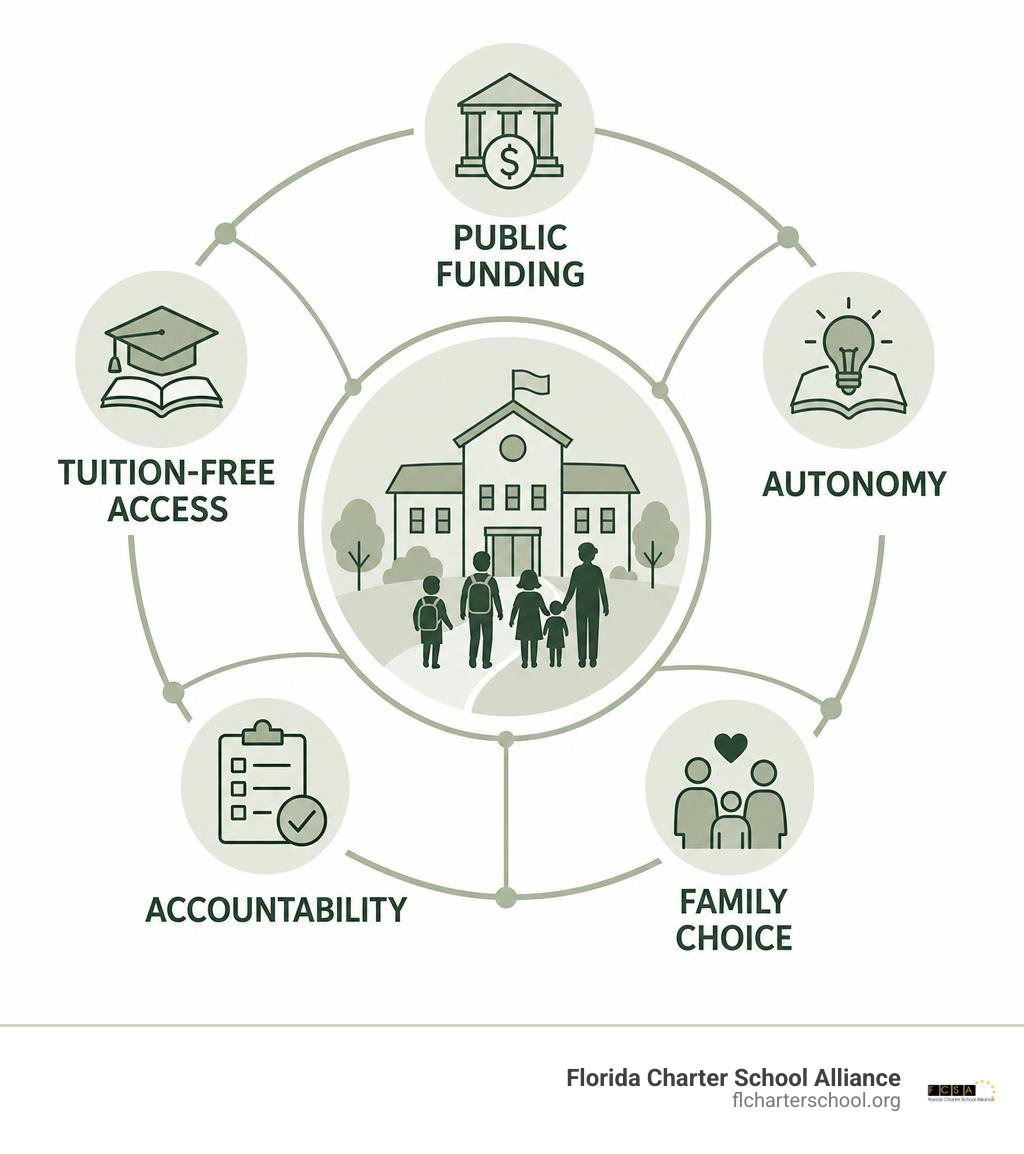
A charter school is a tuition-free public school that operates under a performance contract, called a charter. It has more freedom than a traditional district school to shape its curriculum, staffing, schedule, and learning model. In return, it must meet clear academic, financial, and operational standards set by its authorizer.
For families, charter schools expand public-school choice. For educators, including arts teachers, they can create room for specialized programs and fresh approaches that respond to students’ interests and talents. Like other public schools, they must follow civil-rights, health, safety, and non-discrimination laws.
In Florida, public charter schools are designed to pair innovation with accountability. They offer families a valuable option while remaining responsible for student progress and sound use of public funds.
I am Lynn Norman-Teck, Executive Director of the Florida Charter School Alliance, with experience in public charter school development, policy, advocacy, and community engagement. This guide explains how a charter school works, what families can expect, and why strong oversight matters.
What Is a Charter School and How Does It Work?
At its core, a public charter school represents an agreement between educators, parents, and the public. In exchange for greater autonomy over organizational design, hiring, calendar scheduling, and instructional methods, the school agrees to be held accountable for measurable student performance and fiscal integrity. This foundational trade-off—autonomy in exchange for accountability—empowers community leaders and master educators to design learning environments tailored to the distinct needs of their students.
When learning about Florida charter schools, families quickly discover that these institutions are not private entities operating behind closed doors. They are open-enrollment public schools governed by independent nonprofit boards. By removing unnecessary bureaucratic layers, these institutions can quickly adapt curricula, introduce innovative teaching tools, and establish dedicated support programs that help every child reach their academic potential.
Key Differences: Traditional Public, Private, and Charters
Navigating the educational landscape can sometimes feel overwhelming for parents. Understanding how public charters compare to traditional district schools and private institutions clarifies the unique role charters play in expanding educational choice.
| Feature | Public Charter Schools | Traditional District Schools | Private Schools |
|---|---|---|---|
| Tuition | 100% Tuition-Free | 100% Tuition-Free | Mandatory Tuition / Private Pay |
| Funding Source | Public per-pupil tax dollars | Public per-pupil tax dollars | Private tuition, endowments, donors |
| Admissions | Open enrollment; random lottery if oversubscribed | Geographically zoned by neighborhood | Selective; applications, interviews, testing |
| Governance | Independent nonprofit governing board | Elected county district school board | Private board, diocese, or corporate owner |
| Accountability | State testing, school grades, performance contract | State testing, district oversight, school grades | Independent accreditations; no state tests required |
| Curricular Autonomy | High flexibility to innovate and specialize | Standardized district-wide curriculum | Complete independence from state standards |
| Civil Rights Compliance | Full compliance with federal and state civil rights | Full compliance with federal and state civil rights | Exempt from many federal civil rights mandates |
While traditional public schools assign seats based on geographic zones, public charters welcome students regardless of neighborhood boundaries. In contrast to private schools, public charters are strictly non-sectarian, charge zero tuition, and must adhere to all state testing and civil rights requirements.
Charter School Funding and Tuition Policies
A common misconception is that charter schools charge tuition or operate through private vouchers. In reality, public charters are prohibited by law from charging tuition for standard K-12 instruction. They are funded through the same public per-pupil allocations that support traditional district schools.
When a student enrolls in a public charter, their state and local educational funding follows them to that school. These funds cover teacher salaries, instructional technology, textbooks, and daily operations. Because public charters generally receive less capital outlay funding than district-run schools, their governing boards often secure competitive federal grants or utilize prudent budgeting to finance facilities. The state oversees these financial streams carefully through the official Florida Department of Education Charter Schools portal, ensuring every taxpayer dollar directly supports classroom achievement.
Governance, Authorizing, and Accountability Standards

Public charter schools operate with a high level of transparency. Instead of reporting to a central district bureaucracy, each school is overseen by a dedicated, unpaid governing board composed of parents, business professionals, and community leaders. This board holds fiduciary and operational responsibility, meeting in publicly noticed sessions to evaluate budgets, review academic metrics, and maintain organizational compliance.
District school boards serve as the primary authorizers (or sponsors) of public charter schools within their respective counties. The authorizer monitors compliance with state statutes, tracks student progress, and enforces the legal performance contract that dictates whether a school continues operating.
The Authorization and Lifecycle Process
Launching a public charter is a rigorous process designed to protect the public interest and ensure student safety. Founders must submit a comprehensive charter application detailing their mission, evidence-based curriculum, multi-year financial forecasts, student assessment plans, and emergency protocols.
Under state law, the local school board must review and vote on the application within a 60-day window. Following approval, the school enters a rigorous startup phase before opening its doors.
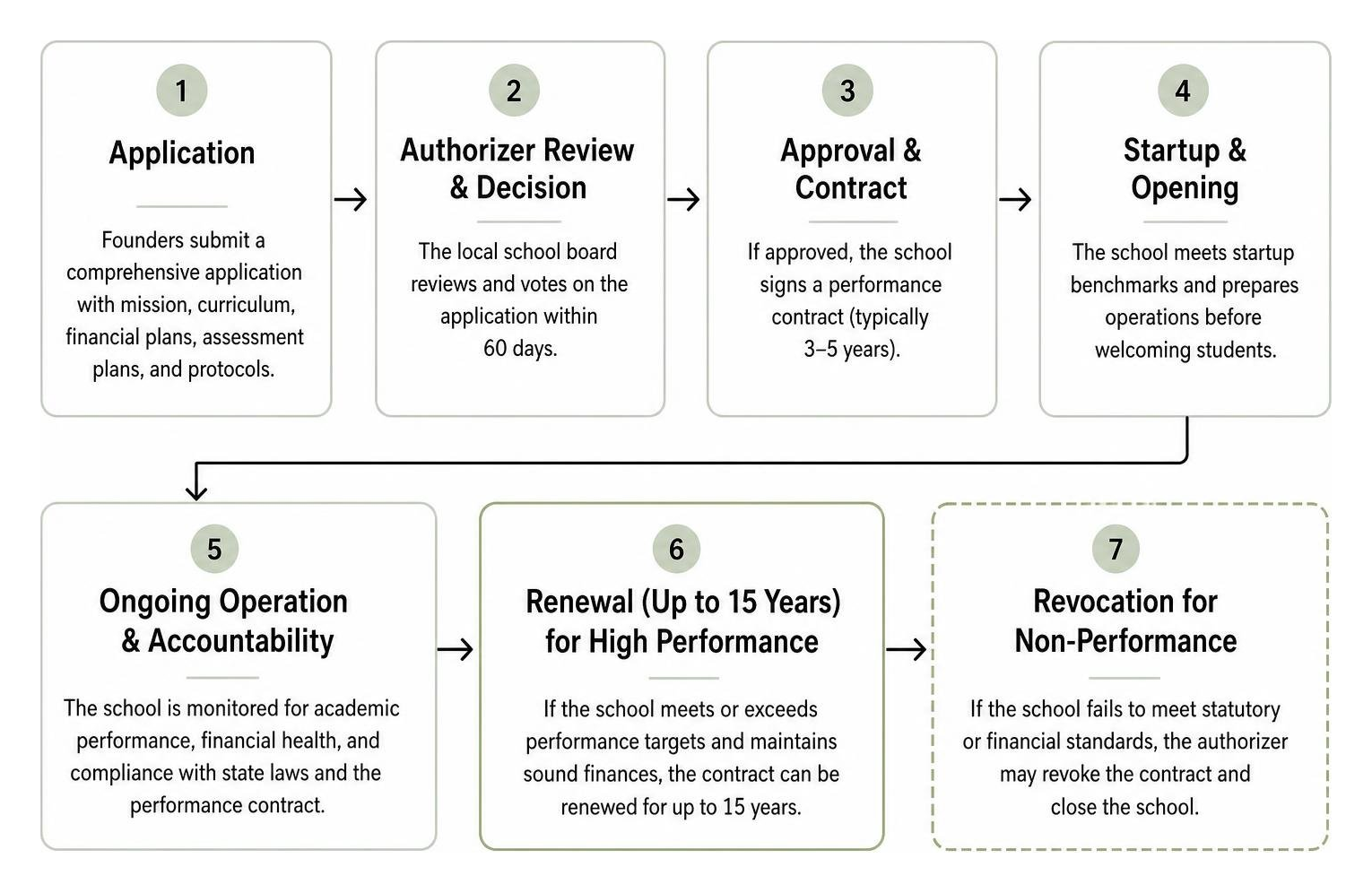
Founders and organizers can consult our step-by-step guide to starting a Florida charter school to navigate the detailed benchmarks required during the startup period. Charters typically operate under an initial three- to five-year contract. If a school consistently exceeds performance targets and maintains sound finances, it can earn high-performing status, making it eligible for charter renewals of up to 15 years. Conversely, if a school fails to meet statutory or financial baselines, the sponsor possesses full legal authority to revoke the contract.
Academic and Financial Accountability
Because public charters operate on public funds, they are held to rigorous academic and operational expectations. Charter students take the exact same statewide standardized assessments as their traditional school peers, and charters receive the same public school grades (A through F) based on student performance and annual learning gains.
Financially, every public charter must undergo an annual independent financial audit conducted by a licensed Certified Public Accountant (CPA). These audits, along with program cost reports, are submitted to both the district sponsor and the state. Parents can explore A parent’s guide to Florida charter school transparency to learn how to review school budgets and operational audits. This dual-accountability model ensures that underperforming schools cannot continue operating indefinitely; in fact, national research shows that roughly half of underperforming or fiscally unsound charters close within 15 years, proving that accountability in the charter sector has real teeth.
Student Admissions, Diversity, and Innovative Learning Models

Public charter schools believe that every student, regardless of background or learning style, deserves an environment where they can thrive. Charters serve a diverse student body, providing specialized services for exceptional student education (ESE), English language learners (ELL), and families needing economic support.
Through federal Title I allocations and McKinney-Vento Homeless Assistance programs, charters ensure that students experiencing economic or housing instability receive free meals, transportation assistance, school supplies, and counseling.
Open Enrollment and Lottery Systems
Admissions at a public charter are straightforward, equitable, and non-discriminatory. Charters cannot administer academic entrance exams or screen applicants based on past test scores or disciplinary history. Any student residing within the county (or adjacent counties with inter-district agreements) is eligible to apply.
When the number of student applications exceeds the available seats in a grade level, state law requires the school to hold a random, blind lottery. Families who are not selected in the initial drawing are placed on a numbered waitlist and admitted as seats become available. Parents looking for options in their neighborhood can use our directory to find a charter school and connect directly with school administrators to submit enrollment paperwork.
Specialized Curricula and Cyber Charter School Options
The operational freedom granted to charter schools makes them fertile ground for educational innovation. Across Florida, families can choose from an array of specialized instructional approaches tailored to their children’s passions, including:
- STEM and Biotechnology Tracks: Immersive laboratory environments focusing on coding, robotics, and life sciences.
- Montessori and Whole-Child Frameworks: Multi-age classrooms emphasizing self-directed, tactile learning and personal responsibility.
- Classical and Character-Driven Academies: Curricula grounded in the liberal arts, civic virtue, logic, and critical inquiry.
- Entrepreneurship and MicroSociety Programs: Hands-on simulations where K-8 students manage small businesses, write legislative bills, and master financial literacy.
- Dual Enrollment and College Prep: Partnerships with state colleges allowing high school students to earn an Associate of Arts (AA) degree concurrently with their diploma.
For families requiring scheduling flexibility or personalized pacing, virtual cyber charters and blended learning programs offer digital coursework guided by certified instructors. While cyber charters provide broad access, national research underscores that high-touch, structured environments yield the strongest results. Families exploring statewide educational models can review resources provided by Florida Charter Schools to see how diverse learning formats are implemented across our state.
Educational Outcomes, Debate, and Global Landscape
Over the past three decades, the charter school model has evolved from an educational experiment into an established pillar of public education. This growth has sparked rigorous academic evaluations and spirited policy discussions regarding public investment, instructional equity, and student performance.
Academic Performance and Public Debate
Extensive independent research demonstrates the positive impact of public charter schools on student growth. A landmark national study by the Center for Research on Education Outcomes (CREDO) at Stanford University revealed that charter school students gain an average of 16 additional days of learning in reading and six additional days of learning in math per year compared to their traditional public school peers.
Detailed analyses of statewide test results in charter school achievement demonstrate that charter students regularly outscore district averages across key demographics, especially in urban environments. In fact, state assessment reports consistently confirm that Florida charter schools get an A at higher rates across diverse student populations.
Critics sometimes argue that charters draw vital funding away from district schools or create operational challenges for local boards. However, healthy competition often encourages all public schools to elevate their offerings. Moreover, charters provide educators with professional autonomy and specialized environments that support high workplace satisfaction and excellent staff retention.
Scale, Growth, and International Comparisons
The demand for high-quality public school choice continues to surge. Nationally, more than 8,000 public charter schools enroll an estimated 3.7 million students, representing approximately 7.4% of total public school enrollment across the United States.
In Florida, this movement has seen remarkable success. During the 2024-25 academic year, 732 charter schools served 406,832 students across 48 of the state’s 67 counties, demonstrating how Florida public charter schools see enrollment growth year after year as families seek personalized learning paths.
The charter concept is also thriving across the globe:
- Sweden (Friskolor): Operates roughly 900 publicly funded, independently operated “free schools” that accept public vouchers and encourage local educational innovation.
- Spain (Escuelas Concertadas): Publicly funded, privately managed schools serve a major share of the student population, including 27% of all students in Catalonia (339,423 children).
- Chile: Approximately 60% of students attend state-funded, privately run voucher schools.
- Canada (Alberta): The province of Alberta has championed public charter schools since 1994, lifting statutory school caps to expand specialized education.
Frequently Asked Questions
Do these public institutions charge tuition or require entrance exams?
No. Public charter schools are 100% tuition-free and are prohibited by law from charging attendance fees for standard K-12 instruction. They do not require entrance exams, auditions, or academic screening for admission. For more quick answers regarding enrollment procedures, consult our comprehensive charter school FAQs.
What is the role of charter management organizations (CMOs)?
While every public charter school is governed by an independent nonprofit board, some boards choose to partner with a Charter Management Organization (CMO) or Education Service Provider (ESP). These organizations provide back-office administrative support, facility management, human resources, and accounting services. The local nonprofit governing board retains ultimate legal and fiscal authority, ensuring the operator fulfills its contractual duties and serves the best interests of students.
How do state laws govern school operations?
Public charter schools enjoy operational flexibility, meaning they are exempt from many restrictive district policies and non-essential sections of the state education code. However, they must strictly follow all state and federal laws regarding student civil rights, health, building safety, public meetings, public records, and financial audits. Furthermore, all core academic educators must hold active state teacher certification. You can review the statutory framework governing these standards in our guide to Florida charter school law.
Conclusion
Public charter schools have transformed the educational landscape by offering families high-quality, innovative, and deeply accountable public education options. By bridging the gap between operational flexibility and strict academic oversight, these public institutions expand parental choice and empower teachers to design learning environments where every student can excel.
Every day across our state, we see inspiring success stories humanizing this movement—from first-generation high school graduates earning college degrees through dual enrollment to young learners finding their confidence in specialized STEM and arts classrooms. At the Florida Charter School Alliance, we remain committed to advocating for high standards, supporting visionary school founders, and ensuring that every Florida family has access to a public school that unlocks their child’s full potential.