
What Every Florida Parent Should Know About Charter School Transparency
Florida charter school transparency is stronger than many parents realize — and knowing exactly what to look for can help you make confident, informed decisions for your child.
Here’s a quick snapshot of what Florida charter schools are required to make public:
| What Must Be Disclosed | Where to Find It |
|---|---|
| School grade (A–F) | School website (required by law) |
| Governing board members and meeting minutes | School website, updated quarterly |
| Annual operating budget | School website |
| Independent financial audit | School website + submitted to sponsor |
| Parent liaison contact information | School website |
| Programs offered and management companies | School website |
| Public records (per Chapter 119, Florida Statutes) | Available upon request |
These aren’t optional. Florida Statute 1002.33 requires every charter school to publish this information — and independent auditors are required to verify that it’s actually there.
Still, transparency requirements only matter if parents know what to look for. Many families choose charter schools for the parental choice, innovative learning, and student-centered environments they offer — but don’t always know how to confirm a school is financially sound and fully compliant.
That’s where this guide comes in.
I’m Lynn Norman-Teck, Executive Director of the Florida Charter School Alliance, and I’ve spent my career working at the intersection of Florida charter school transparency, public policy, and school quality to help families and school leaders navigate exactly these questions. In the sections ahead, I’ll walk you through every layer of accountability Florida law requires — so you can evaluate any charter school with clarity and confidence.
Demystifying Florida Charter School Transparency
When we talk about public charter schools, there is often a bit of confusion. Are they private? Are they public? The answer is simple: public charter schools are tuition-free, public schools of choice. They operate under a performance contract (or “charter”) with a public sponsor, which is typically the local school district.
As of June 2026, Florida has 732 charter schools serving over 406,832 students across 48 of Florida’s 67 counties. This footprint represents approximately 13.8% of the state’s total K-12 public school enrollment.
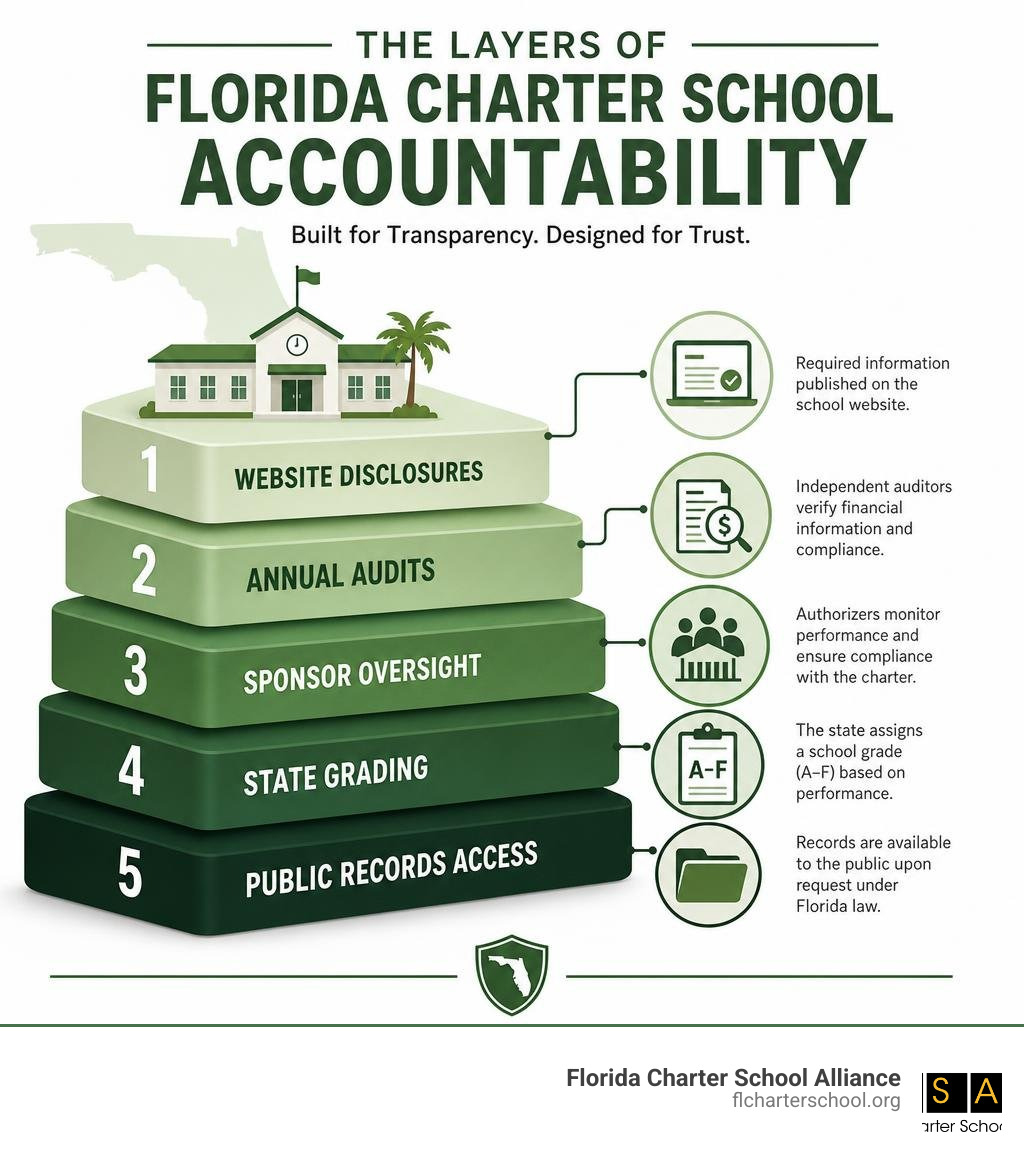
While charter schools are granted flexibility from some of the rigid administrative regulations of the traditional school district, they operate with a high level of accountability. In fact, they are held to the exact same academic and financial standards as traditional schools. To understand the legal framework that keeps these schools accountable, parents can explore the details of Florida Charter School Law.
How Florida Charter School Transparency Empowers Parents
We believe that transparency isn’t just about compliance; it is about family empowerment. When parents have clear, accessible information about how a school is governed, how its students perform, and how public funds are spent, they can exercise true parental choice.
By having open access to academic performance metrics and financial health reports, you can ensure your child is enrolled in a school that prioritizes student achievement and academic excellence. If you are looking for resources on how to evaluate these schools, you can read more at Empowering Parents: Information About Charter Schools.
State Laws Governing Florida Charter School Transparency
In Florida, charter school operations are strictly governed by state law. Under Florida House of Representatives – FLHouse.gov, specifically Section 1002.33, Florida Statutes, charter schools must be organized as or operated by non-profit 501(c)(3) organizations.
Every charter school is governed by an independent, voluntary governing board. This board is legally responsible for the school’s operations, academic outcomes, and financial health. The charter contract itself is a legally binding document that defines the school’s academic goals, financial parameters, and operational responsibilities. If a school fails to meet these terms, the district sponsor has the legal authority to revoke the charter.
What Must Be Disclosed: The Digital Paper Trail
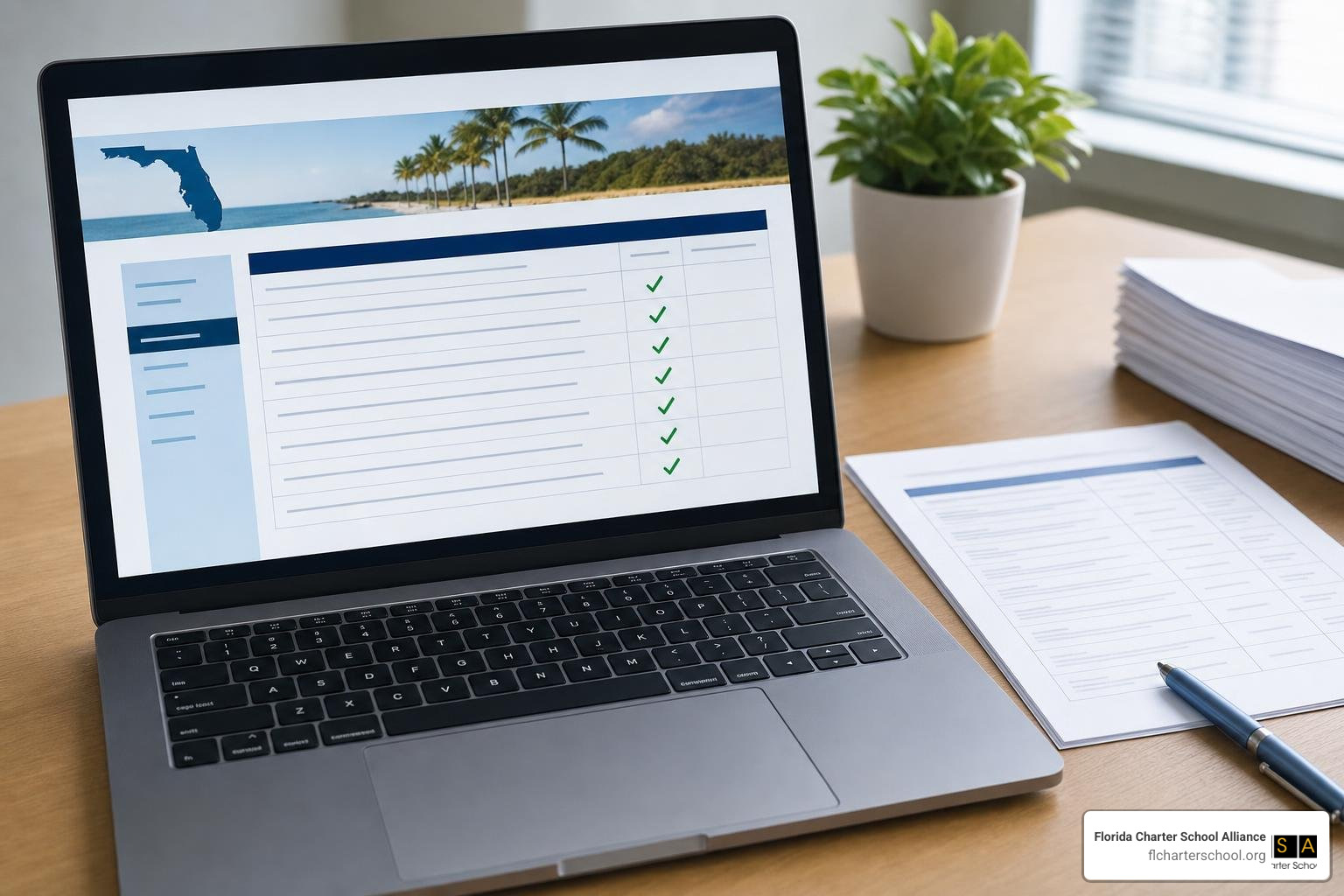
To make information easily accessible to families, Florida law requires charter schools to maintain a high level of website compliance. You shouldn’t have to submit a formal request or jump through hoops just to see how your child’s school is run.
If you are a parent or an administrator looking to audit a school’s digital presence, you can check our detailed guide: Is Your Charter School Website Fully Compliant? Check Today!.
Mandatory Website Disclosures
By law, a Florida charter school’s website must prominently feature:
- The School’s Academic Grade: You can quickly see how the school is performing under the state’s accountability program. To learn more about how charter schools measure up, see Florida Charter Schools Get an A.
- Governing Board Information: The names of all governing board members, along with their contact information.
- Meeting Minutes: Quarterly minutes from governing board meetings must be posted publicly so you can see how decisions are made.
- Annual Budgets and Audits: The school’s operating budget and its latest independent financial audit.
- Parent Liaison: Every charter school must appoint a parent liaison to help resolve parental concerns, and their contact information must be clearly visible on the website.
Public Records and Parent Rights
Because charter schools are public institutions receiving public funds, they are fully subject to Florida’s Chapter 119 Public Records Law (often referred to as the Sunshine Law). This means parents and the public have the legal right to request and inspect school documents, including contracts with Educational Management Organizations (EMOs).
Historically, some critics have pointed to studies showing that in certain states, charter boards did not always respond to public records requests. For example, a national study showed that only 20% of surveyed charter boards initially responded to public records requests regarding EMO contracts.
In Florida, however, the law is clear: failure to comply with Chapter 119 public records requests is a violation of state statute and can result in legal penalties and the loss of the school’s charter. We work closely with school leaders to ensure they understand their legal obligations to keep public records open and accessible.
Financial Accountability and Audit Standards
One of the most persistent myths is that charter schools operate without financial oversight. The reality is that charter schools face a level of financial scrutiny that is in many ways more direct and immediate than that of traditional public schools.
| Oversight Feature | Florida Public Charter Schools | Traditional District Schools |
|---|---|---|
| Annual Independent Audit | Required by certified CPA; submitted to district and State Auditor General. | Audited as part of the massive, district-wide annual budget. |
| Deteriorating Financial Condition Alerts | Must report to district within 7 business days if critical financial indicators are missed. | Managed internally within the district’s overall budget allocation. |
| Closure Policy for Underperformance | School is closed, and assets are returned to the district sponsor. | Schools are rarely closed; underperforming schools are typically reorganized. |
To help schools prepare for these rigorous reviews, we provide regular compliance updates, such as our Reminder: Annual Audit Submission Deadline Approaching.
Rigorous Annual Audits
Under Florida Statute Section 218.39, every charter school must undergo an annual financial audit conducted by an independent Certified Public Accountant (CPA). These audits must follow strict government auditing standards.
According to the Rules of the Auditor General Chapter 10.850, auditors are legally required to verify whether the charter school is maintaining all required disclosures on its website. Furthermore, auditors must perform a financial condition assessment to identify any signs of deteriorating financial health before a statutory financial emergency occurs. If any issues are found, the school must submit a written explanation and a corrective action plan within 30 days.
Funding and Revenue Transparency
Florida charter schools are funded through the Florida Education Finance Program (FEFP), receiving public tax dollars on a per-pupil basis. This means that funding follows the student; when a parent chooses a charter school, that student’s share of public education funding goes to support their education at that school.
To ensure transparency in how these funds are calculated, the Florida Department of Education provides public tools. Parents and administrators can review the official Charter School Revenue Estimate Worksheet Instructions to see exactly how state and local revenues are calculated based on student enrollment.
Oversight, Performance, and School Closures
Accountability is the cornerstone of the public charter school model. In exchange for the flexibility to innovate, charter schools must deliver results. If they do not, they face real consequences, including closure.
This performance-based system works. In fact, Florida’s charter schools continue to excel. For a detailed look at recent performance data, see our report: Florida Charter Schools Earn Top Marks in 2024-25, Outperforming the State and Driving Student Success.
High-Performing Charter Privileges
In Florida, academic and operational success is rewarded with streamlined administrative processes. Under Chapter 2011-232 / SB 1546, the state established a “High-Performing Charter School” designation.
To qualify as high-performing, a charter school must:
- Receive at least two “A” grades and no grade below a “B” during the previous three school years.
- Receive an unqualified financial audit opinion with no material weaknesses for three consecutive years.
- Avoid any financial emergency conditions.
High-performing schools are allowed to expand their enrollment by up to 15% annually and can replicate their successful models to serve more families, expanding educational opportunity and parental choice.
Managing Underperformance and Closure Procedures
What happens when a charter school does not meet expectations? Unlike traditional public schools, which may struggle with underperformance for years without significant structural changes, charter schools that fail to meet academic or financial standards are closed.
In 2019, Florida saw a number of charter school closures, largely driven by financial instability or low enrollment. While closures are difficult for families, they demonstrate that the accountability system is working. When a charter school closes, Florida law dictates that all unencumbered public funds, along with any equipment and property purchased with public tax dollars, must be returned to the local school district. This ensures that taxpayer investments are protected and remain dedicated to public education.
Frequently Asked Questions About Charter Compliance
Are Florida charter schools held to the same academic standards as traditional public schools?
Yes, absolutely. Florida charter schools must participate in the statewide assessment program and are graded under the exact same A–F school grading system as traditional public schools. They are also required to employ state-certified teachers. You can learn more about the history of charter accountability by reading Facts About Charter Schools in Florida: Celebrating 25 Years of Charter Schools in Florida.
How can parents verify if a charter school is financially stable?
Parents can review the school’s annual independent financial audit, which must be posted on the school’s website. You can look at the “net position” of the school to see if it operates with a healthy fund balance. For an example of what a compliant, clean financial audit looks like, you can view the Victory Charter School Financials.
What role do management companies play in charter school operations?
Some charter school governing boards hire Educational Management Organizations (EMOs) to handle day-to-day operations, payroll, and facility management. However, the EMO always reports to the school’s voluntary, non-profit governing board. The governing board retains ultimate legal and financial responsibility for the school, ensuring that public accountability is never compromised.
Conclusion
At the Florida Charter School Alliance, we believe that Florida charter school transparency is the key to building strong, trusted public schools. When parents have clear insight into how their children’s schools are run, it fosters family empowerment and drives academic excellence. Public charter schools offer high-quality, innovative, and accountable learning environments that improve student achievement and expand parental choice.
If you have more questions about charter school operations, compliance, or governance, we are here to help. Get answers to your questions at our Charter School FAQs.