
How to Evaluate a Teacher’s Performance Fairly
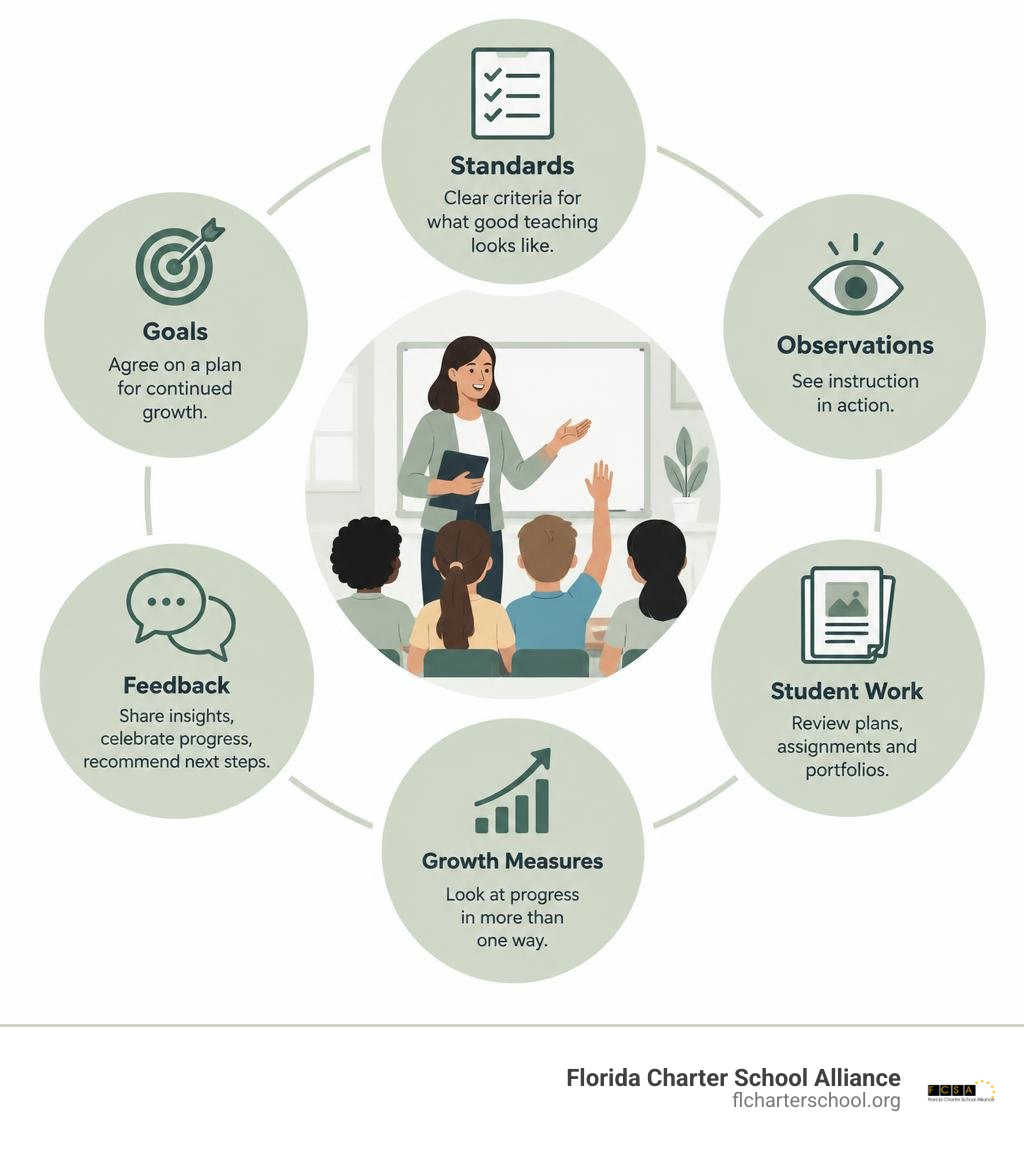
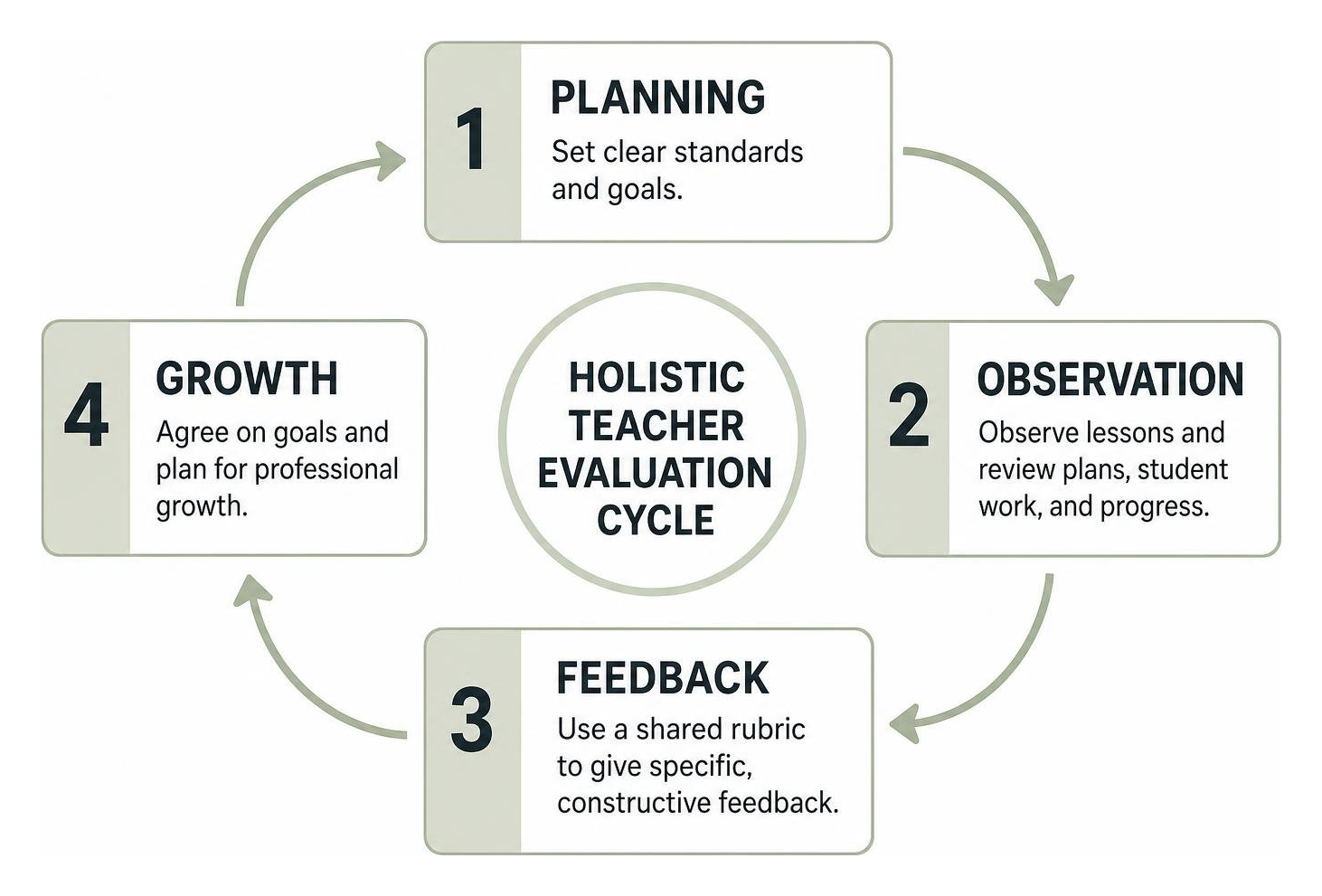
To evaluate a teacher’s performance, start with clear standards. Observe lessons, review plans and student work, and measure student progress in more than one way. Use a shared rubric to weigh the evidence, then give the teacher specific feedback and agree on a goal for growth.
For an arts teacher, a student portfolio may show progress that a test score cannot. Looking at several kinds of evidence helps public charter schools support strong instruction while staying accountable for student achievement.
I’m Lynn Norman-Teck, Executive Director of the Florida Charter School Alliance. My work in public charter school development, policy, and community engagement shapes my approach to evaluating a teacher’s performance: focus on fair evidence, useful feedback, and what students need next.
The Foundations and Standards of Teacher Performance Evaluation Systems
At the Florida Charter School Alliance, we believe that academic excellence begins with high-quality, student-centered learning. A strong Teacher Performance Evaluation System (TPES) does not exist to catch teachers off guard. Instead, it serves as a roadmap for instructional quality, educational innovation, and meaningful professional development.
Historically, traditional evaluations relied on a single unannounced walkthrough accompanied by a quick checklist. Today, comprehensive evaluation frameworks balance instructional accountability with developmental coaching. To achieve this, leaders reference statewide teacher performance evaluation system guidelines to establish clear indicators of effective pedagogy. Selecting the right platform is critical, and administrators often explore the ultimate guide to choosing the best teacher evaluation tool to ensure their observation software matches their school mission and accountability goals.
The Eight Core Performance Standards
A reliable evaluation system relies on eight distinct, interrelated performance standards that capture the true complexity of classroom teaching:
- Professional Knowledge: The educator demonstrates an understanding of the curriculum, subject matter, and pedagogical principles, integrating current instructional best practices.
- Instructional Planning: The teacher plans rigorous, aligned units and daily lessons that accommodate diverse student learning needs.
- Instructional Delivery: The instructor utilizes engaging, research-backed instructional strategies to facilitate active learning and critical thinking.
- Assessment of and for Learning: The teacher systematically gathers, analyzes, and uses formative and summative data to guide instruction and provide actionable feedback.
- Positive Learning Environment: The educator fosters a well-managed, safe, and academically challenging classroom culture rooted in mutual respect.
- Culturally Responsive Teaching and Equitable Practices: The instructor embraces student diversity, ensuring equitable access to rigorous learning opportunities.
- Professionalism: The educator adheres to ethical standards, collaborates with colleagues, communicates effectively with families, and pursues ongoing professional growth.
- Student Academic Progress: The teacher’s instructional practice produces measurable academic growth for all assigned students across the academic year.
Ensuring Fairness, Reliability, and School-Wide Alignment
Public charter schools thrive on flexibility and innovation, making fair and reliable evaluation systems vital. Ensuring inter-rater reliability among administrators is essential. When two evaluators observe the same classroom, their rubric scoring should closely align.
To prevent evaluation bias, school leaders must engage in routine calibration exercises. Common cognitive traps include:
- Halo/Horn Effect: Letting a single positive or negative trait skew the evaluation of every performance standard.
- Recency Bias: Focusing solely on the most recent week of teaching rather than evaluating performance across the entire academic term.
- Observer Fatigue: Rushing through afternoon observations or grading leniently due to administrative overload.
Mitigating these risks ensures that evaluations align directly with school-wide strategic plans, foster educational opportunity, and protect teacher rights.
Multi-Source Evidence Collection and Documentation Logs
Evaluating a teacher accurately requires triangulating multiple sources of qualitative and quantitative evidence. Looking at a single lesson provides an incomplete picture. As outlined in comprehensive district educator effectiveness guidebooks, evaluating educator impact demands multi-source data collection.
A balanced evaluation portfolio combines direct observations, documented artifacts, and community feedback. This multi-source model supports instructional growth while building a high-quality teacher and leadership pipeline through strategic partnerships.

Structured Observation Protocols for Evaluating a Teacher’s Performance
Classroom observations serve as the cornerstone of instructional assessment. Structured observation cycles include:
- Pre-Observation Conferences: Held 1 to 7 days before an announced observation, allowing the teacher to outline lesson objectives, student demographics, and planned differentiation.
- Formal Observations: Must span at least 30 consecutive minutes of instructional time to assess the full flow of lesson opening, direct instruction, guided practice, and closure.
- Informal Walkthroughs: Frequent, unannounced 10-to-15-minute visits designed to capture typical day-to-day instructional habits and classroom management.
- Post-Observation Conferences: Conducted within 5 to 10 working days following the observation, giving educators timely feedback and clear growth targets.
Documentation Logs, Artifacts, and Student Perception Surveys
Many essential teaching responsibilities occur outside administrative observation windows. Documentation logs bridge this gap by housing authentic artifacts, including:
- Annotated lesson plans showing adjustments for exceptional student education.
- Formative assessment trackers and student work samples demonstrating mastery.
- Parent communication logs reinforcing family empowerment and collaboration.
- Specialized scaffolds, such as targeted accommodations for multilingual learners developed using the ultimate guide to ELL training for teachers.
Student perception surveys provide additional insight into classroom climate and instructional clarity across grades 1–12. Standardized survey guidelines suggest:
- Grades 1–5: Administering age-appropriate survey versions to the whole class during the second nine weeks.
- Grades 6–12: Administering surveys across at least two representative course sections to ensure a balanced sample of student perspectives.
Measuring Student Academic Progress and Goal Setting
Standard 8 focuses on student academic progress. In public charter schools, expanding parental choice relies on demonstrating tangible student achievement. However, state assessment data is not always immediately available for every classroom.
Statewide data indicates that fewer than 30% of public school teachers instruct courses with direct state assessment growth measures. Consequently, robust evaluation frameworks use multiple alternative metrics to measure student growth fairly.
| Evaluation Component | Probationary Teachers | Continuing Contract Teachers | Recommended Timeline |
|---|---|---|---|
| Formal Observations | Minimum 3 observations (30+ min each) | Minimum 1 observation (30+ min) | Obs 1 & 2 in Semester 1; Obs 3 by March 1 |
| Informal Walkthroughs | 4 to 6 walkthroughs annually | 2 to 4 walkthroughs annually | Ongoing throughout school year |
| Documentation Log | Comprehensive artifact submission | Targeted artifact submission | Mid-year check; final review in Spring |
| Student Growth Targets | Baseline & Student Learning Objective | Baseline & Student Learning Objective | Goals set by Oct; evaluated by May |
Student Learning Objectives and Alternative Growth Measures
For non-tested grades and subjects—such as kindergarten, visual arts, physical education, and high school electives—evaluators use Student Learning Objectives (SLOs).
An SLO establishes a rigorous, measurable academic growth goal for a defined interval of instruction. Teachers establish baseline proficiency through diagnostic assessments, pre-tests, or historical performance metrics. Evaluators then review growth targets that account for student starting points, demographic factors, and individual learning plans. When combined with rubric-scored student portfolios, SLOs provide an authentic evaluation of student learning gains.
The Goal-Setting Process and Self-Evaluation
At the start of each school year, educators complete a structured self-evaluation against the eight core performance standards. Reflecting on instructional strengths and areas for growth allows teachers to draft SMART (Specific, Measurable, Achievable, Realistic, and Time-bound) student achievement goals.
Mid-year check-ins allow teachers and administrators to review interim benchmark data and refine instructional delivery. When educators identify pedagogical areas needing development, administrators connect them with a quick start guide to professional learning resources to access targeted professional coursework and instructional coaching.
Core Frameworks for Evaluating a Teacher’s Performance Fairly
To ensure clarity and transparency, comprehensive evaluation systems synthesize observation scores, documentation logs, and student growth measures into four descriptive performance rating tiers:
- Highly Effective: Consistently exceeds performance standards, serves as an instructional leader, and demonstrates exceptional student growth.
- Effective: Consistently meets performance standards, demonstrates strong instructional practices, and achieves expected student academic progress.
- Approaching Effective (or Developing): Inconsistently meets standards or requires targeted support in specific pedagogical areas.
- Ineffective: Consistently fails to meet performance standards, requiring immediate remediation.

Interim Assessments and Summative Evaluation Cycles
Evaluation operates on a continuous, multi-tiered timeline:
- Probationary Teachers: New or non-tenured educators receive intensive support, including a minimum of three formal observations per year (two conducted within the first semester and the third completed by March 1), complemented by mid-year interim evaluations.
- Continuing Contract Teachers: Experienced educators participate in annual evaluation cycles comprising at least one comprehensive formal observation, regular walkthroughs, and an end-of-year summative evaluation conference.
Summative evaluations compile all observation ratings, documentation artifacts, survey results, and student growth outcomes into an overall composite score.
Remediation Steps and Support Dialogues for Evaluating a Teacher’s Performance
When an educator struggles with instructional delivery or classroom management, evaluation systems must offer a clear, supportive path forward:
- Support Dialogue: An informal, targeted coaching process initiated when minor performance concerns arise. Completed within a focused four-to-six-week period, it pairs the teacher with an instructional coach to address specific pedagogical challenges.
- Performance Improvement Plan (PIP): A formal corrective plan implemented if a teacher receives an Approaching Effective rating on two or more standards or an Ineffective rating on any single standard. The PIP outlines clear performance targets, required professional learning, administrative coaching supports, and a 90-calendar-day timeline to demonstrate marked instructional improvement.
Frequently Asked Questions About Teacher Evaluations
How often should probationary and continuing contract teachers be observed?
Probationary teachers must be formally observed at least three times per academic year, with at least two observations completed before the end of the first semester and the final observation completed by March 1. Continuing contract teachers must receive a minimum of one formal 30-minute observation annually, supported by informal administrative walkthroughs.
What triggers a Performance Improvement Plan (PIP)?
A formal Performance Improvement Plan is triggered when a teacher receives an evaluation rating of Approaching Effective on two or more performance standards, or an Ineffective rating on one or more standards. The educator is given a structured remediation plan and a specific window (typically 90 calendar days) to correct identified deficiencies.
How is student academic progress measured if standardized test scores are not available?
When state standardized assessment data is unavailable, schools measure student academic progress using Student Learning Objectives (SLOs), district-approved benchmark tests, diagnostic pre- and post-assessments, and rubric-scored portfolio assessments. These multiple measures provide verified evidence of student growth.
Conclusion
A high-performing public charter school relies on continuous educator development, clear accountability, and student-centered instructional leadership. By using structured observation protocols, maintaining documentation logs, and setting meaningful student growth goals, school leaders create a culture of transparency and academic excellence.
At the Florida Charter School Alliance, we champion educational innovation and parental choice across Florida. We encourage school administrators and charter governing boards to implement teacher performance evaluation rubrics that work to support educators and elevate student achievement across every classroom.