
Core Frameworks and Components of an Effective Teacher Evaluation Tool
An effective teacher evaluation tool must balance clear quantitative indicators with rich, qualitative evidence. While end-of-year testing data provides a snapshot of achievement, daily instructional quality is captured through structured rubric indicators and ongoing walkthrough observations.
When building or selecting an evaluation platform for public charter schools, school leaders must prioritize systems that convert raw classroom observations into formative feedback and actionable coaching. A well-designed tool breaks down complex pedagogy into visible classroom behaviors, making professional expectations clear across four core pillars:
- Structured Observation Rubrics: Providing standardized language for observing lesson planning, classroom climate, pedagogical execution, and professional conduct.
- Frequent Walkthroughs: Facilitating frequent, shorter classroom visits that capture authentic teaching moments rather than staged annual performances.
- Formative Feedback Loops: Ensuring that evaluators deliver timely, constructive notes that teachers can implement immediately in their next lesson.
- Targeted Professional Coaching: Linking evaluation results directly to tailored professional growth activities, coaching strategies, and learning modules.
Popular Observation Frameworks: Marzano, Danielson, and T-TESS
Selecting the right evaluation framework establishes a shared instructional language across your school community. Three of the most prominent frameworks used nationwide include:
- The Danielson Framework for Teaching (FFT): Organized around four primary domains (Planning and Preparation, Classroom Environment, Instruction, and Professional Responsibilities), the Danielson framework offers a comprehensive approach to evaluating professional practice across diverse grade levels.
- The Marzano Teacher Evaluation Model: Developed by Dr. Robert Marzano, this framework emphasizes specific, research-validated instructional strategies. Digital platforms like iObservation are built around the Marzano framework to streamline observation cycles, self-assessments, and professional learning communities.
- Texas Teacher Evaluation and Support System (T-TESS): Emphasizing continuous growth, the Texas Teacher Evaluation and Support System focuses heavily on pre-conferences, post-conferences, ongoing dialogue, and Student Learning Objectives (SLOs) to foster reflective practice.
For Florida charter schools, frameworks must align with state expectations. Charter schools benefit from the operational flexibility to adapt research-based frameworks like Marzano or Danielson, ensuring compliance while driving instructional innovation. To review specific Florida standards, consult the official Overview of Florida’s Teacher Evaluation System.
Evaluating Specialized Educators with a Flexible Teacher Evaluation Tool
A common failure of rigid evaluation models is treating every educator like a traditional general education teacher. Special education instructors, English Language Learner (ELL) specialists, media specialists, and arts educators require customized evaluation rubrics that accurately reflect their unique instructional environments.
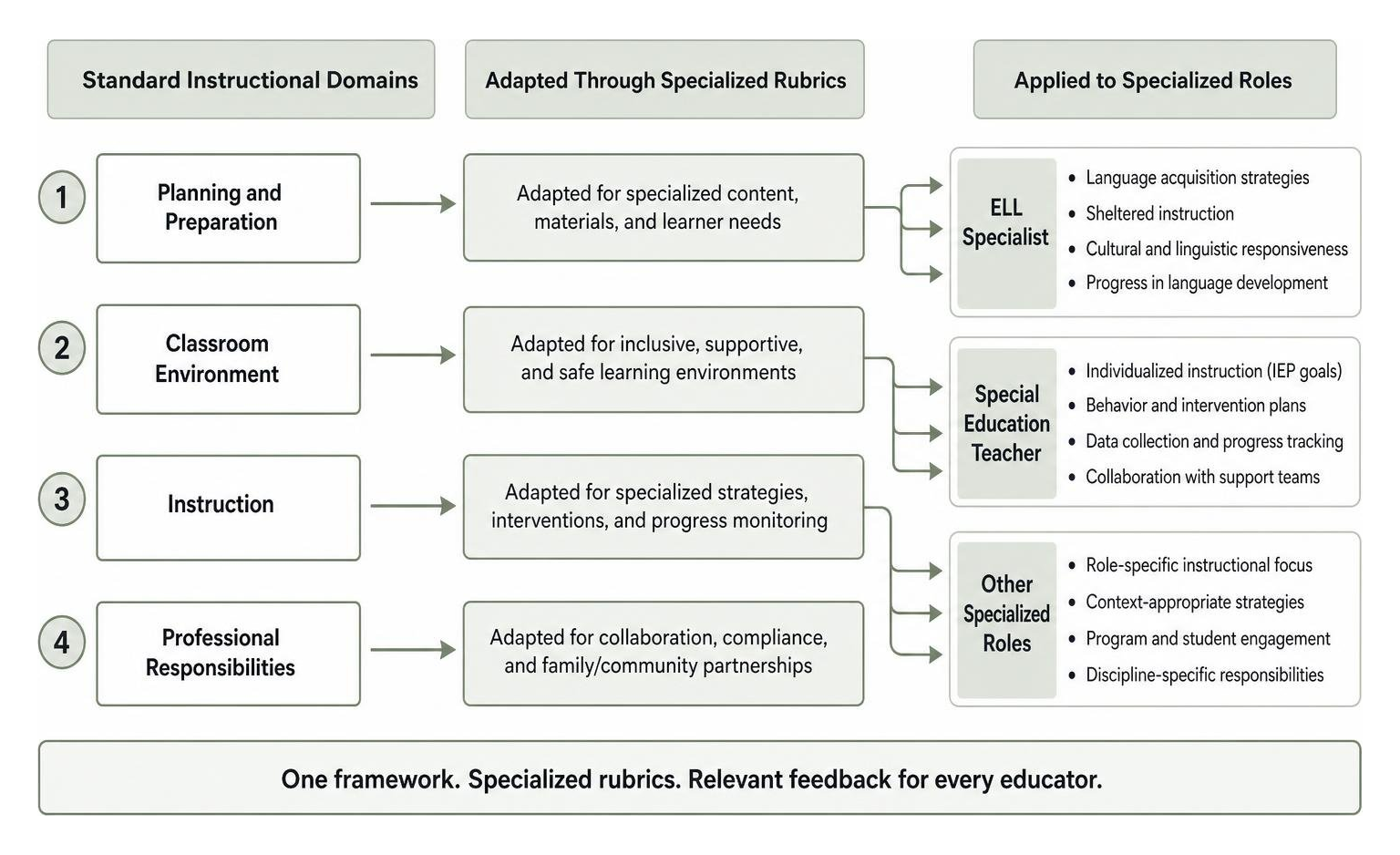
When evaluating specialized personnel, a modern evaluation system should offer flexible rubric templates. For example, when evaluating educators working under full-year staffing permits or special education approvals, administrators need evaluation mechanisms that measure individualized instruction, behavior plan management, and small-group language acquisition strategies. Providing role-specific rubrics ensures all educators receive relevant, supportive feedback tailored to their unique learning environments.
Balancing Accountability, Student Growth, and Coaching
Public charter schools are inherently built on accountability and innovation. Because charter schools offer Florida families an educational choice, maintaining high standards of instructional quality is central to our mission. However, high accountability does not mean evaluations must feel punitive.
The most effective evaluation systems merge accountability with a supportive coaching framework. When evaluation platforms are intentionally decoupled from high-stakes anxiety and reoriented toward continuous professional learning, they cultivate a workplace culture built on trust and professional growth.
| High-Stakes Compliance Model | Growth-Focused Coaching Model |
|---|---|
| Focuses on end-of-year rating | Prioritizes continuous, ongoing feedback |
| Heavy reliance on single high-stakes observations | Relies on frequent, informal walkthroughs |
| One-size-fits-all general rubrics | Role-specific, customized instructional rubrics |
| Evaluation data stored in isolated personnel files | Data directly tied to professional development tools |
| Top-down administrative scoring | Collaborative dialogue and self-assessment |
Integrating Student Growth Metrics and Achievement Data
Combining qualitative observation data with quantitative student performance yields a well-rounded picture of educator effectiveness. Across state systems, student growth measures are integrated into composite scores or overall performance categories. For instance, evaluation frameworks like Tennessee’s TEAM process combine qualitative observations with growth and achievement metrics to calculate a composite score ranging from 100 to 500, translating into a Level of Overall Effectiveness (LOE) scale from 1 to 5:
To establish reliable student growth measures, schools utilize progress monitoring systems and Student Learning Objectives (SLOs) to track growth across the school year. Utilizing dynamic progress monitoring allows educators to make data-driven decisions that immediately impact instruction. For additional insights on implementing progress monitoring in Florida, read our guide on Helpful Tips On Floridas New Progress Monitoring System.
Leveraging AI and Video Technology in a Modern Teacher Evaluation Tool
The integration of artificial intelligence and digital video tools has modernized classroom observations. Platforms like Vector Evaluations+, Trellis, and EvaluWise leverage technological advances to streamline administrative tasks and improve observation accuracy:
- Timestamped Video Feedback: Video observations allow teachers and administrators to review classroom lessons together using a shared, objective record. Evaluators can insert timestamped comments directly onto specific moments in the recording, transforming vague recollections into concrete discussions.
- AI-Assisted Note Organization: AI features built into modern evaluation tools help synthesize observer notes, organize evidence into framework domains, and draft structured feedback reports. This reduces administrative typing time and lets leaders focus on classroom dialogue.
- Privacy and FERPA Compliance: Secure platforms protect teacher trust by anonymizing data sent to processing tools and enforcing strict role-based access. Platforms like Trellis, offering competitive options like site plans at $249 per year with unlimited observations, maintain complete FERPA compliance while ensuring coaching records remain separate from formal HR personnel files.
By using digital evaluation software to generate clear administrative reports, school leaders can easily convert instructional observations into actionable coaching. Learn more about synthesizing observation metrics in our article on Creating Insights To Actionable Data.
State Regulations, Compliance, and Implementation Best Practices
While digital evaluation platforms offer essential software functionality, they must operate strictly within state legislative guidelines. Administrators must verify that their chosen observation software complies with state reporting mandates and administrative laws.

Navigating State Guidelines in Florida, Michigan, and Tennessee
State policies regarding teacher evaluations vary across the nation:
- Florida: Under Florida law, public school districts and charter schools evaluate instructional personnel using performance evaluation systems aligned with professional state standards, incorporating both observation criteria and student performance data. Detailed state guidelines are outlined under the Florida Performance Evaluation Standards and local Instructional Evaluation Guidance.
- Michigan: Enacted through Public Act 173 and Public Act 170, Michigan mandates specific public posting requirements for district evaluation tools. The Michigan Department of Education recommends using one of five state-approved observation tools for observing classroom instruction, including the 5 Dimensions of Teaching and Learning, Danielson’s Framework, Marzano Models, and The Thoughtful Classroom.
- Tennessee: Tennessee utilizes the TEAM model along with specialized administrative support tools like observation pacing calculators. These pacing guides help administrators schedule walkthroughs efficiently throughout the academic year to complete required evaluations before score reporting deadlines.
Overcoming District Implementation Challenges
Implementing a new teacher evaluation tool across a school or charter network presents logistical challenges. Common obstacles include administrative time constraints, observer reliability concerns, and staff onboarding hurdles.
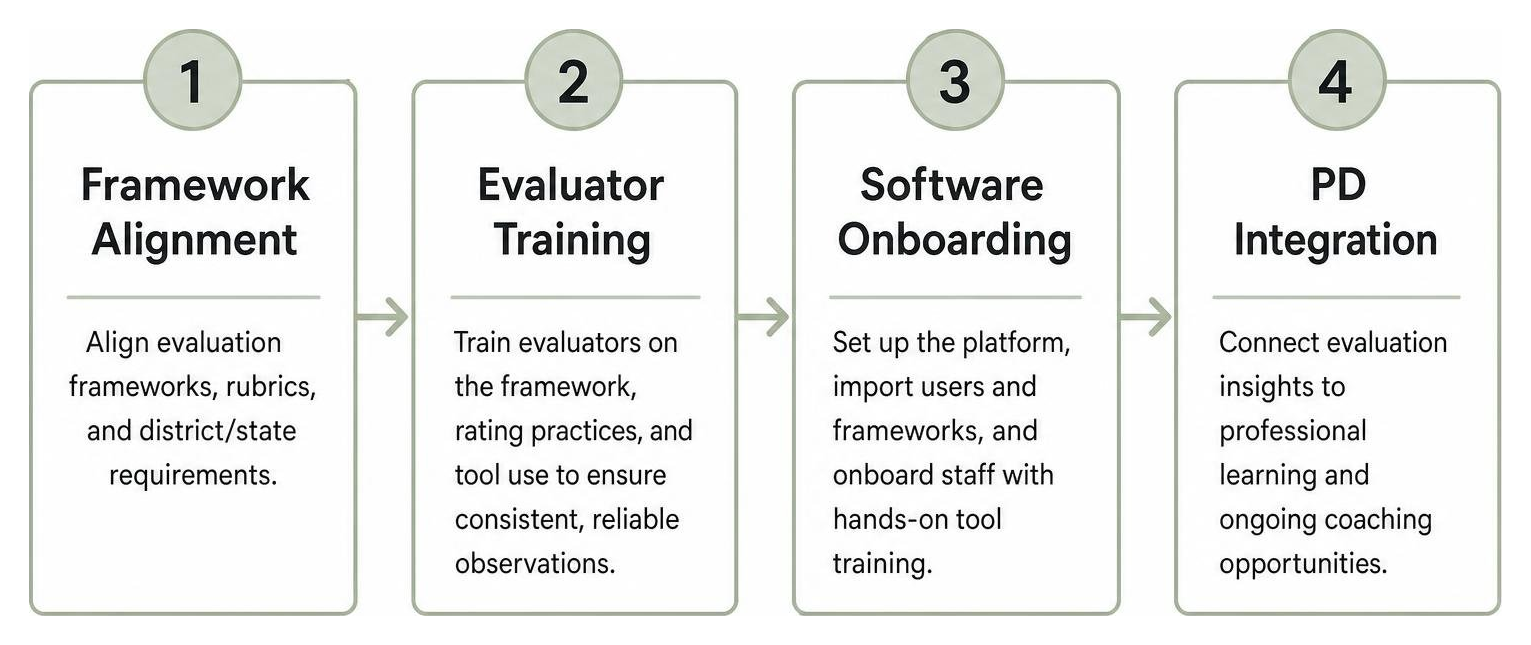
To overcome implementation challenges, charter school administrators should consider the following strategies:
- Ensure Evaluator Reliability: Conduct regular inter-rater agreement training sessions to ensure all administrators score classroom evidence consistently against rubric standards.
- Pace Observations Strategically: Utilize observation pacing calculators to distribute classroom visits across both semesters, avoiding end-of-year administrative bottlenecks.
- Link Evaluation to Professional Learning: Connect observation findings directly to professional development resources. For example, platforms like the NEE Data Tool include an EdHub Library featuring over 500 targeted professional development learning resources, allowing leaders to assign relevant learning modules immediately following an observation.
- Foster a Culture of Collaboration: Share success stories and real-world results from across your school community to demonstrate how constructive feedback directly elevates teacher practice and student learning.
Discover how real-world charter schools foster successful educational models by visiting Whats Working Suned High Charter School and learn how to build an integrated growth platform through our guide on the Professional Learning System.
Frequently Asked Questions About Teacher Evaluation Tools
What are the key components of an effective teacher evaluation system?
An effective teacher evaluation system combines structured observation rubrics (such as Danielson or Marzano), frequent informal walkthroughs, timely formative feedback, student growth metrics, and direct links to targeted professional development.
How do video observations and AI-assisted tools enhance evaluation accuracy?
Video observations provide an objective, rewatchable record of classroom instruction, allowing evaluators and teachers to analyze timestamped evidence together. AI-assisted tools automate administrative note-taking, organize observations by framework domains, and reduce administrative paperwork so evaluators can spend more time coaching.
How do states balance accountability with teacher professional development?
States achieve balance by pairing summative evaluation ratings with formative coaching protocols. Modern evaluation frameworks emphasize continuous walkthroughs, pre- and post-observation conferences, self-assessments, and targeted professional development libraries that treat evaluation as a driver of teacher growth rather than a simple compliance check.
Empowering Educator Growth with the Right Evaluation Framework
Choosing the ideal teacher evaluation tool is one of the most critical decisions a school leadership team can make. When administrators are equipped with research-aligned rubrics, efficient digital software, and clear feedback loops, classroom evaluation transforms from a stress-inducing administrative chore into a catalyst for professional excellence.
At the Florida Charter School Alliance, we remain dedicated to advancing the charter school movement by helping school leaders access the strategies, advocacy, and tools required to foster educational innovation. Public charter schools play a vital role in Florida’s educational landscape, delivering high-quality, accountable, and student-centered alternatives that expand parental choice and drive student achievement. By investing in modern, growth-focused evaluation platforms, charter schools reinforce their commitment to instructional quality and family satisfaction.
Ready to transform your school’s instructional evaluation process? Explore our comprehensive resources and discover how our state-approved Florida Charter School Evaluation Tools can help your school elevate teaching quality, support educator growth, and power student success.