Why Professional Learning Is the Foundation of Every Great School
Professional learning is the ongoing, job-embedded process through which educators continuously grow their skills, refine their practice, and ultimately improve student outcomes — and it looks very different from the one-day workshops most teachers have sat through.
Here is a quick look at what professional learning actually means:
| Feature | Professional Learning |
|---|---|
| Format | Ongoing, collaborative, embedded in daily work |
| Focus | Real classroom needs and student outcomes |
| Who drives it | Educators, with support from leaders |
| Federal standard | Sustained, intensive, data-driven (ESSA definition) |
| Goal | Lasting change in practice, not just awareness |
For educators in public charter schools — where every resource counts and innovation is a core value — the quality of professional learning can make or break a school’s mission. Charter schools have a unique opportunity to design learning systems that are flexible, personalized, and directly tied to student achievement in ways that traditional district models often cannot move as quickly to achieve.
Yet too many schools still rely on disconnected training events that leave teachers frustrated and students underserved. Research is clear: sustained, collaborative, curriculum-aligned professional learning is what actually moves the needle on teacher effectiveness and student success.
I’m Lynn Norman-Teck, Executive Director of the Florida Charter School Alliance, and my work supporting high-quality public charter schools across Florida has shown me how meaningful professional learning transforms both educators and the students they serve. In this guide, we’ll walk through practical strategies, tools, and resources to help your school build a professional learning system that sticks.
Shifting from Traditional PD to Active Professional Learning
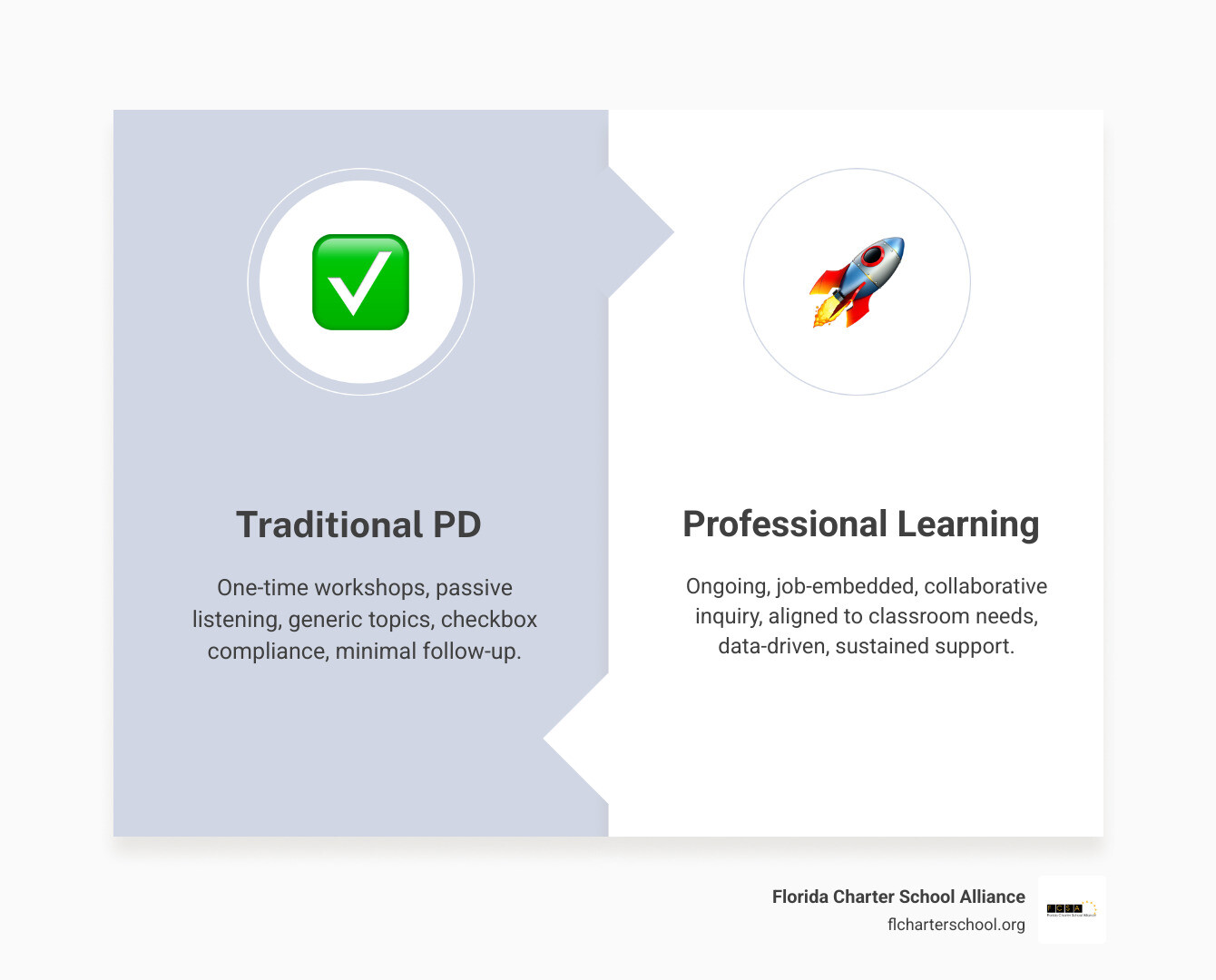
To build a school culture centered on academic excellence, we have to rethink how we support the adults in the building. For decades, “professional development” has been treated like a chore—a mandatory box to check, usually accompanied by lukewarm coffee and a presenter reading directly from a slide deck. True professional learning, however, is an active, ongoing behavior that respects teacher variability and aligns with how adults actually learn.
According to the principles of andragogy (adult learning theory), adults learn best when they have a say in their development, when the content is immediately relevant to their daily work, and when they can collaborate with their peers to solve real-world problems. When we treat educators as active participants rather than passive recipients, we build genuine ownership over their professional growth. To explore this shift further, the resource From Professional Development to Professional Learning outlines how intentionally designed support structures transition schools from one-off events to sustainable daily practice.
The Core Distinction: Event vs. Behavior
The difference between traditional professional development (PD) and professional learning comes down to the difference between an event and a behavior.
- Professional Development (The Event): This is typically a noun. It is a sit-and-get workshop scheduled by an administrator, delivered by an outside consultant, and completed in a single afternoon. Once the seminar ends, teachers return to their classrooms, and the binder of resources is often filed away, never to be opened again.
- Professional Learning (The Behavior): This is a verb. It is an iterative, daily cycle of inquiry, application, reflection, and adjustment. It is embedded in the school day through collaborative planning, peer observations, and data analysis.
When we shift our focus to ongoing learning behaviors, we create sustainable educator growth. Instead of trying to “fix” teachers through isolated training sessions, we establish a collaborative school culture where refining classroom practice is a natural part of the workday. This continuous cycle directly translates to higher student achievement and more vibrant classrooms.
Aligning with Standards and Policy Frameworks
This shift isn’t just a philosophical preference; it is increasingly reinforced by state and federal policy frameworks. Under the federal Every Student Succeeds Act (ESSA), effective professional development is legally defined as activities that are sustained, intensive, collaborative, job-embedded, data-driven, and classroom-focused. Crucially, the ESSA definition explicitly excludes short-term, stand-alone workshops that do not connect to a broader, long-term strategy.
Organizations like Learning Forward have championed these standards for decades, emphasizing that high-quality professional learning must align with systemic goals, high-quality instructional materials, and robust educator support systems. Even on an international scale, educational authorities recognize the necessity of structured, mandatory growth periods. For instance, the policy guidelines outlined in the Mandatory Professional Activity Days for the 2026-27 School Year | Education in Ontario: policy and program direction | ontario.ca demonstrate how modern school systems are aligning mandatory learning days with critical, emerging priorities—such as digital safety, artificial intelligence, and special education standards—rather than leaving professional growth to chance.
For Florida public charter schools, aligning our school-based training with these rigorous standards ensures both regulatory compliance and a measurable return on our instructional investments.
Designing High-Impact Systems for Educator Growth
To build a high-quality education system that expands educational opportunity, we must design professional learning systems that are responsive, collaborative, and directly embedded in the daily life of our schools. When educators are supported by robust, flexible systems, their capacity to foster student-centered learning grows exponentially.
Fostering Educator Agency and Choice
Just as we advocate for parental choice to empower families to select the best educational environment for their children, we must also advocate for educator agency within our schools. Teachers are highly trained professionals with diverse backgrounds, strengths, and professional needs. Offering them voice and choice in their professional pathways builds a sense of ownership and professional dignity.
When teachers can self-select learning modules that address the specific challenges they face in their classrooms, they are far more likely to implement new strategies with fidelity. At the Florida Charter School Alliance, we help schools design these personalized pathways. Through FCSA Member Perks: Training That Supports Your Vision & Mission, we provide our member schools with access to customized training resources that align with each school’s unique mission, allowing school leaders to foster teacher agency while maintaining high standards of accountability.
Curriculum-Based Professional Learning and Student Achievement
One of the most effective levers for improving student outcomes is the pairing of high-quality instructional materials (HQIM) with tightly aligned, curriculum-based professional learning (CBPL). Research consistently demonstrates that adopting a rigorous curriculum is not enough to drive academic success; teachers must be supported in learning how to teach that specific curriculum effectively.
As highlighted by Learning Forward in Curriculum Based Professional Learning To Advance Student Learning | Learning Forward, launching a new curriculum without ongoing, aligned professional learning often leads to instructional gaps and unauthorized classroom modifications. When teachers participate in active, inquiry-based learning experiences—essentially experiencing the curriculum as learners themselves—they gain the deep content knowledge and pedagogical skills needed to deliver lessons with integrity.
To support this critical alignment in Florida, we host specialized events, such as Events: The Science of Reading and Math Professional Learning Workshops, to provide educators with practical, evidence-based strategies to implement core curricula and drive student achievement.
Leveraging Technology for Flexible Professional Learning
In July 2026, technology plays a vital role in making professional learning accessible, flexible, and highly personalized. Online platforms allow busy educators to engage in self-paced learning, microlearning modules (often completed in 15 minutes or less), and collaborative virtual communities without disrupting their classroom schedules.
Top-tier academic institutions are leading the way in developing these flexible, research-backed courses. For example, the Professional Learning Extension Programs | Stanford Graduate School of Education (PLEX) offers cutting-edge courses on critical topics like AI literacy for educators, integrated English language development, and advanced mathematical mindsets.
To bring this level of high-quality, flexible training directly to Florida’s charter school classrooms, we have formed strategic partnerships to expand access. A prime example of this is how the Noble Education Initiative & FCSA Join Forces to Provide Professional Development Courses for Educators, giving teachers across the state access to self-paced, state-approved courses that seamlessly translate into inservice points for recertification.
Key Structures for Sustaining Classroom Impact

For professional learning to have a lasting impact on school success, it must be supported by relational structures that foster collaboration, trust, and continuous improvement over time.
Collaborative Models: Coaching, PLCs, and Learning Walks
The most successful public charter schools rely on collaborative, non-evaluative structures to sustain instructional growth. These models move teaching out of isolated silos and into the public sphere of collaborative inquiry:
- Instructional Coaching: Rather than acting as evaluators, instructional coaches work as collaborative partners with teachers. They co-create goals, conduct non-threatening classroom observations, and provide actionable feedback to help teachers refine their practice.
- Professional Learning Communities (PLCs): In a high-functioning PLC, teachers meet regularly to analyze student work, review assessment data, and share successful teaching strategies. This collective focus on student-centered learning builds collective efficacy—the shared belief that, through their collective efforts, educators can overcome challenges and help all students achieve academic excellence.
- Learning Walks: These are low-stakes, highly collaborative visits where teachers observe their peers in action. Focused on specific instructional strategies rather than teacher performance, learning walks allow educators to gather practical ideas and reflect on their own classroom routines.
Building this collaborative capacity requires leadership development at all levels. Programs like the Leading professional learning programme | Programmes | Professional learning programmes, webinars and events | Professional Learning | Education Scotland illustrate how empowering non-formal leaders—such as department heads and classroom teachers—can cultivate a vibrant, bottom-up culture of professional growth.
In Florida, we support this leadership journey through structured programs like our Fellowship Program Offers In-Depth Coverage of Standards and Practical Real-World Guidance, which prepares school leaders to design and sustain collaborative learning environments.
Tailoring Growth for Diverse Educator Roles
An effective school-wide professional learning system must address the unique needs of every educator role in the building, including teachers, school leaders, and paraprofessionals. For instance, paraprofessionals require targeted training pathways to master their roles and meet federal requirements, while teachers need deep pedagogical support.
As noted by international professional development hubs like the Strengthen teaching practice through professional learning and development – Professional Learning & Development portal, educational leadership training is equally critical to ensure that school principals have the skills, confidence, and evidence-based strategies to manage modern schools effectively.
To cultivate this leadership pipeline within the Florida charter school sector, we created the School Leaders Fellowship. This comprehensive program provides aspiring and new charter school leaders with the mentorship, resources, and policy insights needed to run high-performing, accountable public charter schools. To learn more about this impactful initiative, explore our dedicated resources:
- Get the foundational details on the program via the School Leaders Fellowship Information page.
- Access our curated tools and guides in the School Leaders Fellowship Resource Library.
- Stay updated on our growth, such as when a New Cohort Selected for School Leaders Fellowship Program is announced.
- Celebrate our alumni milestones, as highlighted in Ready to Lead: School Leaders Fellowship Graduates 3rd Cohort.
- Read about how our ongoing efforts keep Leadership Training for Charter Schools Going Strong across the state.
Measuring Impact on Teacher Retention and Student Success
To ensure our professional learning systems are meeting the needs of both educators and students, we must continuously evaluate their impact using objective data. Research shows that when teachers receive high-quality, supportive professional learning, school success and teacher retention rates rise significantly. Educators who feel supported and empowered are far less likely to experience burnout.
Data from major educational platforms in 2024 highlights the massive scale of modern educator support systems, which successfully managed:
- 657,000 evaluations to connect classroom observations with professional growth,
- Over 8 million professional development courses taken to expand instructional skills,
- 293,000 observations and walkthroughs to provide real-time, actionable feedback.
By integrating evaluations, coaching, and professional learning into a single, unified workflow, schools can seamlessly turn feedback into personalized growth plans.
To understand the difference this integrated approach makes, consider how we evaluate professional learning compared to traditional models:
| Traditional PD Metrics | Modern Professional Learning Outcomes |
|---|---|
| Hours logged in a database | Direct changes in classroom practice and instructional delivery |
| Attendance sheets and sign-ins | Increased teacher retention and reduced educator burnout |
| Subjective “satisfaction” surveys | Measurable growth in student achievement and academic success |
| Disconnected, one-day compliance sessions | Ongoing collaborative inquiry tied to high-quality materials |
Frequently Asked Questions
How does professional learning differ from traditional professional development?
Traditional professional development is typically a passive, one-day event “done to” teachers (such as a generic lecture or compliance workshop), whereas professional learning is an ongoing, collaborative behavior. It involves an iterative cycle of planning, learning, applying, reflecting, and improving that is embedded directly into the school day and focused on real classroom needs.
What is curriculum-based professional learning?
Curriculum-based professional learning (CBPL) is professional development that is directly aligned with a school’s adopted high-quality instructional materials. Rather than focusing on generic teaching strategies, CBPL helps teachers master the specific content, sequence, and pedagogical approaches required to implement their core curriculum with integrity, directly impacting student achievement.
How can school leaders support educator agency in professional learning?
School leaders can support educator agency by offering voice and choice in professional development pathways, scheduling dedicated time during the school week for collaborative planning and peer coaching, and moving away from top-down compliance checklists toward trust-building, non-evaluative feedback loops.
Conclusion
At the Florida Charter School Alliance, we believe that every child in Florida deserves access to a high-quality education that prepares them for a bright future. Public charter schools are uniquely positioned to deliver on this promise by combining rigorous accountability with educational innovation. However, the success of any charter school ultimately rests on the strength and continuous growth of its educators.
By investing in robust, collaborative, and curriculum-aligned professional learning, we empower our teachers, support our school leaders, and directly accelerate student achievement. We invite you to partner with us to build a stronger educational landscape for Florida’s families. To discover our comprehensive tools, training opportunities, and advocacy resources, explore the Professional Learning System at the Florida Charter School Alliance. Let’s work together to make academic excellence a daily reality in every classroom.