
7 Steps to Start a Charter School in Florida
To start a charter school in Florida, founding teams must form a non-profit governing board, select an authorizing pathway (a local school district, state university/college, or the Florida Charter School Review Commission), submit a Letter of Intent, and design a compliant academic curriculum and 5-year budget. Applicants then submit the official state application (Form IEPC-M1), complete a sponsor capacity interview, and negotiate the standard charter contract while securing approved facilities. By following our step-by-step guide to starting a Florida charter school, your team can navigate statutory requirements smoothly.
Step 1: Establish Governance and Non-Profit Status to Start a Charter School in Florida
Every successful charter school begins with a dedicated, visionary founding governing board. Under Florida law, charter schools must be organized as non-profit legal entities.
- Recruit a Balanced Board: Assemble community leaders, educators, business professionals, and parents who bring diverse expertise in finance, curriculum, law, and local community outreach.
- Incorporate as a Florida Non-Profit: File your Articles of Incorporation with the Florida Department of State Division of Corporations (Sunbiz) and obtain federal 501(c)(3) tax-exempt status.
- Commit to Transparency: Florida charter school boards operate under Florida’s Government-in-the-Sunshine Laws (Chapter 286, F.S.) and Public Records Law (Chapter 119, F.S.). Board meetings must be publicly noticed, open to the public, and documented with accessible minutes.
- Complete Background Checks and Assurances: Board members must undergo Level 2 background screening (fingerprinting) and complete individual Board Member Information Forms along with a signed Statement of Assurances confirming their commitment to legal and ethical governance.
Step 2: Choose Authorizer Pathway and Submit Letter of Intent
Florida offers multiple authorizing pathways for charter applicants:
- Local School Districts: Florida’s 69 school districts serve as the primary sponsors for public charter schools within their geographic boundaries.
- State Universities and Colleges: State universities may authorize developmental research (lab) schools, and Florida College System institutions (such as Tallahassee Community College) can sponsor charters focusing on secondary-to-postsecondary pathways.
- State-Level Pathway: Applicants may also submit their proposal to the Florida Charter School Review Commission, which evaluates applications and coordinates with local districts for contract execution.
Before submitting a full proposal, authorizers require advance notice via a Letter of Intent (LOI) to prepare review committees. Timelines vary depending on your authorizer:
- Duval County Public Schools: Requires prospective applicants to submit an LOI at least 30 calendar days before submitting a formal application.
- Pasco County Schools: Mandates that new applicants deliver an LOI to the Charter School Office no later than 4 weeks prior to the application due date.
- Commission Pathway: Form IEPC-LOI must be submitted three weeks prior to the state application deadline.
| Feature / Requirement | Local School District Authorizer | Florida Charter School Review Commission (CSRC) |
|---|---|---|
| Primary Focus | Local community and district educational alignment | State-level independent review panel |
| Letter of Intent (LOI) | Typically 30 days to 4 weeks prior to submission | Due 3 weeks prior to application deadline (Form IEPC-LOI) |
| Review Timeline | 90 calendar days to majority vote | Uploaded 90 days before commission meeting; 30 days for district input |
| Capacity Interview | In-person or local district review committee format | Recorded virtual interview via Zoom with FCI & DOE |
| Contract Execution | Negotiated directly with district school board | CSRC approves application; district issues draft contract within 30 days |
Step 3: Design the Academic and Phonics-Based Curriculum
Charter schools thrive when they introduce innovative educational models that meet diverse student needs, from STEM and arts-integrated programs to classical education and dual-language immersion. A well-designed curriculum drives charter school achievement and ensures all children make meaningful annual learning gains.
Your academic plan must align directly with Florida’s state academic standards and incorporate evidence-based strategies:
- Explicit Reading Framework: Under Section 1002.33, F.S., charter school reading instruction must be grounded in scientifically based reading research and explicit phonics instruction for decoding and encoding. The statute explicitly prohibits reading programs that utilize the three-cueing system model or rely on visual memory for word recognition.
- Differentiated Instruction: Outline specific, measurable instructional strategies tailored separately for students performing at or above grade level and those who are struggling or performing below grade level.
- Exceptional Student Education (ESE): Detail how the school will provide a Free Appropriate Public Education (FAPE) within the Least Restrictive Environment (LRE), ensuring that at least 80% of students with disabilities receive services in regular general education classrooms whenever appropriate.
- Multi-Tiered System of Supports (MTSS): Establish clear Tier 1, Tier 2, and Tier 3 academic and behavioral intervention systems to identify and support struggling students early.
Step 4: Build a Viable 5-Year Budget and Business Plan
Financial viability is one of the most critical aspects of your application. Your budget must demonstrate that the school can operate responsibly on public funds while maintaining educational quality.
- Revenue Modeling: Public charter schools receive funding through the Florida Education Finance Program (FEFP) based on Full-Time Equivalent (FTE) student enrollment. Review our guide to charter school funding to understand how state base allocations, categorical funds, and weighted FTE formulas work.
- Utilize Standard Templates: We recommend building your projections with the Charter Support Unit (CSU) budget tool to ensure proper alignment with state accounting codes (Red Book).
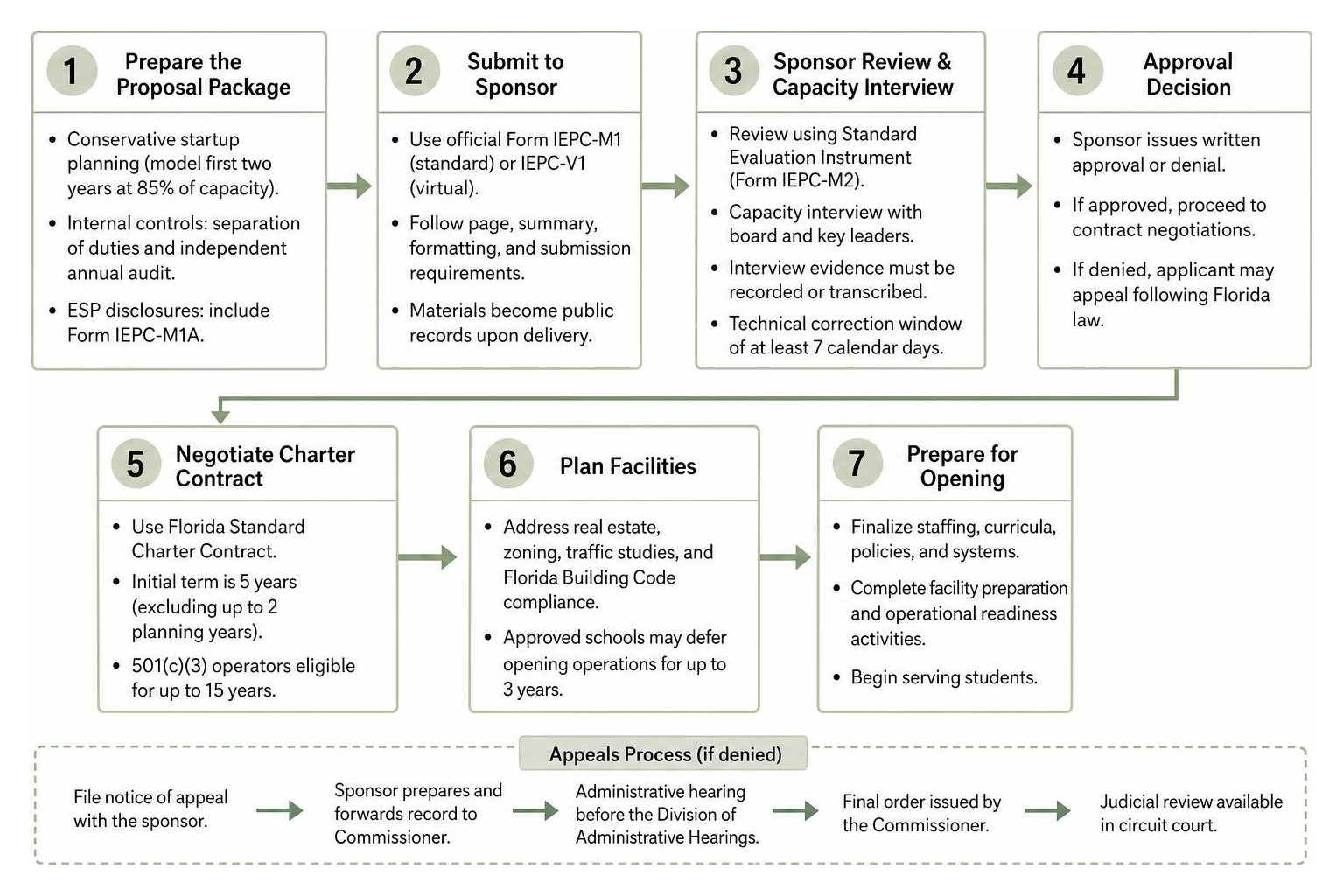
- Conservative Startup Planning: Model your first two operational years on conservative enrollment assumptions (e.g., 85% of capacity) to ensure financial solvency even if early enrollment fluctuates.
- Internal Controls: Define separation of duties for purchasing, payroll, bank reconciliations, and independent annual financial audits.
- Education Service Provider (ESP) Disclosures: If partnering with an ESP or management organization, you must include Form IEPC-M1A outlining the provider’s track record, fee structures, management contract terms, and operational history.
Step 5: Submit the Proposal Package to Start a Charter School in Florida
All Florida applicants must use the official FLORIDA CHARTER SCHOOL APPLICATION – DRAFT (Form IEPC-M1 for standard charters or Form IEPC-V1 for virtual schools), as mandated by the Florida Department of Education under Section 1002.33(6), F.S.
Pay strict attention to state formatting standards:
- Narrative Limits: Standard applications are capped at 110 single-spaced pages (excluding cover page, table of contents, executive summary, and appendices). Applications including replication or ESP addenda are capped at 140 pages.
- Executive Summary: Must not exceed 2 pages.
- Formatting Standards: Use 1-inch margins, standard 12-point font, and clear consecutive page numbering throughout all sections.
- Submission Formats: Districts typically require one bound, tabbed physical copy in a three-ring binder alongside an identical electronic PDF copy. Keep track of specific local charter school deadlines to guarantee on-time delivery.
- Public Records Law: That all submitted materials become public records under Chapter 119 of Florida Statutes upon delivery to the sponsor.
Step 6: Master the Sponsor Capacity Interview
After receiving your application, the sponsor’s review committee will evaluate your written narrative using the state’s Standard Evaluation Instrument (Form IEPC-M2). A critical element of this review is the Capacity Interview.
- Who Attends: Your founding governing board members, school leaders, and key academic and financial contributors should participate. If using an ESP, board members must take the lead in answering governance and financial questions to demonstrate autonomous oversight.
- Purpose: The committee will ask targeted, clarifying questions to test your board’s understanding of the proposed curriculum, budget assumptions, special education laws, and operational procedures.
- Transcript Requirement: State law mandates that any interview evidence used by a sponsor to justify an application denial must be formally recorded or transcribed.
- Technical Clarification Window: Under Florida law, sponsors must provide applicants a mandatory technical correction window of at least 7 calendar days to correct minor, non-substantive, or typographical errors before making a final determination.
Step 7: Negotiate Charter Contract and Plan Facilities
Once approved by the sponsor, the founding board begins final contract negotiations using the Florida Standard Charter Contract.
- Initial Term: The standard initial term of an approved charter contract is 5 years (excluding up to 2 planning years). Non-profit operators holding 501(c)(3) status are eligible for up to a 15-year charter, subject to sponsor approval.
- Facility Planning Deferral: Recognizing the complexities of real estate acquisition, zoning approvals, traffic studies, and Florida Building Code compliance, Florida law permits an approved school to defer opening operations for up to 3 years to ensure adequate facility preparation.
Authorizer Review, Approval Timelines, and Appeals

Under Chapter 1002 Section 33 – 2025 Florida Statutes – The Florida Senate and general charter school law, the authorizer review process follows strict statutory guardrails designed to ensure fair evaluation:
- 90-Day Statutory Decision Window: A sponsor must vote by majority to approve or deny a charter application no later than 90 calendar days after receipt, unless both parties mutually agree in writing to extend the deadline.
- 10-Day Written Justification: If the sponsor votes to deny an application, it must provide the applicant with specific written reasons based on good cause, citing supporting documentation from the evaluation instrument, within 10 calendar days of the vote.
- Prohibition on Unauthorized Criteria: Sponsors are legally prohibited from denying an application based on district-specific priorities or charging application review fees.
- 30-Day Appeal Window: If your application is denied or the sponsor fails to act within the 90-day statutory timeframe, you may appeal the decision to the State Board of Education no later than 30 calendar days after receiving the denial notice. The Charter School Appeal Commission will review the record and provide a recommendation to the State Board.
- Protections for Public Employees: Florida Statutes Section 1002.33(6)(e) explicitly protects district school employees from unlawful employment reprisal if they participate in writing or submitting a charter application.
Post-Approval Mandatory Training and Operational Readiness
Earning charter approval is a major achievement, but operational readiness requires focused execution across multiple pre-opening milestones:
- Mandatory State Financial Training: Under Section 1002.33(6)(f)2., F.S., charter school leadership—specifically the school principal and chief financial officer (or their equivalents)—must participate in Department of Education training on accurate financial planning and good business practices at least 30 calendar days prior to the first day of classes. (Replications of high-performing charter schools are exempt from repeating this training if previously completed).
- Facility Certification: Secure Certificate of Occupancy (CO), fire safety inspection certificates, health department approvals, and local zoning clearances.
- Staff Recruitment & Certification: Hire Florida-certified teachers, complete background screenings, and establish payroll and benefits administration.
- Transparent Student Admissions: Execute open enrollment periods and conduct randomized public lotteries if parent applications exceed available seat capacity, ensuring equal access for all applicants.
- Parent Information Sessions: Host family orientation sessions to review school handbooks, school uniforms, transportation options, and parent involvement opportunities.
Frequently Asked Questions About Starting a Florida Charter School
Who is legally eligible to apply for a charter school in Florida?
Under Florida law, an application to start a new charter school may be submitted by an individual, teachers, parents, a group of individuals, a municipality, or any legal entity organized under the laws of Florida (such as a non-profit corporation). However, private schools, parochial schools, and home education programs are explicitly ineligible to convert into public charter schools.
What are the valid statutory grounds for a sponsor to deny an application?
A sponsor may only deny an application for “good cause,” which means the applicant failed to meet the statutory standards outlined in Section 1002.33, F.S., or the Department of Education’s Model Evaluation Instrument. Common valid grounds include an unviable or deficit-laden financial plan, an unaligned curriculum that violates state reading standards (such as using three-cueing systems), or a failure of the governing board to demonstrate operational capacity. A sponsor cannot lawfully deny an application simply because it does not fit local school board priorities.
How long does the entire charter school startup process take from concept to opening?
The typical charter startup journey takes approximately 18 to 24 months. This timeline provides adequate room for assembling the founding board, preparing the application, completing the 90-day authorizer review, negotiating the standard charter contract, and completing facility build-outs. Furthermore, Florida law provides up to 2 planning years and allows schools to defer opening for up to 3 years to ensure facility readiness.
Conclusion: Empowering Communities Through Educational Choice
Public charter schools represent a cornerstone of educational innovation, accountability, and parental choice in Florida. By offering tailored academic programs—from cutting-edge STEM labs to character-rich classical academies—charters empower educators to rethink traditional instructional models and elevate student achievement. When parents have the freedom to select a school that aligns with their child’s unique talents and learning styles, entire communities thrive.
Every great charter school in Florida began as a bold idea championed by passionate educators, parents, and community advocates. As you embark on the journey to establish a high-quality public charter school, having experienced guidance makes all the difference.
Learn more about Florida charter schools and connect with the Florida Charter School Alliance today for expert advocacy, governance support, and technical resources to help turn your educational vision into a lasting public school legacy.