Charter School vs Public Schools: The Key Difference
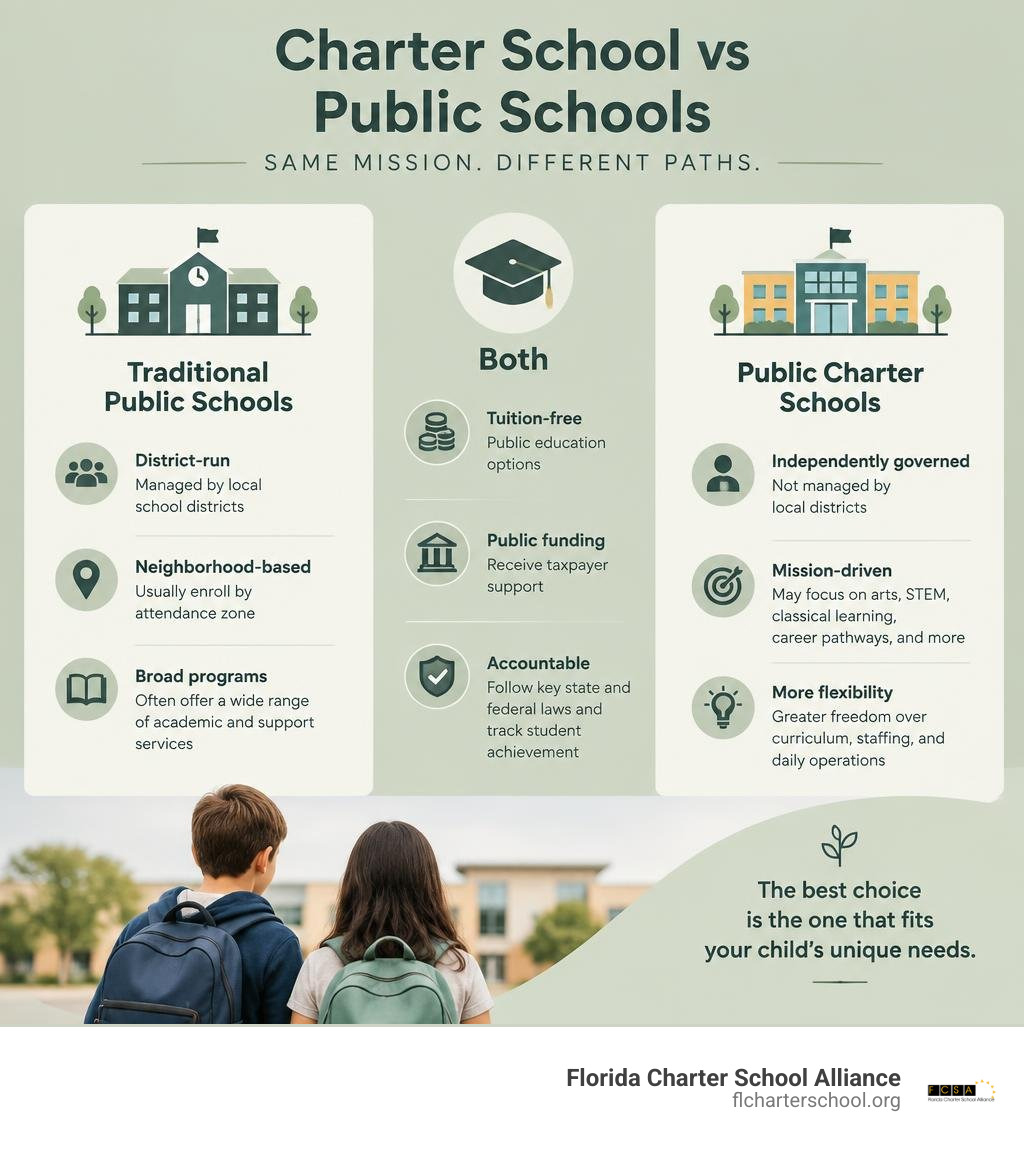
When comparing charter school vs public schools, both are tuition-free public education options. The main difference is how they are run: traditional public schools are managed by local districts and usually enroll students by attendance zone, while public charter schools operate under performance contracts that give them more freedom over curriculum, staffing, and daily operations.
- Traditional public schools: District-run, neighborhood-based, and often offer broad programs and services.
- Public charter schools: Independently governed, mission-driven, and may focus on arts, STEM, classical learning, career pathways, or other student-centered learning models.
- Both: Receive public funding, must follow key state and federal laws, and are accountable for student achievement.
For families and arts educators, the best choice is rarely about a label. Look at each school’s academic results, culture, specialized programs, support services, transportation, and whether its approach creates a high-quality education and real educational opportunity for the student.
I am Lynn Norman-Teck, Executive Director of the Florida Charter School Alliance, with experience in public charter school development, policy, advocacy, and community engagement. My work on charter school vs public schools centers on expanding family empowerment, educational access, and school success for Florida students.
Understanding the Basics: Charter School vs Public Schools
To understand how the K-12 landscape has evolved in Florida and nationwide, we have to look closely at structural models. Traditional public schools and public charter schools share the same fundamental mission: delivering a free, high-quality public education to every student. However, the path each takes to achieve academic excellence is distinctly different.
Public charter schools began as an innovative educational movement in 1992, designed to combine operational freedom with strict accountability. According to Pew Research on school demographics, charter schools have grown rapidly, now serving a significant, diverse cross-section of the K-12 population. Between 2010 and 2021, public charter enrollment across the country more than doubled from 1.8 million to 3.7 million students. In Florida alone, more than 730 public charter schools currently serve over 400,000 students across dozens of counties, demonstrating how deeply families value expanded educational options.
| Feature | Traditional Public Schools | Public Charter Schools |
|---|---|---|
| Governance | Local elected school district boards and superintendents | Independent, non-profit governing boards overseen by authorizers |
| Funding Source | State formulas, local property taxes, voter referendums, federal aid | State per-pupil allocations, public operating funds, competitive grants |
| Tuition | 100% tuition-free public education | 100% tuition-free public education |
| Admissions | Assigned by geographic attendance zones | Open enrollment; random, equitable lottery when demand exceeds seats |
| Curriculum | District-wide standardized curriculum framework | Innovative, mission-driven curricula (e.g., STEM, classical, arts, career) |
| Accountability | District and state compliance reporting | Performance-based charter contracts, state assessments, fiscal audits |
How Governance and Operations Differ
The primary structural divergence between traditional public schools and charter schools lies in daily governance. Traditional public schools operate within a centralized hierarchy overseen by an elected county school board and a district superintendent. Policies regarding curriculum pacing, textbook adoption, master schedules, and operational expenditures are determined district-wide.
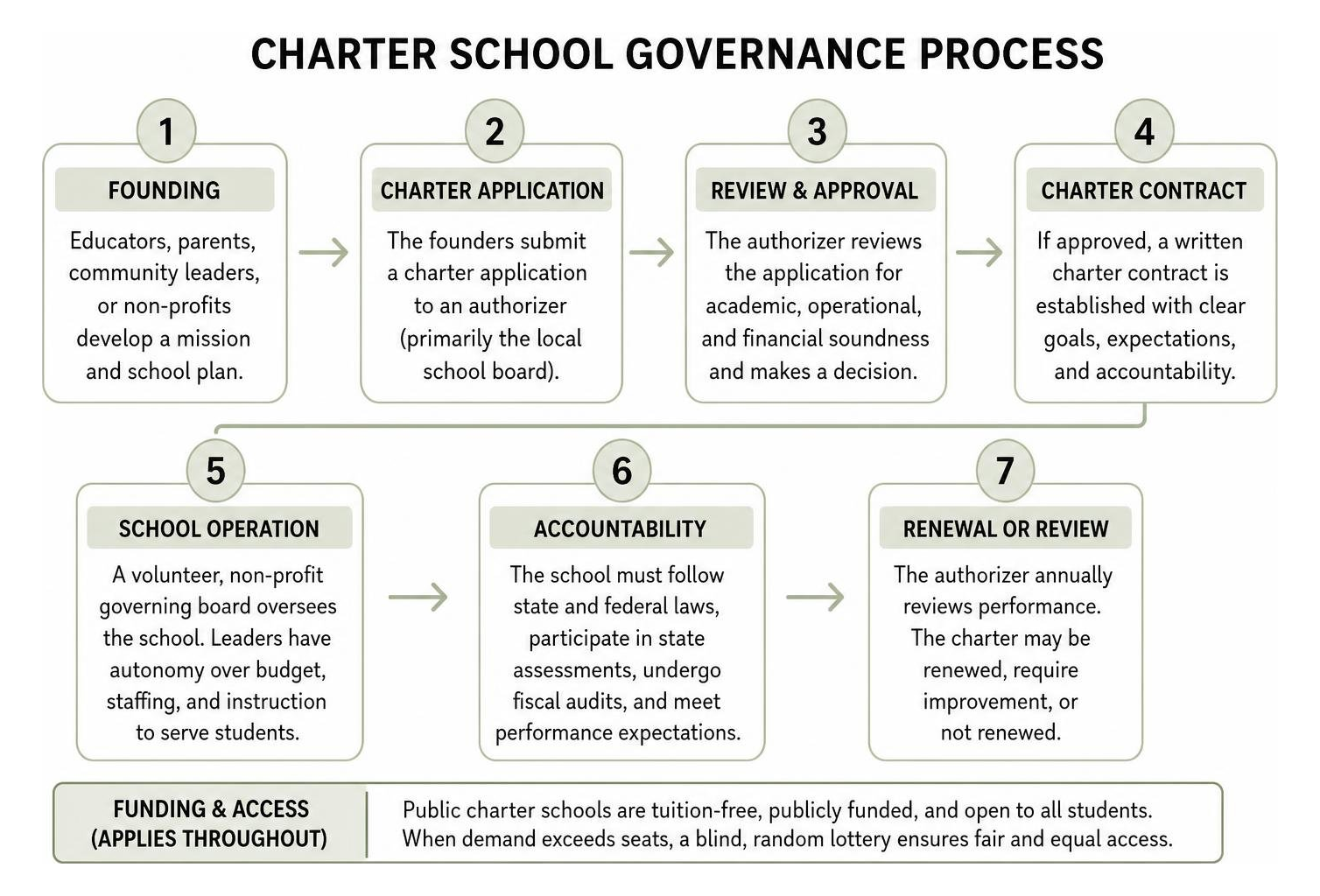
In contrast, public charter schools are founded by educators, parents, community leaders, or non-profit organizations. They operate under a formal charter contract approved by an authorizer—in Florida, primarily the local district school board. A volunteer, non-profit governing board manages the charter school directly. This structure grants school leaders autonomy over their budget, staffing, and instructional design, allowing them to adapt quickly to the unique needs of their students. When families explore educational choice options, this operational flexibility is often what allows educators to implement innovative learning programs that spark genuine student achievement.
Open Enrollment and Admission Lotteries
For traditional public schools, attendance is usually determined by geographic boundaries drawn around residential neighborhoods. If you live inside the boundary, your child is assigned to that neighborhood school.
Public charter schools, however, practice open enrollment. Any student residing within the school district (or participating in inter-district agreements) is eligible to attend, regardless of neighborhood zoning. When the number of applicants exceeds the available capacity in a grade level, state law mandates a blind, random lottery to award seats fairly. Waitlists are maintained for subsequent openings, ensuring equitable access and family empowerment without selective entrance exams. As outlined in the Florida Department of Education Charter FAQs, public charter schools are strictly nonsectarian and open to all learners, reinforcing their commitment to community-wide educational access.
Key Differences in Funding, Facilities, and Resources

Financing public education is an intricate process, and understanding where operational dollars flow helps clarify how different schools manage their resources. Both traditional public schools and public charter schools are funded with public tax dollars based on student enrollment, yet how those funds are accessed and spent varies considerably.
Public Funding Models and Tax Revenue Allocations
When a student enrolls in a public school—whether charter or traditional—state per-pupil funding follows that child. As noted by U.S. News on charter and public school models, funding is tied directly to enrollment numbers.
Traditional school districts typically receive a blended stream of revenue consisting of state funding formulas, local property taxes, voter-approved tax referendums, and federal grants such as Title I. Because traditional districts maintain fixed overhead costs (like central administrative offices and bus depots), policy discussions often explore the financial dynamics of student mobility. Public charter schools receive standard state operational per-pupil funding, but historically have had limited access to local capital outlay millage and municipal bond issuances, requiring charter governing boards to be exceptionally efficient stewards of every public dollar.
Facilities, Operational Freedom, and Accountability Contracts
Unlike district schools, which are built and maintained directly by school districts using public tax-backed municipal bonds, public charter schools must often secure and finance their own facilities. Many charter schools lease commercial spaces, renovate existing structures, or partner with community organizations to create modern learning environments. In some cases, workplace and municipal charter partnerships provide dedicated spaces that benefit local communities and public employees.
In exchange for operational autonomy, public charter schools operate under rigorous, performance-based accountability contracts. While traditional schools operate continuously under district management, a charter school must periodically renew its charter contract. Authorizers review academic performance, state assessment results, and annual financial audits. Charters that fail to meet academic or fiscal benchmarks face closure, with more than 25% of charter schools nationally closing within their first five years due to strict oversight. Conversely, schools demonstrating sustained excellence can earn high-performing status, enabling 15-year contract extensions, streamlined reporting, and the ability to replicate their successful instructional programs.
Academic Performance and Classroom Dynamics: Charter School vs Public Schools
Academic success remains the central priority for parents, educators, and community advocates alike. When we evaluate measuring student performance, looking beyond top-line statewide averages is essential to understand where meaningful student learning gains are happening.
What the Data Actually Shows on Test Scores and Growth
Aggregated national averages can sometimes obscure what is happening inside individual classrooms. For example, raw national composite scores show traditional public schools averaging 5.52 out of 10 compared to 4.96 for charter schools, with traditional math proficiency at 41.7% versus 34.7% for charters, and ELA proficiency at 47.5% versus 44.2%. However, researchers emphasize that charter schools disproportionately open in urban, high-poverty neighborhoods to serve communities historically underserved by district systems. In fact, 31% of charter students nationally attend schools where more than 75% of peers qualify for free or reduced-price lunch, compared to 21% in traditional public schools.
When researchers measure year-over-year academic growth rather than raw scores, a clearer picture emerges. The landmark 2023 National Charter School Study III conducted by Stanford University’s CREDO found that public charter schools provide students with stronger learning gains in both reading and math compared to traditional public schools available to them. Specifically, charter students gained an average of 16 extra days of learning in reading and 6 extra days in math per year. These positive gains were most pronounced for Black students, Hispanic students, English-language learners, and students living in poverty. Florida’s high-achieving charter schools regularly stand as state and national benchmarks for closing achievement gaps through intentional, student-centered learning.
Student-Teacher Ratios, Class Sizes, and Teacher Certification
Classroom dynamics reflect distinct operational strategies across both models:
- Student-Teacher Ratios: Nationally, traditional public schools maintain an average student-teacher ratio of 14.4:1, compared to 20.7:1 in charter schools. Charter leaders frequently utilize co-teaching models, paraprofessionals, and small-group instructional rotations to maintain personalized attention despite varying overall class sizes.
- Teacher Certification: In Florida, teachers in both traditional and public charter schools must be state-certified in accordance with state law. Charter schools often have additional flexibility to recruit subject-matter experts—such as engineers for STEM courses or working artists—and support them through rapid certification pathways.
- Workforce Dynamics: While nearly 70% of traditional public school teachers nationally are represented by collective bargaining unions, approximately 11% of charter educators work within union contracts. Charter school faculties are often younger and racially diverse, with governing boards maintaining direct authority over performance-based incentives, school culture, and targeted professional development.
This combination of dedicated educators and innovative curriculum drives the strong track record of Florida charter schools, demonstrating how autonomy empowers teachers to help students excel.
Navigating the Decision: Charter School vs Public Schools for Your Child

Choosing the best educational setting for your child is one of the most impactful decisions a parent makes. Because every child possesses unique strengths, interests, and learning styles, tailoring learning to individual student needs should always guide family decision-making.
Evaluating Specialized Curricula, School Culture, and Student Needs
One of the greatest benefits of the public charter school model is curricular specialization. While traditional public schools offer broad, standardized programs designed to serve general geographic populations, charter schools are founded on targeted missions. When finding the right charter school fit, families can choose from an array of specialized academic pathways:
- STEM and STEAM Immersion: Rigorous programs centered on science, technology, engineering, mathematics, and arts integration, often featuring robotics labs, coding sequences, and design thinking.
- Classical Education: Curricula grounded in the liberal arts, classical literature, Socratic dialogue, logic, and character development.
- Arts and Performing Programs: Immersion in visual arts, theatre, music, and digital media alongside core academics.
- Career and Technical Education (CTE): Direct pathways to industry certifications, dual-enrollment college credits, and professional mentorships.
- Project-Based and Experiential Learning: Hands-on learning that connects classroom lessons to community problem-solving and environmental science.
Beyond academics, visiting a campus allows parents to evaluate school culture, behavioral expectations, and leadership communication firsthand.
Special Education Services and Practical Logistics
Families evaluating their choices must also consider daily practicalities and specialized support:
- Special Education & IEPs: Public charter schools are public institutions and must fully comply with the Individuals with Disabilities Education Act (IDEA), Section 504, and the Americans with Disabilities Act (ADA). Charters provide Free Appropriate Public Education (FAPE) and implement Individualized Education Programs (IEPs). Depending on district arrangements, specialized district staff or dedicated on-site charter specialists deliver speech, occupational therapy, and behavioral interventions.
- Transportation: Unlike traditional public schools that universally provide neighborhood bus routes, transportation policies for charter schools vary by charter contract and district agreements. Many charters organize carpools, partner with regional transit, or provide centralized shuttle hubs.
- Extracurriculars and Meals: Most public charter schools offer free and reduced-price lunch programs and a wide array of after-school clubs. In Florida, charter school students are legally permitted to try out for athletic teams at their zoned traditional public school if their charter does not offer that specific sport.
Frequently Asked Questions About Charter School vs Public Schools
Do charter schools charge tuition or have selective admissions?
No. Public charter schools are 100% tuition-free public schools funded by public tax dollars. They cannot charge tuition for the standard school day. Charter schools are nonsectarian and open to all students residing within the school district. They do not have selective admissions, entrance examinations, or academic prerequisites. When applications exceed capacity, seats are assigned through a blind, random lottery.
How do charter school academic outcomes compare to traditional public schools?
Academic outcomes vary by school, but independent research shows robust learning growth in charter schools. The 2023 CREDO study revealed that charter students gain on average 16 extra days of learning in reading and 6 extra days in math annually compared to peers in traditional public schools. Because charter schools are held to high accountability standards under performance contracts, they must demonstrate student achievement gains to renew their operating charters.
Are teachers in charter schools required to be certified?
Yes. In Florida, charter school instructional staff must meet the same state certification requirements as teachers in traditional public schools. Charter school governing boards have flexibility in hiring timelines and can recruit industry professionals who complete state-approved educator preparation pathways, ensuring students learn from knowledgeable, qualified educators.
Conclusion
Every child deserves an inspiring learning environment where they can build confidence, master foundational skills, and achieve their full potential. The conversation around public education is not about declaring a single winner between delivery models—it is about honoring parental choice and expanding educational access so every family can find the right academic home.
Whether your family selects a comprehensive neighborhood district school or a specialized public charter school, informed family empowerment is the key to student achievement. At the Florida Charter School Alliance, we remain dedicated to championing high-quality education, supporting educators, and fostering educational innovation across Florida. To take the next step for your family, explore our guide on choosing between charter and traditional public schools for your kid and discover the opportunities available in your community today.