
What You Need to Know About Charter School Funding
Charter school funding works differently than most people think — and those differences have real consequences for students, families, and schools.
Here’s a quick overview of how it works:
| Key Factor | Charter Schools | Traditional Public Schools |
|---|---|---|
| Tuition | Free (public schools) | Free (public schools) |
| Main funding source | State funds (per-pupil formula) | State + local property taxes |
| Facilities funding | Limited or none | Funded through local tax levies |
| Federal funding | Yes (e.g., CSP grants) | Yes |
| Administrative fees | May pay up to 5% to district sponsor (Florida) | N/A |
| Overall per-pupil funding | Typically lower than traditional schools | Higher, due to local tax revenue |
The core issue is simple: charter schools serve public school students with public dollars — but often receive fewer of those dollars than traditional district schools, largely because they cannot access local property tax revenue.
This funding gap isn’t a minor accounting detail. It shapes what schools can offer, what facilities they can maintain, and how well they can serve students who need the most support — including students in low-income communities, English learners, and students with disabilities.
And yet, despite this gap, public charter schools across Florida and the nation continue to deliver strong academic results and expand access to innovative, high-quality education for families who want something different for their children.
I’m Lynn Norman-Teck, Executive Director of the Florida Charter School Alliance, and I’ve spent my career working directly on charter school funding policy, school development, and advocacy to ensure every public charter school has the resources it needs to succeed. In this guide, I’ll walk you through how charter school funding actually works — from state formulas to federal grants to the persistent myths that cloud this important conversation.
Understanding the Basics of Charter School Funding
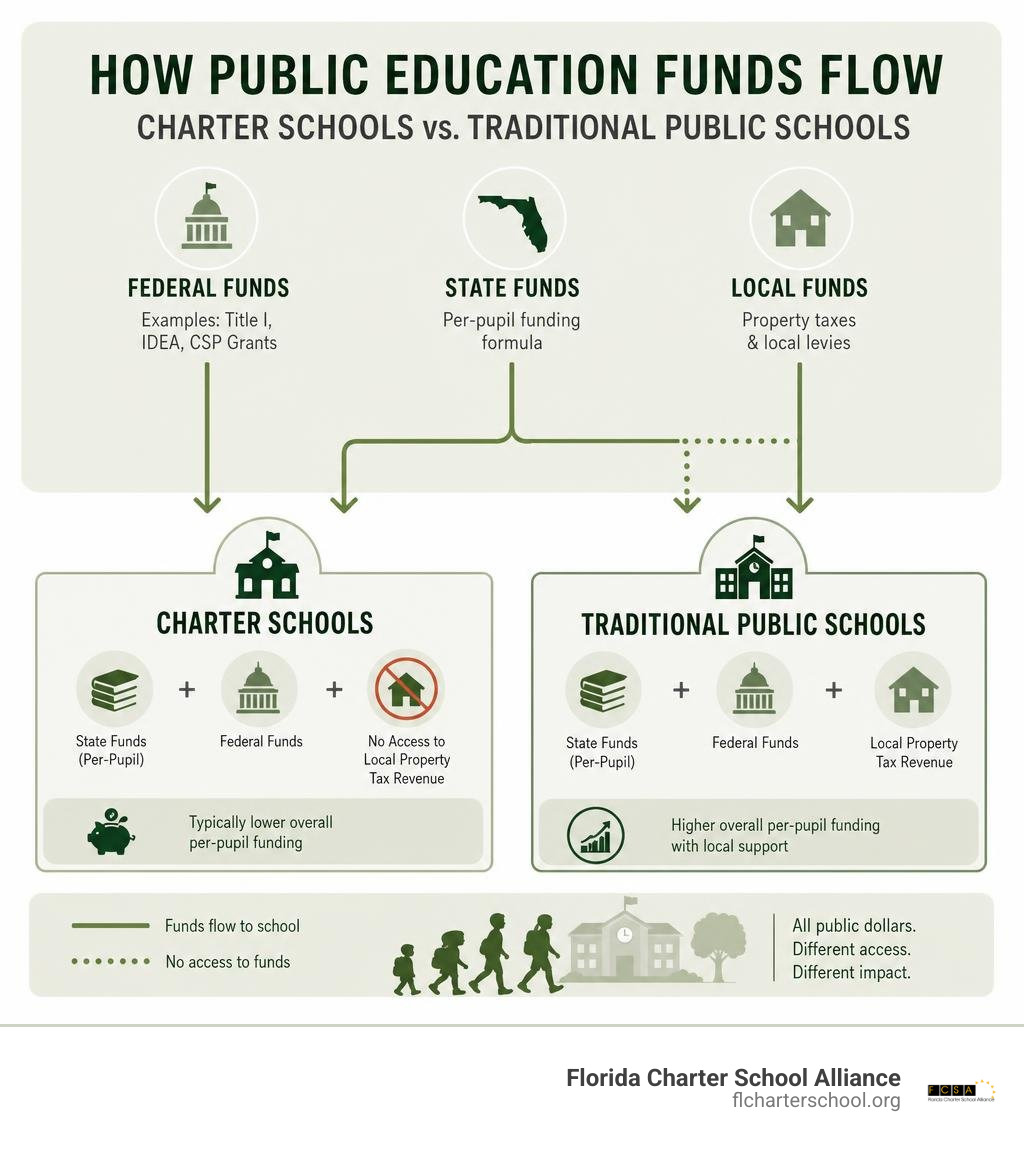
To truly understand how charter school funding works, we have to look at the three main streams of public education revenue: state aid, local property taxes, and federal grants.
Unlike traditional public schools (TPS), which draw heavily from local property tax levies to fund operations and facilities, public charter schools are generally restricted from levying taxes. This simple legal distinction creates a massive structural difference in how these schools are kept running.
Per-Pupil Funding and State Aid
In most states, the baseline of school finance is “per-pupil funding.” This means that public money follows the student. When a family exercises their right to parental choice and enrolls their child in a public charter school, the state allocation for that student’s education is redirected from the traditional school district to the charter school.
This state aid is calculated using specific state funding formulas. However, because traditional districts also have direct access to local property taxes, the state-level allocation is only one part of the equation. For instance, in Texas, charter schools receive 100% of their funding from state sources, while independent school districts (ISDs) receive about 55% from local property taxes and only 45% from state sources. This leaves charter schools completely reliant on state-level allocations, which often fail to make up for the local tax revenue they miss out on. Learn more about Texas charter school funding.
The Local Funding Gap
Because public charter schools do not have a local tax base, they are locked out of the revenue generated by local school board tax referendums or local debt-service levies. In many metropolitan areas, this creates a systematic underfunding issue. When we look at the total revenue available to schools, traditional public schools routinely enjoy a substantial funding advantage because they can rely on local taxpayers to fund everything from operational costs to teacher raises and building renovations.
Federal Grants: A Crucial Catalyst
Federal funding represents the third pillar of school finance. While federal dollars make up a relatively small percentage of any public school’s daily operating budget, they are vital for launching new programs and supporting high-need student populations. Programs like Title I (for low-income students) and IDEA (for special education) flow to both traditional and charter public schools.
Additionally, specialized federal grants—such as the Charter Schools Program (CSP)—help bridge the gap for new and expanding schools, providing the critical startup capital that charter schools cannot otherwise raise through municipal bonds or local taxes.
State-by-State Analysis of Funding Mechanisms
Public education in the United States is primarily a state responsibility, which means charter school funding mechanisms vary wildly depending on where you are on the map. Different states use entirely different formulas, proxies, and statutory rules to determine how public dollars follow students.
For example, states like Georgia utilize a Quality Basic Education (QBE) formula, while Texas relies on its Foundation School Program (FSP). In Louisiana, the state allocation is governed by the Minimum Foundation Program (MFP), which distributes funds based on local wealth and student characteristics. Read about Louisiana’s charter school funding to see how these tiers of funding interact to support student achievement.
State-Level Variations in Charter School Funding
Let’s look at how several key states approach this challenge:
- Florida: In our home state, charter schools are funded through the Florida Education Finance Program (FEFP) using the same Full-Time Equivalent (FTE) student formula applied to traditional district schools. However, Florida charters must pay an administrative fee to their district sponsors of up to 5% of their total FTE funding. This fee covers district oversight but represents a direct reduction in the money that reaches the classroom. Our advocacy efforts, including the FCSA 2026 legislative priorities, continually push for per-pupil equity and the fair distribution of local referendum tax dollars to support our students.
- Texas: Open-enrollment charter schools in Texas receive state aid under the Foundation School Program. According to Texas Education Agency (TEA) data, charter schools receive $676 less per student than independent school districts (ISDs). Because Texas charters cannot levy local property taxes, they receive 100% of their operational funding from the state, using state-average tax rates as a proxy to calculate their basic allotments.
- Pennsylvania: Charter schools in Pennsylvania do not receive funding directly from the state. Instead, they receive the majority of their funding from their students’ resident school districts based on a statutory funding formula. When a district fails to pay, the charter school must request a subsidy redirection through the Pennsylvania Department of Education.
- Louisiana: Louisiana charter schools receive a per-pupil amount based on October 1 student membership. The state cost allocation is calculated using Levels 1, 2, and 3 of the most recent legislatively approved MFP formula. Local revenue representation is factored in using prior-year local tax collections, though local revenues dedicated to capital outlay or debt service are excluded.
- Connecticut: In Connecticut, state charter schools receive a flat foundation budget grant per pupil. The total appropriation for state charter schools is $142,803,548 in FY 2026 and $144,122,548 in FY 2027, representing increases of $5,288,763 and $6,607,763 respectively compared to FY 2025. This funding is phased in using a weighted student funding formula designed to help cover the costs of multilingual learners and students living in concentrated poverty.
- Georgia: State charter schools in Georgia receive QBE formula funding plus a “State Charter School Supplement,” which acts as a proxy for the local tax revenue they cannot collect. The State Charter Schools Commission (SCSC) is legally permitted to withhold up to 3% of a school’s earnings for administrative operations, though this withhold has been reduced to 1.7% for existing schools and 0.7% for new schools in FY 2026.
- Massachusetts: Commonwealth charter schools receive tuition payments directly from the sending school districts. The tuition rate is equal to the district’s foundation budget per pupil, adjusted by the ratio of the district’s actual net school spending to its foundation budget, plus a per-pupil capital facilities component.
- Colorado: Colorado charter schools receive funding through the state’s Public School Finance Act, with money flowing through their authorizing school districts. For capital construction, the state appropriates a dedicated pool of money from the state education fund. The total amount appropriated for charter school capital construction for the 2019-20 budget year and each year thereafter is $20 million multiplied by the ratio of charter school enrollment growth since 2017-18.
The Role of Federal Grants in Charter School Funding
Federal support plays a massive role in fostering educational innovation and expanding high-quality educational options for families. The most significant federal tool for this is the Charter Schools Program (CSP) administered by the U.S. Department of Education.
On September 24, 2025, the U.S. Department of Education announced the release of $500 million to the Charter Schools Programs, marking the largest investment in the program’s history. These funds are designed to support the creation of new public charter schools, the replication of existing high-quality models, and the acquisition of suitable school facilities.
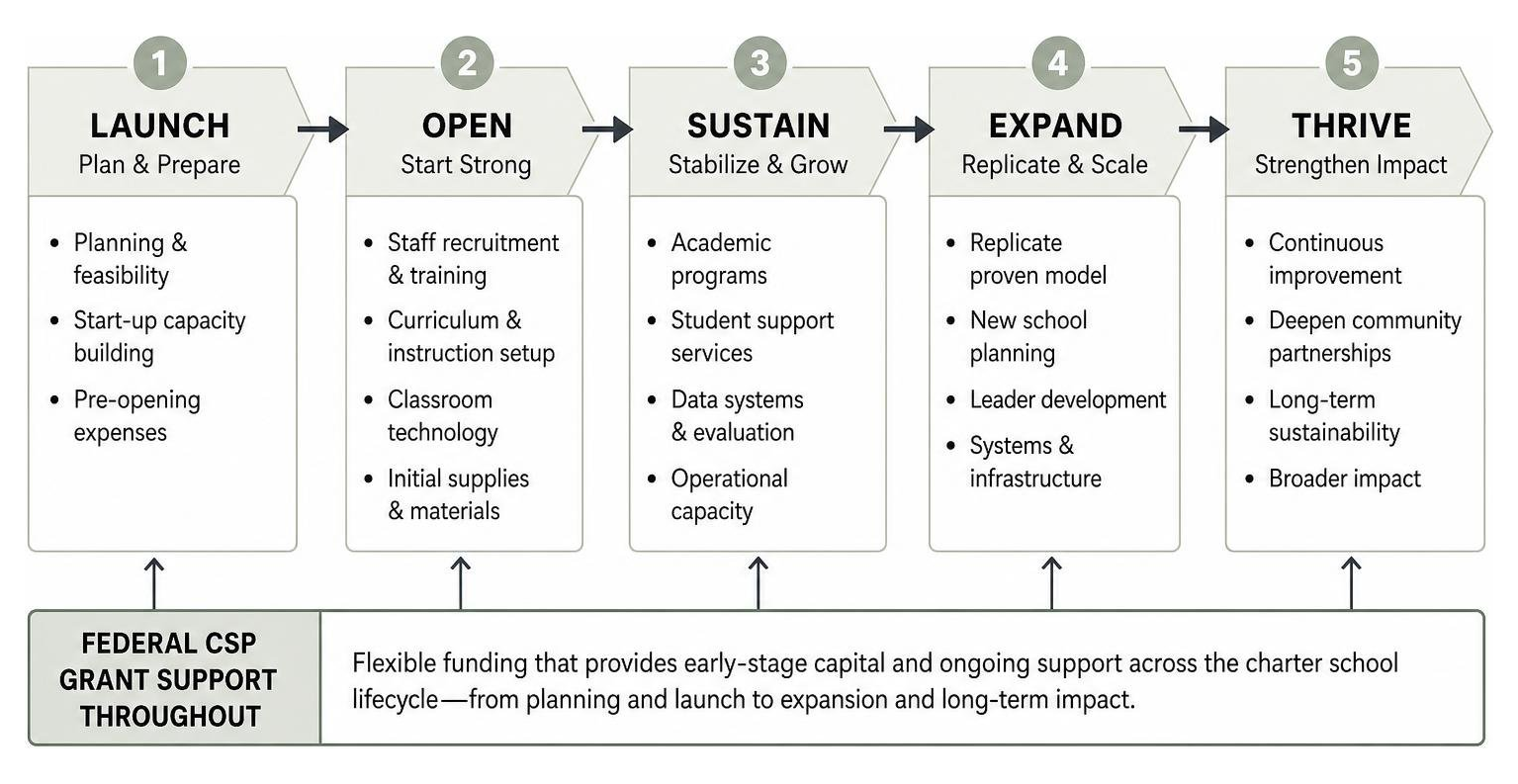
For organizations like the Charter School Growth Fund, which supports schools currently serving over 665,000 students across the country, federal CSP grants are a vital lifeline. They provide the early-stage capital necessary to build capacity, hire teachers, and purchase classroom technology before state per-pupil funding begins to flow. To stay up to date on how these federal resources impact local schools, read our latest Federal CSP funding updates.
Facilities Funding and Capital Outlay Disparities
One of the most persistent and damaging inequities in public education is the disparity in facilities funding. Traditional public school districts routinely build and maintain their schools using local property taxes, voter-approved capital bonds, and dedicated local tax levies.
Public charter schools, however, rarely have access to these mechanisms. In many states, charter school leaders must pay for facilities—including rent, mortgages, renovations, and major capital construction—directly out of their operational budgets. This means that for every dollar a charter school spends to keep the lights on or repair a roof, one less dollar is available for classroom instruction, teacher salaries, and student-centered learning.
To address this gap, some states have passed statutory measures to provide capital support. For example, under the Colorado Revised Statutes on charter school capital construction, the state distributes a dedicated portion of the state education fund to qualified charter schools that have documented capital construction costs and are not operating in rent-free district facilities.
In Florida, we have fought hard to secure and protect “capital outlay” funding. These state-allocated funds help charter schools cover lease payments, facility construction, and safety renovations. However, the demand constantly outpaces the available supply, and the requirements to qualify are strict. To see how these funds are distributed across our state, you can read our detailed breakdown of the Distribution of charter school capital outlay. Ensuring that public charter school students have access to safe, modern, and inspiring learning environments remains a core focus of our advocacy work at the Florida Charter School Alliance.
Dispelling Common Myths About Charter School Funding
When it comes to charter school funding, misinformation is unfortunately common. Critics often spread incomplete or misleading claims to suggest that charter schools are either pulling money away from public education or operating with unfair financial advantages.
Let’s look at the facts and use rigorous research, such as the comprehensive study on Dispelling myths about charter school funding, to set the record straight.
Myth 1: For-profit EMOs are siphoning off public funds.
- The Fact: By law, public charter schools are nonprofit organizations governed by volunteer, community-based boards of directors. While some charter boards contract with Education Management Organizations (EMOs) or Charter Management Organizations (CMOs) to handle back-office services—like payroll, human resources, and compliance—the public funds are fully overseen by the nonprofit board. Research shows that charter schools actually spend a higher percentage of their overall revenues directly on classroom instruction than traditional public schools do, even when working with management partners.
Myth 2: Charter schools rely heavily on wealthy private philanthropists.
- The Fact: While some high-profile charter networks receive philanthropic support, the vast majority of public charter schools receive very little private funding. Nationally, nonpublic funding represents only about 6% of charter school revenues, compared to 11% for traditional public schools. In fact, research across major metropolitan areas shows that charter schools receive an average of $1,499 fewer nonpublic dollars per student than traditional public schools. Philanthropy does not come close to bridging the broader public funding gap.
Myth 3: Charter schools spend less on students and more on administration.
- The Fact: Because charter schools must operate within tight financial constraints, they are forced to be highly efficient. Administrative costs are kept low because charter schools do not maintain massive central office bureaucracies. Instead, funding is kept as close to the student as possible, driving resources directly into innovative learning, classroom technology, and student achievement.
Frequently Asked Questions about Charter School Funding
Do charter schools charge tuition?
No. Public charter schools are tuition-free public schools. They are organized as nonprofit corporations and are open to all students. Because they are part of the public education system, they cannot charge tuition for the regular school day. If a charter school receives more applications than it has available seats, state law requires them to hold a random, unbiased enrollment lottery to ensure equal educational access for every family.
How do charter schools receive funding compared to traditional public schools?
Charter schools receive operational funding based on student enrollment, utilizing a state-level per-pupil allocation (often referred to as the FTE formula in Florida). However, unlike traditional public schools, charter schools face local tax revenue restrictions and cannot levy property taxes. Additionally, they must often pay administrative fees of up to 5% to their school district sponsors, resulting in lower overall per-pupil funding than traditional public schools.
What role do Education Management Organizations (EMOs) play in charter school funding?
EMOs are external professional service providers contracted by a charter school’s governing board to handle day-to-day operations, such as facility management, accounting, and human resources. The school’s independent, volunteer nonprofit board maintains full authority over the school’s budget, public funds, and academic goals. Contracting with an EMO allows school leaders to focus on student-centered learning and academic excellence while maximizing operational efficiency.
Conclusion
Understanding the mechanics of charter school funding is about more than just numbers on a spreadsheet—it is about ensuring equity, opportunity, and family empowerment for hundreds of thousands of students.
At the Florida Charter School Alliance, we believe that every child deserves access to a high-quality education, regardless of the type of public school their family chooses. While funding disparities persist, public charter schools continue to serve as beacons of educational innovation and academic excellence.
We will continue to advocate in Tallahassee and across the state to ensure that public funding fairly supports every student. Together, we can build a stronger, more equitable public education system. We invite you to join our movement and support our call to Fund all public school students fairly.