
Why the Charter School Application Deadline Matters for Your Family
Missing a charter school application deadline can mean waiting an entire year for the next enrollment cycle — so knowing the key dates is critical for families exploring public charter schools.
Here is a quick overview of typical deadlines for the 2026-27 school year:
| Location / School | Application Deadline | Lottery Date | Results / Offers |
|---|---|---|---|
| Philadelphia (Apply Philly Charter) | January 20, 2026 | February 4, 2026 | February 6, 2026 |
| Rhode Island (EnrollRI) | March 18, 2026 @ 5pm | April 1, 2026 | April 15, 2026 (post-lottery opens) |
| PACT Charter School (Minnesota) | November 1, 2025 (in-person) | First Monday in November | Within 30 days of lottery |
| TMSA Charter Schools (North Carolina) | February 5, 2026 | February 9, 2026 | February 9, 2026 |
| Miles Ahead Charter School (Georgia) | March 12, 2026 | March 13, 2026 | Within 5 business days |
Key rule: Under most charter laws, no school can set a deadline earlier than April 1 — but many schools set their deadlines months before that, so checking early is essential.
Public charter schools are free, open-enrollment public schools that offer families a real choice in how their children learn. They combine accountability and innovation in ways that traditional schools often cannot. But accessing those opportunities starts with one thing: submitting your application on time.
I’m Lynn Norman-Teck, Executive Director of the Florida Charter School Alliance, and through years of advancing parental choice and supporting high-quality public charter schools across Florida, I’ve seen how understanding the charter school application deadline process empowers families to unlock life-changing educational opportunities for their children. In this guide, I’ll walk you through everything you need to know to navigate the process with confidence.
Navigating the Charter School Application Deadline for 2026-2027
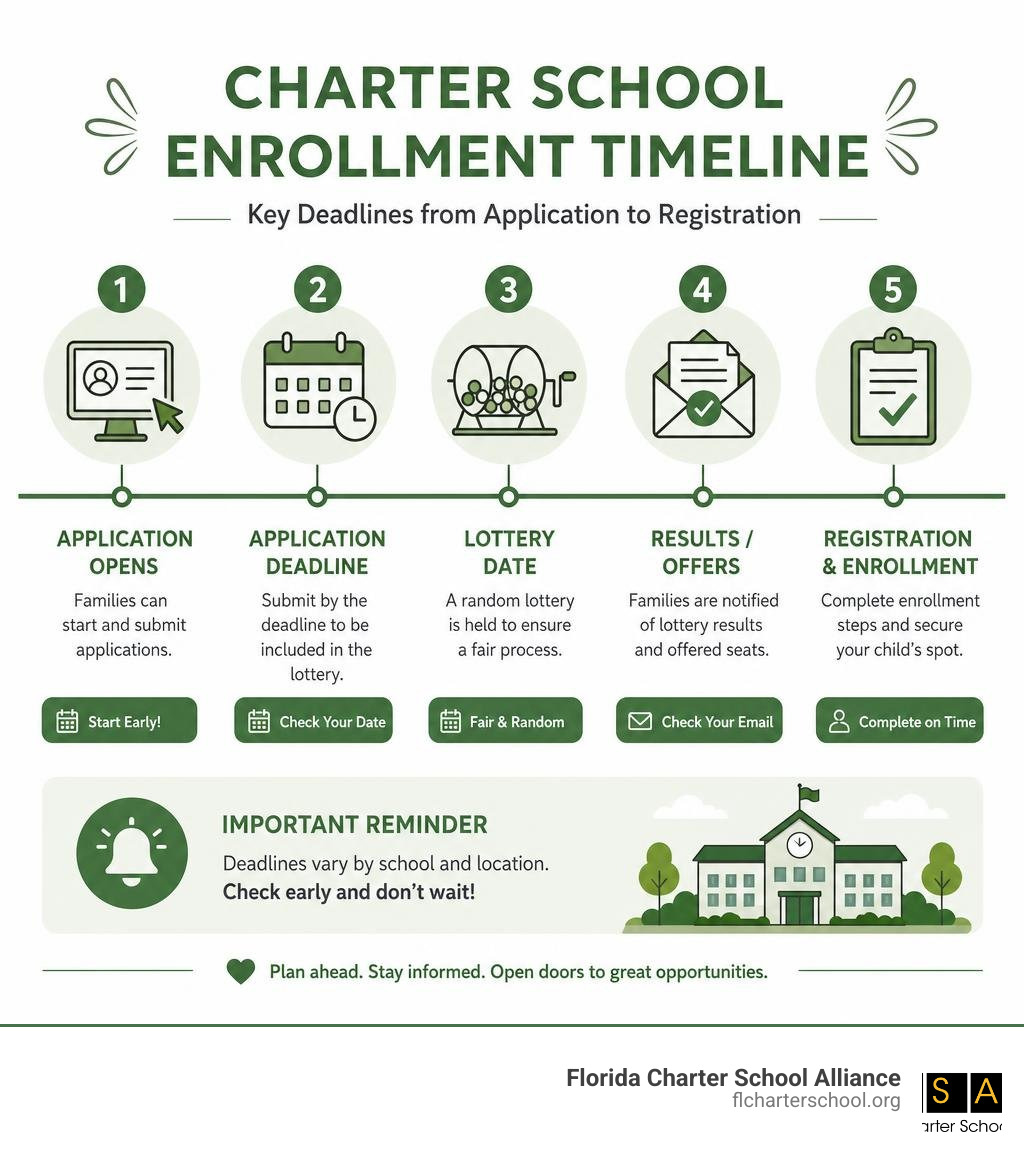
When it comes to securing a spot at a high-performing public charter school, timing is everything. Because these institutions are built around student-centered learning and designed to foster school success, demand often outpaces the number of available seats. To ensure your child has access to these innovative programs, you must treat the charter school application deadline as a firm, non-negotiable target.
In Florida, unlike some states with centralized statewide timelines, deadlines are largely decentralized. They can vary significantly by school district, charter network, or individual school campus. For example, major school districts like Hillsborough, Pasco, Broward, and Miami-Dade each have their own windows for school choice applications.
To help you visualize how these timelines differ and plan your family’s next steps, we have compiled a quick comparison of deadlines across various regions and networks:
| State / District / School | Application Deadline | Lottery Date | Registration Deadline |
|---|---|---|---|
| Florida (Hillsborough County) | Mid-January to early February (Varies by school) | Mid-February | Within 1-2 weeks of offer |
| Florida (Pasco County) | Mid-December to late January | February | Within 10-15 business days |
| Georgia (Miles Ahead Charter) | March 12, 2026 | March 13, 2026 | June 30, 2026 |
| North Carolina (TMSA Charlotte) | February 5, 2026 | February 9, 2026 | Within 15 days of acceptance |
| Rhode Island (EnrollRI) | March 18, 2026 | April 1, 2026 | Late Spring |
Because these windows can shift, we always recommend that families take a proactive approach. The best way to start is to use our Find a Charter School tool to locate high-quality options in your local area and visit their official websites directly to confirm their exact dates for the 2026-2027 school year.
How the Charter School Lottery and Enrollment Preferences Work
What happens when a high-quality charter school receives more applications than it has physical seats available? By law, public charter schools cannot hand-pick their students. Instead, they must use a fair, transparent, and completely random selection process—most commonly a random lottery.
Many modern charter schools utilize independent, automated systems like Lotterease to run their lotteries. These third-party software platforms prevent school staff from manipulating outcomes, ensuring absolute fairness and transparency for every family involved.
While the lottery itself is random, state laws permit schools to establish specific enrollment preferences. These preferences are applied before the random drawing occurs, giving certain groups of applicants priority access to open seats. Common preferences include:
- Sibling Preference: To keep families together, siblings of currently enrolled students are almost always given top priority.
- Returning Students: Students already attending the school do not need to re-enter the lottery; their seats are automatically reserved for the following year.
- Children of Staff/Board Members: To recruit and retain high-quality educators, schools often reserve a small percentage of seats (typically capped by state law, such as 15% in some states) for the children of employees or board members.
- Local Neighborhood Residents: Some municipal or “neighborhood” charters prioritize students living within a specific local boundary.
For a detailed look at how these rules are applied in practice, you can review this Step-by-step enrollment guide from TMSA Charlotte, which illustrates how applications move from submission to lottery selection and final placement.
What Happens If You Miss the Charter School Application Deadline?
If you miss the main charter school application deadline, do not panic—but you must act quickly. Missing the deadline means your child will not be included in the initial random lottery. However, you still have viable options to secure an excellent education.
Most public charter schools accept post-deadline applications. When you submit a late application, your child is typically placed directly onto the school’s waitlist. Because student enrollment is highly fluid—with families moving away, changing plans, or declining offers—waitlists move constantly throughout the spring and summer months.
Additionally, some charter schools operate on a rolling enrollment basis if they have not yet reached their maximum capacity. If seats remain open after the lottery, late applicants may be accepted on a first-come, first-served basis.
If you find yourself in this situation, we encourage you to consult our Charter School FAQs to learn more about waitlist mechanics and how to maximize your chances of securing a spot.
State-by-State Differences and Common Application Systems
As we look across the national landscape in 2026, the way families apply to public charter schools varies dramatically. Some states have embraced centralized, common application systems to streamline the process, while others rely on localized, district-level, or school-specific applications.
Understanding these regional differences can help families appreciate the unique landscape of Florida school choice and how our state works to expand educational access and family empowerment. To learn more about the broader context of our state’s educational landscape, check out our guide About Florida Charter Schools.
How Common Platforms Simplify the Charter School Application Deadline
In several metropolitan areas and states, centralized platforms have revolutionized the enrollment process. Instead of filling out ten different forms for ten different schools, families use a single portal to apply to multiple campuses simultaneously.
- Apply Philly Charter: In Philadelphia, this system allows families to apply to dozens of participating charter schools using one online profile. For the 2026-2027 school year, the main application deadline was January 20, 2026, with results released on February 6, 2026. Post-deadline applications opened on February 23, 2026, allowing late applicants to easily join waitlists.
- EnrollRI: Rhode Island’s common application system simplifies enrollment statewide. For the 2026-27 cycle, the application opened on November 18, 2025, and closed on March 18, 2026, with lotteries running on April 1, 2026.
These platforms dramatically reduce the administrative burden on parents, making educational opportunity more equitable and accessible. Families can easily research schools, submit applications, track lottery results, and accept offers all in one secure digital space. For a closer look at how these timelines and requirements are structured on a school level, you can explore the Enrollment Information page of Miles Ahead Charter School.
Key Differences in State Enrollment Processes
While common applications are highly convenient, the regulatory framework governing public charter schools differs by state.
- New York: State law dictates that the earliest a charter school application deadline can be set is April 1. This protects families by ensuring they have ample time to research their options during the winter.
- Pennsylvania: Systems like Apply Philly Charter use a “Rank and Match” lottery system, which helps match students to their highest-preferred school while preventing single students from holding multiple active offers and clogging up waitlists.
- Rhode Island: The EnrollRI system coordinates charter enrollment on a state level, ensuring a standardized timeline and a single, unified lottery day on April 1.
- Florida: Florida utilizes a decentralized, district-by-district approach. For example, parents in the Tampa Bay area must navigate local district portals or apply directly to individual schools. You can learn more about this localized process by visiting the Apply to Attend a Charter School page for Hillsborough County Public Schools.
What to Do After Receiving a Charter School Offer
Congratulations! Your child received an enrollment offer. This is an exciting milestone on your journey toward academic excellence and innovative learning. However, receiving the offer is not the final step—you must officially claim your seat before the school’s deadline, or the offer will be rescinded and given to the next student on the waitlist.
Most charter schools give families a very brief window to accept or decline an offer—often between 4 to 15 business days. Once you accept the seat online or in writing, you must complete the formal registration process by submitting the required documentation.
Required Documentation for Final Registration
To finalize your child’s enrollment and secure their spot, you will need to gather and submit several official documents. While exact requirements can vary slightly depending on state and local district policies, you should generally prepare to provide:
- Proof of Age: A certified birth certificate is required to verify your child’s identity and ensure they meet state age requirements for their grade level.
- Proof of Residency: Documents such as a utility bill, lease agreement, or mortgage statement matching the address on your application.
- Immunization and Health Records: Up-to-date immunization forms and school physical examination records.
- Previous School Records: Report cards, standardized test scores, or transcripts (for older students) to assist with proper academic placement.
For a comprehensive checklist of what to expect during this phase of the enrollment cycle, we recommend reviewing the Charter School Application Process guide provided by Pasco County Schools.
Frequently Asked Questions About Charter School Enrollment
Can charter schools exclude students based on academic ability?
No. Public charter schools are tuition-free, open-enrollment public schools. They are legally required to accept all students, regardless of academic ability, past grades, standardized test scores, special education needs (IEPs), or English language proficiency. They operate under strict non-discrimination policies and are held to high standards of public accountability. If a school has more applicants than seats, they must use a random lottery to determine admission.
Is there a fee to apply to a public charter school?
Absolutely not. Because charter schools are public schools funded by taxpayers, they are completely tuition-free. There are no fees to apply, register, or attend. This ensures that high-quality, innovative educational choices are accessible to every family, regardless of financial background, fostering true family empowerment and educational access.
How do I check my child’s waitlist status?
Most modern charter schools provide a secure online parent portal (such as SchoolMint or Lotterease) where you can log in and view your child’s real-time position on the waitlist. As other families accept or decline offers, your child’s number will update automatically. If you have questions about where you stand, you can always contact the school’s enrollment coordinator directly for assistance.
Conclusion
Navigating the charter school application deadline requires careful planning, but the reward is invaluable: a high-quality, student-centered learning environment tailored to your child’s unique needs. At the Florida Charter School Alliance, we believe that every child deserves access to academic excellence and educational innovation.
By staying informed, tracking deadlines, and submitting your applications early, you can take full control of your child’s educational future. If you are ready to find the perfect school for your family, we invite you to use our Find a Charter School tool today to explore the exceptional public charter school options available in your community.