
Why Charter School Laws Florida Matter for Students, Families, and Educators
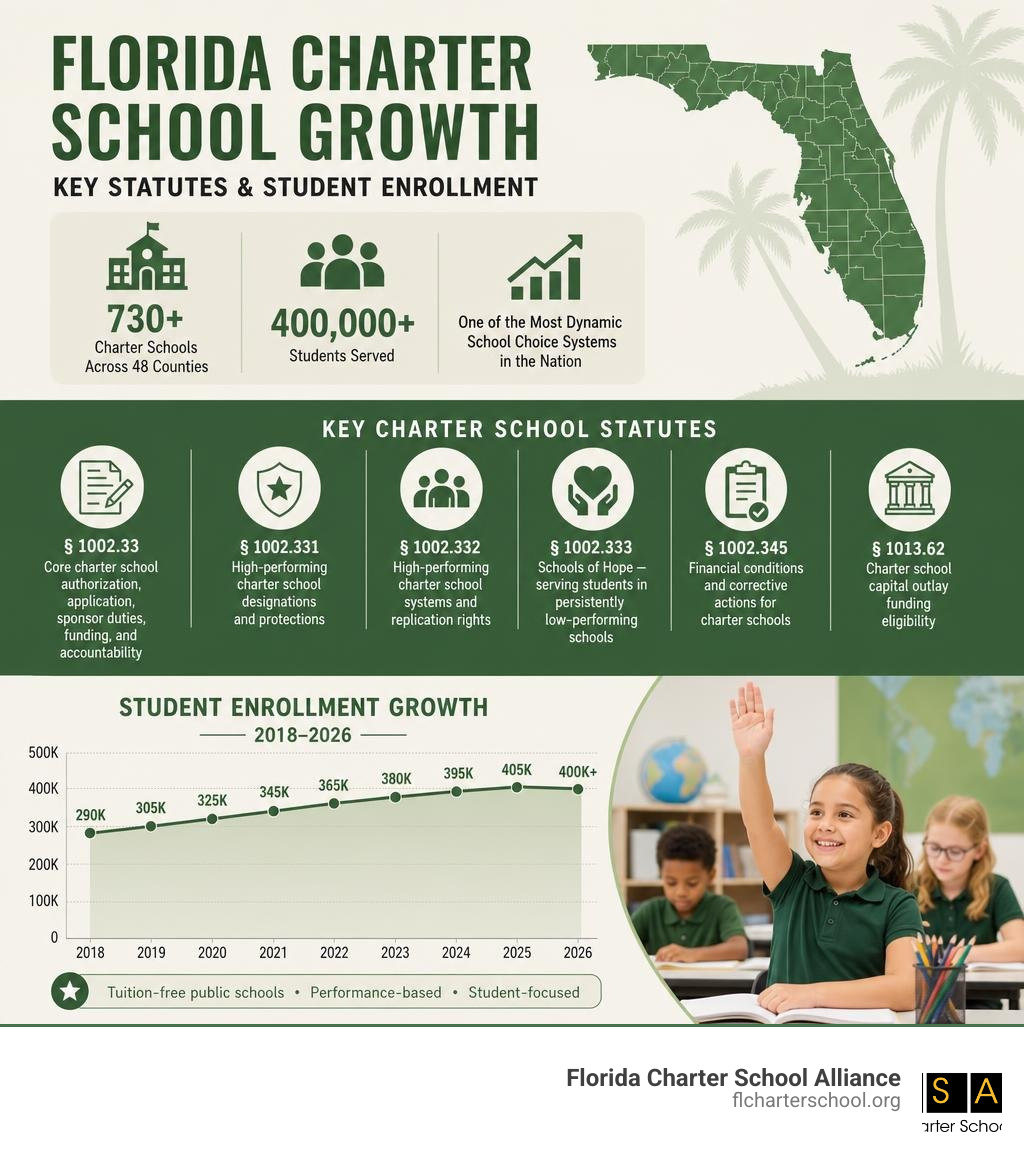
Charter school laws in Florida form the legal backbone of one of the most dynamic public school choice systems in the country. Here’s a quick overview of the key statutes every stakeholder should know:
| Statute | What It Covers |
|---|---|
| § 1002.33 | Core charter school authorization, application process, sponsor duties, funding, and accountability |
| § 1002.331 | High-performing charter school designations and protections |
| § 1002.332 | High-performing charter school systems and replication rights |
| § 1002.333 | Schools of Hope — serving students in persistently low-performing schools |
| § 1002.345 | Financial conditions and corrective actions for charter schools |
| § 1013.62 | Charter school capital outlay funding eligibility |
The short answer: Florida charter schools are tuition-free public schools operating under a performance contract. They are governed primarily by Section 1002.33 of the Florida Statutes, overseen by district school board sponsors, and held accountable through annual school grades, financial audits, and state reporting requirements.
Today, over 730 charter schools serve more than 400,000 students across 48 Florida counties — and that number keeps growing. For arts educators in particular, charter schools offer a unique opportunity to build innovative, student-centered programs with more curricular flexibility than traditional public schools.
I’m Lynn Norman-Teck, Executive Director of the Florida Charter School Alliance, and I’ve spent my career working directly on charter school laws in Florida — from policy development to school community support. In this guide, I’ll walk you through everything you need to know to understand, navigate, and make the most of Florida’s charter school legal framework.
The Statutory Framework of Charter School Laws Florida

Florida’s charter school system didn’t happen by accident. It is the product of decades of deliberate, student-centered legislative design. When the Florida Legislature passed the state’s first charter school law in 1996, it set in motion a movement centered on family empowerment, educational access, and innovative learning.
To understand how these schools operate today, we must look at the specific statutes that govern them:
- Section 1002.33 (The Cornerstone): This is the foundational statute for all public charter schools in Florida. It establishes that charter schools are part of the state’s program of public education, defines who can apply, outlines the sponsor’s duties, and sets the basic guidelines for operational autonomy and academic accountability.
- Section 1002.345 (Financial Health): This statute governs the financial conditions of charter schools. It outlines what triggers a state of financial emergency, the requirements for corrective action plans, and the financial reporting duties designed to protect taxpayer dollars.
- Section 1013.62 (Capital Outlay): Facilities are one of the biggest hurdles for any public charter school. This statute defines the strict eligibility requirements and funding formulas for capital outlay, which helps high-quality schools build, lease, and maintain safe learning environments.
- Section 1002.331 (High-Performing Charters): This statute rewards success. It defines the criteria for “high-performing” status, giving top-tier schools greater operational flexibility and streamlined replication rights.
- Section 1002.332 (High-Performing Systems): This law extends high-performing benefits to networks or systems of charter schools that demonstrate a proven track record of academic excellence across multiple campuses.
- Section 1002.333 (Schools of Hope): Designed to close the achievement gap, this program facilitates the opening of charter schools in “Opportunity Zones” or near persistently low-performing traditional public schools to provide immediate, high-quality options to families.
- Section 1002.3301 (Student Enrollment): This section governs how student enrollment, lottery systems, and demographic balances are managed to ensure equal educational opportunity for all Florida students.
If you want to dive deeper into how these laws have evolved over the years, you can Learn more about charter school law directly through our comprehensive legal resources.
State Board of Education Rules and Model Forms
While the statutes provide the legislative framework, the Florida State Board of Education (SBE) establishes the specific administrative rules and model forms that turn policy into daily practice:
- Model Forms Rule (SBE 6A-6.0786): This rule standardizes the application and contract process across the state. It mandates the use of specific, uniform templates (such as Form IEPC-M1 for new applications and Form IEPC-M2 for renewals) so that school districts cannot impose arbitrary hurdles on applicants.
- Governance Training Rule (SBE 6A-6.0784): To ensure strong leadership and local accountability, all charter school governing board members must complete state-approved governance training within 90 days of appointment, followed by refresher courses every three years.
- Capital Outlay Rule (SBE 6A-2.0020): This rule governs the distribution of capital funds, ensuring that eligible public charter schools receive their fair share of facility funding in a transparent and timely manner.
- Monthly Financial Statement Rule (SBE 6A-1.0081): To prevent financial surprises, charter schools must submit monthly financial statements to their sponsors. This rule establishes the exact format and indicators used to monitor a school’s fiscal health.
The Application, Approval, and Appeal Process

Starting a new public charter school in Florida is a rigorous process designed to ensure that only well-prepared, highly capable groups are authorized to serve our students.
The standard application timeline begins with the submission of a comprehensive charter school application to the local school district (the sponsor). By law, the sponsor has 90 calendar days after receiving the application to approve or deny it by a majority vote, unless both parties mutually agree in writing to an extension.
If the sponsor denies the application, they must provide written, specific reasons based on “good cause” within 10 calendar days of the vote. The applicant then has a 30-day appeal window to file an appeal with the State Board of Education.
The State Board of Education, often utilizing the Charter School Appeal Commission, conducts a de novo review of the application. This means they look at the proposal with fresh eyes to determine if it meets the state’s rigorous standards, protecting applicants from local political bias. You can Read the 2025 Florida Statutes on Educational Choice to explore the exact legal protections and timelines built into this process.
Navigating Charter School Laws Florida for New Applicants
For those looking to establish a new school, navigating charter school laws Florida requires close attention to detail.
All applicants must use the state-approved Model Application Form (IEPC-M1). This extensive document requires detailed plans covering:
- Educational Plan: Curriculum, instructional strategies, reading programs grounded in scientifically based research, and services for students with disabilities and English Language Learners (ELL).
- Organizational Plan: Governing board structure, staffing plans, and community outreach.
- Business Plan: Financial projections, facilities, and operational budgets.
Under SBE Rule 6A-6.0792, applicants also have the option to submit their proposals to the Charter School Review Commission (CSRC). The CSRC acts as an alternative state-level authorizer, providing a consistent, expert-led review process that helps bring high-quality educational options to areas where they are needed most.
High-Performing Charter Schools and Replication Rules
To accelerate the growth of successful educational models, Florida law provides a fast-track replication process for designated High-Performing Charter Schools.
To qualify for this elite status under Section 1002.331, a charter school must:
- Receive at least two “A” school grades and no grade below a “B” in the most recent three years.
- Receive clean, unqualified opinions on its annual financial audits for the past three consecutive years.
- Demonstrate that it has not met any financial emergency conditions.
Once designated, a school can use Form IEPC-HPS1 to apply for replication. High-performing schools and high-performing charter school systems (networks operating multiple highly rated schools) have the statutory right to replicate their successful model in any district in Florida. They are eligible to open one new school per year using a streamlined application process that school districts cannot unreasonably deny.
Funding, Operations, and Sponsor Oversight
One of the most common myths about public charter schools is that they are funded differently than traditional public schools. In reality, Florida charter schools are funded through the Florida Education Finance Program (FEFP), using the exact same full-time equivalent (FTE) student enrollment formula as traditional schools.
However, there are some important operational differences in how these funds are distributed and managed:
| Funding Category | Traditional Public Schools | Public Charter Schools |
|---|---|---|
| Per-Pupil FEFP Funding | 100% | Approximately 95% (Sponsor retains up to a 5% administrative fee) |
| Categorical Funds (e.g., Safe Schools, Reading) | Fully Funded | Distributed proportionally based on student enrollment |
| Capital Outlay (Facilities) | Funded via local tax revenues and bonds | Eligible only after meeting strict state performance and longevity criteria |
| Administrative Oversight Fees | N/A | Sponsor retains 5% of FEFP funds (capped at 2% for high-performing schools) |
While charter schools receive public funding, they must cover their own facility costs, often operating with significantly less revenue per student than traditional schools. To stay updated on how legislative changes affect these numbers, you can Explore the 2026-27 education budget updates to see the latest per-pupil allocations.
Academic Accountability and Operational Requirements
With flexibility comes high accountability. Florida charter schools participate in the same state assessment system and receive the same annual school grades as traditional public schools.
Under Florida’s strict accountability laws:
- School Improvement Plans: Any charter school that receives a grade of “D” or “F” must immediately implement a state-approved school improvement and corrective action plan.
- Automatic Termination: If a charter school receives two consecutive “F” grades, its contract is automatically terminated by law, with very few exceptions. This ensures that only schools delivering academic excellence are allowed to operate.
- Teacher Certification: Charter school teachers must be certified in accordance with Florida law, ensuring that students receive high-quality, professional instruction.
Governance, Transparency, and Closure Procedures
Public charter schools are governed by independent, local nonprofit boards. These boards must operate under strict transparency and conflict-of-interest standards:
- Public Meetings & Records: Charter school boards must comply fully with Florida’s Sunshine Law and Public Records Act. All board meetings must be advertised, open to the public, and documented with accessible minutes.
- No Pledging of Public Credit: Charter boards are independent legal entities. They cannot pledge the credit of the school district or the state to secure private loans.
- Closure and Asset Reversion: In the rare event that a charter school closes, the law protects public resources. All remaining public funds, state-purchased equipment, and property purchased with public capital outlay funds automatically revert to the school district sponsor. Student records are also securely transferred to the district to ensure no interruption in educational access.
Specialized Charter Models and Enrollment Rules
A defining feature of charter school laws Florida is the emphasis on open enrollment. Charter schools cannot “cherry-pick” students; they must be open to any student residing in the school district. If a school receives more applications than it has available seats, it is legally required to conduct a random, public lottery to determine admission.
However, the law does allow for specific, logical enrollment preferences, including:
- Siblings of students currently enrolled in the school.
- Children of the charter school’s founders, governing board members, or employees.
- Students transferring from a classical school or a specialized feeder pattern.
Florida also supports several unique charter school models designed to meet diverse community needs:
- Conversion Charter Schools: Existing traditional public schools can convert to charter status if the conversion is supported by at least 50% of the school’s teachers and 50% of voting parents.
- Virtual Charter Schools: These schools deliver full-time online K-12 instruction, offering unique flexibility for students who thrive in a home-based environment.
Specialized Models Under Charter School Laws Florida
To foster educational innovation and community partnerships, Florida law recognizes several highly specialized charter school models:
- Charter Schools-in-the-Workplace: These schools are created as partnerships between a charter operator and a local business. They are located at or near the workplace, giving employees the convenient, high-quality option of having their children attend school close to work.
- Charter Schools-in-a-Municipality: Established in partnership with local city governments, these schools help municipalities attract families and support local economic development.
- Schools of Hope: This program recruits national, high-performing charter networks to open schools in historically underserved neighborhoods, bringing academic excellence and family empowerment to communities that need it most.
To see how the legislature continues to refine and expand these options, you can Review the 2026 education bills that we are actively tracking for our members.
Frequently Asked Questions about Florida Charter Laws
Navigating the legal landscape of public charter schools can be complex. Here are answers to some of the most common questions we receive from parents, teachers, and school founders:
Do Florida charter schools charge tuition?
No. All public charter schools in Florida are tuition-free. They are organized as nonprofit 501(c)(3) organizations and receive public funding to provide a high-quality education to all eligible students, regardless of income or background. They are strictly prohibited from charging tuition or registration fees for the regular school day.
Are charter school teachers in Florida required to be certified?
Yes. Charter school teachers in Florida must meet the same state certification requirements as teachers in traditional public schools. The only exception applies to specialized charter technical career centers, where industry-expert instructors may be hired based on their professional credentials to teach specific workforce and vocational courses.
What happens to a charter school’s assets if it closes?
If a charter school closes, all of its assets purchased with public funds (including laptops, textbooks, furniture, and real estate purchased with capital outlay funds) automatically revert to the local school district sponsor. All student records are immediately transferred to the district to protect student privacy and ensure a smooth transition to their next school.
Conclusion
At the Florida Charter School Alliance (FCSA), we believe that every child in Florida deserves access to a high-quality, student-centered education. By protecting parental choice, encouraging educational innovation, and maintaining high standards of academic and financial accountability, charter school laws in Florida have created a world-class educational ecosystem.
Whether you are a parent looking for the perfect school for your child, an educator wanting to build an innovative arts program, or a community leader looking to start a new school, we are here to support you.
We invite you to Join the movement for charter school advocacy in Florida and help us continue to shape a brighter, more empowering future for Florida’s students.