
Core Differences in Governance, Operations, and Accountability
When families ask whether charter schools are better than public schools, national data shows that public charter school students achieve measurable academic growth advantages in reading and math. Stanford University’s CREDO research found charter students gain an average of 16 additional days of learning in reading and 6 additional days in math each year compared with their traditional public school peers. To understand why, we first need to look at how these two educational models function behind the scenes. Both options are tuition-free, publicly funded institutions open to all children. However, their structural frameworks create very different educational environments.
Traditional public schools operate directly under county school boards, following uniform district policies, zoned attendance boundaries, and centralized curricula. In contrast, public charter schools operate under independent performance contracts—known as charters—approved by local school districts or state entities. This framework gives school leaders the operational flexibility to design tailored learning programs, establish unique school cultures, and hire mission-driven faculty outside rigid bureaucratic constraints.
Understanding the structural ins and outs of charter school vs public schools helps explain how this operational independence influences student outcomes.
| Feature | Public Charter Schools | Traditional Public Schools (TPS) |
|---|---|---|
| Governance | Independent governing board operating under an approved charter contract | Local elected county school board and district superintendents |
| Admissions | Open enrollment; random lottery system when applications exceed capacity | Zoned enrollment based on geographic residential district boundaries |
| Curriculum | Flexible, specialized themes (STEM, classical, arts, language immersion) | Standardized district-mandated curriculum following state standards |
| Funding | Public per-pupil funding (often around 70% of TPS levels); limited facility aid | Full public per-pupil allocations plus local property tax and capital funds |
| Staffing | Site-based hiring flexibility; only about 11% unionized nationally | Centralized district hiring managed under collective bargaining agreements |
| Accountability | Contract-based: failure to meet performance targets results in closure | District-managed interventions; school closures are exceptionally rare |
Charter schools typically operate with roughly 70% of the per-pupil funding that traditional public schools receive, often navigating significant facility financing challenges without direct access to local capital tax streams. Despite these budgetary constraints, public charter schools leverage administrative autonomy to allocate resources directly to classroom priorities and student-centered learning.
Accountability Systems and Authorizer Oversight
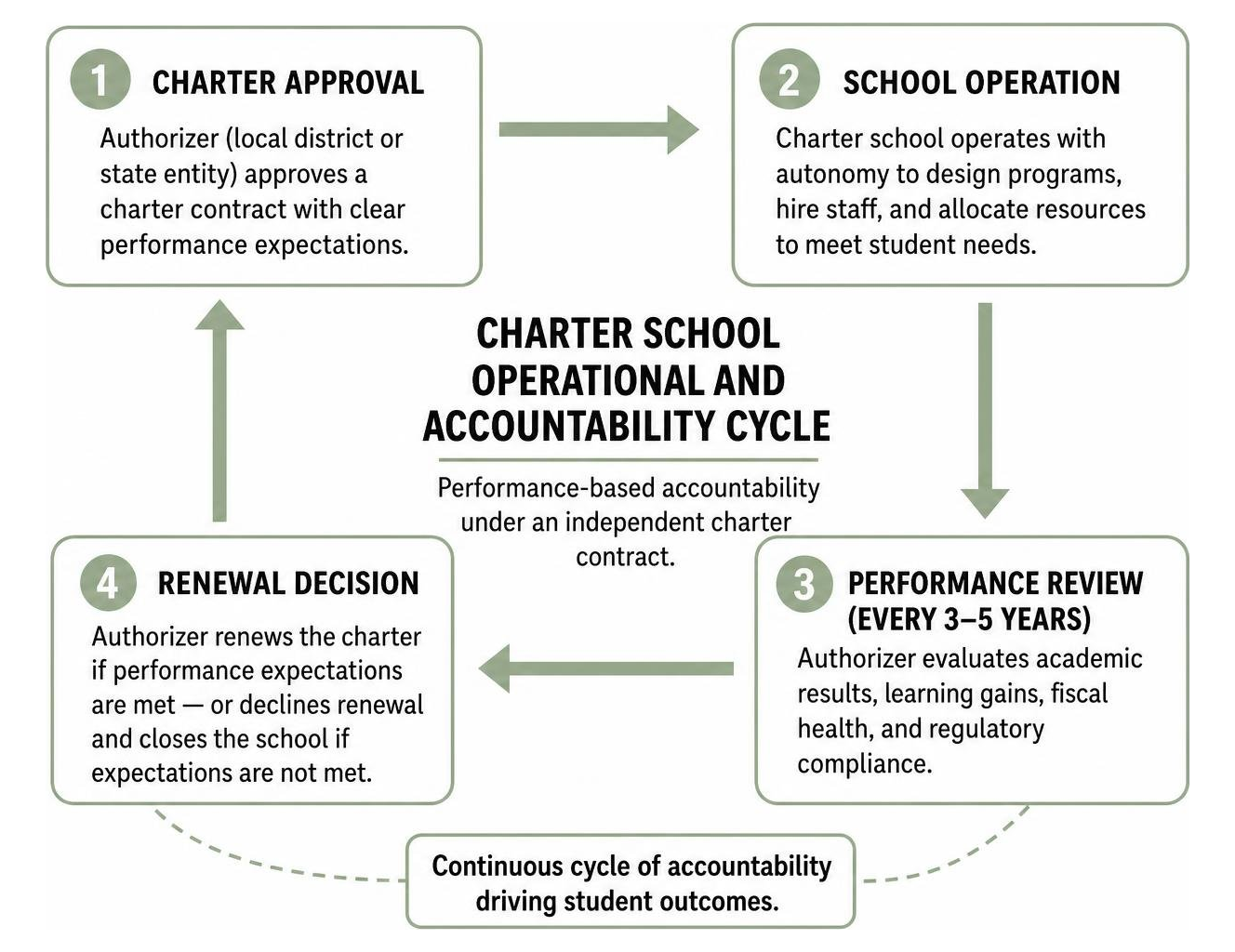
A common misconception is that operational flexibility means less accountability. In reality, public charter schools face an added layer of scrutiny that traditional district schools do not experience: the charter renewal cycle.
Every three to five years, authorizers evaluate charter schools against strict performance contracts. Authorizers assess standardized test scores, longitudinal learning gains, fiscal health, and regulatory compliance. If a charter school underperforms academically or mismanages its finances, the authorizer can refuse to renew the contract and shut the school down.
Over the past two decades, this high-stakes accountability has actively elevated sector quality. Hundreds of underperforming charter schools have closed across the country, while state-level reforms that heightened authorizer standards caused overall charter academic quality to climb. This performance-based model ensures that high standards of academic excellence remain non-negotiable.
Academic Growth Breakdown: Are Charter Schools Better Than Public Schools?
When evaluating school quality, measuring academic growth—how much learning a child gains over a 180-day academic year—provides a much clearer picture than raw test score snapshots. Raw test averages often reflect neighborhood demographics rather than the instructional quality of the school itself.
The most comprehensive research on this topic comes from Stanford University’s Center for Research on Education Outcomes (CREDO) in their landmark National Charter School Study III 2023. CREDO analyzed longitudinal academic progress from 2015 to 2019 using a “virtual twin” methodology, matching charter students with demographically and academically identical peers in traditional public schools.
The data reveals that charter school students gain an average of 16 additional days of learning in reading and 6 additional days of learning in math each year compared to their traditional public school counterparts.
To look closely at the data, the real deal on charter school outcomes and student performance demonstrates that charter schools are not just holding their own—they are steadily accelerating year-over-year student achievement. When examining the national landscape in the CREDO dataset:
- 36% of charter schools produced significantly higher academic growth than local district options.
- 47% achieved equivalent growth.
- Only 17% saw lower growth.
Furthermore, students who remain enrolled in a charter school over multiple years experience compounding academic gains. While moving to any new school can cause an initial adjustment period, by their fourth year, charter students achieved 45 additional days of growth in reading and 39 additional days in math annually over their traditional public school peers.
Subgroup Analysis: Where Are Charter Schools Better Than Public Schools for Learning Gains?
The positive impact of charter schools is most pronounced among historically underserved student populations. Rather than “cherry-picking” high achievers, national data shows that public charter schools disproportionately enroll students who were previously lower-performing in their assigned district schools.
Peer-reviewed findings highlighted in new research on charter school student outcomes show that charter schools serve as powerful engines of educational access:
- Students in Poverty: Charter students experiencing economic hardship gained an extra 17 days of learning in math and 23 days in reading per year compared to peers in poverty attending traditional public schools.
- English-Language Learners (ELL): ELL students demonstrated accelerated gains in both reading and mathematics within charter environments.
- Black and Hispanic Students: Both demographics advanced significantly faster in charter schools than their matched peers in traditional district settings.
- Urban Environments: In urban communities, charter school students gained an astounding 29 extra days in reading and 28 extra days in math per year.
Across the United States, researchers have identified over 1,000 “gap-busting” charter schools that have completely erased historical learning disparities, propelling their students well past statewide academic benchmarks.
School Models and Geographic Variance: CMOs vs. Stand-Alone and Virtual Charters
Charter school performance varies across management structures and delivery models:
- Charter Management Organizations (CMOs): Public charter networks managed by non-profit CMOs achieve the strongest growth metrics. Students in CMO schools gained 27 additional days of learning in reading and 23 days in math compared to traditional public school peers.
- Stand-Alone Charter Schools: Independent, single-campus community charters posted an average of 10 additional days of reading growth, with math growth remaining equal to traditional public schools.
- Virtual Charter Schools: Full-time, fully online virtual charters drag down overall sector averages significantly, showing learning deficits equal to 58 fewer days in reading and 124 fewer days in math. Separating brick-and-mortar campuses from virtual schools is essential when analyzing data.
Geographic location also plays a major role. In Florida, state evaluations documented in the FLDOE report on increased student achievement in Florida’s charter schools reflect high performance levels statewide. As analyzed in Charter Schools vs Public Schools: What the Data Actually Shows (2026), Florida charters operate with near-parity to top-performing district counterparts (a composite gap of just 0.08), presenting families with consistently competitive, high-achieving public schooling options.
Key Trade-Offs Families Must Evaluate
While academic growth data is encouraging, academic statistics alone do not guarantee a specific campus is the right match for your student. Every family balances different priorities, from curriculum specializations to campus amenities.

When weighing the reasons why school choice is the better choice for your household, consider these key operational trade-offs:
- Curricular Focus vs. Comprehensive Electives: Charter schools often specialize deeply in areas like STEM, classical liberal arts, performing arts, or language immersion. However, traditional public high schools, which tend to have larger total student bodies, may offer a wider range of general electives, vocational shops, and broad career tracks.
- Class Sizes and Staffing Ratios: While many charters maintain smaller overall school communities (averaging around 492 students nationwide), student-teacher ratios can vary. National averages show charters running ratios of 20.7:1 compared to 14.4:1 in traditional district schools, though high-performing charters offset this using instructional aides, co-teaching models, and targeted small-group rotations.
- Athletics and Extracurricular Facilities: Traditional district high schools often have expansive, taxpayer-funded athletic facilities, marching bands, and large athletic departments. Charter schools may offer competitive varsity sports, but their physical campuses are sometimes more compact, utilizing community partnerships for playing fields and arenas.
- School Culture and Expectations: Charter schools often institute distinct uniform policies, explicit behavioral rubrics, and high-expectation academic codes. Families should review state guidelines like the Florida Department of Education charter school FAQs to understand how charter policies align with their parenting values.
Evaluating Fit: When Are Charter Schools Better Than Public Schools for Your Child?
Selecting an educational environment requires evaluating your child’s specific personality, interests, and academic trajectory. For example, parents frequently evaluate school climate and whether a charter school is truly safer than a public school when looking for tight-knit, secure learning environments.
When touring prospective campuses, use this checklist to evaluate fit:
- Curriculum and Instruction: Does the school’s academic focus (such as Montessori, STEM, or classical) match how your child learns best?
- Academic Growth Data: What percentage of students are achieving year-over-year learning gains in state reading and math assessments?
- Intervention and Support: How does the school provide high-dosage tutoring or support for English learners and students with unique abilities?
- Faculty Stability and Culture: What is the teacher turnover rate, and how do educators describe the instructional culture?
- Parental Engagement: What opportunities exist for parents to volunteer, participate in advisory councils, or communicate directly with teachers?
- Transportation and Logistical Practicality: Does the school offer bus routes, carpool coordination, or before-and-after school care programs?
Frequently Asked Questions About Charter and Public Schools
Do charter schools receive the same funding as traditional public schools?
No. Public charter schools receive public per-pupil funding from state and local formulas, but they typically receive about 70% of the overall per-pupil funding allocated to traditional district schools.
The biggest disparity lies in capital facilities funding. Traditional public schools construct and maintain buildings using dedicated local tax revenues and voter-approved municipal bonds. Charter schools usually must cover their mortgage, lease, and facility maintenance costs directly out of their general operational budgets or through independent private fundraising.
What evidence-based practices drive higher-performing charter schools?
In a landmark study on urban charter school performance, researchers Will Dobbie and Roland Fryer, Jr. identified five core operational practices that consistently predict higher student achievement:
- Frequent Teacher Feedback: Administrators and instructional coaches regularly observe classes and provide actionable, weekly feedback.
- Data-Driven Instruction: Teachers administer regular benchmark assessments to pinpoint learning gaps and adjust lesson plans immediately.
- High-Dosage Tutoring: Providing targeted, small-group tutoring during the school day to accelerate struggling students.
- Extended Instructional Time: Lengthening the school day or academic year to provide more dedicated time for reading, math, and enrichment.
- A Culture of High Expectations: Fostering a schoolwide ethos of academic excellence, personal accountability, and college readiness for every student.
How do charter schools impact college readiness and long-term outcomes?
Beyond annual standardized test scores, longitudinal studies show that students attending high-performing charter schools graduate high school and enroll in two- and four-year colleges at higher rates than peers with similar demographic and academic backgrounds. By instilling independent study habits, data-driven mastery, and college-bound mindsets early on, quality charter schools equip students with the skills needed for long-term career readiness and postsecondary success.
Conclusion
When asking whether charter schools are better than traditional public schools, the data demonstrates that public charter schools provide substantial, measurable advantages in academic growth—delivering the equivalent of weeks of additional learning per year in reading and math, particularly for underserved students.
However, no single school type fits every child perfectly. Finding the best school comes down to your child’s unique needs, your family’s educational priorities, and the instructional quality of the specific schools available in your neighborhood.
At the Florida Charter School Alliance, we champion parental choice, student achievement, and educational innovation. We believe every parent deserves transparent access to high-quality public schooling options that nurture academic excellence and student success.
If you are exploring educational pathways for your child, review our in-depth guide on choosing between charter and traditional public schools to make an informed, confident choice for your child’s future.