Understanding the Impact and Purpose of Arts Education Grants
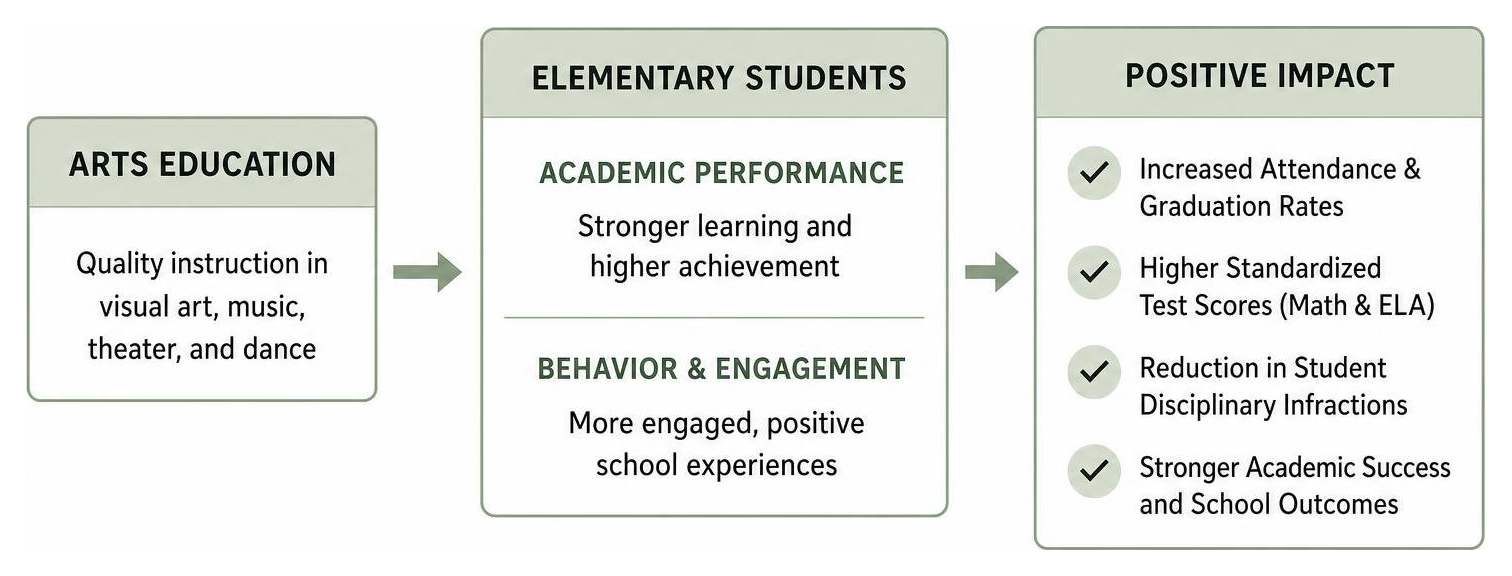
When school budgets face pressure, creative enrichment programs are frequently vulnerable to scale-backs. However, decades of educational research demonstrate that art instruction is vital to comprehensive student development. Extensive state research, such as studies conducted by the Missouri Arts Council in 2010 and 2015, highlights a direct correlation between student participation in fine arts courses—such as music, visual art, theater, and dance—and improved academic performance. Students engaging in fine arts exhibit higher attendance rates, increased graduation rates, fewer disciplinary infractions, and superior scores on standardized test metrics in both mathematics and language arts. To learn more about these trends, explore Why School Art Programs Are Disappearing and What the Data Says.
By prioritizing creative programs, public charter schools demonstrate how educational access and innovative learning can drive academic excellence. Parents seeking strong educational options for their children recognize that holistic, creative development builds core cognitive skills, critical thinking, and emotional resilience.
Understanding the distinction between general arts funding and dedicated arts education grants is essential when seeking financial support:
- General Arts Funding: Primarily supports public performances, museum exhibitions, cultural organizations, and community venue operations, prioritizing public audience exposure.
- Arts Education Grants: Specifically target sequential, standards-based instruction and learning outcomes for Pre-K–12 students or provide structured professional development for classroom educators.
Measuring Success Through Academic Outcomes and Assessment
Modern grantmakers do not measure success merely by counting the number of students who attend an assembly or view a painting. Federal and state grant programs evaluate proposals based on rigorous, standard-aligned student learning assessment.
Competitive grant applications demonstrate how direct learning experiences align with National Core Arts Standards or state educational framework requirements. To satisfy grant evaluation requirements, programs must incorporate measurable skill acquisition. Students must not only experience exemplary works of art, but also actively create, perform, and reflect while educators assess their artistic and cognitive progression. These innovative learning models reinforce overall student achievement and showcase how creative discipline elevates foundational academic skills across every grade level.
Navigating Federal, State, and Philanthropic Arts Education Grants
Securing capital for school arts programs requires navigating federal, state, and philanthropic grant mechanisms.
At the national level, the National Endowment for the Arts serves as the primary federal agency funding arts instruction. The NEA National Endowment for the Arts Grants for Arts Projects (GAP) program offers grant awards ranging from $10,000 to $100,000. Operating on two annual submission cycles (GAP 1 in February and GAP 2 in July), the GAP program mandates a non-federal 1:1 cost share match, which can be satisfied through non-federal cash or documented in-kind contributions. For additional strategies on stretching your school budget, see Funding Your School Art Program Without Breaking the Bank.
State Level Priorities and Arts Education Grants for Schools
State arts councils tailor their funding models to address local educational priorities and community needs. Examining how different states structure their grants provides valuable insight into the nationwide funding landscape:
- Minnesota State Arts Board: Offers pilot programs providing $5,000 to $35,000 per project with a $0 cash match requirement, allowing schools and teaching artists to deliver accessible community programming. Learn more directly at the Minnesota State Arts Board.
- California Arts Council: Uses a multi-tiered approach, separating initiatives into distinct categories like Arts Education Exposure (funding student field trips), Arts Integration Training (educator professional development), and Creative Youth Development.
- Maryland State Arts Council (MSAC): Their Arts in Education (AiE) program operates with a total annual budget around $700,000, offering awards up to $6,000 per site application to bring rostered teaching artists into schools.
- Colorado Creative Industries: The Equity in Arts Learning grant awards $10,000 to $25,000 for sustained projects lasting six weeks or longer, explicitly targeting historically marginalized youth ages 4–21.
Private Foundations and Invitation-Based Arts Education Grants
Beyond public tax dollars, major philanthropic organizations contribute significantly to the creative ecosystem. Foundations like the Mellon Foundation drive institutional leadership, archive preservation, and creative research.
Unlike public grants that utilize open application portals, many major private foundations operate on an invitation-only model. Program scouts actively monitor the educational sector for exemplary, innovative learning initiatives before inviting institutions to submit formal proposals. Public charter schools and non-profit arts partners can build visibility with private philanthropists by publishing program data, demonstrating artistic innovation, and fostering community impact.
Key Strategies to Secure Funding for Public Charter Schools
Public charter schools are uniquely positioned to leverage arts education grants. As tuition-free public schools operating with flexibility and high accountability, charter institutions frequently pioneer interdisciplinary learning models that integrate visual and performing arts into daily curricula.
Because certain federal guidelines (such as the NEA GAP rules) prohibit individual public, private, or charter school buildings from applying directly as standalone applicants, successful charter school leaders secure funding by establishing strategic partnerships. Public charter schools commonly partner with 501(c)(3) non-profit arts agencies, certified teaching artists, or their local education agency (LEA) to apply for and administer grant awards.
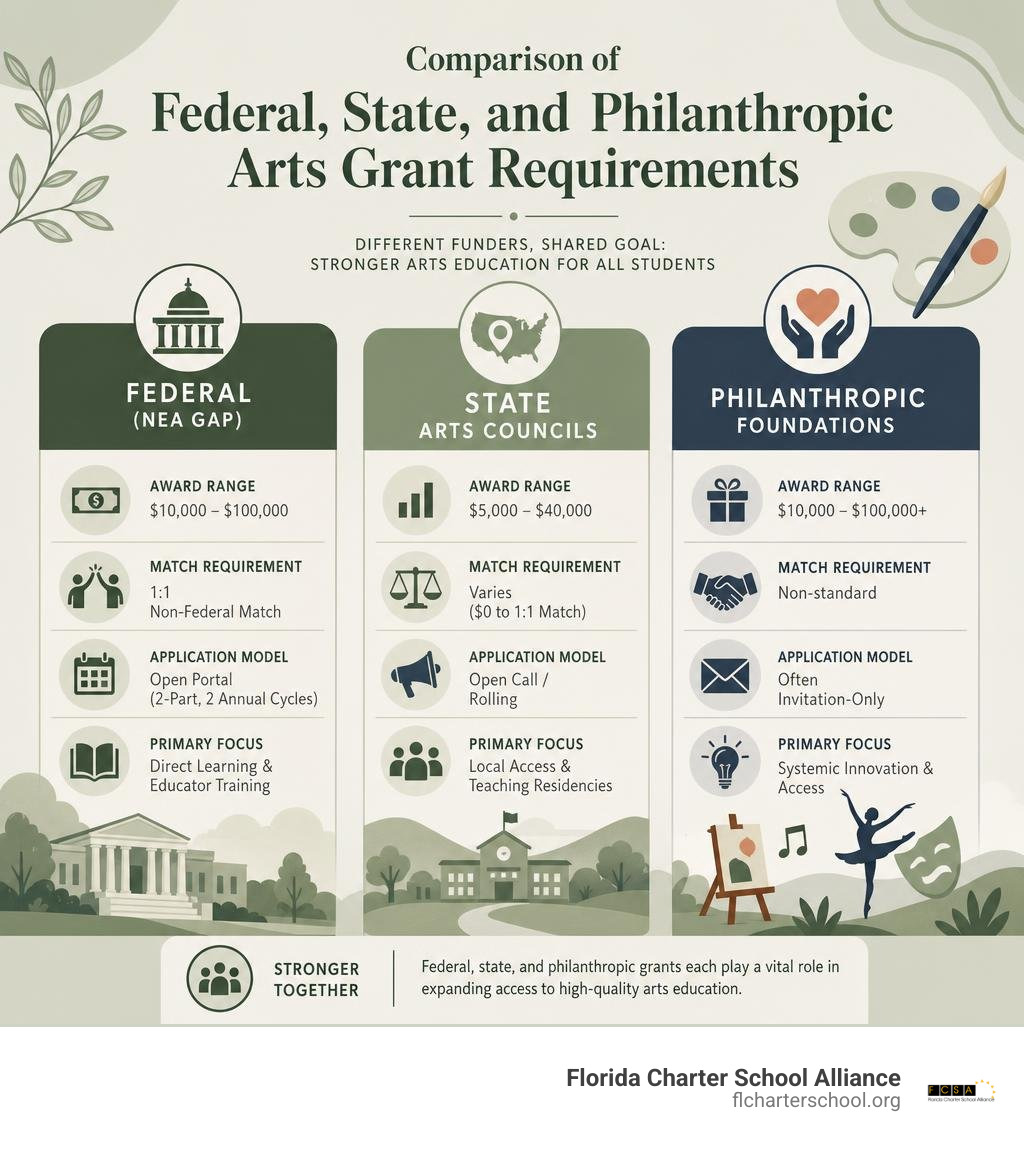
| Grant Category | Average Award Range | Matching Requirement | Application Model | Primary Focus |
|---|---|---|---|---|
| Federal (NEA GAP) | $10,000 – $100,000 | 1:1 Non-Federal Match | Open Portal (2-Part) | Direct Learning & Educator Training |
| State Arts Councils | $5,000 – $40,000 | Varies ($0 to 1:1 Match) | Open Call / Rolling | Local Access & Teaching Residencies |
| Private Foundations | $10,000 – $100,000+ | Non-standard | Often Invitation-Only | Systemic Innovation & Access |
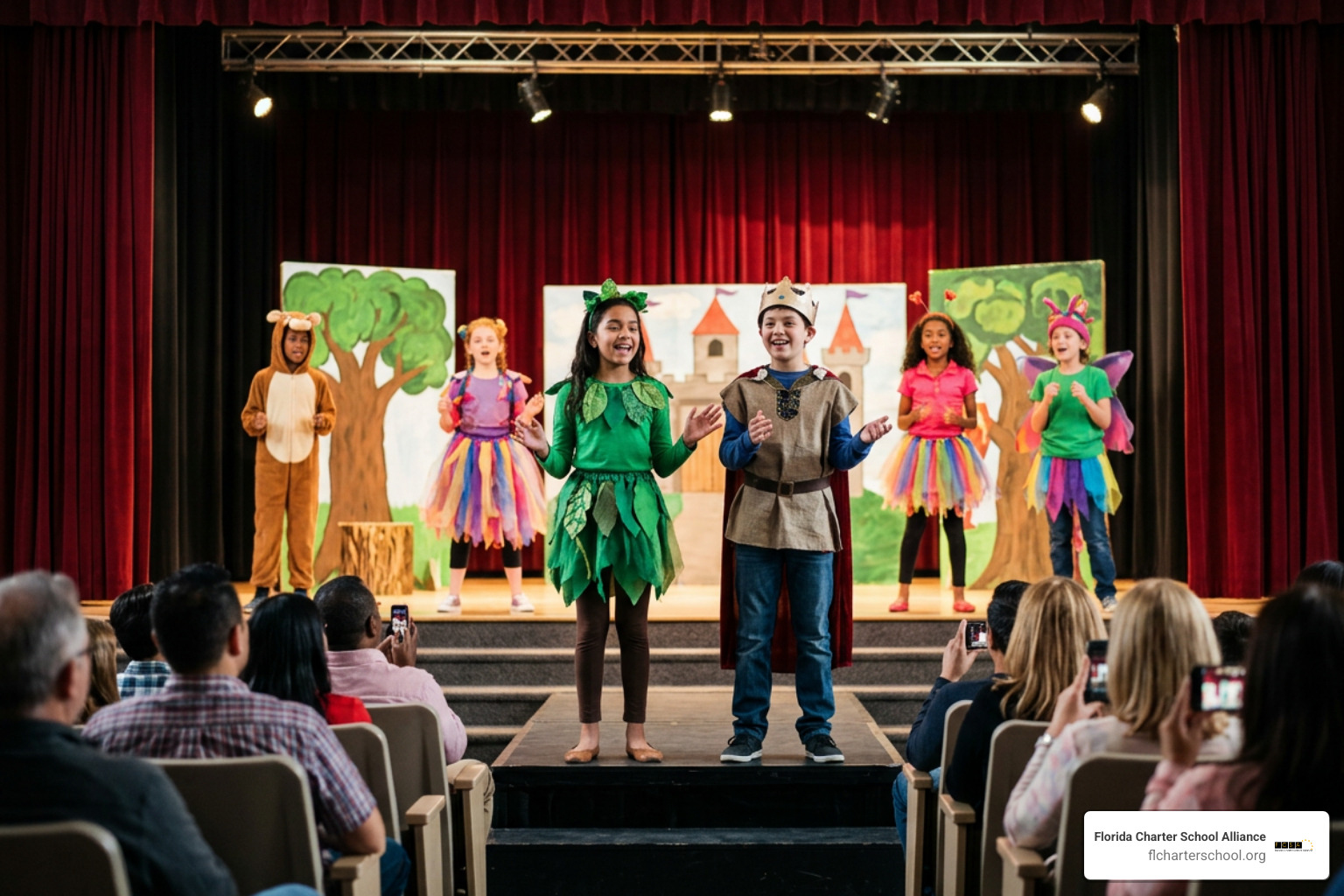
Key Requirements and Budgeting for Arts Education Grants
Grant writing requires meticulous attention to operational rules and financial reporting. Before applying for federal arts funding, organizations must establish active accounts with Login.gov, SAM.gov, and Grants.gov.
Key budgeting requirements and restrictions include:
- Operating Budget Thresholds: Applicants to programs like the NEA GAP must demonstrate a minimum of 5 years of continuous programmatic history and provide 3 years of organizational budget reports, including at least $20,000 in total expenses for their most recently completed fiscal year.
- Allowable Expenditures: Grant funds typically cover teaching artist fees, specialized art supplies directly tied to instruction, standard-aligned curriculum development, and transportation for arts exposure field trips.
- Unallowable Costs: General operating expenses, facility construction, fundraising galas, gift cards, and direct school booster club subsidies are strictly prohibited.
- Technical Assistance: Applicants should utilize available agency resources, including posted sample applications, technical assistance webinars, and instructions like the official FY27 GAP ARTS EDUCATION APPLICATION INSTRUCTIONS.
Integrating Arts Across Core Academic Subjects
Grant review panels favor proposals that integrate artistic disciplines with core academic subjects like science, technology, engineering, and mathematics (STEAM). Arts integration engages students through varied learning modalities, improving concept retention and problem-solving skills.
Furthermore, prioritize equity and access in program design. Grantmakers consistently award points to initiatives designed to close the opportunity gap for historically marginalized youth, English language learners, and students with special needs. By ensuring programs are fully accessible and culturally responsive, educators foster high-quality, student-centered learning environments.
Frequently Asked Questions About Arts Education Grants
Who is eligible to apply for elementary arts grants?
Eligibility varies by funding agency. Generally, 501(c)(3) non-profit organizations, local education agencies (school districts), government units, and tribal entities are eligible. While individual public and charter school sites often cannot apply directly for federal NEA grants, they can serve as primary implementation sites by partnering with eligible non-profit organizations, cultural institutions, or local education agencies.
What is the difference between direct learning and arts exposure projects?
Direct learning projects involve sequential, hands-on instruction led by qualified educators or teaching artists over an extended duration. They require structured assessments to measure student skill progression aligned with core arts standards. Arts exposure projects focus on shorter-term student experiences, such as attending a single theater performance or museum exhibit. Federal programs like the NEA Arts Education discipline require direct learning components, directing pure exposure projects to alternative grant streams.
Do arts grant programs require matching cash funds?
Not always. Federal NEA GAP grants require a strict 1:1 non-federal match, which can include cash and verified in-kind contributions (such as donated room space or volunteer teaching hours). Conversely, many state grant opportunities—such as the Minnesota State Arts Board pilot program—do not require any cash match, allowing smaller organizations and schools to access necessary funding.
Maximizing Art Grant Opportunities for Elementary School Success
Securing arts education grants allows elementary schools to build sustainable, high-impact creative programs that enrich student learning. At the Florida Charter School Alliance, we remain dedicated to advancing educational choice, expanding parental choice, and empowering school leaders with actionable resources to drive student achievement, academic excellence, and family empowerment.

By pairing creative discipline with academic standards, public charter schools across Florida continue to prove that innovative learning models unlock every child’s full potential. When schools combine strong charter school operations with student-centered learning initiatives, families gain unprecedented access to high-quality education. To explore complete funding strategies and discover additional grant opportunities, visit The Definitive Guide to Arts Education Funding.