
What You Need to Know Before Starting a Charter School in Louisiana
At the Florida Charter School Alliance (FCSA), based in Tallahassee, FL, we advocate for high-quality public charter schools that expand parental choice and drive academic excellence. While our primary mission is supporting Florida’s vibrant charter school community, we recognize that educational innovation knows no state borders. Many Florida-based operators and educators look to expand their impact across the Southeast. Understanding how neighboring states manage charter school authorization offers valuable insights for regional growth.
Starting a charter school in Louisiana is a real, achievable goal — but it requires navigating a structured process with specific legal requirements, deadlines, and decision points.
Here is a quick overview of the core steps:
- Form a nonprofit corporation registered with the Louisiana Secretary of State
- Assemble your founding group — at least 3 certified Louisiana teachers must be involved in developing the application
- Choose your charter type — Louisiana has six types (Type 1 through Type 5, including Type 3B), each with a different authorizer
- Determine your operator track — New Operator or Experienced Operator, based on prior school leadership experience
- Submit a Letter of Intent to either your local school board or the Louisiana Department of Education (LDOE), depending on your charter type
- Complete the full application — including your educational plan, academic goals, organizational plan, and financial plan
- Attend a capacity interview and respond to any independent evaluator feedback
- Receive authorization from either the local school board or the Board of Elementary and Secondary Education (BESE)
Louisiana’s approximately 150 charter schools serve over 87,000 students statewide — and that number reflects real demand from families who want innovative, high-quality public school options for their children. Charter schools are public, tuition-free, and open to all students, held accountable to rigorous academic, financial, and governance standards.
This guide walks you through every stage of the process — from choosing your charter type to submitting your application and beyond.
I’m Lynn Norman-Teck, Executive Director of the Florida Charter School Alliance, and I’ve spent my career supporting educators and leaders through the process of starting a charter school in Louisiana and across the Southeast — from governance strategy to community engagement. My background in both business and education gives me a practical lens for helping founding teams build schools that last.
Understanding the Six Types of Charter Schools in Louisiana
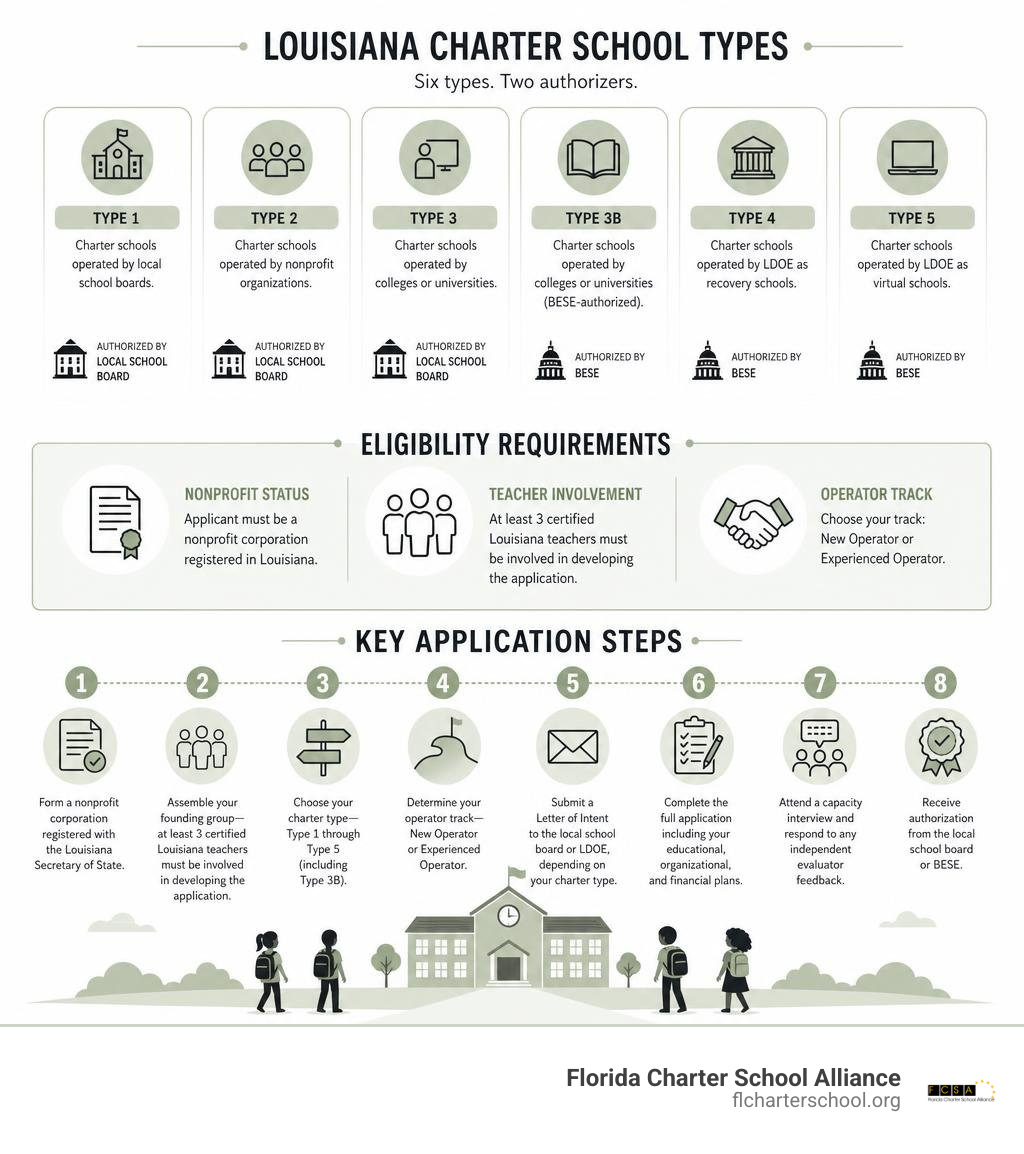
To successfully navigate the landscape of starting a charter school in Louisiana, you must first understand the legal categories. Unlike Florida’s streamlined charter system, which primarily utilizes local school districts as authorizers, Louisiana recognizes six distinct types of public charter schools. The type you choose determines your authorizing body, your target student population, and how your school will be governed.
- Type 1: A brand-new school authorized by a local school board. This is the most common path for local community groups looking to bring educational innovation directly to their neighborhood.
- Type 2: A new or conversion school authorized by the state Board of Elementary and Secondary Education (BESE). These schools serve a statewide or regional student population. You can also apply for a Type 2 charter if a local school board denies your Type 1 proposal, or if the local school system has a “D” or “F” letter grade.
- Type 3: An existing traditional public school that converts to a charter school, authorized by the local school board.
- Type 3B: A former Type 5 charter school (originally taken over by the state) that is transferred back to the oversight of the local school system.
- Type 4: A brand-new or conversion school authorized jointly by a local school board and BESE.
- Type 5: A failing traditional public school transferred to the Recovery School District (RSD) and authorized by BESE to be operated by an experienced charter operator.
This diverse structural ecosystem is designed to maximize educational access and family empowerment. Whether you want to establish a brand-new option or turn around a struggling school, there is a specific pathway for your vision.
| Charter Type | Authorizing Body | School Origin | Enrollment Scope |
|---|---|---|---|
| Type 1 | Local School Board | Brand-New School | Within the local school district |
| Type 2 | State Board (BESE) | New or Conversion | Statewide or regional |
| Type 3 | Local School Board | Conversion of existing public school | Within the local school district |
| Type 3B | Local School Board | Former Type 5 school transferred back | Within the local school district |
| Type 4 | Local Board & BESE | New or Conversion | Within the local school district |
| Type 5 | State Board (BESE) | Underperforming school in Recovery District | Statewide/parish-wide |
Eligibility and Founding Group Requirements for Starting a Charter School in Louisiana
Before you write a single page of your proposal, you must assemble an eligible founding group. Louisiana law is very specific about who can propose a public charter school. To begin, you must form a nonprofit corporation under Chapter 2 of Title 12 of the Louisiana Revised Statutes. This entity must be registered with the Louisiana Secretary of State and eventually secure IRS 501(c)(3) tax-exempt status.
Your founding group must meet several statutory requirements:
- Certified Teachers: By law, your application development team must include at least three individuals who hold valid and current Louisiana teaching certificates. This ensures that educators are directly involved in shaping the academic vision of the school.
- Citizen Group: If you are forming a citizen-led group, it must consist of at least ten citizens residing in the community.
- Board Residency: At least 60 percent of your governing board of directors must reside in the parish or parishes in which the charter school plans to enroll students. This rule guarantees that local voices retain control over the school’s governance. (By comparison, Florida charter school boards have more flexible residency guidelines but still emphasize local representation).
Understanding these foundational rules is critical. If your group does not meet these structural requirements, your application will be disqualified during the initial completeness check. For a deeper dive into how these rules compare to other state frameworks, you can review our guide on Charter School Law and access the official Louisiana Laws – Louisiana State Legislature portal.
Choosing Your Track: New Operator vs. Experienced Operator
Louisiana streamlines its application review process by dividing applicants into two distinct tracks:
- New Operator: This track is for local nonprofit groups whose primary members do not have prior experience leading a public school and do not plan to hire an experienced Educational Service Provider (ESP).
- Experienced Operator: This track is for existing charter management organizations, groups whose leaders have a proven track record of running public schools, or nonprofits that intend to employ an experienced ESP to manage daily operations.
Your chosen track dictates which version of the BESE-approved Common Charter Application you must fill out. The Charter School Application for new operators focuses heavily on establishing foundational capacity, while the experienced operator track requires extensive historical academic, financial, and organizational data from existing schools.
Legal Assurances and Board Governance for Starting a Charter School in Louisiana
Operating a public charter school requires absolute commitment to public accountability. Your board must provide explicit legal assurances that the school will remain completely non-religious and tuition-free, with open enrollment policies that do not discriminate based on academic ability, race, or socioeconomic background.
Furthermore, Louisiana charter boards must operate with total transparency:
- Open Meetings Laws: All board meetings must be publicly noticed, and minutes must be recorded and made available to the public.
- Public Records: Charter school documents, budgets, and applications are subject to the Louisiana Public Records Law.
- Mandatory Board Training: Every president and member of a BESE-authorized charter board must complete at least one hour of training covering board governance, special education, and financial management within one year of appointment.

Key Steps and Deadlines in the Louisiana Charter Application Timeline
Timing is everything when starting a charter school in Louisiana. Missing a single deadline can delay your school’s opening by an entire academic year. The state operates on strict, multi-month cycles to ensure thorough evaluation and adequate planning time. By law, a charter school must begin operations within 24 months of final approval (or 36 months if engaged in active desegregation compliance).
To help you visualize the journey, here is a general breakdown of the application sequence:
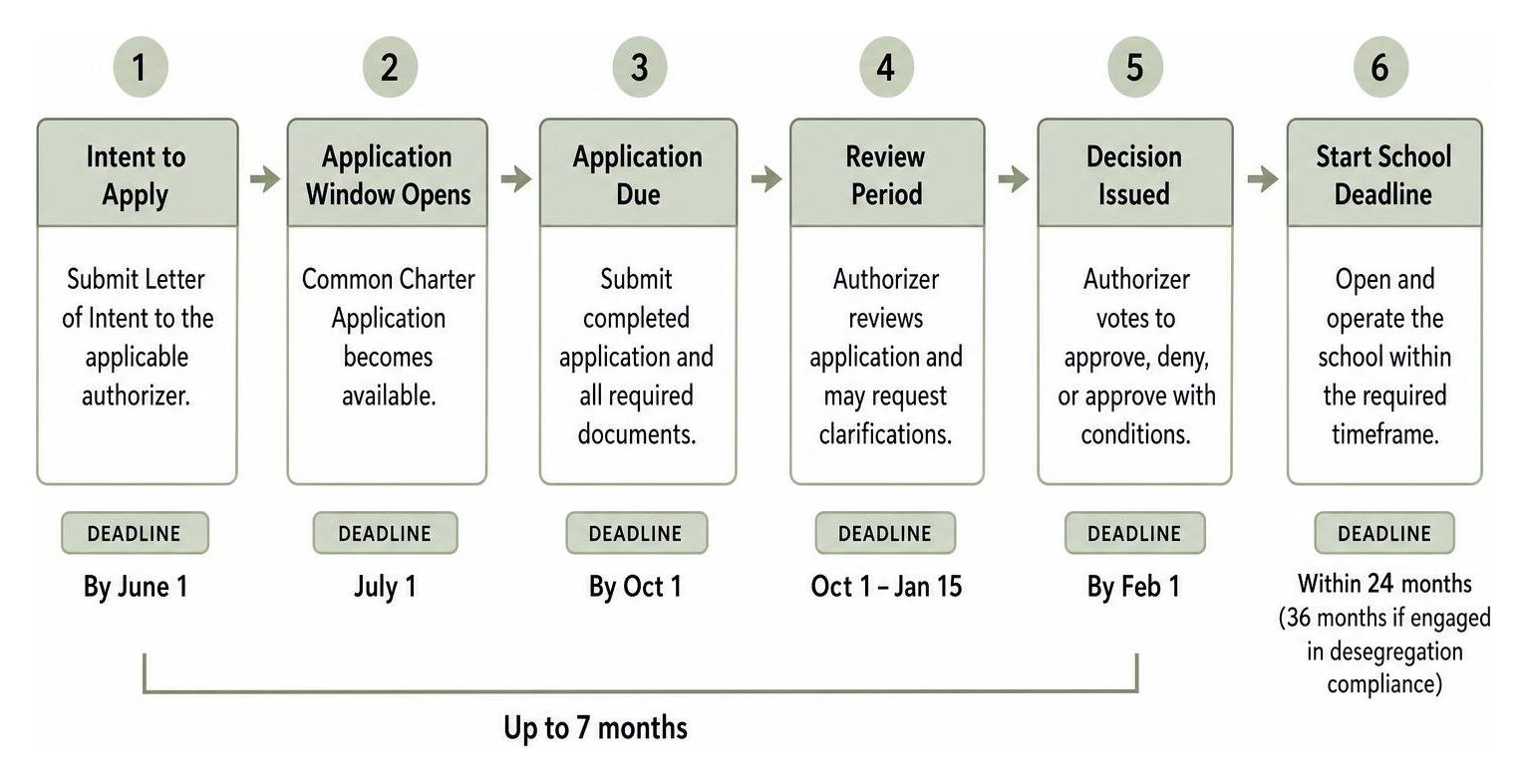
Understanding these milestones is essential for managing your team’s workload. For a comprehensive look at why these structural timelines exist, explore our resources on Everything You Need to Know About Charter School Deadlines.
Local School Board Application Timeline (Type 1 and Type 3)
If you are applying to a local school district for a Type 1 or Type 3 charter, you must adhere to the district’s local authorizing timeline. While specific dates can vary slightly by parish, the general cycle follows this pattern:
- September: Submit your Letter of Intent and Eligibility Documentation to the local school board.
- October: Submit the full, completed application to the local board.
- Late October: Provide formal notice of your Type 1 or Type 3 submission to the Louisiana Department of Education (LDOE).
- January: The local school board must make its final decision. If they deny your application or fail to make a decision by the statutory deadline, you have the right to appeal to BESE.
For a practical example of a local district’s strict submission portal requirements, you can review the Experienced Operator Common Application guidelines utilized by large parishes like Jefferson Parish.
BESE Application Timeline (Type 2 and Type 4)
For state-authorized schools (Type 2 and Type 4), the LDOE manages a centralized annual Request for Applications (RFA) process. This cycle is designed for schools planning to open their doors roughly 18 months after the application process begins:
- February: Submit your Letter of Intent (LOI) to the LDOE.
- March: Submit your Eligibility Determination Form to verify compliance with BESE Bulletin 126.
- May/June: Submit the full written application, adhering to strict formatting limits (typically a maximum of 65 to 80 pages for the narrative, and 200 pages for appendices).
- Summer: Undergo a completeness check, third-party evaluation, and a rigorous capacity interview.
- December: BESE votes on final approval.
You can monitor active application cycles and download current templates directly from the official Charter School Authorization page.
Core Components of a Successful Louisiana Charter Proposal
A successful charter application is much more than a collection of good intentions. It is a comprehensive business and educational blueprint that proves your team has the capacity to deliver academic excellence and manage public funds responsibly. To build a strong foundation, we recommend studying our comprehensive guide, From Blueprint to Classroom: The Ultimate Guide to Starting a Charter School.
Your proposal must detail four core plans:
- Educational Plan: This is the heart of your application. You must define an innovative curriculum that aligns with Louisiana’s state standards and grade progression rules. Explain how your school will serve diverse learners, including the 14% of Louisiana public school students with disabilities and the 5.4% who are English Learners.
- Academic Goals: Establish clear, measurable targets for student achievement. These must align with the state’s LEAP 2025 assessments, graduation index, and ACT benchmarks.
- Organizational Plan: Outline your governance structure, staffing model, and professional development plans. Detail how your board will oversee the school leader and ensure compliance with all state public school laws.
- Financial Plan: Provide a realistic, conservative five-year budget. This must include a detailed start-up plan, operational budgets based on varying enrollment scenarios, and clear internal financial controls.
Community Engagement and Evidence of Support
You cannot build a school in a vacuum. Authorizers want to see deep, authentic community engagement. Your application must include documented evidence of support from local families, business leaders, and civic organizations.
This evidence can take several forms:
- Completed parent surveys indicating a desire to enroll their children.
- Letters of support from local community leaders and partner organizations.
- Documentation of public town hall meetings where families were able to ask questions and provide feedback.
Showcasing this grassroots demand proves that your school is not just a project, but a vital community asset designed to expand parental choice and student-centered learning.
Financial Planning, MFP Funding, and Contingency Requirements
Charter schools in Louisiana are publicly funded through the Minimum Foundation Program (MFP). MFP funds are allocated on a per-pupil basis, combining state and local tax revenues. However, managing public funds comes with strict legal boundaries.
First, your school must implement a dual-accounting system. This is crucial because, under Louisiana law, all assets purchased with public funds automatically revert to the chartering authority if the school closes. You must keep a meticulous, separate accounting of assets bought with private donations or grants to protect those private investments.
Second, your expenditures must comply with Article VII, Section 14 of the Louisiana Constitution. This requires applying the three-pronged “Cabela’s Test” to ensure that public funds are never donated, pledged, or used to benefit private entities without a direct, public, and proportional return to the school.
Navigating Denials, Appeals, and the Path to Approval
If your charter application is denied by a local school board, the journey does not end there. Louisiana law provides a robust appeal mechanism designed to protect high-quality proposals and ensure that families are not denied access to educational innovation.
If a local board denies your Type 1 or Type 3 proposal, or places unacceptable conditions on its approval, you have the right to appeal to BESE. Your appeal will take the form of a Type 2 charter application. BESE will conduct an independent review of your proposal. If your team demonstrates strong capacity and a sound plan, the state board can bypass the local denial and grant authorization directly, allowing you to open as a state-chartered school.
This appeals process is a vital safety valve, particularly in districts facing academic crisis or holding a “D” or “F” letter grade. You can read the exact statutory language governing these appeals in the Louisiana Revised Statutes § 17:17:3983 – Chartering process by type; eligibility; limitations; faculty approval; parental approval :: 2025 Louisiana Laws :: U.S. Codes and Statutes :: U.S. Law :: Justia database.
Overcoming Obstacles When Starting a Charter School in Louisiana
The path to approval is designed to be rigorous. To succeed, your team must be prepared to face and overcome several key hurdles:
- Independent Evaluator Review: Your application will be graded by an independent evaluator with academic, financial, and legal expertise. You must be ready to submit a thorough, fact-based written response to their initial findings.
- The Capacity Interview: This is a critical, in-person evaluation. Only your charter board chair, your proposed school leader, and key board members (up to a maximum of eight people) may attend. External consultants, back-office providers, and ESP representatives are strictly barred from participating. Your team must demonstrate that you are the ones driving the school’s vision and operations.
For a step-by-step breakdown of how to prepare your team for these high-stakes reviews, we encourage you to read The Step-by-Step Guide to Starting a Florida Charter School, which offers valuable, universally applicable strategies for passing rigorous charter interviews.
Frequently Asked Questions About Starting a Louisiana Charter School
What is the difference between a local school board and BESE in authorizing charter schools?
Local school boards authorize and oversee Type 1, Type 3, and Type 3B charter schools. These schools operate within the geographic boundaries of the local school district. BESE (the state board) authorizes and directly oversees Type 2, Type 4, and Type 5 charter schools, which often serve broader regional or statewide student populations.
How long does an approved charter school have to begin operations in Louisiana?
Once your charter is approved, you must begin operations within 24 months. If your school is actively working to comply with a federal or state desegregation order, this operational timeline can be extended to 36 months.
Can a business partner with a charter school in Louisiana?
Yes! Louisiana has a unique “Corporate Partnership” law. If a business or corporate partner donates land, building space, renovations, or technology worth at least 50% of the school’s per-pupil allocation, they can enter into a formal partnership. In exchange, the corporate partner can receive an enrollment preference of up to 50% of the school’s seats for their employees’ dependents, as well as a minority share of seats on the charter school’s governing board.
Conclusion
Starting a charter school in Louisiana is a powerful way to expand educational opportunity, champion parental choice, and bring student-centered learning to communities that need it most. While the regulatory framework requires diligence, the reward is a high-quality, accountable public school that helps students achieve their full potential.
At the Florida Charter School Alliance, headquartered in Tallahassee, FL, we believe that public charter schools are a vital engine for educational access and academic excellence. Although our primary focus is supporting and advocating for high-quality charter schools within Florida, we are passionate about fostering a strong regional network of educational innovation. For Florida-based charter operators looking to expand their footprint into Louisiana, or local founders seeking regional expertise, we offer a wealth of shared resources and strategic guidance.
If you want to learn more about the charter movement, access operational resources, or join our advocacy efforts, we invite you to explore our starting a charter school resource page and connect with us today. Together, we can continue to build a brighter future for public education.