
Why Starting a Charter School Could Be the Most Impactful Thing You Do for Your Community
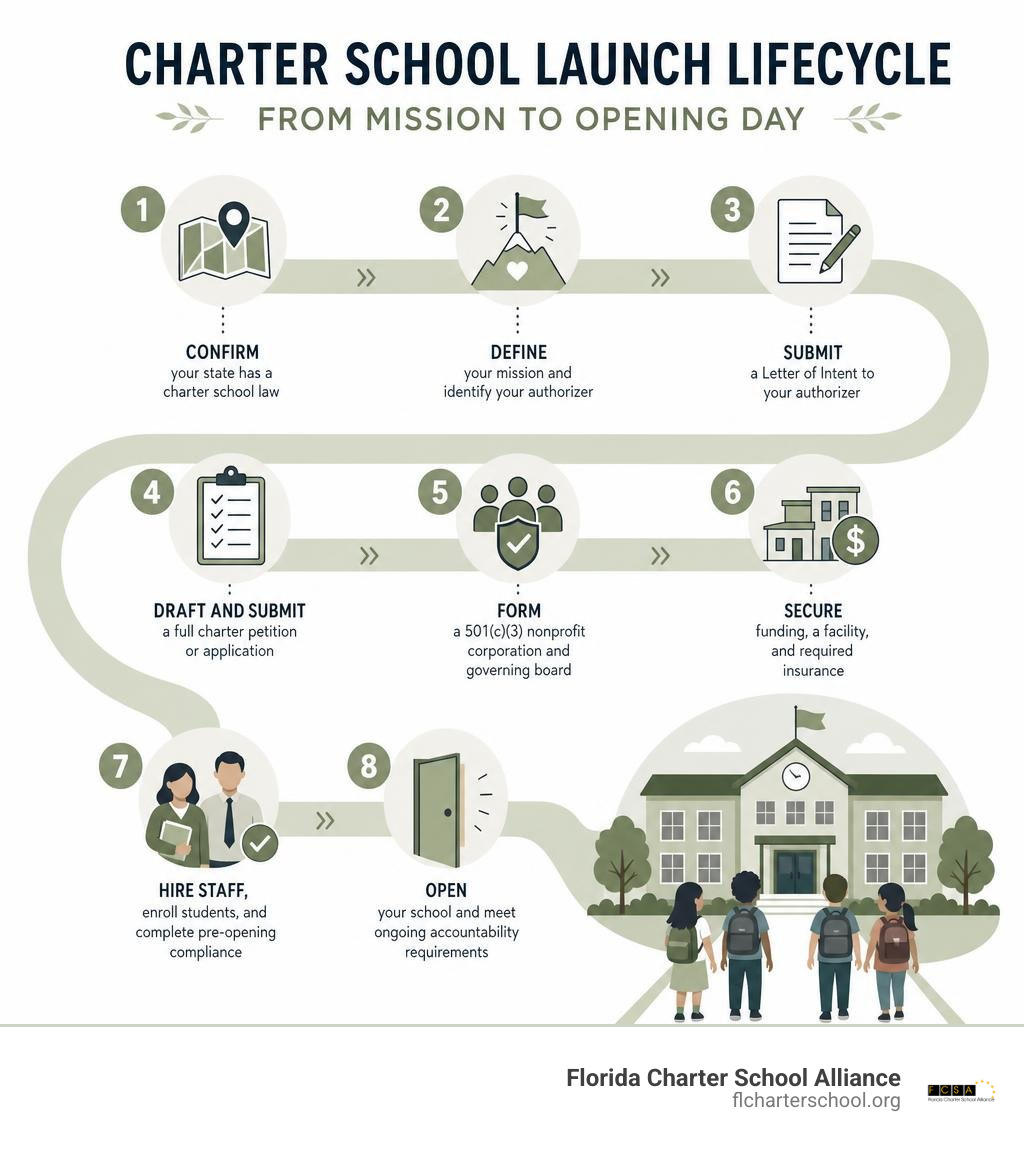
Starting a charter school is a legal process that typically takes one to two years before the first student walks through the door. Here is a quick overview of what it involves:
- Confirm your state has a charter school law
- Define your mission and identify your authorizer
- Submit a Letter of Intent to your authorizer
- Draft and submit a full charter petition or application
- Form a 501(c)(3) nonprofit corporation and governing board
- Secure funding, a facility, and required insurance
- Hire staff, enroll students, and complete pre-opening compliance
- Open your school and meet ongoing accountability requirements
The demand for high-quality public charter schools is real. In Philadelphia alone, more than 25,000 students are on waiting lists — a clear sign that families are hungry for better educational options. Public charter schools offer an innovative, accountable alternative to traditional district schools, and they do it at roughly 75% of the per-pupil cost. That combination of academic excellence and financial efficiency is exactly why so many educators, parents, and community leaders are choosing to build something new.
If you are an educator with a vision for a school that truly serves students — one built around innovation, high standards, and parental choice — this guide walks you through every step of the process.
I am Lynn Norman-Teck, Executive Director of the Florida Charter School Alliance, and I have spent my career supporting the development and success of high-quality public charter schools across Florida. My work in charter school policy, community engagement, and school operations gives me a front-row seat to what it actually takes to go from idea to open doors when starting a charter school — and I am here to share that knowledge with you.
The Legal and Practical First Steps in Starting a Charter School
To take a dream of educational innovation and turn it into a physical schoolhouse, we must start with a solid foundation. This foundational phase is where your core team, your community, and your legal framework come together.
First, we need to gather a passionate, skilled founding team. While a single visionary can spark the idea, it takes a diverse collective to carry out the rigorous work of starting a charter school. We recommend assembling a group of individuals who bring distinct expertise to the table—specifically in finance, K-12 education, local real estate, law, and community outreach.
Once your core team is assembled, your next task is to write a compelling mission statement. This statement should not be a collection of educational buzzwords. Instead, it must clearly define your school’s purpose, the specific population you aim to serve, and the unique instructional model you will use to drive student achievement.
To ensure your mission aligns with local needs, you must conduct a thorough community needs assessment. This involves:
- Analyzing local school district demographic data.
- Studying historical student enrollment patterns in your target neighborhood.
- Surveying local families to understand what educational gaps they believe exist.
- Holding informal town halls to listen to parent and neighborhood feedback.
This data-driven approach is critical. When we look at the broader landscape of public education, charter schools operate with remarkable efficiency, often educating students at just 75% of the cost of traditional school districts while maintaining a high standard of academic success. Demonstrating this potential for financial efficiency and community alignment is vital to gaining early support.
Legally, we must also ground our efforts in the specific statutes that govern these public institutions. In Florida, we operate under a robust legislative framework. Understanding the nuances of Charter School Law is non-negotiable, as it dictates everything from your operational autonomy to your accountability standards. For a broader look at how these legal obligations function nationally, the resource How to Start a Charter School: From Petition to Opening – LegalClarity provides an excellent overview of the legal steps and requirements that founders face across various jurisdictions.
Selecting an Authorizer and Navigating the Application Timeline
A charter school is a public school that operates under a performance contract (or “charter”) with an authorizing body. In Florida, the primary authorizers (or sponsors) are the local school districts. Selecting your authorizer is less about choosing from a list and more about understanding the specific district in which your school will reside.
The application process is highly structured and bound by strict statutory timelines. Missing a single date can delay your school’s opening by an entire academic year. To keep your team on track, we recommend reviewing our comprehensive guide on Everything You Need to Know About Charter School Deadlines.
For those starting their journey in Florida, the state provides official templates, evaluation rubrics, and technical assistance documents. Navigating these state-level resources is much easier when you leverage the tools on the New Applicant – Florida Department of Education portal.
Key Milestones in Starting a Charter School
Navigating the application process requires passing through several crucial milestones. Once you have submitted your initial paperwork, your proposal undergoes a multi-stage review by the district sponsor.
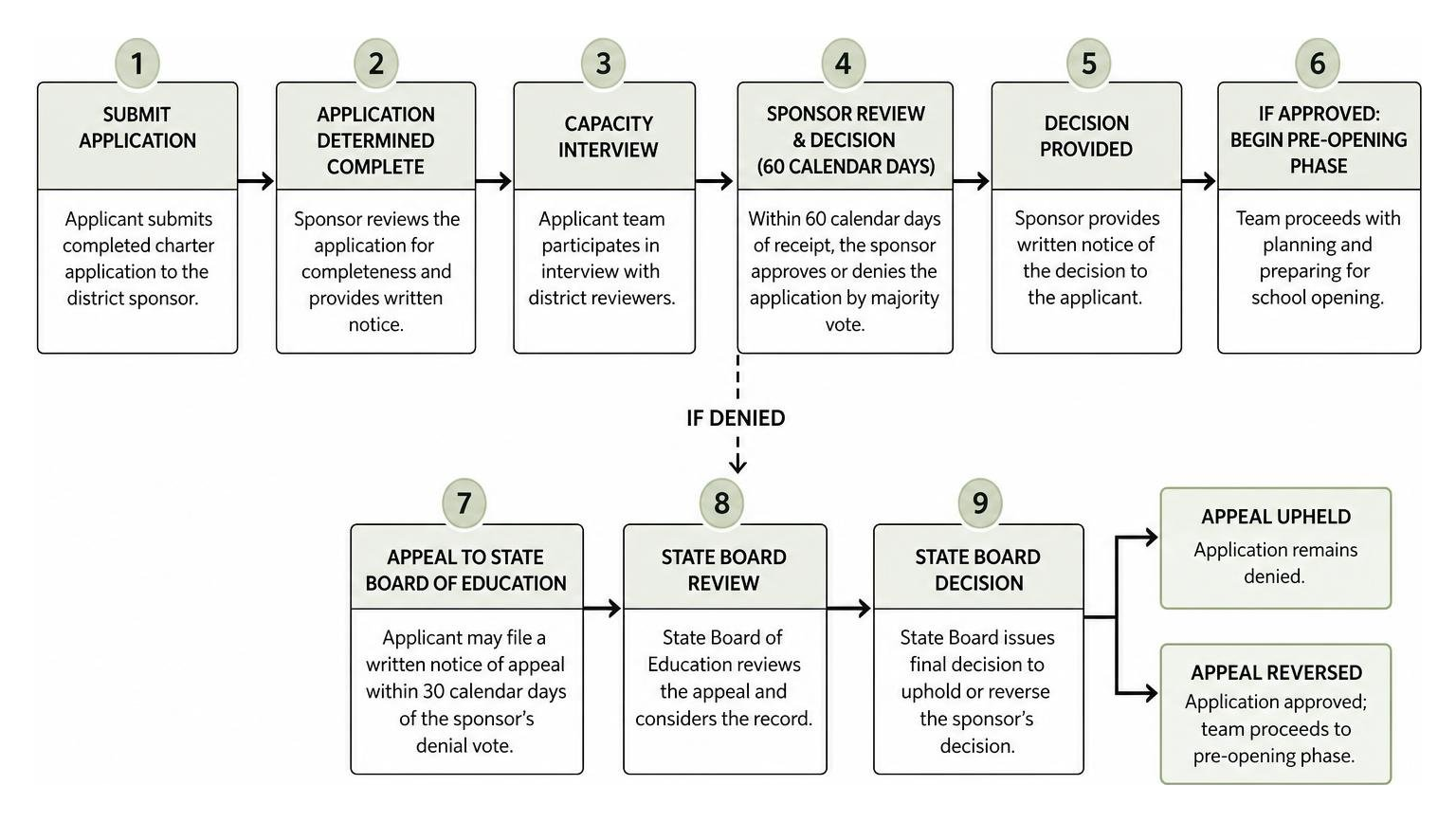
Under Florida law, once a sponsor receives a charter application, they have a 60-calendar-day window to approve or deny it by a majority vote. During this period, your founding team will participate in a capacity interview, where district reviewers grill you on your educational program, budget assumptions, and governance structure.
If the school district approves your application, we celebrate—and then immediately begin the intense pre-opening phase. If the application is denied, all hope is not lost. Applicants have the legal right to appeal the decision to the State Board of Education within 30 calendar days of the denial vote.
Crafting a Winning Petition for Starting a Charter School
Your charter petition is more than an application; it is a comprehensive business plan, an educational blueprint, and a legally binding accountability contract. To secure approval, your petition must excel in three core areas:
- The Educational Program: You must outline a rigorous, research-backed curriculum that aligns with state standards. It should clearly show how you will foster innovative learning, measure student progress, and support students who are reading below grade level.
- The Operational Plan: This section details how your school will run day-to-day. It must describe your governance structure, your student recruitment and marketing strategy, human resources practices, and safety protocols.
- The Financial Plan: Authorizers look closely at budgets. You must provide detailed, five-year financial projections with conservative enrollment assumptions. Every single budget line item must have a clear, written justification.
For a deep dive into how to draft these sections to meet local standards, read The Step-by-Step Guide to Starting a Florida Charter School.
Building a Strong Governance Structure and Nonprofit Foundation

A charter school is only as strong as the board that governs it. Because charter schools are public trusts run by private citizens, establishing a transparent, highly capable governance structure is essential for long-term viability.
Your first step is to incorporate as a Florida 501(c)(3) nonprofit corporation. Once incorporated, you must recruit your governing board. We recommend a board size of 7 to 11 members. To prevent conflicts of interest, initial board members must not be related parties, and we strongly advise against having teachers or parents serve as voting members during the start-up phase.
Board members must understand that their role is strictly focused on governance (setting the vision, ensuring financial health, and holding the school leader accountable) rather than management (the day-to-day operations of the schoolhouse).
To maintain legal compliance in Florida, all governing board members must complete state-mandated board training within their first 90 days of appointment. Additionally, because charter schools are public entities, your board must conduct all business in publicly noticed meetings, keep detailed minutes, and strictly adhere to Florida’s open meetings and public records laws (often referred to as the Sunshine Law). For a broader framework on building a resilient founding board that can weather the challenges of the pre-opening phase, consult the research-backed guide Starting .
Financial Planning, Facilities, and Pre-Opening Operations
The number one reason new charter schools face operational challenges in their early years is fiscal mismanagement or facility complications. Unlike traditional district schools, charter schools do not receive free public buildings, nor do they receive public funding before their doors open.
During the pre-opening phase, you must secure start-up capital. This is typically achieved through federal Charter Schools Program (CSP) planning grants, philanthropic donations, or low-interest loans. Once the school opens, your primary revenue source will be per-pupil funding (allocated through the Florida Education Finance Program, or FEFP). However, because FEFP funds are distributed based on actual student enrollment, you will experience a cash-flow gap during the summer months leading up to your first day of school.
Securing a safe, compliant facility is often a founder’s greatest hurdle. Your building must meet strict educational occupancy codes (such as the State Requirements for Educational Facilities, or SREF, in Florida) and secure a formal certificate of occupancy before any students can enter.
| Facility Option | Pros | Cons | Best Suited For |
|---|---|---|---|
| Leasing Commercial Space (e.g., retail, office parks) | Lower upfront capital, faster to secure | High renovation costs to meet educational codes, lease payments eat into operating budget | Start-up schools looking to open quickly with smaller initial enrollment |
| Purchasing / Building | Complete control over design, builds long-term equity | Requires massive upfront capital, complex zoning and construction delays | Established networks or schools with significant philanthropic backing |
| Municipal Partnerships / Co-location | Reduced facility costs, built-in community integration | Shared space limitations, complex inter-local agreements | Charter schools-in-the-workplace or municipality-sponsored schools |
Before signing a lease or purchase agreement, you must also secure comprehensive insurance coverage. This includes commercial general liability, Directors and Officers (D&O) liability, property insurance, workers’ compensation, and specialized student/sexual abuse coverage.
Student Enrollment, Staffing, and Ongoing Compliance

With your charter approved, your board trained, and your facility secured, you can focus on the heart of your school: the students and the educators who will guide them.
As public charter schools, our admissions processes must be open, fair, and transparent. Charter schools cannot charge tuition, and they cannot set selective academic admission requirements. If the number of student applications exceeds the physical capacity of your building, you must conduct a random, publicly noticed lottery to award enrollment seats.
We are also deeply committed to serving all students, which means ensuring full compliance with federal special education and disability rights laws, including the Individuals with Disabilities Education Act (IDEA) and Section 504 of the Rehabilitation Act. Whether your school operates as its own Local Education Agency (LEA) or under the umbrella of your authorizing district, you must budget for certified special education teachers and support staff from day one to ensure every child receives the services outlined in their Individualized Education Program (IEP).
When it comes to staffing, Florida law requires that all charter school teachers be state-certified, just like their counterparts in traditional district schools. You must also factor the cost and processing time of criminal background checks and fingerprinting into your hiring timeline, as these must be completed before any employee interacts with students.
Once your school is open, the work of maintaining compliance never stops. You will be subject to annual financial audits conducted by an independent certified public accountant, regular academic reviews by your sponsor, and ongoing operational reporting. To help you manage these post-opening requirements, we have compiled a set of best practices on Operating a Charter School.
Frequently Asked Questions About Charter Schools
Navigating the landscape of public charter schools often brings up common questions from founders, parents, and community members alike. For a quick reference on these and other topics, visit our Charter School FAQs.
Do charter schools charge tuition?
No. Public charter schools are tuition-free public schools. They are funded through public tax dollars and are open to all students. While charter schools do not charge tuition for the regular school day, they may charge reasonable fees for optional, non-academic services, such as before and after-school care programs.
What is a high-performing charter school?
In Florida, a “high-performing” charter school is a designation awarded by the Commissioner of Education to schools that demonstrate sustained academic excellence and financial stability. To earn this status, a school must receive at least two “A” grades and no grade below a “B” over the most recent three-year period, while maintaining clean financial audits. High-performing charter schools enjoy significant benefits, including the right to expand enrollment, add grade levels, and replicate their successful model in other districts. To learn more about how charter schools consistently achieve these high marks, read our update on how Florida Charter Schools Get an A.
How are charter schools funded?
Charter schools receive funding based on their student enrollment through the Florida Education Finance Program (FEFP). This per-pupil funding is generated from state sales tax and local property tax revenues. Because this funding follows the student, when a family chooses to enroll their child in a charter school, that student’s proportional share of public education funding moves with them. Charter schools can also supplement this operational funding through federal start-up grants (like the CSP), private philanthropy, and community partnerships.
Conclusion
Starting a charter school is undoubtedly a challenging journey, but it is also one of the most rewarding ways to drive educational innovation, expand parental choice, and empower families in your community. Every successful charter school begins as a simple blueprint—a shared vision of academic excellence and student-centered learning that eventually transforms into a thriving classroom.
You do not have to walk this path alone. The Florida Charter School Alliance (FCSA) is here to advocate for you, support your team, and provide the critical resources you need to turn your educational vision into a reality. If you are ready to take the first step toward launching a high-quality public charter school in Florida, we invite you to connect with our team of experts and access our specialized support services at the Florida Charter School Alliance Startup Portal. Together, we can build a brighter future for Florida’s students.