
How Special Education Charter Schools Serve Florida Students
Special education charter schools are tuition-free public schools that offer another choice for Florida families. Like other public schools, they must follow federal disability laws, provide eligible students with a free appropriate public education, and carry out required services in an IEP. A school may use a flexible teaching approach, but it cannot turn away a student because of a disability.
To explore your options, ask each school how it provides IEP services, 504 plan supports, related services, and access to general education classes. The answers can help you judge whether its approach fits your child.
I’m Lynn Norman-Teck, Executive Director of the Florida Charter School Alliance. My work in charter school development, policy, and family choice helps me explain what families should look for in special education charter schools.
Quick Special education charter schools definitions:
Understanding Special Education Charter Schools vs. Traditional Public Schools
Navigating school options can sometimes feel overwhelming, but understanding the core differences between educational models brings clarity. Public charter schools operate under an agreement—or charter—with a local school district authorizer or state entity. This structure grants them administrative and curricular flexibility while holding them strictly accountable for academic outcomes, fiscal management, and statutory compliance.
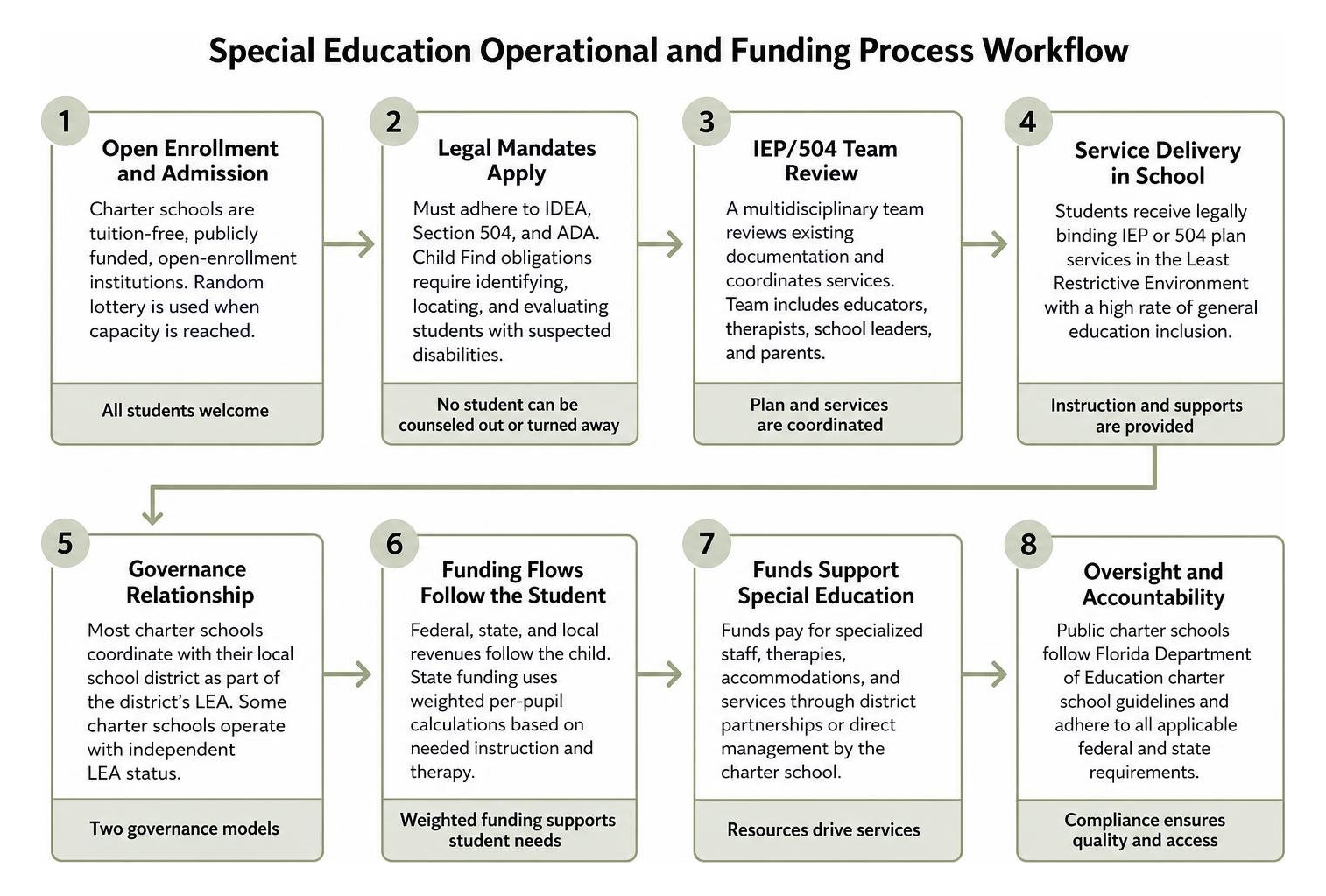
Both charter schools and traditional public schools are tuition-free, publicly funded institutions open to all children. When you explore all about charter schools, you will find that their unique operational freedom allows them to design innovative learning environments tailored to diverse student populations. If applications exceed classroom capacity, charter schools hold an open, randomized lottery to assign available seats fairly.
The Florida Department of Education charter school guidelines establish clear operational rules, ensuring that all public charter campuses adhere to open-door admissions.
| Feature | Public Charter Schools | Traditional Public Schools |
|---|---|---|
| Tuition & Cost | Tuition-free public institution | Tuition-free public institution |
| Admissions Process | Open enrollment; random lottery when capacity is reached | Zoned neighborhood boundaries or district choice options |
| Federal Disability Law Mandates | Must adhere to IDEA, Section 504, and ADA | Must adhere to IDEA, Section 504, and ADA |
| Curricular Structure | Flexible instructional design meeting state standards | Standardized district-wide curriculum frameworks |
| IEP & 504 Plan Delivery | Legally binding, provided by school or district linkage | Legally binding, provided by local school district |
| Inclusion in General Education | High rate of general education inclusion (over 80%) | Varies by campus resources and district program design |
Federal Protections and Legal Mandates Under IDEA and Section 504
Federal civil rights and education laws protect children with disabilities across all public educational settings. Under the Individuals with Disabilities Education Act (IDEA), every eligible child is entitled to a Free Appropriate Public Education (FAPE) delivered in the Least Restrictive Environment (LRE). This means that students must be educated alongside their non-disabled peers to the maximum extent appropriate.
Section 504 of the Rehabilitation Act and Title II of the Americans with Disabilities Act (ADA) prevent discrimination based on disability in any program receiving public funds. Charter schools are bound by “Child Find” obligations to identify, locate, and evaluate students suspected of having a disability. Because public charter schools are open-enrollment institutions, they cannot counsel out, turn away, or discourage any student from applying due to an IEP, behavioral accommodation, or diagnosed condition.
Managing IEPs, 504 Plans, and Special Education Funding

When a student with an Individualized Education Program (IEP) or 504 plan enrolls in a charter school, a multidisciplinary team convenes to review existing documentation and coordinate services. This team typically includes general education teachers, certified Exceptional Student Education (ESE) instructors, therapists, school leaders, and parents.
Special education delivery often depends on the school’s governance relationship with its authorizer. In Florida, most charter schools operate in close coordination with their local school district, serving as part of the district’s Local Education Agency (LEA). In this arrangement, specialized staff and district-wide funding models help support service delivery. Other public charter schools operate with independent LEA status, receiving direct federal and state IDEA disbursements to manage services, therapeutic contracts, and specialized staff directly.
Reviewing a practical guide to charter school funding shows how federal, state, and local revenues follow the child. State funding models utilize weighted per-pupil calculations based on the level of specialized instruction and therapy required. A comprehensive analysis of Florida special education enrollment data shows that public charter schools across the state continue to expand their capacity to serve students with diverse learning requirements.
The Benefits and Strengths of Inclusive Charter Environments
Public charter schools frequently excel in fostering inclusive learning cultures. Nationally, 83.1% of students with disabilities in charter schools spend 80% or more of their day in general education classrooms, compared to 67.5% in traditional district schools. This high level of integration ensures that students access grade-level standards while benefiting from individualized accommodations.
Many charter campuses implement co-teaching frameworks, pairing a general education teacher with an ESE specialist in the same classroom. This approach, combined with smaller class sizes, allows educators to offer flexible pacing, sensory adjustments, and targeted interventions. Our educators demonstrated this adaptability when serving SWD during distance learning, showing how dynamic methods support uninterrupted academic progress. Furthermore, educators statewide celebrate inclusive leadership, such as when a local charter school leader was honored for championing inclusive employment, demonstrating a sustained commitment to whole-person development.
Specialized Programs in Special Education Charter Schools
Some charter schools design their entire educational environment around specific developmental, physical, or neurodivergent profiles. These specialized schools bring clinical and therapeutic supports directly into the academic day, removing the logistical strain of coordinating after-school therapy appointments.
For example, the UCP Charter Schools unique program supports bring together certified physical, occupational, and speech therapists alongside academic instructors to serve children of all abilities under an inclusive umbrella. Similarly, specialized schools like the Foundation School for Autism provide early childhood intervention models that integrate Board Certified Behavior Analysts (BCBAs) and structured environments into the daily schedule.
These specialized campuses frequently incorporate:
- Dedicated sensory decompression rooms and calming spaces.
- On-site speech-language pathology and occupational therapy suites.
- Structured daily routines featuring visual schedules and predictable transitions.
- High staff-to-student ratios with dedicated paraprofessional support.
- Specialized post-secondary transition tracks focused on life skills, workforce readiness, and community independence.
Navigating Challenges, Compliance, and Authorizer Oversight
Operating high-quality special education programs requires rigorous oversight. Nationally, charter schools have expanded special education enrollment from 8% to 11.8% over the past decade, though challenges in matching resources to intensive needs remain an area of continuous improvement.
Charter authorizers play a critical role in maintaining service quality. During the application review and contract renewal cycles, authorizers evaluate an applicant’s capacity to deliver FAPE. Authorizers and state agencies review Total Special Education System (TSES) plans, monitor procedural timelines, and conduct formal compliance reviews, similar to state-level reviews found in published special education program compliance review reports.
Technical assistance initiatives and structured evaluation rubrics help charter operators manage compliance, maintain certified staff, and accurately track progress against measurable IEP benchmarks.
Practical Steps for Families Choosing a Charter School
Finding the right academic environment involves asking thoughtful questions. We encourage families to schedule campus tours and meet with school teams to evaluate services firsthand.
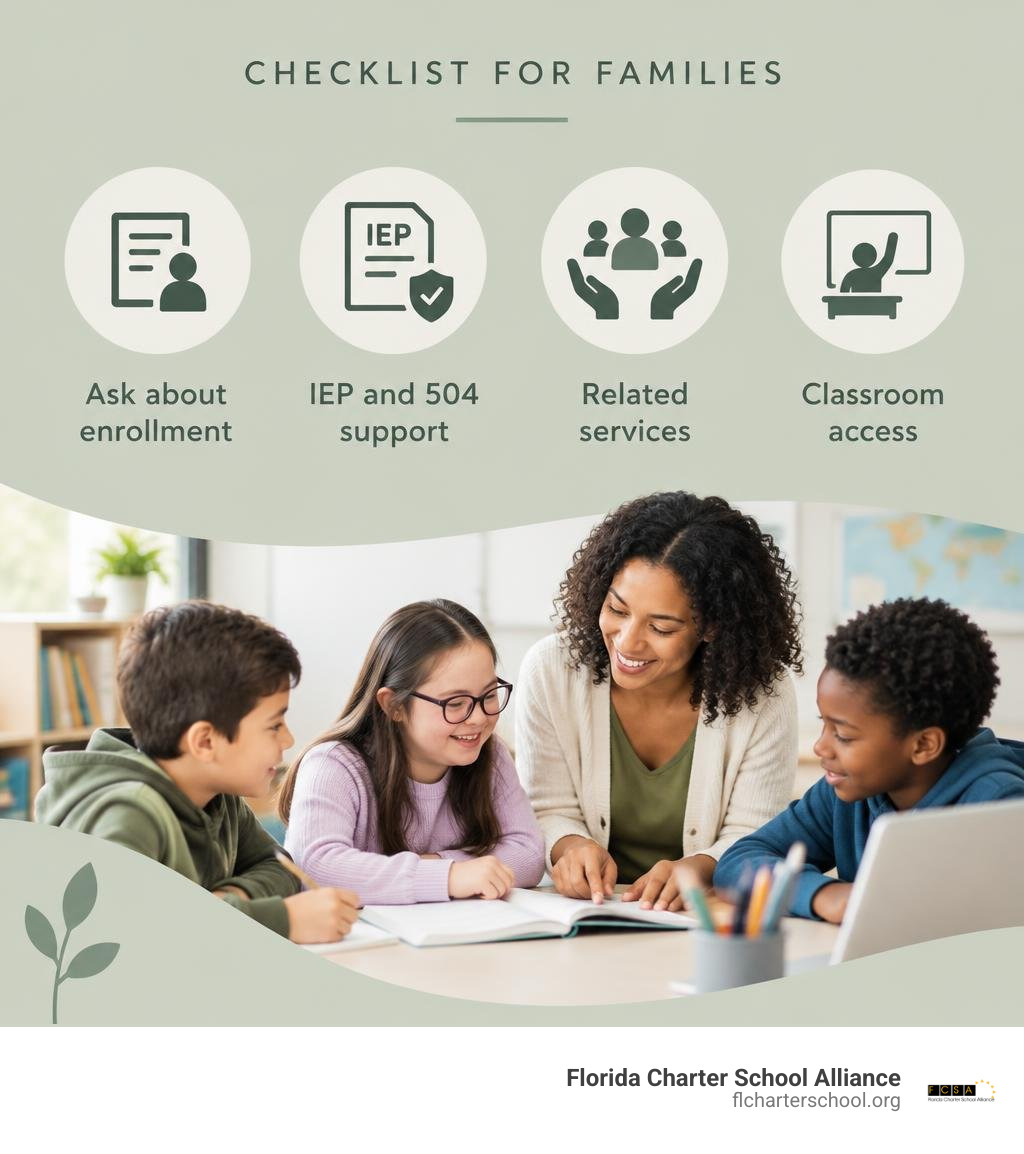
Use this checklist during your campus visits:
- IEP and 504 Implementation: How does the school team review, adapt, and implement existing plans for new students?
- Instructional Delivery: What service models are used (e.g., push-in co-teaching, resource pull-out, or small group instruction)?
- Therapy Coordination: Are related services—such as speech, occupational, or physical therapy—provided on campus during school hours?
- Behavioral Supports: What positive behavioral interventions, sensory spaces, or de-escalation strategies are available?
- Staff Credentials: Are ESE educators and paraprofessionals fully certified and trained in specialized behavioral and learning strategies?
- Progress Monitoring: How frequently is student data collected and communicated to parents outside of annual IEP reviews?
For additional answers to general operational inquiries, explore our charter school FAQs.
Evaluating Special Education Charter Schools for Your Child
When touring a campus, evaluate both physical accessibility and the overall school environment. Look for wide hallways, accessible restrooms, designated calming areas, and assistive technology embedded into regular classroom instruction.
Families researching localized public school options can review regional tools, such as the directory of Palm Beach County special education programs, to identify campuses offering specialized sensory, behavioral, or therapeutic interventions.
Frequently Asked Questions about Charter Special Education
Do charter schools have to accept students with IEPs?
Yes. As public schools, charter schools must abide by federal zero-reject principles under IDEA and Section 504. They cannot deny admission, discourage enrollment, or counsel families away because a student has an IEP or requires specialized accommodations. If applicant numbers exceed grade-level caps, admissions are determined by a random, transparent lottery.
Are charter schools better suited for autistic students?
Many families find that public charter schools provide an ideal setting for autistic learners due to smaller campus environments, flexible pacing, structured sensory supports, and personalized attention. However, every child has unique strengths and requirements. Visiting schools and speaking with ESE coordinators helps determine if a specific campus culture and resource structure align with your child’s needs.
Who is responsible for providing related services and transportation?
Responsibility depends on the charter school’s operating agreement and LEA structure. In Florida, charter schools coordinate with their authorizer or contract directly with certified specialists to deliver all mandated therapies—including speech, occupational, and physical therapy. If specialized transportation is written into a student’s IEP as a required related service, the school or district ensures appropriate transportation is provided.
Conclusion
Every child deserves an enriching, supportive educational environment that recognizes their unique potential and fosters academic success. Public charter schools offer Florida families innovative, high-quality, and accountable pathways designed to help diverse learners excel. By asking clear questions, reviewing campus resources, and partnering with dedicated educators, you can find a learning community where your child thrives.
To discover how expanding parental choice strengthens communities and elevates student success across our state, read our perspective on how school choice empowers Florida families and improves educational outcomes. At the Florida Charter School Alliance, we remain dedicated to supporting quality public charter schools and helping families navigate their education choices with confidence.