
Understanding the Charter School Lottery System and Why It Exists
A charter school lottery system is an impartial, blind randomization process used by tuition-free public charter schools to allocate student seats fairly whenever application demand exceeds physical classroom capacity. Because public charter schools maintain open enrollment policies and non-discriminatory admission standards, they cannot evaluate applicants through auditions, academic tests, or interviews. When interest outpaces available desks, a transparent draw ensures equal access. Understanding how the school choice lottery system actually works helps families navigate these innovative public campuses that expand parental choice and foster student achievement.
Across the United States, more than 7,800 charter schools serve over 3.7 million students—an enrollment figure that has more than tripled over the past two decades. In Florida alone, 732 charter schools served 406,832 students across 48 counties during the 2024–25 academic year, offering rigorous, student-centered academic programs ranging from STEM academies to performing arts.
How Demand Triggers a Random Selection Draw
Every public charter school operates within strict physical and contractual capacity limits. Charter agreements establish maximum student capacity caps across total campus enrollment and specific grade levels.
When the open enrollment application window closes, school administrators tally the submissions. If the number of qualified applicants is less than or equal to the number of available seats, every student is accepted immediately. However, when a school experiences oversubscription—meaning more families apply than there are physical desks available—the school is legally required to trigger a blind, random selection draw.
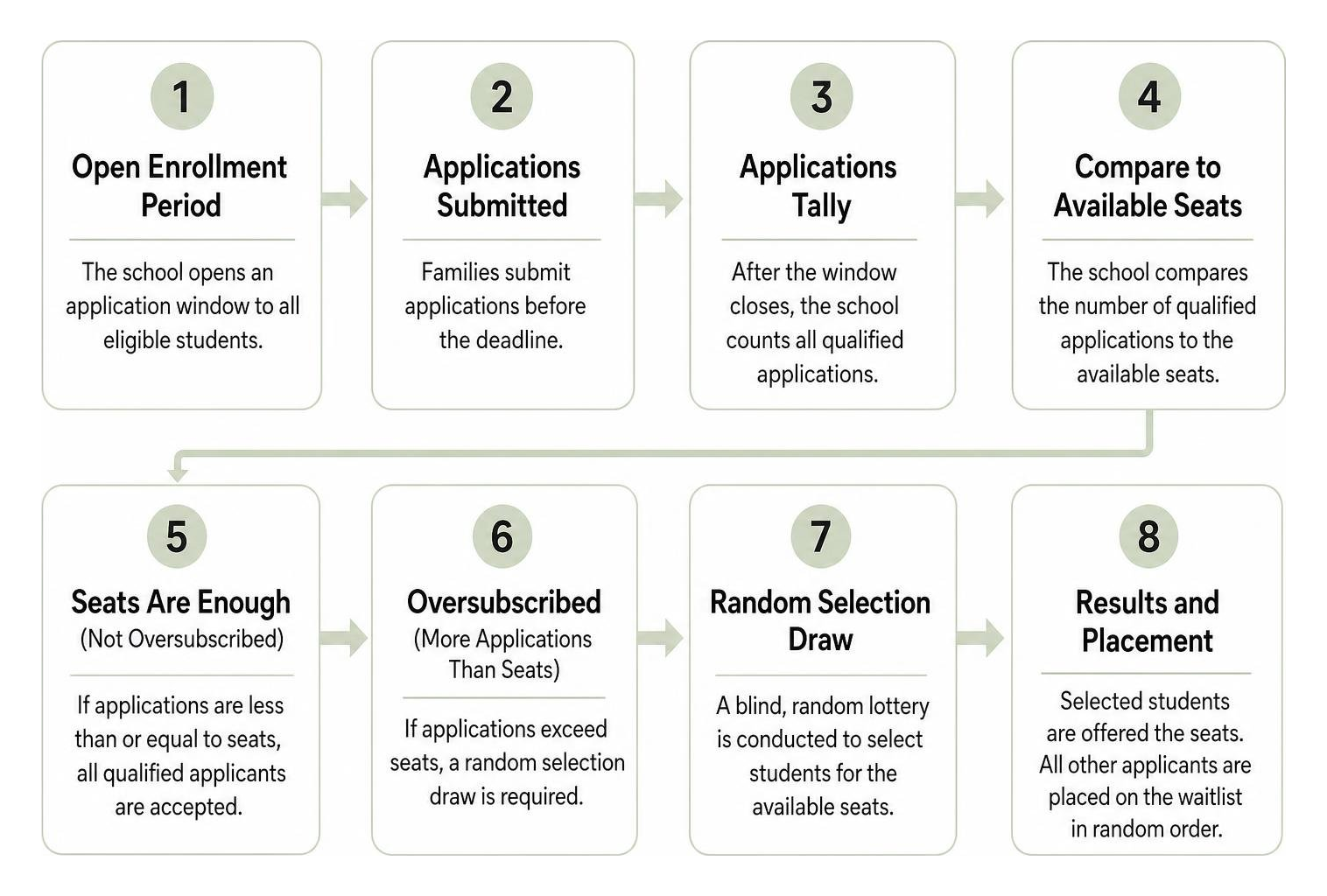
This random selection process is applied grade by grade. Because Kindergarten and 6th grade are common entry points, they often experience the highest demand, while transitional grades may only have a handful of seats available due to existing student retention.
Public Accountability and Open Enrollment Mandates
Charter schools are built on a foundation of public accountability. Unlike private schools, they cannot charge tuition or administer academic entrance exams. Florida law mandates that charter schools remain non-sectarian, tuition-free, and fully accessible to all eligible students within their authorizing jurisdiction.
State regulations require robust public oversight to prevent administrative favoritism. Detailed operational guidelines like Charter School Regulations 119.5 and independent resources exploring How Does a School Lottery System Work? demonstrate that public school admissions must prioritize equal opportunity above all else. Every student who submits a complete application within the published timeline enters the draw with an equal baseline probability of securing a desk.
Step-by-Step Mechanics: How the Lottery Process Works
Modern school lotteries have evolved from pulling numbered ping-pong balls out of a rotating drum to highly audited, digital systems.
The lottery lifecycle follows several concrete phases:
- Application Window Open: Schools establish a published enrollment window during which families submit basic student identification and residency data.
- Data Verification & Scrubbing: Administrative staff review submissions to remove duplicate applications and verify eligibility criteria (such as age requirements for Kindergarten).
- Priority Tagging: Permitted statutory preferences (such as sibling status) are verified and tagged within the system.
- Random Draw Execution: An automated, cryptographic algorithm or supervised public draw establishes an initial roster and an ordered waitlist.
- Impartial Observation: The selection must be conducted or observed by an independent third party. State guidelines require that impartial observers cannot be board members, school employees, or relatives (parents, siblings, grandparents, aunts, uncles, or first cousins) of any applicant or enrolled student.
- Result Publication & Audit Logging: Seat offers and waitlist numbers are generated and communicated directly to families.
Applying Software and Algorithms in the Charter School Lottery System
Most modern public charter networks utilize purpose-built software to manage large-scale lotteries. Platforms like Lotterease and purpose-built Charter School Lottery Software apply crypto-secure randomization algorithms to ensure that the draw order cannot be manipulated or predicted.
These platforms maintain timestamped, immutable audit logs that record the precise millisecond each application was processed. Built to adhere strictly to Family Educational Rights and Privacy Act (FERPA) regulations, these systems protect sensitive student data while generating exportable verification reports. If an authorizer or parent requests an audit, the software provides mathematical proof that every applicant was processed in accordance with the school’s approved admissions policy.
How Weighted Lottery Rules Differ from Standard Draws
While a standard charter lottery gives every non-priority applicant an identical mathematical probability of selection, some schools implement weighted lotteries. A weighted lottery assigns additional statistical weight (often represented as an additional digital “ticket” in the draw) to specific educationally disadvantaged student subgroups to foster socioeconomic diversity.
Under federal Charter Schools Program (CSP) guidelines, schools receiving certain grant funds may only implement weighted lotteries with authorizer approval, and students can only receive a single weight category.
| Feature | Standard Lottery Draw | Weighted Lottery Draw |
|---|---|---|
| Selection Basis | Pure random mathematical distribution across all general applicants. | Mathematical weight assigned to specific eligible student subgroups. |
| Target Population | General applicant pool across grade levels. | Educationally disadvantaged or at-risk student populations. |
| Statistical Odds | Every general applicant has an identical 1:1 draw probability. | Targeted subgroups receive adjusted odds (e.g., a 2:1 ticket ratio). |
| Regulatory Approval | Standard operating charter compliance. | Requires specific authorizer and state-level policy authorization. |
| Multi-Weighting | Not applicable. | Strictly limited to a single weight per student to prevent compounding bias. |
Enrollment Preferences and Priority Tiers Explained
State law permits charter schools to establish specific priority tiers before running the general public lottery. These tiers recognize community connections, family continuity, and school founding efforts without compromising overall equity. Practicing clear Florida charter school transparency means publishing these priority hierarchies prominently on the school’s website well before enrollment opens.
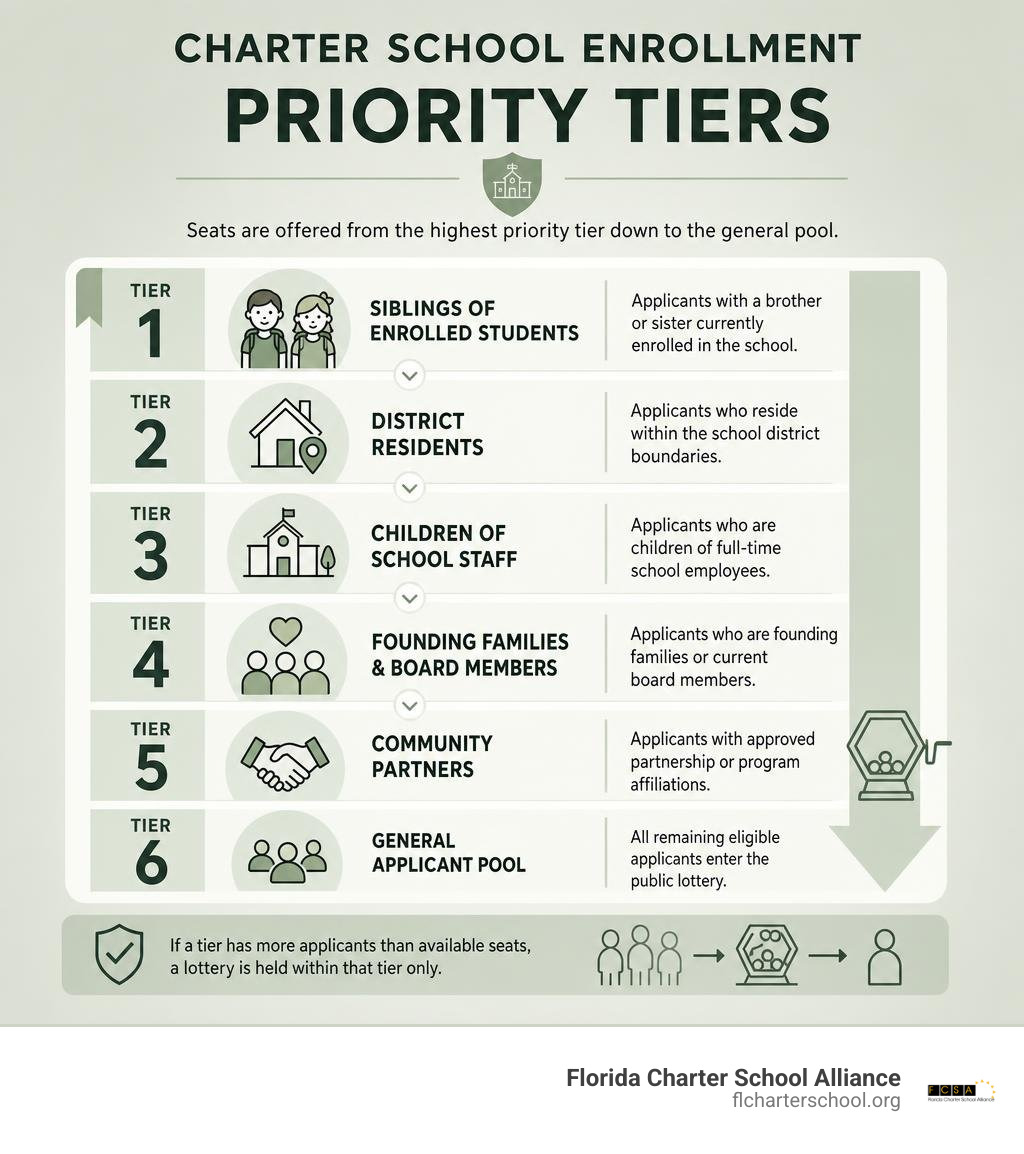
When seats are allocated, they are distributed sequentially from the highest priority tier down to the general applicant pool. If a priority tier contains more applicants than available seats, an internal lottery is run exclusively within that tier.
Statutory Priorities: Siblings, District Residents, and Staff
Under Florida law and standard charter governance, priority tiers generally follow a structured order:
- Returning Students: Pupils already enrolled in the charter school during the prior academic year are guaranteed their seats and do not participate in the lottery.
- Sibling Preference: Siblings of currently enrolled students receive primary priority to ensure families can keep their children at the same school campus.
- District Residents: Students residing within the school district where the charter is located receive preference over out-of-district applicants seeking open enrollment across county lines.
- Children of Employees & Board Members: To support recruitment and community retention, schools may provide an enrollment preference to children of school employees and board members. State regulations strictly cap this category—typically limiting it to no more than 15% of the school’s total student enrollment.
Municipal and Workplace Charter Preferences
Florida statutes also authorize specialized public charter structures that serve distinct community and workplace needs:
- Charter Schools-in-the-Workplace: Created through partnerships with business organizations, these schools allocate a portion of their enrollment to the children of company employees, while reserving remaining seats for the local community.
- Charter Schools-in-a-Municipality: Established by local municipal governments, these public charters provide enrollment preferences to children residing within the municipal boundaries, helping towns build neighborhood-centered public school options.
In both models, if applications within the workplace or municipal group exceed available capacity, a random lottery must be conducted among those eligible applicants to ensure balanced and fair representation.
How to Navigate Deadlines, Results, and Waitlists
Securing a seat requires proactive planning and adherence to strict registration timelines. When preparing your family’s educational plan, use our directory to find a charter school and note the admissions dates for each campus of interest.
Managing Timelines in the Charter School Lottery System
Every charter school sets its own operational calendar, but open enrollment windows generally launch in late fall or early winter for the upcoming academic year. Mastering these schedules is straightforward once you review everything you need to know about charter school deadlines.
Key milestones in the timeline include:
- Open Enrollment Period: Applications are collected over a multi-month window (typically November through February). Submitting on day one yields the exact same lottery odds as submitting on the final day of the open window.
- Post-Deadline Cutoff: Applications submitted after the formal deadline are excluded from the lottery draw and placed directly onto the post-lottery waitlist in the order received.
- Notification Window: Results are released via email, text, or parent portal dashboards within a few days of the draw.
- Acceptance Window: Families offered a seat typically have a firm window (often 7 to 14 calendar days) to formally accept the offer and submit required registration documents.
What Happens If Your Child Is Placed on a Waitlist
Receiving a waitlist notification is common, but it is not the end of the road. Because parents frequently apply to multiple schools to explore their options, significant waitlist movement occurs throughout the spring and summer.
Waitlists are strictly sequential. If a student is assigned waitlist position #12, they will move up to position #11 as soon as one admitted student declines their offer. Mid-year vacancies also trigger immediate outreach to waitlisted families.
If your child receives an enrollment offer, you will need to provide essential verification records:
- Proof of child’s age (official birth certificate or passport)
- Proof of Florida residency (utility bill, lease agreement, or mortgage statement)
- Florida Department of Health immunization records (Form DH 680)
- School-entry health examination report (Form DH 3040)
- Prior academic records and transcripts (if applicable)
- Individualized Education Program (IEP) or 504 Plan documentation (if applicable)
Debunking Common Misconceptions About Charter Lotteries
Because charter schools enjoy curricular flexibility and high parental demand, several myths persist regarding how their admissions work. You can explore our extensive charter school FAQs to review the facts behind public school choice.
Myths vs. Facts: Academic Screening, Fees, and Tampering
- Myth: Charter schools only accept high-performing students.
Fact: Charter schools cannot administer academic entrance exams, evaluate prior test scores, or screen students based on grades. They are open-enrollment public schools designed to serve students of all abilities and backgrounds. - Myth: Students with special needs cannot participate in the lottery.
Fact: Federal civil rights laws and state statutes require charter schools to admit students with disabilities. Individualized Education Programs (IEPs) and 504 Plans are accommodated just as they are in traditional public schools. - Myth: There is a fee to enter the lottery or secure a higher spot.
Fact: Charging fees for lottery entry or enrollment is strictly illegal under public school law. Charter schools are completely tuition-free. - Myth: School administrators hand-pick students behind closed doors.
Fact: Digital random number generators, third-party oversight, and public drawing requirements prevent administrative tampering. Audit trails provide clear records for state review.
Frequently Asked Questions About Charter School Lotteries
Can applying earlier in the open window increase my lottery odds?
No. As long as your application is received before the published deadline, applying on the first day gives you the exact same odds as applying on the final day. All applications received during the open window are pooled together for the random draw. Submissions received after the deadline, however, are placed at the bottom of the waitlist on a first-come, first-served basis.
Do charter school lotteries cost anything to enter?
No. Charter schools are tuition-free public institutions. They are prohibited by state and federal law from charging application fees, entrance fees, or tuition for the standard academic day.
What records ensure the lottery draw is fair and impartial?
Charter schools maintain verifiable digital audit trails that record every step of the randomization process. Additionally, state guidelines require independent observers who have no personal or professional ties to the school or applicant pool. Draw methodologies, preference documentation, and results are retained for review by the school district sponsor and the state department of education.
Conclusion
Every child deserves an educational environment where they can thrive, discover their strengths, and build a foundation for lifelong success. Public charter schools play an essential role in expanding parental choice across Florida by offering innovative, student-centered learning models that raise the bar for academic achievement. From rigorous collegiate academies to specialized arts and career-technical programs, these schools demonstrate how flexibility and public accountability work hand in hand.
When exceptional demand leads to an enrollment lottery, the process is designed to protect every family’s right to equal access. By understanding how priority tiers, application windows, and waitlists operate, you can confidently navigate your options. At the Florida Charter School Alliance, we remain committed to empowering parents, supporting high-quality public schools, and ensuring that every Florida family has access to the educational opportunities their children deserve.