
How the School Choice Lottery System Works (Quick Answer)
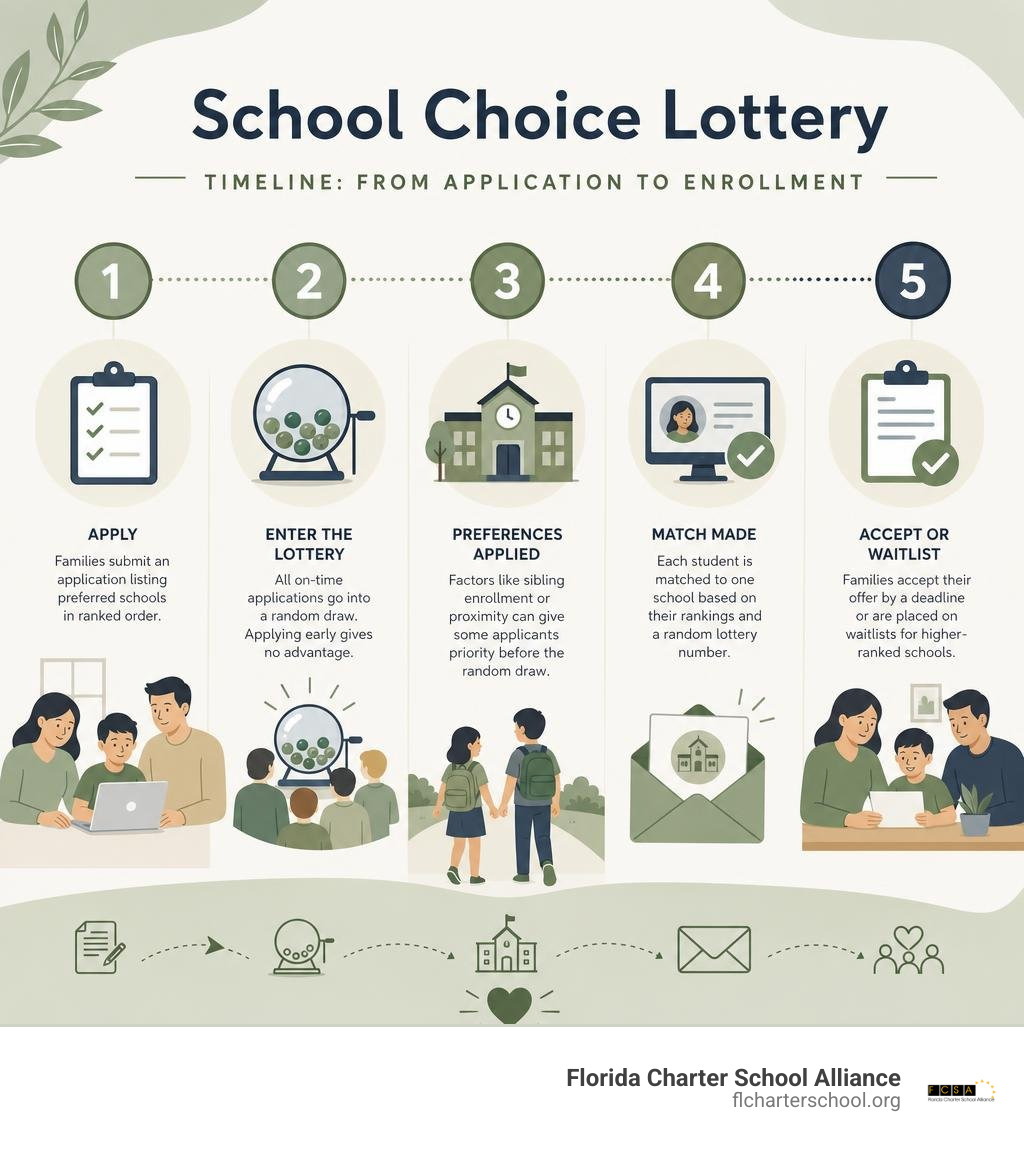
The school choice lottery system is how many public school districts fairly assign students to schools when more families want a spot than there are seats available. Here’s how it works at a glance:
- Apply – Families submit an application listing their preferred schools in ranked order, within a set deadline.
- Enter the lottery – All on-time applications go into a random draw. Applying early gives no advantage.
- Preferences applied – Factors like sibling enrollment or proximity can give some applicants priority before the random draw.
- Match made – Each student is matched to one school based on their rankings and a random lottery number.
- Accept or waitlist – Families accept their offer by a deadline or are placed on waitlists for higher-ranked schools.
Choosing the right school for your child is one of the most important decisions a family can make. But when demand exceeds available seats — which happens often at high-quality public charter schools and magnet programs — a fair, transparent process is needed to decide who gets in.
That process is the lottery.
For many families, especially those seeking innovative or specialized programs, the lottery can feel confusing or even intimidating. Deadlines vary by district. Preferences differ by location. And missing a key step can mean losing your spot entirely.
This guide breaks it all down in plain language so you can navigate the process with confidence.
I’m Lynn Norman-Teck, Executive Director of the Florida Charter School Alliance, and I’ve spent my career helping families and school leaders understand how the school choice lottery system works — and how to use it to access high-quality educational opportunities. As we walk through each step together, you’ll see exactly what to expect and how to give your child the best possible chance at the school that’s right for them.
School choice lottery system further reading:
What is a School Choice Lottery System and How Does It Work?
At its core, a school choice lottery system is a fair, centralized process designed to allocate school seats when demand exceeds capacity. Instead of a first-come, first-served system—which naturally favors families with the time and resources to apply the second a portal opens—a lottery levels the playing field. It ensures that every student has an equal opportunity to access high-quality educational options.
Many major metropolitan areas and school districts have transitioned to what is known as a “common lottery.” A prime example of this is About My School DC | My School DC , which replaced a fragmented system of multiple separate applications with a single, streamlined process. Under a common lottery, families submit one application listing their preferred schools in ranked order.
To determine matches fairly, these modern systems often utilize the Deferred Acceptance algorithm, also known as the Gale-Shapley algorithm (a Nobel Prize-winning mathematical model). This system is “strategy-proof,” meaning there is no advantage to trying to “game” the system. According to the FAQ | My School DC , families are highly encouraged to rank schools in their true order of preference.
Here is how the algorithm processes your application:
- The computer assigns every applicant a random lottery number.
- The system attempts to place each child in their first-choice school.
- If a school has more applicants than seats, the system looks at priority tiers (such as sibling or proximity preferences) and then uses the random lottery numbers to break ties.
- If a student cannot be placed in their first choice, the system automatically tries to place them in their second choice, and so on.
- Crucially, a student will only receive a single best offer. If they are matched with their third-choice school, they are automatically placed on the waitlist for their first and second choices, but they are removed from the running for any schools ranked lower than third.
This mathematical approach maximizes matches, eliminates duplicate holding of seats, and guarantees that families are not penalized for aiming high.
Key Differences: Lottery-Based Choice vs. Selective Admissions vs. Controlled Open Enrollment
Navigating public school choice requires understanding the different pathways available to families. Not all choice programs operate the same way. Below is a comparison of the three primary school choice mechanisms:
| Feature | Lottery-Based Choice | Selective Admissions | Controlled Open Enrollment (COE) |
|---|---|---|---|
| Primary Mechanism | Random computer drawing | Academic/criteria-based evaluation | Inter-district and intra-district transfers based on capacity |
| Academic Requirements | None (open to all eligible students) | High (requires test scores, auditions, or transcripts) | None (subject to school capacity limits) |
| Who Governs It | Individual charter schools or district central offices | Specialized magnet or criteria-based high schools | State guidelines and local school boards |
| Best Suited For | Families seeking innovative public charter schools or theme-based programs | Students pursuing highly specialized academic, arts, or CTE tracks | Families looking to attend a traditional public school outside their zoned boundary |
In Florida, the state’s framework for School Choice – Florida Department of Education ensures that families have access to all three pathways.
While selective admissions programs look at past academic performance, auditions, or portfolios, public charter schools focus on open, equitable access. Under Florida law, public charter schools must accept all students. If a charter school receives more applications than it has seats available, it is required by law to conduct a random lottery to ensure fair admission. This makes public charter schools an incredibly accessible vehicle for families seeking academic excellence, student-centered learning, and innovative curricula without selective barriers.
Navigating the Application Process and Key Deadlines
Participating in a school choice lottery requires careful planning and attention to detail. Because deadlines are strict, missing a window can exclude your child from the main lottery entirely.

To secure your spot, we recommend following these standard, actionable steps:
- Research and Tour: Explore local options early. Look for schools that offer innovative learning models, such as STEM, dual-language, or classical education.
- Create Your Parent Portal Account: Most districts and charter networks require you to register through an online portal. For example, in Columbus City Schools, families must complete online registration with all necessary documents by March 13, 2026, to guarantee portal access before the lottery deadline.
- Prepare Required Documents: Have your proof of residency, child’s birth certificate, and immunization records ready.
- Rank Your Choices Carefully: Since modern lottery algorithms prioritize your ranking, list your absolute favorite school as number one.
- Submit Before the Deadline: Submit your application within the designated window. Applying on day one of the window gives you no advantage over applying on the final day, but late applications are pushed to the bottom of the waitlist.
Deadlines vary widely across different regions. For instance, the Fort Wayne Community Schools (FWCS) lottery opens on December 1, 2025, for the 2026-27 school year, with on-time applications accepted through March 1, 2026. In Washington, D.C., the My School DC lottery requires applications by February 2, 2026, for grades 9-12, and March 2, 2026, for PK3 through grade 8.
For Florida families, keeping a close eye on individual public charter school enrollment windows is essential. To learn more about how charter schools empower parents with flexible, high-quality options, you can read our guide on Empowering Parents: Information About Charter Schools.
Sibling and Proximity Priorities in the School Choice Lottery System
While the lottery is random, school districts and public charter schools build specific “preferences” or “priorities” into the system to support families and communities. These preferences act as tie-breakers before the general random drawing occurs.
- Sibling Preference: Keeping families together is a high priority. If a student already has a sibling enrolled at a school, the applying sibling is given a significant priority boost. In some systems, twins and multiples can be linked on a single application so they are admitted together.
- Proximity/Neighborhood Preference: Many districts give priority to families living within a certain radius of the school or within designated neighborhood boundaries.
- At-Risk or Equitable Access Priorities: Some lotteries reserve a percentage of seats for students from low-income households, English learners, or students with special needs to ensure equitable access.
To manage these complex priorities transparently, many high-quality public charter schools utilize automated lottery software. Tools like Lotterease ensure that sibling and proximity rules are applied with absolute precision and fairness. To see how these tools improve equity, read about how Lotterease Brings the Benefits of Charter Schools to All Children.
Managing Waitlists and Late Applications in the School Choice Lottery System
What happens if your child isn’t matched with their top-choice school during the initial lottery? They will be placed on a waitlist.
Waitlist management is dynamic. As families decline offers or move out of the area, seats open up, and the system automatically pulls the next student from the waitlist.
If you miss the main lottery deadline, you can still submit a late application. However, late applications are generally processed in the order they are received and placed at the bottom of the waitlist, behind all on-time applicants. For example, in San Diego Unified, applications received after November 15, 2025, are excluded from the January lottery and processed sequentially. In Hamilton County, a formal “2nd Round” application window opens from April 13 to July 17, 2026, specifically for families who missed the first round, placing them on the remaining seat lists as space permits.
For charter schools, managing these waitlists efficiently is vital to maintaining full enrollment and communicating clearly with anxious parents. Systems like Easysuite help schools automate this communication, ensuring parents get real-time updates on their waitlist status. You can learn more about these administrative tools by reading how Easysuite Offers Lotterease, FoodEase.
Important Considerations: Transportation, Special Needs, and Out-of-District Policies
Before accepting a school choice match, there are several practical logistics that families must carefully evaluate.

Transportation Limitations
One of the most common surprises for families participating in school choice is transportation. Unlike traditional neighborhood schools, school districts do not always provide busing for students attending choice schools outside their zone. For example, in many districts, transportation is only guaranteed for magnet programs or if specifically outlined in a student’s Individualized Education Program (IEP). Parents are often responsible for organizing carpools, using public transit, or driving their children to school.
Supporting Students with Special Needs and English Learners
Public charter schools and district choice programs are fully committed to serving all students, including English learners (ELs) and students with disabilities. In robust systems like the School Selection | The School District of Philadelphia , an “Individualized Review” process is available for students with IEPs or 504 plans to ensure they receive the necessary accommodations and support services at their chosen school. Public charter schools must provide services to students with disabilities in compliance with state and federal laws, ensuring that school choice remains a gateway to educational access for every child.
Out-of-District Eligibility
Thanks to Florida’s Controlled Open Enrollment laws, families are not strictly limited to the schools in their immediate residential zone. If a public school or charter school has open seats, students from neighboring counties can apply. However, out-of-district families must typically verify residency and agree to handle their own transportation to and from the school.
Frequently Asked Questions About School Choice Lotteries
What happens if I miss the enrollment deadline after being matched?
If you are offered a seat through the lottery, you must formally accept the offer and complete enrollment by the district’s specified deadline. If you miss this deadline, you will forfeit your seat, and it will be offered to the next student on the waitlist.
For example, in Fort Wayne Community Schools, the deadline to accept a lottery award is April 17, 2026. In Palm Beach County, where Controlled Open Enrollment lottery results for the 2026-2027 school year were released on May 29, 2026, families who miss their registration windows lose their hard-earned spots. You can find detailed local guidelines on the School Choice – Palm Beach County School District page.
Do public charter schools use the same lottery system as district schools?
Not always. While some districts include charter schools in their centralized common lottery, many public charter schools in Florida manage their enrollment independently. Because charter schools are governed by autonomous, community-based boards, they often run their own random drawings.
If a charter school has more applicants than seats, they will hold an independent, transparent lottery. To understand more about charter school operations, enrollment policies, and funding, check out our comprehensive Charter School FAQs.
How can out-of-district families apply for a school choice lottery?
Out-of-district families can participate in school choice lotteries through Controlled Open Enrollment. You will need to submit an application through the target school’s portal during their open window.
While priority is often given to in-district residents, out-of-district students are placed in the lottery or on waitlists for any remaining available seats. Districts like Leon County provide clear instructions on how out-of-county families can begin this process; you can learn more on the Welcome to School Choice! – Leon County Schools website.
Conclusion
The school choice lottery system is a powerful mechanism that transforms public education into a fair, accessible, and parent-driven landscape. By replacing outdated enrollment barriers with random, strategy-proof lotteries, every family—regardless of their zip code—gains the power to choose an educational environment that aligns with their child’s unique needs.
At the Florida Charter School Alliance, we believe that family empowerment and student-centered learning are the keys to academic excellence. Public charter schools across Florida continue to deliver outstanding student achievement, offering innovative learning environments, certified teachers, and rigorous accountability.
If you are ready to explore the high-quality, tuition-free public charter school options available in your community, we invite you to take the next step. Use our interactive tool to Find a Charter School near you and begin your journey toward a customized, world-class education.
For more insights on how educational freedom is shaping the future of our state, read our full editorial on how School Choice Has Put Florida Schools Head and Shoulders Above the Rest.