Charter School vs Public School: Core Governance and Funding Differences
To truly evaluate the charter school vs public school comparison, we need to start with how these institutions are structured. A common myth is that public charter schools are private schools. In reality, public charter schools are 100% public, tuition-free, nonsectarian institutions open to all students.
The primary difference lies in governance and autonomy. Traditional public schools are governed directly by county school district boards that dictate unified district-wide curricula, staffing policies, and operating budgets. Public charter schools, on the other hand, operate under a performance contract (a “charter”) approved by an authorizer — in Florida, typically the local district school board.
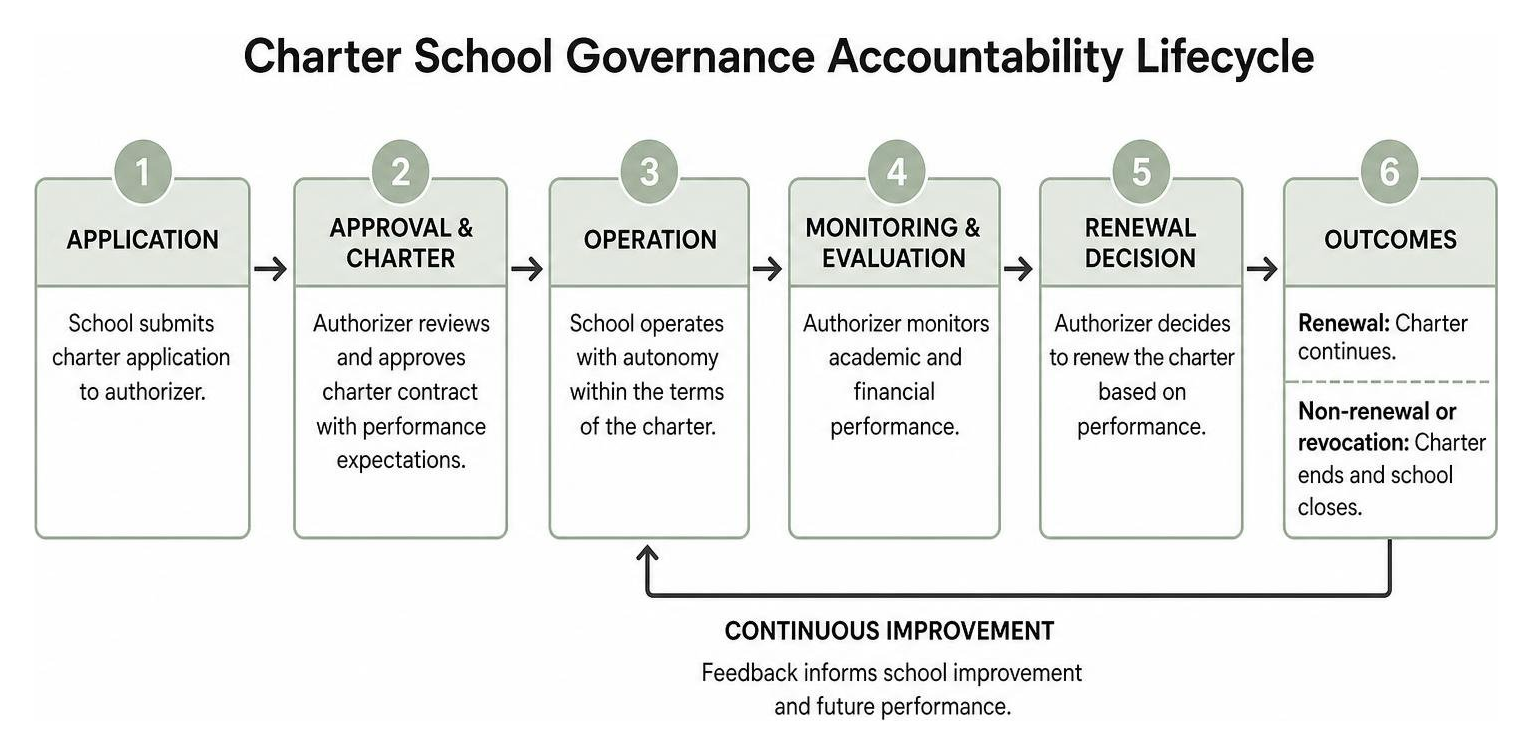
This operational flexibility gives public charter schools freedom over curriculum design, school calendars, and specialized learning themes (such as STEM, classical education, performing arts, or language immersion). However, flexibility comes with heightened accountability standards. If a public charter school fails to meet strict academic and financial performance benchmarks laid out in its charter contract, the authorizer can non-renew or revoke its charter, causing the school to close. Traditional public schools rarely face closure for underperformance; instead, they receive district intervention.
How Funding Works
When looking at funding mechanics, both charter and traditional public schools rely on taxpayer funding. Funding follows the student. In Florida, per-pupil allocations derived from state and local tax dollars are distributed based on student enrollment.
However, funding equity remains a key operational topic:
- Operational Funding: Public charter schools receive basic per-pupil operational dollars through state funding formulas just like district-run schools.
- Capital Outlay & Facilities: Traditional public schools often have direct access to local school board taxing authority and bond issuances to construct and maintain physical campuses. Public charter schools must frequently cover facility rents, leases, or debt service out of their operational budgets or designated state capital outlay funds.
- Operational Control: Charter school governing boards maintain direct budget control, allowing them to redirect capital straight into classroom tools, technology, and specialized teaching resources.
To explore the details of how state operational formulas work, read our detailed guide on A Practical Guide to Charter School Funding. Families interested in a broader systemic breakdown can also review this resource on Comparing Systems: Charter vs. Public vs. Private Schools.
Academic Outcomes: What the Data Reveals About Student Performance
Parents exploring the charter school vs public school landscape naturally prioritize academic excellence. Standardized testing data, third-party research, and longitudinal studies reveal a dynamic picture of student achievement across both models.
Nationally, raw average test scores across all 118,000+ public schools show traditional public schools averaging slightly higher composite scores (5.52 vs. 4.96 out of 10). However, education researchers widely acknowledge that raw national averages can be misleading. Why? Because public charter schools are disproportionately located in high-poverty, urban communities where educational choice is needed most, while traditional public school averages include wealthy suburban districts.
When researchers control for student demographics and measure actual annual student learning gains, public charter schools stand out.
Student Growth and Achievement: Charter School vs Public School Learning Gains
The landmark Stanford University CREDO study provided definitive data on comparative student growth. Rather than capturing a single point-in-time snapshot, CREDO tracked identical demographic student pairs over multiple academic years.
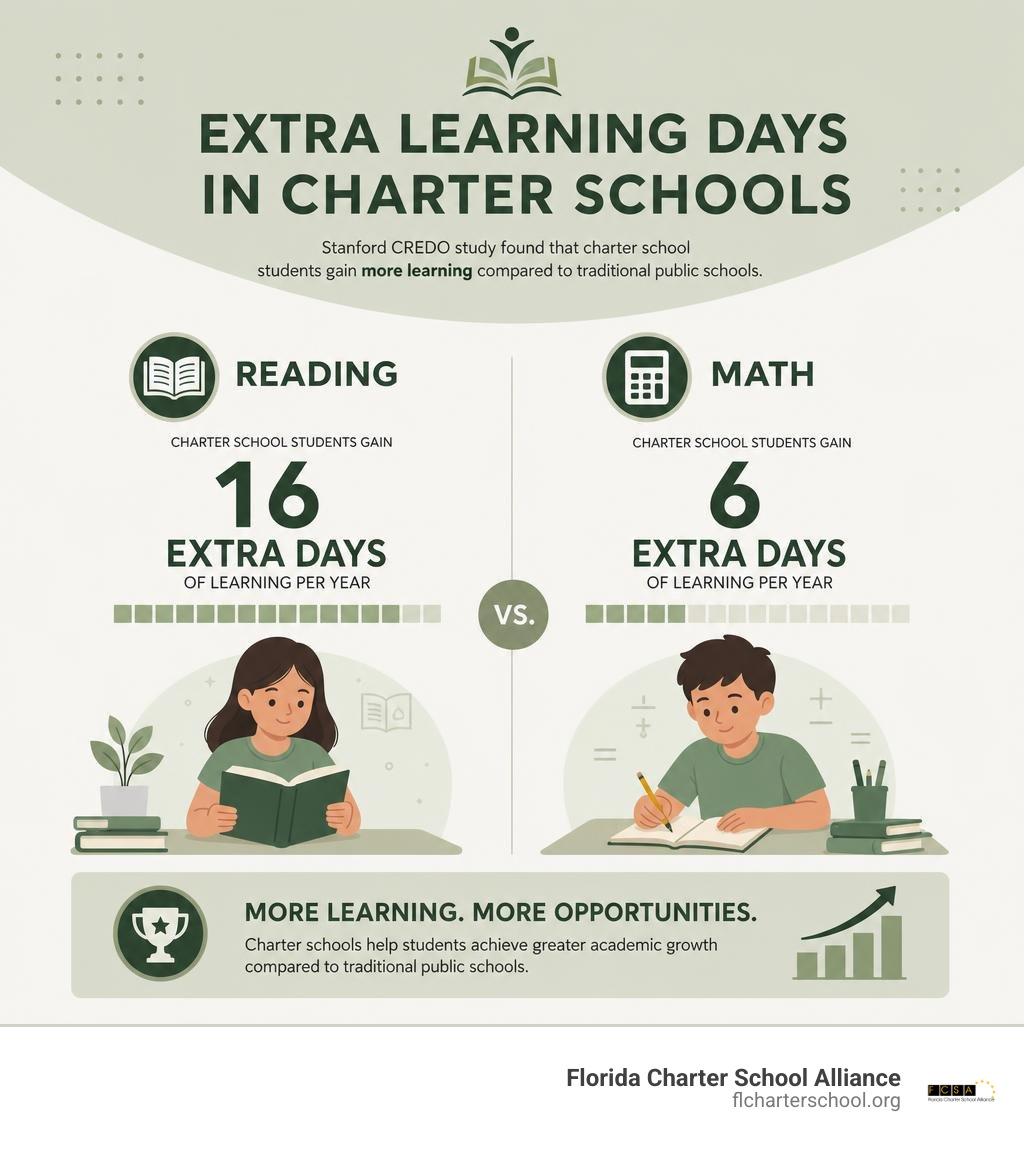
The findings demonstrate significant academic growth:
- Reading Gains: Charter school students gained the equivalent of 16 extra days of learning per school year in reading compared to their traditional public school peers.
- Math Gains: Charter school students achieved the equivalent of 6 extra days of learning in mathematics annually.
These learning gains are especially prominent in mature, highly regulated charter sectors like Florida, where public charter schools perform at or above traditional public school averages across almost every grade level and subject area. We regularly highlight these breakthroughs in our review of New Research: Charter Schools Improve Student Outcomes. For additional national empirical breakdowns, see Charter Schools vs Public Schools: What the Data Actually Shows (2026).
Demographic Success and Urban School Contexts

Public charter schools play a critical role in delivering equitable educational opportunity to diverse student bodies. According to national NCES data published by the Facts about public, private and charter schools in the US | Pew Research Center, public charter schools serve a significantly higher percentage of non-White and low-income students compared to traditional district public schools:
- Charter School Demographics: 36% Hispanic, 29% White, 24% Black, and 4% Asian American.
- Traditional Public School Demographics: 47% White, with lower average concentrations of minority students nationwide.
- Free and Reduced-Price Lunch: 31% of public charter school students attend high-poverty schools, compared to 21% in traditional public schools.
By keeping student-centered learning at the heart of their missions, urban charter schools consistently narrow the historical achievement gap, driving reading proficiency and math achievement among Black, Hispanic, and economically disadvantaged students.
Classroom Environment, Teachers, and Special Student Populations
Every child thrives in a unique environment. Comparing class sizes, teacher diversity, and specialized support systems helps parents determine where their child will flourish.
| Feature / Metric | Public Charter Schools | Traditional District Public Schools |
|---|---|---|
| Average Student-Teacher Ratio | ~20.7 : 1 (National Avg) | ~14.4 : 1 (National Avg) |
| Teacher Racial Diversity | 31% Non-White (69% White) | ~20% Non-White (~80% White) |
| Teacher Certification (Florida) | 100% State Certified Required | 100% State Certified Required |
| Teacher Unionization | Primarily Non-Unionized | Primarily Unionized |
| Special Education (IEP/504) | Fully Mandated / Inclusion Models | Fully Mandated / Comprehensive Services |
| Curriculum Focus | Specialized / Targeted Themes | Broad / Comprehensive Programs |
Evaluating Classrooms in the Charter School vs Public School Comparison
While national statistics show public charter schools often maintain higher student-teacher ratios (averaging 20.7:1 compared to 14.4:1 in district schools), charter leaders compensate by fostering strong school cultures, utilizing instructional aides, and implementing specialized learning tracks.
Teacher dynamics also differ:
- Teaching Freedom & Innovation: Charter teachers often report greater curriculum agility and freedom to tailor lessons to student interest without direct district-wide bureaucratic constraints.
- Staff Diversity: Public charter school teaching bodies are markedly more racially diverse (31% non-White) and younger, bringing fresh perspectives and relatable mentorship into the classroom.
- Certification Standards: In Florida, public charter school teachers are legally held to the exact same state certification standards as traditional district teachers.
Supporting Special Education and English Language Learners
A common question among parents is how public charter schools handle special education (IEP) services and English Language Learners (ELL). Under federal law (including the Individuals with Disabilities Education Act), public charter schools are public schools and must provide free and appropriate public education (FAPE) to all enrolled students.
Public charter schools deliver specialized support through inclusive co-teaching models, tailored intervention labs, and dedicated resource specialists. Because Education is Not One-Size-Fits-All, parents of students with specialized needs should tour prospective campuses to evaluate specific in-house support programs.
Enrollment, Lotteries, and Parent Choice Frameworks
One of the greatest benefits of the public charter school model is breaking down traditional geographic housing barriers to high-quality education.
Traditional public schools usually restrict attendance based on neighborhood residential attendance zones. If a family cannot afford to buy or rent a home in a top-performing neighborhood school zone, their child is locked into whatever district school is assigned to their address.
Public charter schools eliminate neighborhood zoning requirements:
- Open Access: Any student residing within the school district (and in many cases, neighboring Florida counties) is eligible to apply for free.
- Fair Lotteries: If student applications exceed available seats, Florida law mandates that the school hold a random, equitable enrollment lottery. No academic entrance exams or selective screening are permitted.
- Parental Choice: Families are empowered to select a school based on academic quality and specialized programming rather than home address.
For detailed steps on navigating the application season, visit our guide on Empowering Parents: Information About Charter Schools.
Frequently Asked Questions About Charter and Public Schools
Do charter schools charge tuition or require selective entrance exams?
No. Public charter schools are 100% tuition-free public schools. They do not charge tuition, nor do they hold selective academic entrance exams. Admission is open to all eligible students, and lotteries are used when applicants exceed capacity.
Are charter school teachers held to state certification standards?
Yes. In Florida, charter school teachers must meet the same state certification requirements as teachers in traditional public schools. They undergo standard background checks and credential evaluations.
How do charter schools support students with special needs and IEPs?
Public charter schools are legally required to serve students with special needs and implement Individualized Education Programs (IEPs) or 504 plans. They offer specialized accommodations, resource teachers, and inclusion strategies tailored to individual learning plans.
Finding the Best Educational Fit for Your Child
When deciding between a charter school vs public school, there is no one-size-fits-all answer. Both sectors contain exceptional, dedicated educators focused on helping children succeed.
Traditional public schools offer established district resources, neighborhood proximity, and broad athletic programs. Public charter schools offer innovative learning models, specialized academic tracks, tight-knit school cultures, and freedom from residential zoning constraints.
At the Florida Charter School Alliance, our mission is to ensure every family has access to a high-quality education that unlocks their child’s full potential. We encourage you to research local options, visit campuses, talk with teachers, and choose the environment where your child will thrive.
Ready to explore your options? Use our directory to Find high-quality charter schools near you and take the next step in empowering your child’s educational journey today.