Florida Charter Schools: What Every Family and Educator Should Know
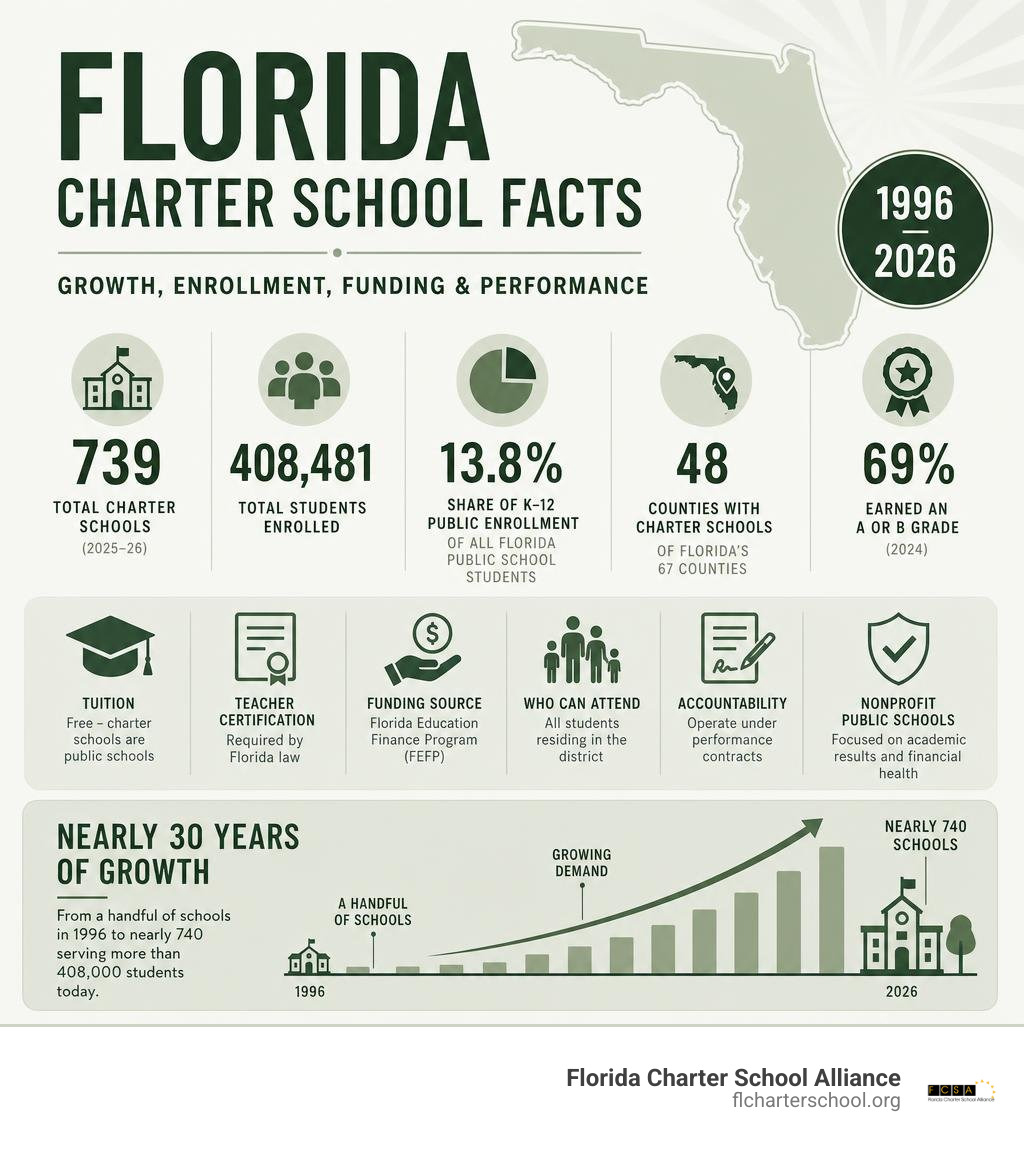
Florida charter school facts paint a clear picture of one of the fastest-growing public school movements in the country. Here is a quick snapshot of what you need to know right now:
| Key Fact | Detail |
|---|---|
| Total charter schools (2025-26) | 739 schools statewide |
| Total students enrolled | 408,481 students |
| Share of K-12 public enrollment | 13.8% of all Florida public school students |
| Counties with charter schools | 48 of Florida’s 67 counties |
| School grade performance (2024) | 69% earned an A or B grade |
| Tuition | Free – charter schools are public schools |
| Teacher certification | Required by Florida law |
| Funding source | Florida Education Finance Program (FEFP) |
| Who can attend | All students residing in the district |
| Year first charter school opened in Florida | 1996 |
Florida charter schools are tuition-free, nonprofit public schools operating under performance contracts. They have more flexibility than traditional public schools, but they are held strictly accountable for academic results and financial health. They do not cherry-pick students. They use a random lottery when more students apply than there are seats available.
Since 1996, Florida’s charter school sector has grown from a handful of schools to nearly 740 – serving more than 408,000 students. That growth is not accidental. It reflects real demand from families who want more options, more innovation, and more accountability in public education.
For arts educators in particular, charter schools have opened doors that traditional district schools often keep closed – dedicated programs, smaller learning communities, and the freedom to build curricula around creative excellence.
I’m Lynn Norman-Teck, Executive Director of the Florida Charter School Alliance, and my career has been built on advancing high-quality public charter schools and understanding Florida charter school facts from the policy level down to the classroom. In the sections ahead, I’ll walk you through the most important data, rankings, and insights to help you understand what makes Florida’s charter school sector one of the strongest in the nation.
What Are Public Charter Schools and How Do They Differ?
At the Florida Charter School Alliance (FCSA), we believe that every child deserves an education tailored to their unique needs. To understand why public charter schools are so popular, it helps to look at how they differ from traditional public schools.
Charter schools are public schools of choice. They are tuition-free, nonsectarian, and open to all students residing within the school district. However, unlike traditional public schools, they operate under a performance contract—or “charter”—between the school’s governing board and its sponsor. This contract allows them the regulatory flexibility to innovate, design specialized curricula, and manage their own operations. In exchange for this freedom, they are held strictly accountable for meeting academic and financial performance standards.
One of the key differences lies in governance. Traditional public schools are run by county-level school districts. Public charter schools, by contrast, are governed by independent, volunteer-led nonprofit boards. While they can contract with for-profit entities for specialized services like payroll, human resources, or facilities maintenance, the schools themselves must remain registered 501(c)(3) nonprofit organizations.
Staffing requirements also feature distinct rules:
- Teacher Certification: Just like traditional public schools, Florida charter school teachers must be certified by the Florida Department of Education (FLDOE) or be eligible for certification.
- Administrator Certification: Unlike traditional public school principals, charter school administrators are not legally required to hold state administrator certification. This allows charter boards to recruit visionary leaders with diverse professional backgrounds—such as military veterans, business executives, or specialized arts directors—to lead their schools.
The process of opening a charter school is rigorous. It begins when an individual, group, business, municipality, or legal entity submits a detailed application to a local sponsor. The sponsor must review and either approve or deny the application using a model form prepared by the state. If a local school board denies an application, the applicant has the right to appeal the decision to the State Board of Education, ensuring a fair and balanced approval process.
Understanding the Legal Framework and Florida charter school facts
The bedrock of the charter movement in the Sunshine State is Florida Statute 1002.33. This statute codifies the legal requirements, authorization pathways, sponsor duties, and operational parameters for all charter schools.
Under Florida law, charter schools are recognized as fully integrated parts of the state’s public education system. However, they are exempt from many of the restrictive regulations of the Florida K-20 Education Code. This legislative design is intended to foster educational innovation. However, charter schools are never exempt from critical laws governing:
- Services to students with disabilities (IEP compliance and Exceptional Student Education)
- Civil rights and student health, safety, and welfare
- Public records (Chapter 119) and open public meetings (Sunshine Law)
The legal framework also outlines who can authorize a charter school. Sponsors in Florida include local district school boards, state universities, Florida College System institutions, and the newly established Charter School Review Commission.
Additionally, the statute establishes strict curriculum guidelines. For example, reading instructional strategies in charter schools must prioritize phonics instruction for decoding and encoding as the primary strategy. The law explicitly prohibits the use of the three-cueing system model, ensuring that charter students receive scientifically based reading instruction. Finally, the law makes it clear that private schools, parochial schools, and home education programs are completely ineligible to convert to charter school status.
Essential Florida charter school facts: Enrollment and Growth
The trajectory of public charter schools in Florida is a story of remarkable, sustained growth. As families seek out student-centered learning environments, enrollment has climbed year after year.
To put this in perspective, in the 2024-25 school year, Florida was home to 732 charter schools serving 406,832 students across 48 of the state’s 67 counties. By the 2025-2026 school year, those numbers climbed to a record-breaking 739 charter schools serving more than 408,481 students. Today, charter school enrollment represents an impressive 13.8% of the total K-12 public school enrollment in Florida.
This growth mirrors a larger national trend. Between 2010 and 2021, public charter school enrollment in the United States more than doubled, growing from 1.8 million to 3.7 million students. While the District of Columbia (45%) and Arizona (20%) lead the nation in the percentage of public school students enrolled in charters, Florida firmly ranks among the top tier of states leading the charge in educational access.
| Feature | Public Charter Schools | Traditional District Schools |
|---|---|---|
| Tuition | Free | Free |
| Governance | Independent Nonprofit Board | District School Board |
| Admissions | Open Enrollment / Random Lottery | Residential Zoning / Controlled Open Enrollment |
| Teacher Certification | Required | Required |
| Class Size Compliance | Required | Required |
| Exemption from K-20 Code | Yes (with exceptions) | No |
When it comes to admissions, charter schools are designed to be highly accessible. They must participate in controlled open enrollment, allowing students to apply to any public charter school that has not reached physical capacity, regardless of their residential zip code. If the number of applications exceeds the school’s capacity, Florida law requires the school to conduct a random, double-blind lottery to determine admissions.
Certain enrollment preferences are legally permitted. For example, schools can give preference to siblings of currently enrolled students, children of active-duty military personnel, or children of the school’s founders and employees. Conversion charter schools—traditional public schools that transitioned to charter status after receiving support from at least 50% of parents and teachers—must give first preference to students who would have otherwise been zoned for that school.
Funding Mechanisms and Operational Realities
How do these schools keep their doors open? A common misconception is that charter schools receive private funding or siphon money away from local districts. In reality, Florida charter schools are publicly funded through the Florida Education Finance Program (FEFP). Funding is calculated based on the number of full-time equivalent (FTE) students enrolled, meaning public education dollars follow the student to the school their family chooses.
As highlighted by the Florida Public Charter Schools See Enrollment Growth report, this funding structure means charter schools must remain highly efficient. In fact, charter schools operate with less public funding per pupil than traditional district schools because they do not receive the same local tax revenues for operations.
Furthermore, charter schools must pay an administrative fee to their sponsoring school district to cover oversight and administrative services. This fee is capped at up to 5% of the school’s total FTE funding for the first 250 students. For high-performing charter schools, this fee is reduced to 2% to reward operational efficiency.
Capital outlay funding, which is used for building maintenance, rent, and facilities, is not guaranteed. To qualify for capital outlay funds, a charter school must meet strict criteria, such as operating for at least two consecutive years, being governed by an established board, and receiving clean, unqualified annual financial audits.
If a charter school closes or its contract is not renewed, strict asset distribution rules apply. All unencumbered public funds, as well as any property, equipment, and land purchased using public education dollars, immediately revert to the local school district sponsor. This ensures that taxpayer investments in public education are fully protected.
Academic Excellence: How Florida’s Top Charter Schools Rank
At the FCSA, we are incredibly proud of the academic achievements of our student-centered learning communities. Florida’s charter schools consistently demonstrate that when you combine educational innovation with strict accountability, students thrive.

The proof is in the school grades. The Florida Department of Education evaluates and assigns A-to-F grades to charter schools using the exact same rigorous standards applied to traditional public schools. In 2024, 69% of Florida charter schools earned a school grade of A or B.
To encourage even higher standards, the state utilizes special designations:
- Schools of Excellence: Established in 2017, this program identifies top-performing schools and grants them administrative flexibility regarding class-size compliance and budgeting.
- Schools of Hope: This initiative targets persistently low-performing zones. It provides specialized funding and regulatory relief to high-performing charter operators willing to open schools within the attendance zones of struggling district schools, working directly to close the achievement gap.
Analyzing Academic Performance and Florida charter school facts
The academic data tells a compelling story of student success. As highlighted in the state’s press release, Commissioner Kamoutsas Celebrates Increased Student Achievement, Florida’s charter schools are helping students outpace statewide averages.
According to the official Florida Charter Schools Earn Top Marks in 2024-25 Outperforming the State and Driving Student Success report, charter school students outperformed traditional public school students in 55 of 77 academic achievement comparisons across English Language Arts, mathematics, science, and social studies. This is an improvement from the previous year’s 53 of 77 comparisons, demonstrating a clear upward trend in academic excellence.
The success of these schools is also reflected in national rankings:
- The report 18 of the Top 100 High Schools in Florida are Charter Schools shows that charter schools represent a massive share of the state’s elite secondary programs.
- Similarly, 21 of the Top 100 Public School in Florida are Charter School highlights that charter schools consistently secure spots at the top of statewide public education rankings.
- This excellence is a national phenomenon. As detailed in Punching Above Their Weight: Charter Schools Are Disproportionately Represented in U.S. News’s Top 100 Best Public High Schools, charter schools make up only about 8% of all public schools nationwide, yet they represent more than 20% of the top-ranked public high schools in the country.
- In the competitive landscape of Florida’s educational ecosystem, Charter Schools Rival Magnet and Private Programs in Florida’s Top 100 List, proving that tuition-free public charter schools can match or exceed the performance of selective private academies.
These rankings are backed by independent academic research. As shown in New Research: Charter Schools Improve Student Outcomes, longitudinal studies demonstrate that students attending charter schools show significant, cumulative learning gains in math and reading over time, with particularly strong benefits observed for economically disadvantaged students and students with disabilities.
High-Performing Charter Schools and System Benefits
Florida law recognizes and rewards charter schools that maintain high academic and financial standards. A school is designated as a “high-performing charter school” if it receives at least two “A” grades and no grade below a “B” over the last three years, maintains clean financial audits with unqualified opinions, and has no financial emergency conditions.
Under the Florida Charter High Schools Rank Among the Best in the State framework, high-performing charter schools receive significant operational benefits, including:
- Longer Charter Terms: Up to 15-year charter contract renewals, providing long-term stability.
- Enrollment Expansion: The right to increase student enrollment by up to 15% once per year.
- Grade Level Expansion: The authority to expand grade levels (e.g., adding a middle school program to an existing elementary school).
- Replication Rights: The ability to submit an expedited application to replicate their successful model in any district across the state of Florida.
Frequently Asked Questions About Florida Charter Schools
Navigating public school options can feel overwhelming. To support family empowerment and help you make informed decisions, we have compiled answers to the most common questions about Florida’s charter school sector.
Do Florida charter schools charge tuition or cherry-pick students?
Absolutely not. Florida charter schools are tuition-free, open-enrollment public schools. They are legally prohibited from charging tuition for the regular school day, though they may charge nominal fees for optional before- and after-school care programs.
Furthermore, charter schools do not “cherry-pick” their students. By law, they must accept all students residing within the school district up to their physical capacity. If a school receives more applications than it has available seats, it must use a random, double-blind lottery system to admit students.
As celebrated in Facts About Charter Schools in Florida Celebrating 25 Years of Charter Schools in Florida, the charter school movement has spent over a quarter-century expanding educational access. Today, 63% of Florida’s charter school students identify as Black or Hispanic, reflecting the rich, diverse makeup of our state’s communities.
How are charter schools held accountable for academic and financial performance?
Charter schools face a double layer of accountability. First, they must participate in the state’s A-to-F school grading system, and their students must take the same state assessment exams as traditional public school students. If a charter school receives two consecutive “F” grades, the sponsor has the legal authority to close the school.
Second, charter schools must submit monthly or quarterly financial statements to their sponsoring school district and undergo rigorous annual financial audits conducted by independent Certified Public Accountants (CPAs). If an audit reveals a financial emergency condition, the state steps in immediately.
Finally, every charter school’s governing board must appoint a dedicated parent liaison. This representative is responsible for facilitating parental involvement, resolving disputes, and ensuring that parents have a direct voice in school governance.
Do charter schools serve students with disabilities and provide transportation?
Yes. As public schools, charter schools must comply with federal and state civil rights laws, including those protecting students with disabilities. They must provide Exceptional Student Education (ESE) administration services and implement Individualized Education Programs (IEPs) to ensure equal access to educational opportunities.
Regarding transportation, charter schools are required to address student transportation in their charter agreements. They often partner with private transportation providers, establish centralized hub-and-spoke bus stops, or coordinate parental carpools to ensure that transportation is not a barrier to enrollment. For more detailed operational resources, you can visit the Charter Schools – Florida Department of Education portal.
Conclusion
The Florida charter school facts are clear: the public charter school movement is a cornerstone of educational innovation, accountability, and academic excellence in the Sunshine State. By putting students first and giving families the power of choice, charter schools are reshaping public education for the better.
At the Florida Charter School Alliance (FCSA), we are proud to advocate for high-quality public charter schools that expand educational access, close achievement gaps, and empower families. Whether you are a parent looking for the perfect fit for your child or an educator seeking an innovative teaching environment, we invite you to explore the incredible opportunities available in Florida’s charter school sector.
As we look to the future, it is clear that School Choice Has Put Florida Schools Head and Shoulders Above the Rest. Let’s continue working together to support, inspire, and unite our communities to deliver the high-quality, student-centered education that every Florida child deserves.