
Introduction
Charter school budget deficits can be resolved through five proven tactics: optimizing staffing ratios and personnel expenditures, restructuring facility debt and lease commitments, diversifying revenue streams beyond basic state aid, implementing monthly variance monitoring and state reporting compliance, and stabilizing student recruitment to maximize per-pupil FEFP allocations. These strategies help public charter schools protect enrollment and maintain fiscal sustainability while continuing to deliver high academic standards.
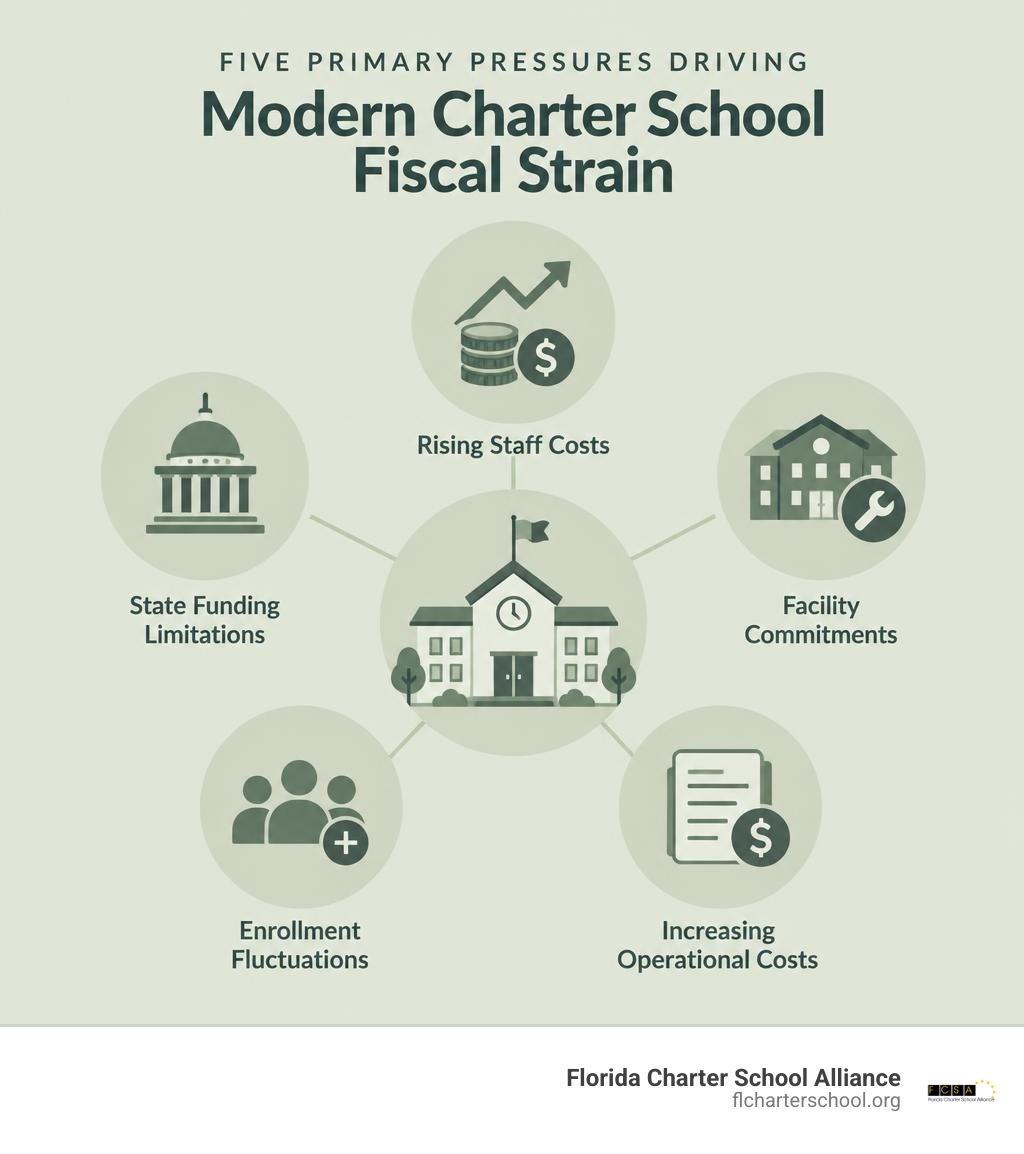
Operating a high-performing public charter school requires balancing high academic standards with disciplined fiscal management. While school leaders enter education to champion academic excellence, student-centered learning, and family empowerment, operational reality requires managing state aid allocations, rising staff costs, and heavy facility commitments.
When operational expenses outpace revenue, public charter schools face severe financial strain. Unlike traditional district-run schools that can fall back on local property tax referendums or municipal absorption, charter schools operate as autonomous, self-balancing public entities. Addressing budget shortfalls demands prompt intervention, deep compliance awareness, and strategic revenue planning.
Understanding the Root Causes of Charter School Budget Deficits
Public charter schools deliver innovative learning and expand parental choice, yet their underlying financing structures create unique vulnerabilities. While public charters are free, open-enrollment public schools held to strict state accountability benchmarks, their revenue mechanisms differ fundamentally from traditional school districts.
To navigate fiscal challenges, leaders must understand how public charter operations compare to district schools and private voucher programs. Reference a practical guide to charter school funding for a detailed orientation to core state allocations.
| Criteria | Public Charter Schools | Traditional District Schools | Education Freedom Accounts (EFAs) / Vouchers |
|---|---|---|---|
| Governance & Oversight | Independent non-profit governing board under public charter contract | Elected county or municipal school board | Private or religious school board / Home education |
| Primary Operational Revenue | State per-pupil funding formula (e.g., Florida FEFP) | State aid, local discretionary millage, and county property taxes | Direct state adequacy scholarship to individual family accounts |
| Capital Outlay Support | Restricted state capital outlay allocations (statute-driven) | Dedicated local capital millage, general obligation bonds, sales taxes | Private tuition, philanthropic gifts, or family co-pay |
| Public Financial Accountability | Annual independent CPA audits, quarterly state filings, public meetings | Annual comprehensive district financial reports (ACFR), county audits | Private financial management or scholarship funding organization audits |
| Enrollment Funding Basis | Direct per-pupil weighted counts (FEFP surveys) | District-wide attendance projections and fixed property tax baselines | Disbursed per participating student to private vendors |
Structural Inequities and State-Level Funding Gaps
State-level policy research highlights significant funding disparities facing public charter schools nationwide. According to Charter School Funding – Report Detail – OPPAGA, charter schools regularly receive lower overall public revenue per pupil than traditional public schools, primarily because charters are excluded from local discretionary millage and municipal tax enhancements.
Across the country, these gaps impact educational equity:
- In Washington, D.C., public charter students face an estimated $1,850 per-pupil funding gap compared to traditional public school students under municipal budget proposals, even while serving over 48,000 students—more than 90% of whom are Black or Brown and 60% economically disadvantaged.
- Academic analysis of New York State charter formulas shows tuition rates in cities like Buffalo have remained tied to outdated 1999 benchmarks. While some mature schools maintain reserve buffers of $1 million to $2 million, rising health benefit costs and facility inflation continue to squeeze instructional margins.
- In South Carolina, shifting virtual public charter student weights from 0.65 down to 0.5 in the FY2024-25 state budget created sudden operational deficits across virtual learning models.
These structural inequities mean that even minor shifts in student recruitment or state categorical grants can push a balanced school balance sheet into a deficit.
Public Charter Accountability vs. Education Freedom Accounts (EFAs)
Public debates often conflate public charter schools with private school vouchers or Education Freedom Accounts (EFAs). In our advocacy, we frequently explain why community members should stop blaming charter schools for district financial challenges.
Public charter schools are public institutions. They charge no tuition, have no selective admissions, administer all state-mandated standardized assessments, and submit to regular public financial reporting. EFA mechanisms, by contrast, disburse state funds to private and home-education settings outside the public school framework. Conflating these two funding paths obscures the transparency and performance standards public charter schools uphold every day.
Facility Debt, Lease Liabilities, and Capital Burdens
Unlike traditional districts that build facilities using voter-approved capital bonds, public charter schools must secure, finance, and maintain their own brick-and-mortar classrooms.
Facility rent and debt service frequently consume 15% to 22% of a charter school’s operating budget. When property insurance spikes, municipal tax assessments shift, or noncurrent lease liabilities compound, operating margins narrow quickly. Managing these capital obligations is essential to preserving classroom resources.
Case Study Analysis: Real-World Balance Sheets Under Pressure

Understanding financial strain in charter school operations requires looking closely at audited financial statements. A school’s Statement of Net Position and governmental fund balances tell two different, complementary stories.
Analyzing Charter School Budget Deficits: The Woodmont Case Study
An examination of the audited financial statements for Woodmont Charter School provides a clear look at how capital lease accounting and revenue shifts interact.
As of June 30, 2025:
- Net Position: Woodmont reported a government-wide net position deficit of $2,069,381. This represented a measurable recovery from the $2,199,847 deficit recorded on June 30, 2024 (a net positive improvement of $130,466).
- Assets vs. Liabilities: Total liabilities stood at $13,682,923 (including $12,697,293 in noncurrent lease obligations) against total assets of $10,456,783.
- Fund Balances: Despite the negative net position caused by long-term building leases, Woodmont increased its operational governmental fund balances from $205,046 in FY2024 to $356,853 in FY2025. Its unassigned general fund balance closed at $206,516 (4.19% of total general fund expenditures).
- Revenue Reductions: Total revenues dropped by $1,571,601 (from $9,033,304 in FY2024 to $7,461,703 in FY2025). This reduction was driven by a modest decline in student enrollment and the final expiration of federal ESSER III emergency funding, an adjustment discussed further in our guide on navigating the conclusion of ESSER funding.
- Annual Debt Service: Woodmont faced annual lease service requirements of $1,225,290 for the fiscal year ending June 30, 2026.
Woodmont avoided operational insolvency by aligning staff counts with enrollment, controlling support service expenses, and keeping near-term fund balances positive while carrying long-term lease liabilities.
How Formula Changes and Enrollment Lags Trigger Charter School Budget Deficits
Sudden changes to funding formulas can create severe financial imbalances:
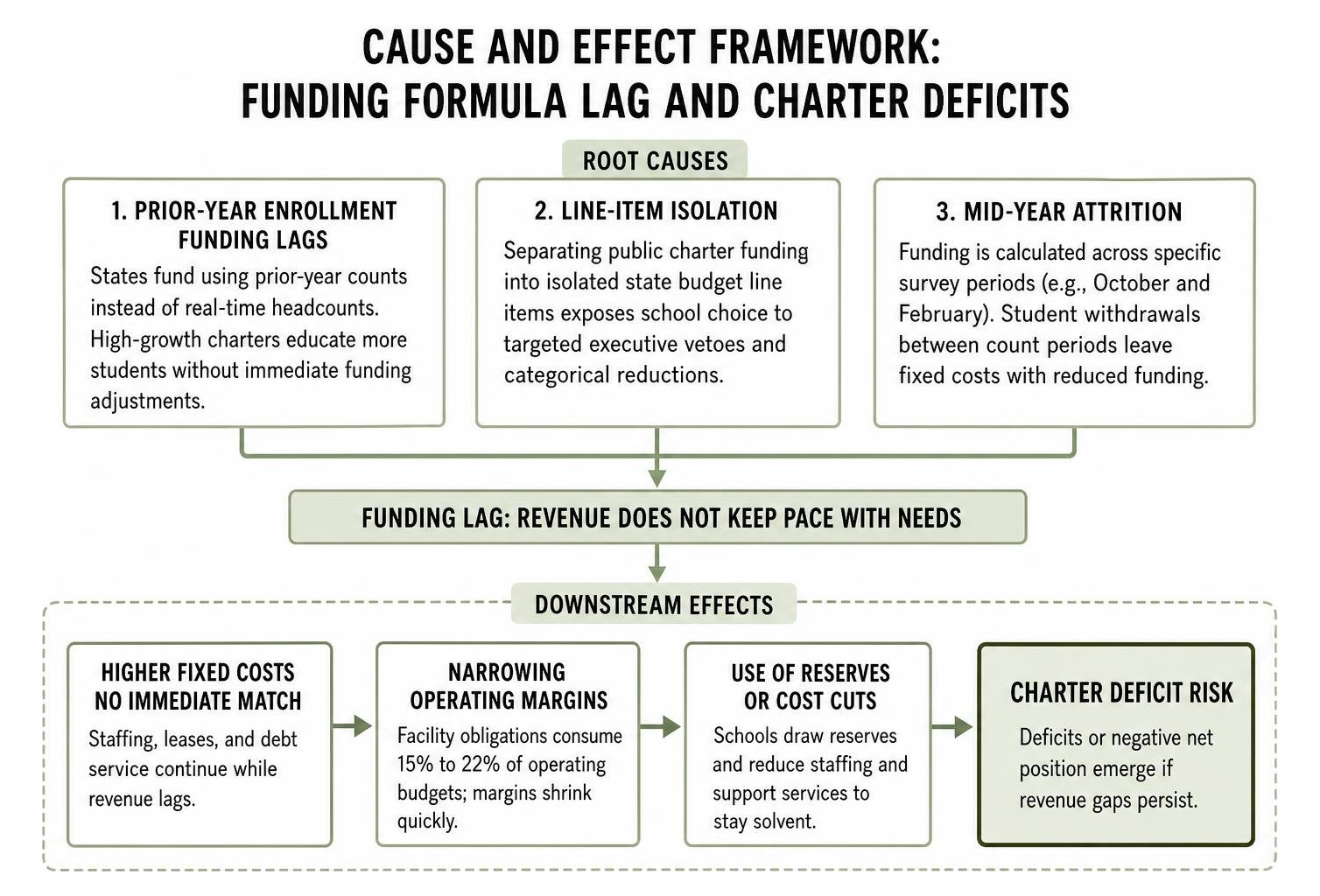
- Prior-Year Enrollment Funding Lags: When states fund charter districts using prior-year student counts instead of real-time headcounts, high-growth charters face unfunded operational costs. For example, when the South Carolina Public Charter School District expanded by nearly 2,600 students across 2023 and 2024, funding models based on prior-year attendance forced schools to educate more students without immediate funding adjustments.
- Line-Item Isolation: Separating public charter funding into isolated state budget line items exposes public school choice to targeted executive vetoes and categorical reductions.
- Mid-Year Attrition: Because funding is calculated across specific survey periods (such as Florida’s October and February FTE surveys), unexpected student withdrawals between count periods leave schools with fixed staffing commitments against reduced per-pupil funding.
5 Proven Tactics to Overcome Operating Shortfalls and Stabilize Finances

When revenue decreases, school boards and leaders must respond systematically. Here are five practical, field-tested tactics to address operating deficits and build long-term sustainability.
1. Optimize Staffing Ratios and Personnel Expenditures
Instructional and administrative salaries, taxes, and fringe benefits typically represent 60% to 75% of a school’s operating budget. Resolving a budget deficit requires evaluating personnel structures without sacrificing educational quality.
- Align Student-Teacher Ratios: In a 280-student elementary program, shifting average class sizes from 20:1 to 23:1 can reduce staffing needs by two full-time equivalent (FTE) positions, generating $100,000 to $130,000 in annual recurring savings.
- Cross-Train Support Staff: Use dual-certified instructors and cross-train administrative personnel to handle student services, testing coordination, and parent outreach.
- Evaluate Benefit Load Assumptions: Rising healthcare and retirement costs can quietly push a budget into the red. Review talent and compensation models by attending our workshop on how talent and finance decisions shape school stability.
2. Diversify Revenue Streams Beyond Basic State Aid
Relying entirely on base student allocations leaves a school exposed to legislative changes. Sustainable charters build diversified funding models.
- Pursue Federal Categorical Grants: Maximize Title I (disadvantaged students), Title II (teacher quality), Title III (English language learners), and Title IV allocations.
- Use Special Education Cost Reimbursements: IDEA Part B and state high-cost risk pools help offset specialized related services, assistive technologies, and dedicated paraprofessional salaries.
- Engage Local Philanthropic Partners: Community foundations and corporate partners frequently support capital improvements, STEM curriculum, and digital infrastructure. Expand your school’s funding approach by reviewing our session on strategic revenue planning for charter sustainability.
3. Restructure Facility Debt and Lease Commitments
Facility occupancy costs should remain within manageable operating ratios. If debt service or lease terms are straining instructional budgets, governing boards should take proactive steps.
- Renegotiate Lease Terms: Work with property owners to secure temporary rent deferrals, tiered lease step-ups, or extended lease terms in exchange for lower baseline payments.
- Refinance Long-Term Debt: If market conditions and school credit metrics allow, explore tax-exempt municipal bonds or USDA rural development loans to reduce annual debt service payments.
- Track Debt Service Coverage Ratios (DSCR): Maintain a DSCR of 1.20 to 1.35 or higher and build toward 30 to 60 days of cash on hand to comply with bond covenants and maintain liquidity.
4. Implement Monthly Variance Monitoring and State Reporting Compliance
Financial surprises often stem from delayed reporting. Establishing monthly budget-to-actual variance reviews enables governing boards to identify shortfalls early and adjust spending before year-end.
- Track Monthly Variances: Compare actual revenues, personnel costs, utility bills, and contracted services against your board-approved budget every month. Any negative variance exceeding 5% in a core department requires an immediate operational adjustment.
- Comply with State Deficit Reporting: Under Florida oversight standards, charter schools must continuously monitor actual versus budgeted figures. If a school projects an operating deficit, it must certify its financial position to the state commissioner and implement a detailed financial recovery plan.
- Review Regulatory Standards: Stay up to date on state operating guidelines by consulting the Florida Department of Education Charter School FAQ.
5. Stabilize Student Recruitment to Maximize Per-Pupil FEFP Allocations
Because Florida Education Finance Program (FEFP) revenue is calculated on a per-pupil basis, enrollment stability directly protects your operating budget. Even a loss of 15 students can reduce annual operational revenue by more than $110,000.
- Strengthen Family Engagement and Retention: Host regular student showcase events, parent workshops, and campus tours to retain enrolled families across transition grades (e.g., kindergarten-to-first, fifth-to-sixth, and eighth-to-ninth).
- Run Transparent Intent-to-Return Campaigns: Conduct early spring re-enrollment campaigns to identify open seats and activate waitlists well before fall FTE count windows.
- Address Enrollment Drops Directly: Discover how other public charter schools have stabilized their student counts by reviewing our case study on reversing multi-year enrollment declines.
Frequently Asked Questions About Charter School Finances
How do charter school funding formulas differ from traditional public districts?
Public charter schools are funded on a student-centered, per-pupil model through the Florida Education Finance Program (FEFP). Funding follows the student directly to their chosen public charter school based on program weights and attendance counts. Unlike traditional school districts, charter schools do not receive direct proceeds from county discretionary property tax millages or municipal sales tax initiatives, requiring charters to cover classroom operations, facilities, and administration out of their baseline per-pupil allocation.
What compliance triggers occur when a Florida charter projects a budget deficit?
When a Florida charter school projects a year-end operational deficit or falls below mandatory minimum fund balances, state oversight rules require the governing board to notify the district authorizer and submit a detailed financial recovery plan. The school must file regular progress certifications demonstrating corrective steps—such as staffing realignments, contract renegotiations, or non-essential spending freezes. Failing to address an ongoing deficit can lead to authorizer intervention or charter non-renewal.
Why did the conclusion of ESSER funding impact charter schools disproportionately?
Federal Elementary and Secondary School Emergency Relief (ESSER) funds provided temporary capital to address pandemic-related learning loss, mental health supports, and instructional technology. Because charter schools face capital and operational funding disparities, many used these nonrecurring federal funds to cover critical intervention staff, reading specialists, and operational costs. When ESSER funds expired, schools that had not transitioned these positions back to recurring state allocations experienced an immediate budget gap.
Conclusion
Managing public charter school finances requires balancing mission-driven educational goals with disciplined operational oversight. Operating deficits present serious operational challenges, but with prompt intervention, balanced staffing, diversified revenues, and continuous monthly monitoring, charter leaders can maintain financial stability while preserving high-quality instruction.
At the Florida Charter School Alliance, we support public charter school leaders, administrators, and governing boards with the tools and advocacy needed to protect parental choice and advance student achievement. We encourage community members, parents, and education advocates to work together to fund all public school students fairly across every community in Florida.