
How Charter School Operational Support Protects Time for Students
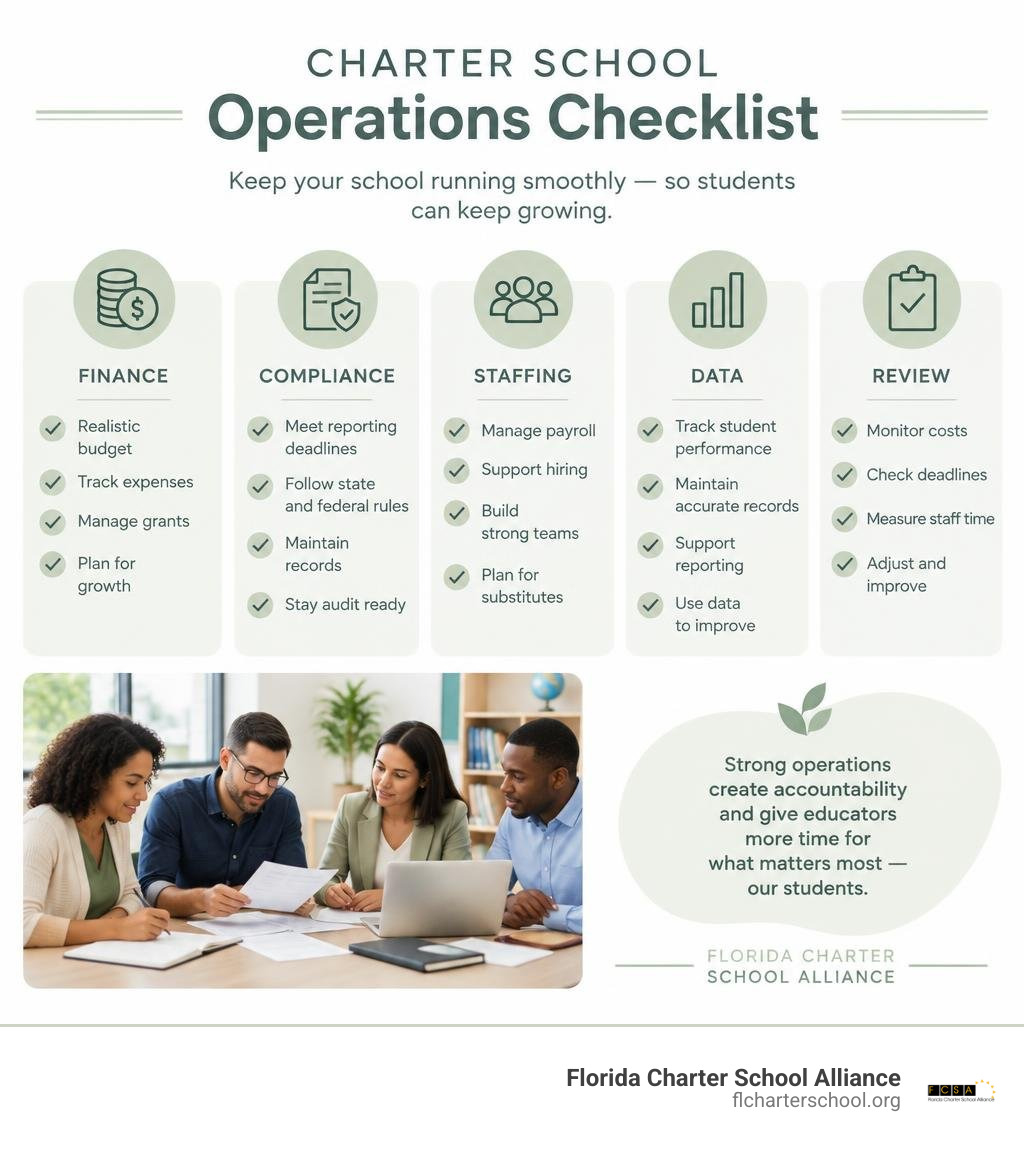
To improve charter school operations, start with a realistic budget, a calendar of reporting deadlines, and clear steps for payroll, hiring, grants, and student data. Assign an owner to each task. Bring in outside specialists when your team lacks the time or expertise, but keep school goals and oversight with your leaders and board.
Strong operational support helps public charter schools stay accountable while giving educators more time for student-centered learning. Track costs, missed deadlines, and staff time to see whether your approach is working.
I’m Lynn Norman-Teck, executive director of the Florida Charter School Alliance. Charter school operational support is part of my work in public charter school development, policy, and community engagement.
Learn more about Charter school operational support:
Primary Challenges in Charter School Operational and Financial Management

Running a tuition-free public charter school requires balancing high-stakes academic goals with the complex mechanics of running an independent municipal agency. While district-run schools rely on centralized central office departments to handle procurement, building codes, staff benefits, and accounting, public charter school administrators often manage these responsibilities on campus.
Without a structured back-office strategy, administrative burdens quickly pull principals away from coaching teachers and supporting students. Successfully operating a charter school means maintaining rigorous internal controls while navigating fluid enrollment numbers and complex funding allocations.
Common operational hurdles include:
- Cash Flow Volatility: Funding formulas distribute state dollars based on student counts that fluctuate during survey windows, making monthly cash projections critical.
- Complex Regulatory Compliance: Charter schools operate under strict local, state, and federal oversight, requiring accurate reporting across multiple reporting portals.
- Staff Recruitment and Retention: Competing for certified educators and administrative talent without the scale of traditional school districts requires dedicated recruitment pipelines.
- Facility Maintenance and Risk Management: Managing physical plants, local safety mandates, and long-term capital maintenance demands specialized facilities knowledge.
Financial Vulnerabilities and Grant Management
Charters rely heavily on public funding formulas, but supplemental competitive and entitlement grants (such as Title I, Title II, IDEA, and state initiatives) provide essential resources for high-need student populations. Securing these funds requires strict adherence to federal Uniform Guidance, complex grant drawdown processes, and precise expenditure tracking.
Navigating charter school funding strategies requires understanding both base funding allocations and supplemental grants. When schools lack dedicated grant management, they risk leaving tens of thousands of dollars on the table or facing audit findings due to non-compliant procurement or documentation. Strategic operational support enables schools to track grant lifecycles end-to-end—scouting eligible grants, preparing compliant applications, managing timely drawdowns, and remediating budget deficits before they affect classrooms.
Compliance Overhead and Authorizer Accountability
Charter schools are built on a framework of autonomy in exchange for strict accountability. Authorizers continuously evaluate school performance against operational, financial, and academic benchmarks outlined in charter contracts and state statutes.
Maintaining proactive authorizer relations and compliance protocols protects a school’s charter agreement and community reputation. Specialized back-office partners bring regulatory expertise, leading to a 20-40% improvement in compliance by systematically managing statutory calendars, organizing board governance filings, and conducting regular risk assessments.
Core Pillars of Charter School Operational Support
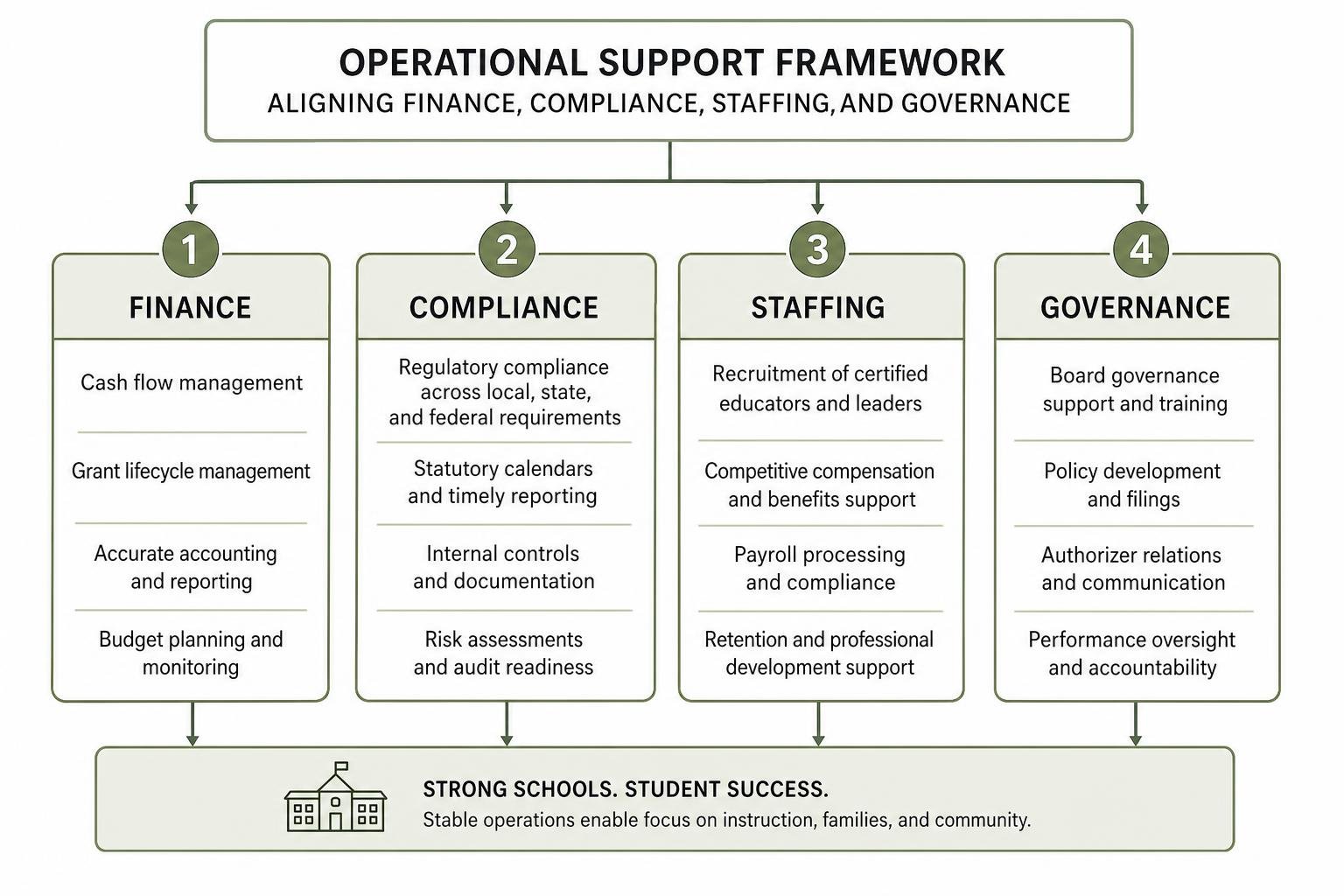
Comprehensive operational support creates the foundation for school stability, ensuring leadership teams can dedicate their energy to instructional quality and family engagement.
Back-Office Accounting, Payroll, and Financial Reporting
Sound financial stewardship is vital to school longevity. Specialized operational providers supply comprehensive accounting support tailored to public school fund structures, including:
- Interim CFO & Financial Strategy: Developing multi-year financial forecasts, assessing bond issuance or expansion financing, and presenting clean key performance indicators (KPIs) to the governing board.
- Day-to-Day Accounting: Managing general ledgers, accounts payable, purchasing approvals, and payroll processing aligned with retirement systems.
- Audit Preparation: Building documented standard operating procedures (SOPs) and assembling audit-ready trial balances that satisfy external independent auditors and state oversight bodies.
Talent Acquisition, HR, and Staff Retention
Attracting and retaining qualified instructional talent is fundamental to academic excellence. Operational human resource support provides the structure needed to build a stable workplace:
- Equitable Recruitment: Structuring recruitment campaigns to source certified educators and specialized staff.
- Credentialing and Onboarding: Tracking educator certification renewals, background checks, and state-mandated training milestones.
- Benefits Administration & Compensation: Designing competitive health, leave, and retirement packages that keep great educators in public charter classrooms.
- Professional Communities: Organizing professional learning communities and leadership development pathways to elevate educator practice and school culture.
IT Infrastructure and Student Information Systems
Modern schools depend on resilient digital infrastructure for instructional delivery and statutory reporting. Operational technology services ensure that critical data flows cleanly between classrooms, school records, and state databases:
- Student Information System (SIS) Management: Managing attendance, grading, master scheduling, and student enrollment records to ensure error-free reporting.
- Data Visualization & Analytics: Transforming student performance and attendance metrics into actionable visual dashboards that inform instructional interventions.
- Safety & Emergency Infrastructure: Implementing secure IT infrastructure and digital communications to support school safety protocols. Coordinating digital safety systems alongside comprehensive charter school emergency preparedness ensures campus readiness during unexpected disruptions.
Operational Lifecycle: Navigating Application, Start-Up, and Growth

A charter school’s operational requirements evolve across distinct phases, from founding vision to mature, multi-campus operations.
Charter Application and Start-Up Execution
Launching a new school requires translating an educational vision into a detailed operational and financial model. Founders following established guidelines for starting a Florida charter school must develop complex budget narratives, detailed facility acquisition strategies, and documented administrative procedures.
During the planning year, operational support services assist founding teams with:
- Budget Narrative Formulation: Modeling realistic multi-year cash flow projections aligned with state funding formulas and expected enrollment curves.
- Procurement Setup: Implementing compliant purchasing policies that distinguish between federal grant rules and general operating funds.
- Facility Acquisition & Site Planning: Evaluating lease agreements, zoning approvals, and renovation timelines to open school doors on schedule.
- Community Engagement Infrastructure: Establishing enrollment portals and lottery systems that ensure open, equitable family access.
Start-Up vs. Established Charter School Operational Support
As schools transition from their first year into long-term maturity, operational needs shift from initial setup to scalable refinement:
- Start-Up Stage (Years 0–2): Focuses on survival and foundational compliance—implementing core payroll and SIS software, stabilizing first-year cash flow, onboarding the founding staff, and establishing basic operational routines.
- Growth and Established Stage (Years 3+): Focuses on optimization and strategic expansion—refining multi-year capital plans, improving staff retention programs, building reserve funds, and supporting governing boards with strategic planning retreats. Regular self-evaluation helps mature institutions find opportunities to upgrade board practices to ensure long-term sustainability.
In-House Operations vs. Outsourced Support: Comparative Analysis
Charter school governing boards often face a strategic choice: hire an internal team for every back-office function or partner with an experienced operational support provider.
| Dimension | In-House Operations Model | Outsourced / Shared Operational Support |
|---|---|---|
| Cost Structure | High fixed overhead (multiple salaries, benefits, software licenses, onboarding costs). | Predictable, scalable fee structure that adjusts to school enrollment size. |
| Specialized Expertise | Relies on small internal staff whose expertise may not span all regulatory, grant, and accounting domains. | Broad access to specialized CFOs, certified accountants, HR directors, and compliance managers. |
| Turnover Resilience | Vulnerable to single-point failure; operations can stall if a key business manager leaves. | Continuous coverage and institutional redundancy with standardized procedures. |
| Compliance & Accuracy | Staff must independently track changing state deadlines and reporting updates. | Dedicated compliance teams actively monitor authorizer calendars, lowering reporting error rates by 20-40%. |
| Instructional Focus | School principals frequently get pulled into operational firefighting and vendor disputes. | Executive leadership delegates back-office management, preserving time for academic leadership. |
Measurable Impacts on Academic Focus and Retention
When school leaders are freed from managing daily payroll reconciliations, facilities crises, and compliance paperwork, the entire learning community benefits. Dedicated operational support helps school networks sustain compliant reporting across multiple consecutive years, achieve high staff retention through reliable HR systems, and redirect administrative hours directly back into teacher coaching and student intervention programs.
Strategic Governance and Partner Selection
Selecting the right operational support model requires careful oversight from the charter school governing board. The board maintains ultimate fiduciary responsibility for the school and must ensure that any external partner aligns with its mission and accountability standards.
School boards can consult the verified education vendor marketplace to connect with experienced providers who understand public education standards and requirements set by the Florida Department of Education.
Evaluating and Selecting Charter School Operational Support Partners
When vetting operational partners, governing boards should evaluate candidate organizations against clear criteria:
- Public Charter Track Record: Verify that the organization has deep experience in public school fund accounting, state compliance portals, and authorizer relations.
- Transparent Fee Models: Ensure service agreements provide transparent fee structures without hidden costs, aligning partner incentives with school stability.
- Scalability and Systems Integration: Choose partners that utilize modern cloud-based accounting, HR, and student data systems that can scale smoothly as enrollment grows.
- Client Retention and References: Request direct references from peer charter school leaders to confirm responsiveness, data security standards, and reporting accuracy.
Frequently Asked Questions About Charter School Operations
What are the most critical operational challenges facing charter school leaders?
The most common challenges include balancing cash flow during enrollment count windows, managing complex state and federal compliance deadlines, navigating staff recruitment shortages, and maintaining aging facilities without municipal capital tax allocations. Dedicated operational structures provide the systems needed to manage these challenges smoothly.
How does outsourced operational support improve regulatory compliance?
Specialized support organizations employ dedicated compliance and reporting specialists who work across state reporting systems every day. This focused attention reduces reporting errors by 20-40%, ensures all statutory deadlines are tracked well in advance, and provides governing boards with accurate, audit-ready financial statements.
When should a charter school begin establishing its operational infrastructure?
Founding groups should begin designing their operational and financial infrastructure 12 to 18 months before welcoming their first students. Establishing chart of accounts structures, HR onboarding frameworks, procurement policies, and student information systems during the planning year ensures a smooth, compliant opening day.
Conclusion
A strong operational framework is the quiet engine behind every exceptional learning environment. When public charter schools establish rigorous accounting, reliable HR systems, resilient technology infrastructure, and proactive compliance protocols, educational leaders can focus fully on what matters most: elevating student achievement and expanding opportunities for families.
The Florida Charter School Alliance remains committed to defending, supporting, and empowering public charter school leaders across Florida. By pairing innovative educational models with proven operational systems, we ensure that public school choice continues to deliver high-quality, accountable, and transformative educational opportunities for every child. To see how these principles drive systemic educational progress, explore how school choice has elevated Florida education and shaped communities statewide.