
Why School Choice Programs Matter for Every Family
School choice programs give families the power to select the learning environment that best fits their child — whether that’s a public school, charter school, private school, or home-based option.
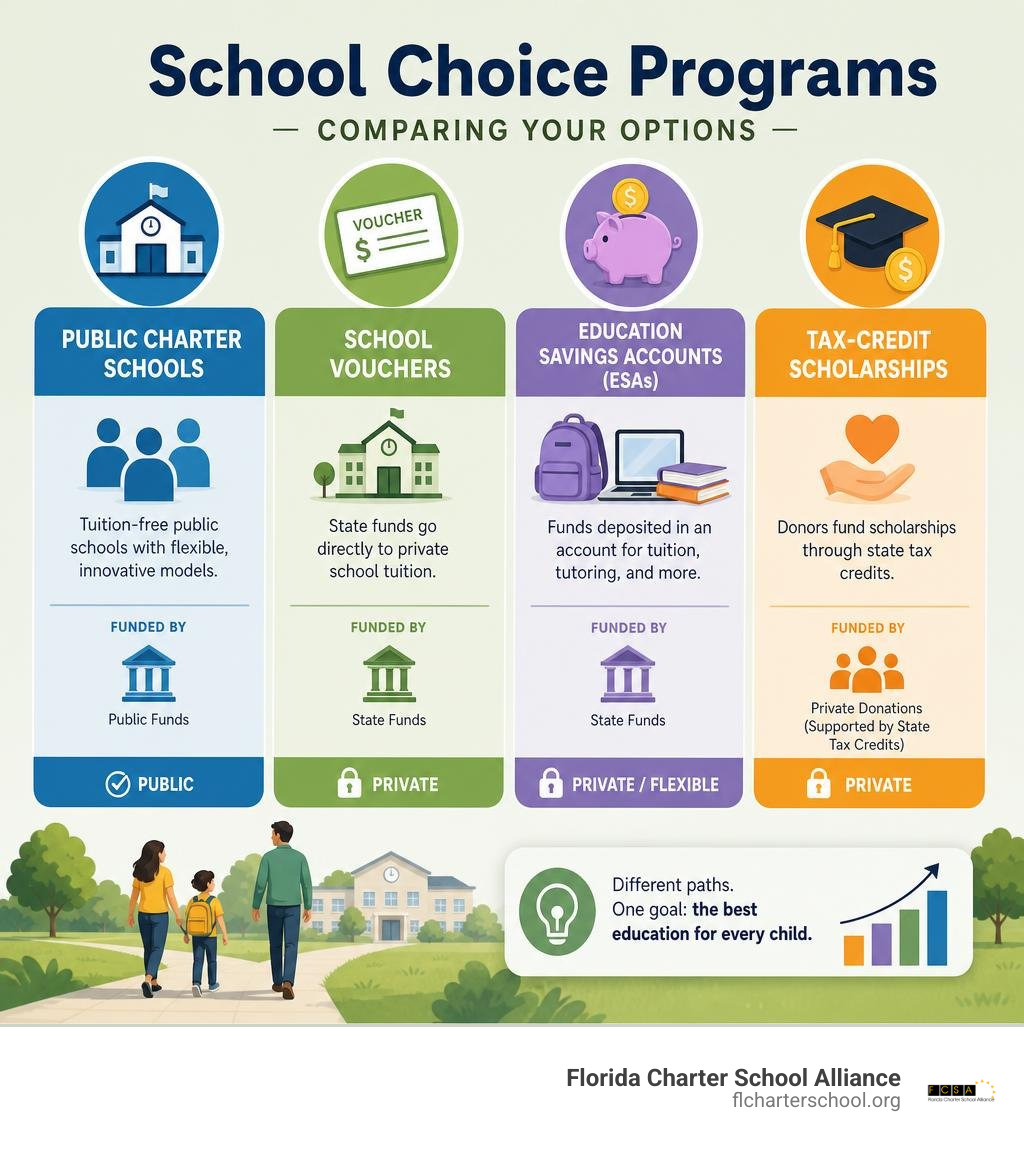
Here’s a quick look at the main types available today:
| Program Type | How It Works | Public or Private |
|---|---|---|
| Public Charter Schools | Tuition-free public schools with flexible, innovative models | Public |
| School Vouchers | State funds go directly to private school tuition | Private |
| Education Savings Accounts (ESAs) | Funds deposited in an account for tuition, tutoring, and more | Private/Flexible |
| Tax-Credit Scholarships | Donors fund scholarships through state tax credits | Private |
| Magnet Schools | Specialized programs within the public school system | Public |
| Interdistrict Open Enrollment | Attend a public school outside your home district | Public |
Today, 33 states have some form of school choice, and over 50 private school choice programs operate nationwide. More families than ever have real options — and that number keeps growing.
I’m Lynn Norman-Teck, Executive Director of the Florida Charter School Alliance, and I’ve spent my career working at the intersection of public charter school development, policy, and community advocacy to expand school choice programs for Florida families. In this guide, I’ll walk you through every major program type, compare how they work across key states, and help you understand which options may be the right fit for your child.
School choice programs further reading:
What is School Choice and How Does It Work?
At its heart, school choice is built on a simple yet powerful idea: public education funds should follow the student to whatever learning environment best meets their individual needs. Rather than assigning a child to a school solely based on their home address, school choice programs allow public funding to follow the student. This approach provides families with the flexibility to customize their child’s educational journey.
This philosophy shifts the focus from supporting systems to empowering students. When parents have options, they can seek out specialized curricula, smaller class sizes, or specific support services that traditional neighborhood schools might not offer. This flexibility is why we believe that parental choice is a fundamental driver of academic success and personal growth. To explore this concept further, you can read our detailed breakdown on Why is School Choice the Better Choice?.
Defining the Core Philosophy of Educational Freedom
Educational freedom is rooted in the belief that parents have the right to secure the best possible education for their children. It recognizes that every child is unique, with distinct learning styles, interests, and talents. By shifting to a student-centered model, school choice ensures that educational opportunities are not limited by a family’s ZIP code or income.
According to national research published in The ABCs of School Choice 2026, private school choice programs have expanded rapidly across the country, driven by a growing demand for customization. These programs allow public funds to be used for a variety of educational options, giving parents the autonomy to make decisions that align with their family values and their child’s future goals.
Public vs. Private Educational Pathways
When navigating the landscape of school choice, it is helpful to categorize the available pathways into public and private options:
- Public Pathways: These options are funded by taxpayers and remain tuition-free. They include traditional public schools, specialized magnet schools, and public charter schools. Public charter schools are particularly unique because they are authorized to operate with greater flexibility in exchange for strict academic and financial accountability.
- Private Pathways: These options allow families to use state-supported financial assistance to attend private schools or access customized learning environments. They include school vouchers, Education Savings Accounts (ESAs), and tax-credit scholarships.
- Alternative Pathways: Homeschooling, hybrid homeschooling, and micro-schooling have also grown in popularity, allowing families to design custom curricula that combine home instruction with part-time school attendance or specialized tutoring.
Comparing the Main Types of School Choice Programs
Choosing the right path requires understanding how each program functions, its funding mechanism, and its eligibility rules. Below, we compare the primary types of private and public choice programs to help you make an informed decision.
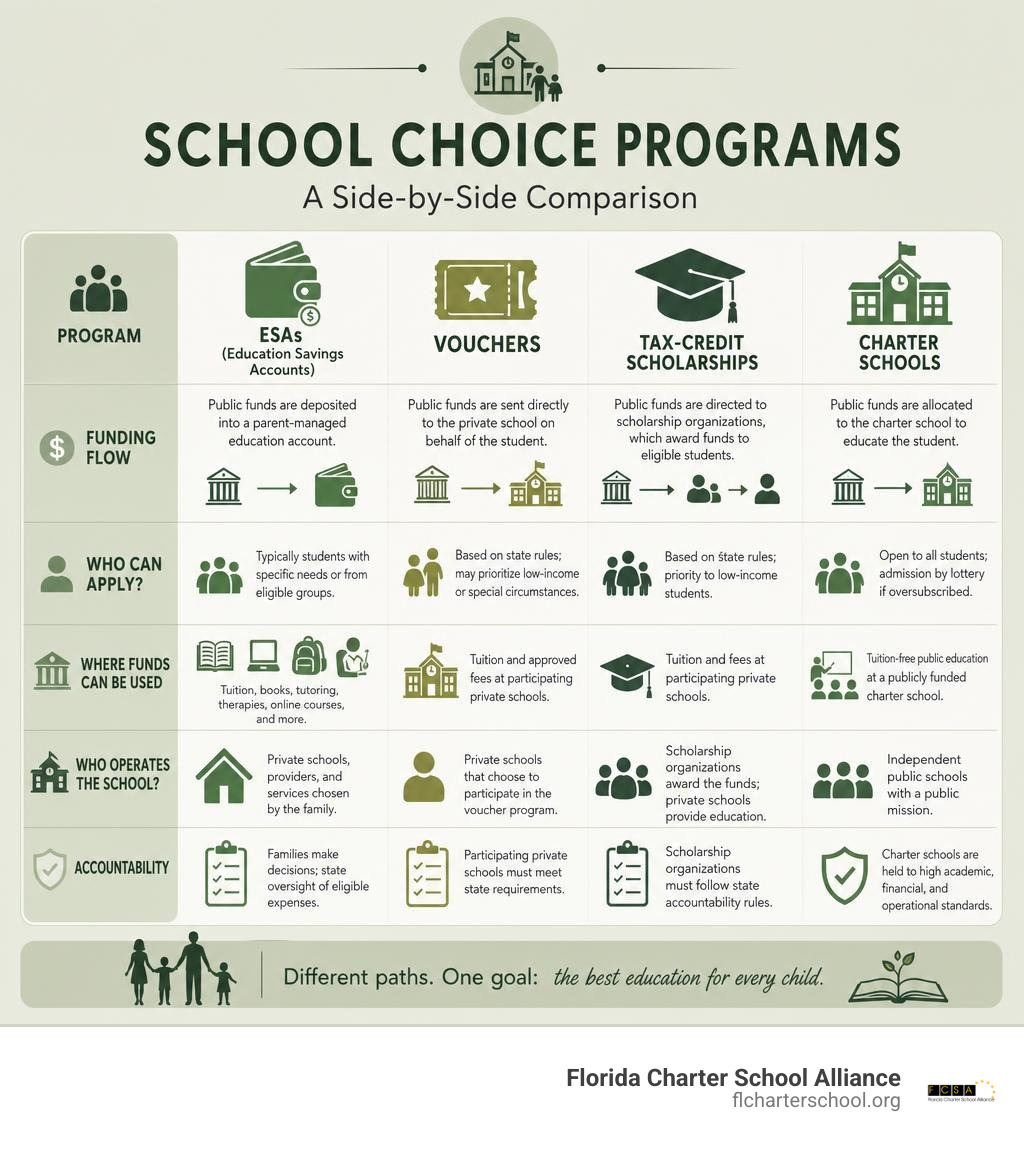
For a deeper dive into managing these options, check out our guide on How to Navigate Florida School Choice Programs and Scholarships.
Education Savings Accounts (ESAs)
Education Savings Accounts represent the most customizable school choice option available today. Instead of sending public funds directly to a specific school, the state deposits a portion of a student’s education funding into a secure, parent-managed digital account.
According to The ABCs of School Choice 2023, ESAs allow parents to direct those funds toward multiple approved educational services, including:
- Private school tuition and fees
- Online learning programs
- Private tutoring services
- Therapies for students with special needs (such as speech or occupational therapy)
- Textbooks, curriculum materials, and specialized educational technology
This multi-provider model gives families unprecedented flexibility, allowing them to craft a truly personalized education plan that matches their child’s learning pace and interests.
How Private School Choice Programs Work
Private school choice programs generally fall into three categories: vouchers, tax-credit scholarships, and ESAs.
- School Vouchers: These are state-funded scholarships that allow parents to use public education dollars to pay for tuition at a participating private school. Vouchers were the earliest form of modern school choice, starting with the Milwaukee Parental Choice Program in 1990.
- Eligibility Criteria: Historically, private school choice programs have been structured with specific eligibility rules. Across the country, twenty-seven of the nation’s fifty private school choice programs are either means-tested (limited to families below a certain income threshold) or means-preferenced. Additionally, twenty of those fifty programs are specifically designed to serve students with special needs, ensuring that vulnerable student populations receive the resources they need.
- Community Impact: These programs enjoy broad support across diverse communities. In particular, research and advocacy show that Black Families Support Education Choice at exceptionally high rates, as these programs provide families with the financial means to escape underperforming neighborhood schools and access higher-quality learning environments.
Scholarship Tax Credits and Individual Tax Deductions
Scholarship tax-credit programs expand educational opportunities by leveraging private donations. Under these programs, individuals or corporations receive a state tax credit (often up to 100% of their contribution) when they donate to non-profit Scholarship Granting Organizations (SGOs). These SGOs then distribute those funds as K-12 scholarships to eligible families, allowing them to cover private school tuition or other educational expenses.
There are currently over two dozen scholarship tax-credit programs operating nationwide. Some states also offer individual tax credits or deductions, allowing parents to receive a state income tax write-off for approved educational expenses, such as textbooks, tutoring, or private school tuition.
The Role of Public Charter Schools in School Choice Programs
While private school choice options are highly effective, public charter schools serve as a cornerstone of the public school choice movement. Charter schools are tuition-free, public schools of choice that are open to all students. They operate under a performance contract (or “charter”) with a local school district or state authorizer, giving them the flexibility to design innovative learning models.

At the Florida Charter School Alliance, we advocate for charter schools because they offer:
- Innovative Learning: Charter schools can focus on specialized curricula, such as STEM, performing arts, Montessori, or classical education.
- Strict Accountability: Unlike traditional public schools, charter schools must meet rigorous academic, financial, and operational standards. If they fail to perform, their charter can be revoked.
- Equal Access: Charter schools are open to all students, do not charge tuition, and use a random lottery system when applications exceed available seats.
For parents seeking public school options with a high standard of academic excellence, charter schools represent a highly effective, student-centered choice. You can learn more about how these schools operate in our guide, Empowering Parents: Information About Charter Schools.
State-Level Implementation and Eligibility Requirements
Because education is primarily managed at the state level, school choice programs vary significantly depending on where you live. Some states have embraced universal programs, while others limit eligibility based on income, geography, or special needs.
Florida: The National Leader in Educational Innovation
Florida has long been recognized as the national leader in educational choice, offering a robust portfolio of options that cater to nearly every student’s needs. The state’s commitment to family empowerment is reflected in its massive scholarship programs, which have expanded over the years to reach near-universal eligibility.
Key programs in Florida include:
- The Florida Tax Credit Scholarship Program: This program historically served 108,098 students with $631,100,000 in annual funding, making it one of the largest scholarship programs in the country.
- The Family Empowerment Scholarship (FES): Established in 2019, this program operates in two branches: one for educational options (FES-EO) and one for students with unique abilities (FES-UA). The FES-UA program replaced the historic John M. McKay Scholarship for Students With Disabilities Program, which once served 31,044 students with $220,435,516 in annual funding.
- The New Worlds Scholarship Accounts: This program provides $500 education savings accounts for students in grades K-5 who are struggling with reading or mathematics, allowing parents to purchase supplemental tutoring and learning materials.
To explore the full range of state-supported programs, visit the Florida Department of Education School Choice portal. As we often share, this extensive choice environment has driven academic excellence across all sectors. For an in-depth perspective on how choice has elevated the entire state system, read our Commentary: Florida School Choice is a Rising Tide That Has Lifted All Boats.
Indiana: The Choice Scholarship Program
Indiana’s voucher system is another highly successful model of school choice. The Indiana Choice Scholarship Program provides state-funded vouchers to help families pay for tuition at participating non-public schools.
Historically, the program served 35,458 students with $153,967,952 in annual funding. To participate, students must meet specific age requirements (between 5 and 22 years old by October 1) and fall within the state’s income guidelines. Participating private schools must administer statewide standardized assessments, ensuring academic accountability.
Wisconsin: Milwaukee and Statewide Parental Choice
Wisconsin is home to the nation’s oldest modern school voucher program. The Milwaukee Parental Choice Program (MPCP) was established in 1990 to provide low-income families in Milwaukee with access to private schools. Historically, the MPCP served 28,702 students with $201,900,000 in annual funding.
Over the years, Wisconsin expanded this model to create the Racine Parental Choice Program (RPCP) and the statewide Wisconsin Parental Choice Program (WPCP). Eligibility is based on strict residency criteria and income limits, though students who participated in a choice program in the prior school year are exempt from income re-verification.
New Jersey: Interdistrict Public School Choice
Unlike states that focus heavily on private school vouchers, New Jersey’s primary choice initiative is the Interdistrict Public School Choice Program. This program allows approved public school districts to enroll K-12 students who do not reside within their district boundaries, at no cost to the parents.
This program has proven highly beneficial for rural and suburban districts facing declining enrollment, as it helps stabilize local school budgets and enriches classroom diversity by bringing in non-resident students.
Policy Developments and the Future of Educational Freedom
The national landscape of school choice is evolving rapidly, driven by significant policy shifts at both the federal and state levels.

At the federal level, major changes are on the horizon. Beginning January 1, 2027, a new nationwide tax-credit initiative, the Education Freedom Tax Credit, is set to launch. This program will allow individual and corporate taxpayers to receive a federal tax credit of up to $1,700 for donating to approved Scholarship Granting Organizations.
The White House has released interactive resources tracking state participation in this program. While 23 states have already opted in to allow their families to benefit from these federal tax credits, others have pushed back. You can track this developing policy map through the White House Unveils Map Showing States Opting Out of School Choice Program report, and view the administration’s official stance on the School Choice – The White House portal.
As public awareness of these programs grows, parental support has reached historic highs. Our tracking of public sentiment shows that families across all demographics are demanding greater control over their children’s education, as detailed in our report, Poll: School Choice Support Soars.
Frequently Asked Questions about School Choice
What is the difference between a school voucher and an ESA?
While both are private school choice options, they function differently. A school voucher is a state-funded scholarship that goes directly to a participating private school to cover tuition. An Education Savings Account (ESA) is far more flexible; funds are deposited into a parent-controlled digital account and can be spent on a variety of educational needs, including tutoring, curriculum, therapies, and private school tuition.
Are public charter schools considered part of school choice?
Yes! Public charter schools are a fundamental component of public school choice. They are tuition-free, open to all students, and operate with greater flexibility than traditional schools. They provide families with an innovative, highly accountable public option that focuses on academic excellence and student-centered learning.
How do school choice programs impact public school funding?
School choice programs operate on the principle that public funding should serve the student rather than a specific building. When a student chooses an alternative option, the funding associated with that student’s education moves with them. This creates a healthy, competitive environment that encourages all schools to improve, ultimately acting as a rising tide that lifts all educational options in the community.
Conclusion
The expansion of school choice programs across the nation represents a major step forward for educational equity, family empowerment, and student achievement. Whether through public charter schools, ESAs, or tax-credit scholarships, families now have the tools to customize their children’s learning to match their unique needs.
At the Florida Charter School Alliance, we remain dedicated to advocating for high-quality, innovative, and accountable public charter schools that expand educational access for all families. To learn more about how Florida’s choice landscape is driving success, read our opinion piece on how School Choice Has Put Florida Schools Head and Shoulders Above the Rest (Opinion).