
Why Arts Education Funding Matters for Every Student
Arts education funding shapes which students get access to music, theater, visual arts, and dance — and which students don’t.
Here’s a quick overview of the main sources and key facts:
| Funding Source | Type | Typical Use |
|---|---|---|
| Title I (ESEA) | Federal, $18.4B | Schoolwide improvement, arts in high-poverty schools |
| Title IV-A (SSAE) | Federal, $1.4B | Well-rounded education, flexible arts program support |
| 21st Century Community Learning Centers | Federal, $1B+ | Afterschool and enrichment arts programs |
| Assistance for Arts Education (AAE) | Federal, $36.5M | Only dedicated federal arts education grant program |
| NEA Grants for Arts Projects | Federal, $10K–$100K | Direct learning, professional development, collective impact |
| State Arts Agencies | State-level | Local distribution, partner grants |
A few facts that put the challenge in focus:
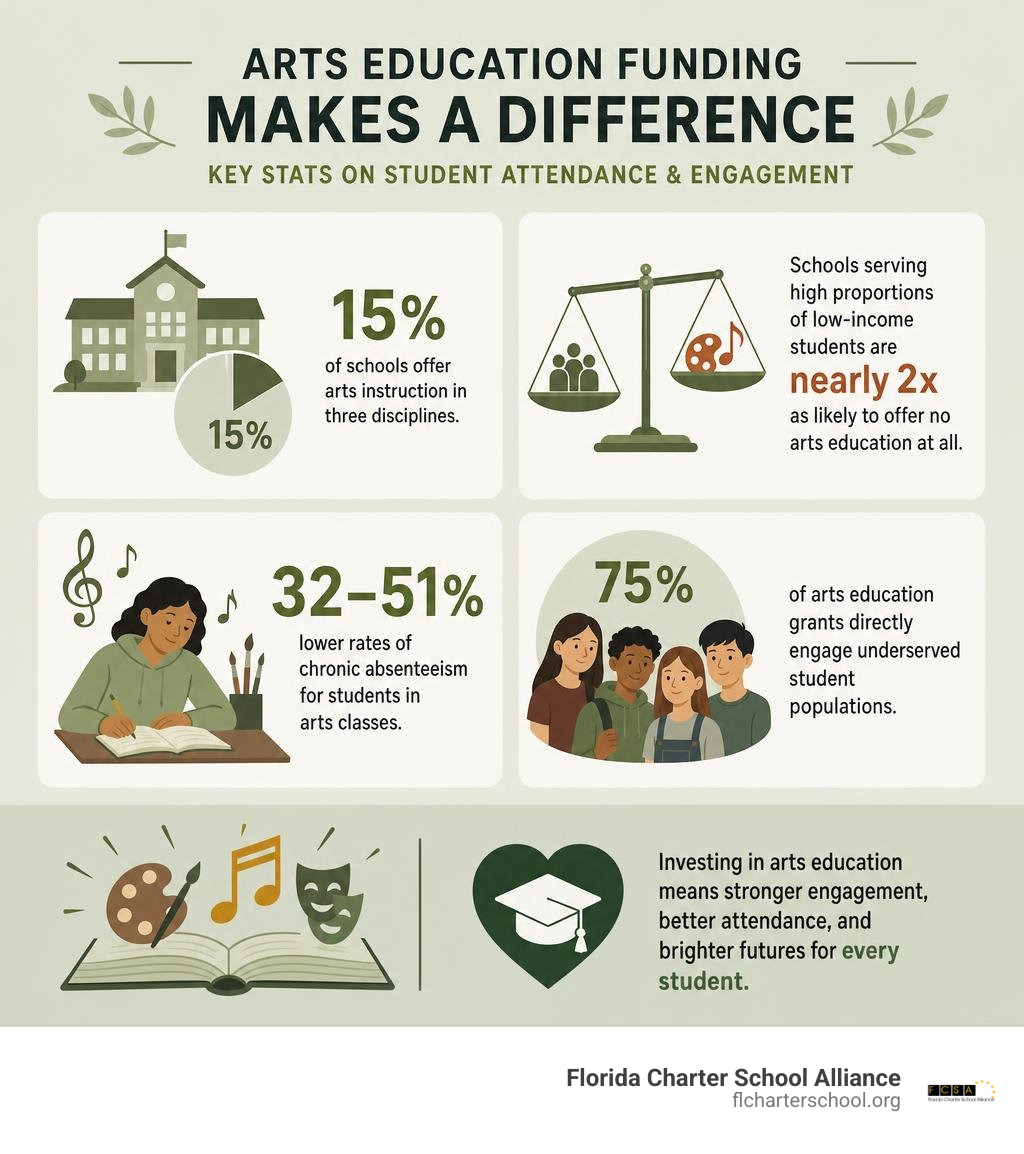
- Only 15% of schools offer arts instruction in three disciplines
- Schools serving high proportions of low-income students are nearly twice as likely to offer no arts education at all
- Students in arts classes show 32–51% lower rates of chronic absenteeism
- Around 75% of arts education grants directly engage underserved student populations
The gap between students who have access to the arts and those who don’t is real — and it’s largely a funding problem. Federal programs exist to close that gap, but navigating them takes knowledge, planning, and advocacy.
For Florida’s public charter schools, this is especially important. Charter schools are uniquely positioned to build innovative, arts-rich learning environments — but only when school leaders know how to find and access the funding available to them.
I’m Lynn Norman-Teck, Executive Director of the Florida Charter School Alliance, and throughout my career supporting public charter school development and policy across Florida, I’ve seen how arts education funding can transform a school’s ability to serve the whole student. This guide will walk you through every major funding source, policy shift, and practical strategy you need to know.
Federal Sources of Arts Education Funding

When we talk about federal support for the arts in our schools, we are looking at a complex, interconnected ecosystem. Federal arts education funding primarily flows through two federal agencies: the National Endowment for the Arts (NEA) and the U.S. Department of Education (ED). While both agencies share the goal of expanding educational opportunity, their eligibility criteria, scope, and distribution methods differ significantly.
The National Endowment for the Arts focuses on strengthening the broader arts education ecosystem. Through targeted grantmaking, leadership initiatives, and research partnerships, the NEA aims to close opportunity gaps for students who historically lack access to high-quality arts instruction.
In contrast, the U.S. Department of Education distributes funding on a much larger scale, primarily through the Elementary and Secondary Education Act (ESEA), which is the federal government’s main K-12 assistance framework. While the NEA funds specific, highly structured projects, ED funds are typically integrated into broader schoolwide improvement plans, professional development systems, and academic enrichment initiatives.
For public charter schools and local school districts, understanding how to navigate both agency pipelines is essential. We can access NEA funds directly by applying for specific project-based grants, whereas ED funds usually flow through state education agencies before reaching local classrooms. To successfully apply for these programs, school leaders should consult the detailed requirements outlined in the FY26 GAP Arts Ed INSTRUCTIONS.
Specific NEA and ED Grants for Arts Education Funding
Under the NEA’s Grants for Arts Projects (GAP) program, organizations can request cost-share/matching grants ranging from $10,000 to $100,000. These grants are categorized into three distinct, highly competitive project types:
- Direct Learning: This category funds projects that provide sequential, standards-based arts instruction directly to pre-K-12 students. To be competitive, projects must include hands-on creation or performance, direct experience with exemplary works of art, and robust assessment of student learning.
- Professional Development: These grants support training for classroom teachers, arts specialists, and teaching artists. Funded projects focus on equipping educators with curriculum-based arts integration strategies and pedagogical skills.
- Collective Impact: These initiatives target systemic, community-wide change. They require deep, cross-sector partnerships—including school districts, arts organizations, and local governments—to align resources, share data, and systematically expand arts access across entire regions.
On the Department of Education side, the premier dedicated funding source is the Assistance for Arts in Education (AAE) program. Managed by the Well-Rounded Education Program Division, the AAE program consolidated three historical grant streams in 2021 to streamline federal support.
However, dedicated federal funding remains vulnerable. In recent federal budget cycles, the House Appropriations Committee proposed reducing the Department of Education’s total funding by 10%, which included a controversial proposal to entirely eliminate the $36.5 million AAE grant program. This potential threat is detailed in the report House Proposes Slashing Major Arts Education Grant. While advocates continue to fight for these resources, it underscores why public charter schools must diversify their funding strategies.
Leveraging Title IV-A and 21st Century Community Learning Centers
Fortunately, larger and more flexible federal funding streams can be leveraged to support arts programs. Under Title IV, Part A of ESEA—known as the Student Support and Academic Enrichment (SSAE) grant program—school districts and public charter schools receive allocations designed to foster a well-rounded education. Because the arts are explicitly recognized as a core component of a well-rounded education, SSAE funds can be flexibly used to purchase instructional materials, musical instruments, and digital arts equipment, or to pay for specialized staff.
Additionally, the 21st Century Community Learning Centers (21st CCLC) program provides vital funding for afterschool, before-school, and summer enrichment initiatives. By partnering with local arts organizations and teaching artists, public charter schools can use 21st CCLC funds to establish creative youth development programs, theater clubs, and studio art workshops. These programs not only keep students safe and engaged during out-of-school hours but also directly support academic achievement and social-emotional growth.
Policy Shifts: How ESSA Transformed the Funding Landscape
The transition from the No Child Left Behind (NCLB) Act of 2002 to the Every Student Succeeds Act (ESSA) of 2015 marked a monumental shift for arts education funding. Under NCLB, intense federal focus on high-stakes testing in reading and mathematics often led schools to narrow their curricula, frequently sidelining arts education in the process.
ESSA fundamentally corrected this course by replacing the rigid academic frameworks of the past with a commitment to a “well-rounded education.” Under this new definition, music and the arts are explicitly designated as necessary components of a complete education, on par with reading, science, and math. This legislative shift opened up multi-billion-dollar federal funding streams—such as Title I and Title II—to arts educators and programs.
| Feature | No Child Left Behind (NCLB) | Every Student Succeeds Act (ESSA) |
|---|---|---|
| Core Philosophy | Narrow focus on high-stakes math and reading testing | Commitment to a “well-rounded education” including the arts |
| Federal Funding Access | Arts funding was restricted to isolated, small-scale grants | Arts programs are eligible for Title I, Title II, and Title IV-A funds |
| Accountability Focus | Adequate Yearly Progress (AYP) based strictly on test scores | Flexible state-defined accountability, allowing arts access metrics |
| Reporting Requirements | Standardized test participation and graduation rates | Option to include arts course enrollment and access on report cards |
State Accountability and Reporting Under ESSA
Under ESSA, states were given the flexibility to design their own accountability systems, which led to innovative strategies to measure and reward arts participation:
- Connecticut: Incorporated an “arts access” indicator directly into its high school accountability system. High schools can earn up to 50 points of their total accountability score based on the percentage of students participating in at least one arts course, targeting a 60% participation rate.
- Arizona: Added arts and music program availability directly to school report cards, giving parents clear data on which schools offer comprehensive, student-centered learning environments.
- Colorado: Leveraged Title IV funds to host a statewide Summer Institute, training educators to build high-quality, arts-integrated curricular resources that boost academic excellence across all subjects.
These state-level models prove that when we measure and value the arts, we create stronger incentives for schools to invest in creative, student-centered learning.
Legislative Efforts to Expand Arts Education Funding
To build on these policy shifts, federal lawmakers have introduced targeted legislation to further entrench arts education into our national school systems. The Arts Education for All Act represents the most comprehensive federal legislative effort to date.
Introduced as H.R. 5463 and updated in subsequent terms as H.R. 2485, this bill aims to close opportunity gaps by embedding arts education requirements into existing federal child care, K-12, and juvenile justice programs. For a closer look at the legislative framework, you can read the Text of H.R. 5463 (118th): Arts Education for All Act (Introduced version) – GovTrack.us and review the updated version H. R. 2485.
This legislation would:
- Require states to report arts course offerings, pupil-teacher ratios, and teacher certification rates on school report cards.
- Amend the Child Care and Development Block Grant to include arts integration in professional development for early childhood educators.
- Support arts-based programs within juvenile justice facilities to reduce recidivism and support youth reentry.
State and Local Distribution Models
While federal guidelines set the rules of the road, the actual distribution of arts education funding is determined at the state and local levels. State arts agencies and local education agencies (LEAs) act as the primary gatekeepers and administrators of these funds.
A prime example of a highly structured local distribution model is the New York City Department of Education’s SCHOOL ALLOCATION MEMORANDUM NO. 36, FY 2026. This memorandum outlines exactly how supplemental arts funding is distributed across 12 distinct programs to target specific educational needs, including:
- The Arts Accelerator Grant Program: Awarding up to $25,000 per school to create or enhance arts-related spaces that support student engagement and social-emotional learning.
- The Early Childhood Strings Program: Allocating over $36,000 per selected school to fund a dedicated classroom aide for violin instruction in 3K and Pre-K classrooms.
- The Arts Studio Allocation: Distributing $1,619 per full-time arts teacher directly to schools for culturally responsive studio materials.
By analyzing these municipal models, we can learn how to structure local and regional partnerships that bring high-quality resources directly to our students.
Navigating Florida’s Arts Funding Environment
Here in Florida, navigating the state’s arts funding landscape requires strategic planning and local advocacy. Key state and regional entities include the Florida Division of Arts and Culture, the United Arts of Central Florida, and the Tallahassee Arts Guide. These organizations offer valuable resources, grant opportunities, and technical assistance to schools and local arts organizations.
However, the state-level funding environment has recently faced significant volatility. In June 2026, many local organizations and school partners were left reeling after sudden state-level budget vetoes eliminated millions of dollars in expected cultural and educational grants. This situation is detailed in the article Florida arts funding perplexes many who receive zero in state money.
For a deeper understanding of how these state-level decisions impact local programs, school leaders can refer to the State of Florida Arts Funding Q&A – Cultural Council. Because state-level funding can be unpredictable, public charter schools must remain agile. By combining state grant opportunities with local philanthropic partnerships and federal Title funds, we can insulate our arts programs from local funding fluctuations and protect our students’ educational access.
Targeting Underserved Populations and Tracking Access
A central priority of modern arts education funding is equity. Currently, around 75% of arts education grants are intentionally structured to target underserved or disadvantaged student populations, including low-income families, English language learners, and students with disabilities.
To ensure these funds are actually reaching the students who need them most, robust data collection is critical. Initiatives like the Arts Education Data Project track student enrollment in arts courses nationwide, highlighting where opportunity gaps exist.
Furthermore, national studies such as the Fast Response Survey System (FRSS) and the National Assessment of Educational Progress (NAEP) provide the benchmarks we need to measure student achievement and program efficacy. By utilizing this data, school leaders can conduct thorough needs assessments to justify and secure federal grant dollars.
Frequently Asked Questions about Arts Education Funding
How can local school districts and charter schools access federal arts funding?
To access federal funds, school leaders should start by conducting a comprehensive schoolwide needs assessment. If a school qualifies for Title I schoolwide status, arts programs can be integrated directly into the school’s improvement plan as a tool to boost student achievement and attendance. Additionally, charter schools and districts can build strategic partnerships with local non-profit arts organizations to co-apply for federal grants like the NEA’s Direct Learning or Collective Impact programs.
What percentage of arts education grants target underserved student populations?
Approximately 75% of federal and state arts education grants directly target underserved or disadvantaged student populations. These grants are specifically designed to close opportunity gaps, ensuring that students in high-poverty schools, students with disabilities, and English language learners have equitable access to high-quality, sequential arts instruction.
How do 21st CCLC and SSAE grants support arts programs?
These grants provide highly flexible funding streams. Student Support and Academic Enrichment (SSAE) grants under Title IV-A can be used to buy musical instruments, visual arts supplies, and digital media equipment, or to fund arts integration training for teachers. 21st Century Community Learning Centers (21st CCLC) grants fund afterschool and summer programs, allowing schools to hire teaching artists and partner with cultural organizations to provide engaging, hands-on arts experiences outside of regular school hours.
Conclusion
Securing robust arts education funding is not just about supporting the school band or buying paintbrushes — it is about equity, student achievement, and fostering innovative learning. When we invest in the arts, we empower families, boost student engagement, and build a stronger foundation for academic excellence.
At the Florida Charter School Alliance, we believe that every child in Florida deserves access to an education that nurtures their full potential. Public charter schools are uniquely positioned to lead the way in educational innovation, offering families high-quality, student-centered options that integrate the arts into everyday learning. However, to sustain these programs, we must advocate for fair, transparent, and robust funding models that support every public school student.
We must raise our voices to ensure that our state and local policies align with our commitment to educational opportunity. We encourage you to join us in our mission to Fund All Public School Students Fairly and protect the creative future of Florida’s children.