
What Is Educational Advocacy — and Why Should You Care?
Educational advocacy is the practice of working on behalf of students to make sure they get the support, services, and opportunities they need to succeed in school.
Here’s a quick breakdown:
- What it covers: IEPs, 504 plans, special education evaluations, parental rights, and school placement decisions
- Who it helps: Students with learning differences, disabilities, or any child not getting the right support
- Who does it: Parents, professional advocates, attorneys, and organizations that know education law
- Why it matters: Without advocacy, many students — especially those with dyslexia, ADHD, autism, or other learning differences — may not receive the services they’re legally entitled to
Every child has a right to a free and appropriate public education. But knowing that right exists and actually securing it are two very different things.
Navigating school systems can feel overwhelming. The paperwork is dense. The meetings are intimidating. And the terminology — IDEA, FAPE, LRE, IEP — can feel like a foreign language to families who are just trying to help their child thrive.
That’s exactly where educational advocacy steps in. It gives families the knowledge, tools, and support to make sure their child’s voice is heard — and their needs are met.
I’m Lynn Norman-Teck, Executive Director of the Florida Charter School Alliance, and I’ve spent my career at the intersection of educational advocacy, public school choice, and community engagement, helping families and schools across Florida access high-quality educational opportunities. In this guide, I’ll walk you through everything you need to know to navigate educational advocacy with confidence.
What is Educational Advocacy and Why Does It Matter?
At its core, educational advocacy is about bridging the gap between what a student needs and what the school provides. It is the driving force behind student achievement, parental choice, and equitable educational access. For students with special needs, learning differences, or unique behavioral profiles, having a dedicated advocate can mean the difference between falling behind and achieving academic excellence.
In Florida, we believe that every family deserves a high-quality education that fits their child’s unique learning style. However, the path to obtaining specialized services is rarely a straight line. School districts are often stretched thin, and parents may find themselves facing bureaucratic hurdles just to get a basic evaluation.
Advocacy matters because it empowers families. It shifts the dynamic from one where parents passively receive school decisions to one where they are active, equal partners in shaping their child’s educational journey. When parents exercise parental choice and stand up for their children, they secure the tailored supports that make student-centered learning a reality.
Understanding Your Rights Under Federal Education Laws
To advocate like a pro, you must first understand the legal foundation that protects your child’s educational rights. There are three key pillars of federal special education law that every parent and advocate must know:
- Individuals with Disabilities Education Act (IDEA): This federal law ensures that eligible children with disabilities receive special education and related services. Under IDEA, eligible students are entitled to an Individualized Education Program (IEP) tailored to their unique academic, social, and behavioral needs.
- Free Appropriate Public Education (FAPE): A core guarantee of IDEA, FAPE means that public schools must provide personalized instruction and support services at no cost to the parents, designed to meet the student’s unique needs and prepare them for further education, employment, and independent living.
- Section 504 of the Rehabilitation Act: This civil rights law prohibits discrimination against individuals with disabilities. A 504 plan provides accommodations—such as extra time on tests, preferential seating, or assistive technology—to students with physical or mental impairments that substantially limit one or more major life activities, even if they do not require specialized instruction under an IEP.
Navigating these laws can be incredibly complex. When families need local, specialized guidance to understand how these federal mandates are implemented in our state, turning to professional resources like Florida Professional Special Education Advocates can provide the expert legal and procedural clarity needed to secure a child’s rights.
The Role of Educational Advocacy in Supporting Diverse Learners
Every student learns differently. For neurodivergent children—including those with dyslexia, dysgraphia, dyscalculia, or attention deficits—traditional, one-size-fits-all classroom models can present significant barriers.
Advocacy is especially critical for:
- Students with Dyslexia: Ensuring they have access to evidence-based, structured literacy programs rather than a “wait-and-see” approach.
- Twice-Exceptional (2e) Learners: Supporting students who are highly gifted academically but also have a learning disability or neurodivergent profile. These students need dual accommodations that nurture their high capabilities while supporting their challenges.
- Behavioral Support Needs: Helping families secure functional behavior assessments (FBAs) and positive, trauma-informed, and neurodiversity-affirming behavioral intervention plans (BIPs) rather than relying on exclusionary discipline.
Taking a neurodiversity-affirming approach means viewing a student’s differences as natural variations in human brain function rather than deficits that need to be “cured.” Professional services like Shared Voice Educational Advocacy LLC specialize in this strengths-based philosophy, helping families navigate evaluations and craft accommodations that celebrate a child’s unique strengths while addressing their challenges.
Navigating IEPs, 504 Plans, and Special Education Evaluations
The special education journey usually begins with an eligibility evaluation. If you suspect your child has a disability that impacts their learning, you have the right to request a comprehensive educational evaluation in writing. Once completed, the school team meets with you to determine if your child qualifies for an IEP or a Section 504 plan.

An IEP is a legally binding document that outlines specific academic goals, specialized services (such as speech therapy or occupational therapy), and progress monitoring metrics. A 504 plan, on the other hand, focuses primarily on classroom accommodations and environmental modifications.
Unfortunately, many families find themselves overwhelmed during these meetings. School teams are filled with educators who use specialized terminology, and it can be difficult for parents to push back when they feel a proposed plan lacks measurable goals or sufficient support.
To help make sense of this structured terrain, working with specialized coaches and advocates—such as the team at Rise Educational Advocacy: IEP and 504 Help | IEP Advocate—can turn a stressful meeting into an organized, strategic planning session that yields practical, long-term progress for your student.
How Professional Advocates Help Families Overcome Barriers
Why do families hire professional educational advocates? Because schools and school districts are massive systems, and systems often resist change. Families frequently face systemic barriers, such as delayed evaluations, vague IEP goals, or schools claiming they “don’t have the funding” for a specific service.
An experienced educational advocate helps you level the playing field through:
- Comprehensive Records Review: Examining your child’s entire educational history, previous evaluations, report cards, and work samples to identify gaps in services.
- Meeting Preparation: Creating a clear, evidence-based strategy before you step into the school building.
- Communication Strategies: Helping you write professional, written communications to school administrators that establish a paper trail and command respect.
- Direct Representation: Accompanying you to IEP and 504 meetings to ensure the school team listens to your concerns and adheres to legal timelines.
Instead of navigating these waters alone, partnering with dedicated professionals like Bright Path Advocacy – Special Education Advocate, IEP Help can help you transition from feeling isolated to feeling completely empowered, ensuring your child receives the tailored instruction they deserve.
How Parents Can Partner with Schools for Student Success
While advocates are incredibly valuable, the ultimate goal of educational advocacy is to build a strong, collaborative relationship between parents and educators. Collaborative advocacy is far more effective than an adversarial approach. When families and schools work together with mutual respect, student achievement and school success naturally follow.

To build a healthy partnership:
- Be Prepared and Organized: Keep a dedicated binder or digital folder with all IEPs, evaluations, and school communications.
- Focus on Solutions: Frame your child’s needs around strengths-based solutions rather than focusing solely on what the school is doing wrong.
- Know Your Resources: Access tools designed to help you communicate clearly and effectively. For example, our Advocacy Toolkit provides practical resources and strategies to help parents raise their voices and collaborate with educators.
Practical Steps to Get Started with an Educational Advocacy Service
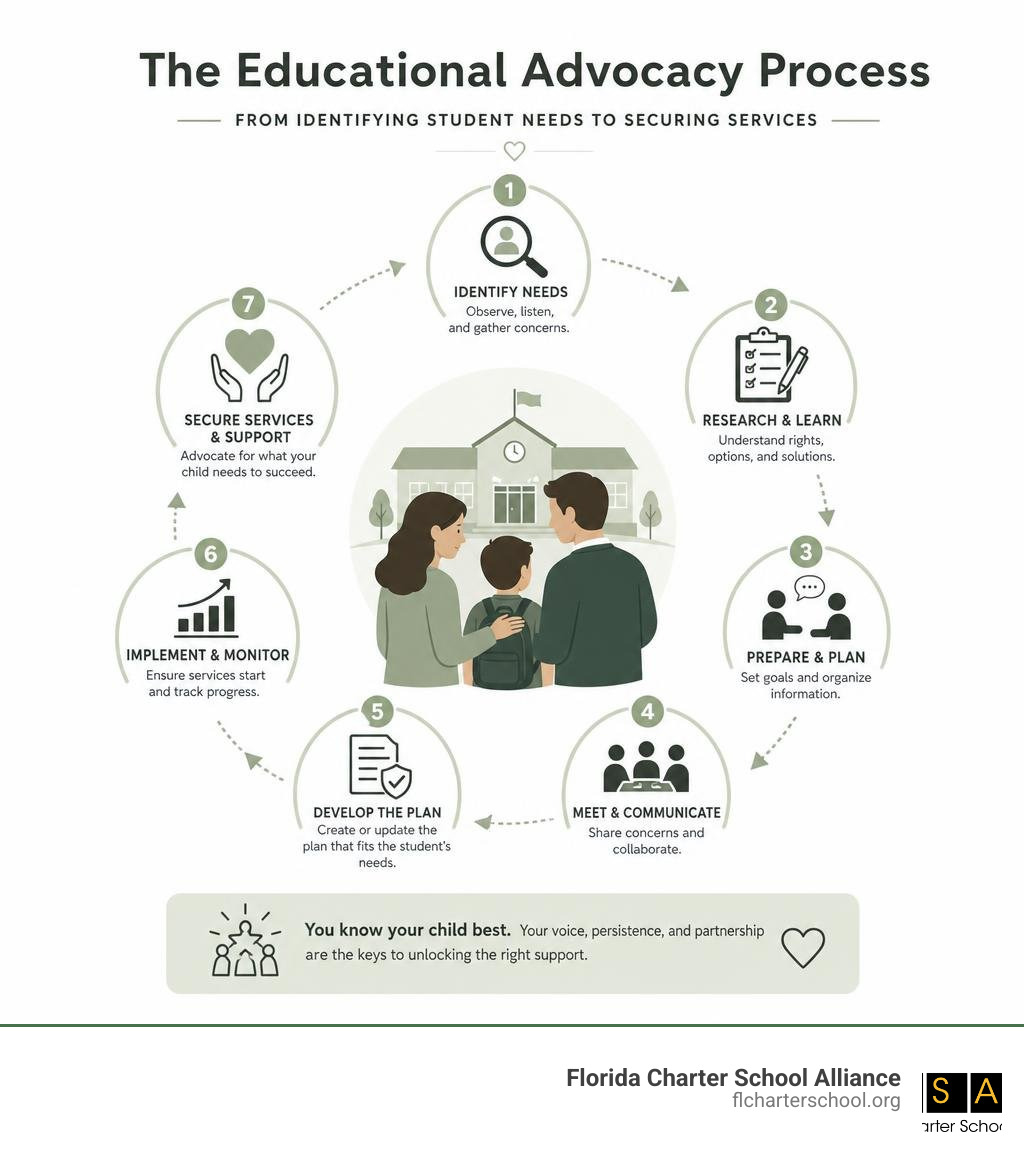
If you decide that you need professional support, taking the first step is simple. Most reputable educational advocates follow a structured process to understand your family’s unique needs:
- Free Consultation: Most advocates offer an initial, no-obligation consultation (often 30 minutes) to discuss your concerns and see if their services are a good fit.
- Intake Form Submission: You will fill out an intake form detailing your child’s educational background, diagnoses, and current challenges.
- IEP Strategy Session: The advocate will review your documents and host a dedicated strategy session to outline clear goals.
- Tailored Advocacy Plan: You will receive a customized plan of action, which may include direct meeting representation or parent coaching.
To explore how structured, step-by-step professional guidance can help your family secure measurable educational outcomes, you can connect with EmpowerED Advocates to begin building your child’s tailored support plan.
Frequently Asked Questions about Educational Advocacy
What are the main services provided by educational advocacy organizations?
Educational advocacy organizations offer a wide range of services designed to support families at every stage of their educational journey. These services generally fall into three main categories: parent coaching, direct meeting representation, and transition support.
| Service Category | Description | Key Benefits |
|---|---|---|
| Parent Coaching | One-on-one training to teach parents how to communicate with schools, read evaluations, and understand their legal rights. | Empowers parents to advocate independently over the long term. |
| IEP & 504 Advocacy | Reviewing records, drafting accommodation requests, and attending school meetings with the family. | Ensures legal compliance, measurable goals, and appropriate accommodations. |
| Transition Support | Helping older students plan for life after high school, including college accommodations or workforce entry. | Protects student rights during major life transitions. |
| Training & Resources | Community workshops, webinars, and written guides on special education topics. | Builds community knowledge and local support networks. |
How do advocacy organizations measure success and impact?
Advocacy organizations measure success through both individual student outcomes and broader, systemic improvements. On an individual level, success is measured by improved student achievement, the implementation of appropriate services, and increased parent confidence.
On a systemic level, advocacy organizations track their impact through community outreach, parent training, and legislative reform. For example, looking at established advocacy groups like the Massachusetts Advocates for Children, they demonstrate systemic impact by:
- Answering over 2,000 helpline calls per year to assist families in crisis.
- Training more than 3,000 parents in advocacy techniques and legal rights.
- Successfully advocating for 16 state laws since 2002 to improve educational access and protect student rights.
This multi-tiered approach ensures that individual families get immediate help while structural barriers are dismantled at the policy level.
How do public charter schools support student-centered learning and advocacy?
Public charter schools are uniquely positioned to foster student-centered learning and support educational advocacy. Because charter schools operate with greater flexibility than traditional public schools, they are hubs of educational innovation and academic excellence.
Our mission at the Florida Charter School Alliance is to protect and defend these high-quality educational options. As public schools of choice, charter schools are held to strict standards of academic and financial accountability. Yet, their regulatory freedom allows them to design innovative learning environments that can adapt quickly to the diverse needs of their students.
Whether a charter school specializes in classical education, STEM, or dedicated support for students with unique abilities, they expand parental choice and ensure that educational access is not determined solely by a family’s ZIP code. To learn more about how these tuition-free public options operate, explore our guide About Florida Charter Schools.
Conclusion
Navigating educational advocacy is a journey of family empowerment. Whether you are working with a professional advocate, learning the ropes yourself, or exploring new public school options, you are your child’s most important champion.
At the Florida Charter School Alliance (FCSA), we believe that every child in Florida deserves a high-quality education that meets their individual needs. By advocating for parental choice, protecting innovative learning models, and expanding educational access, we are working to build a brighter future for all Florida students.
If you are ready to take an active role in shaping the educational landscape in our state, we invite you to join us. Learn more about our mission and discover how you can get involved by visiting Charter School Advocacy in Florida. Together, we can ensure that every student has the opportunity to achieve academic excellence.