
Why Public School Zoning Restrictions Matter to Families
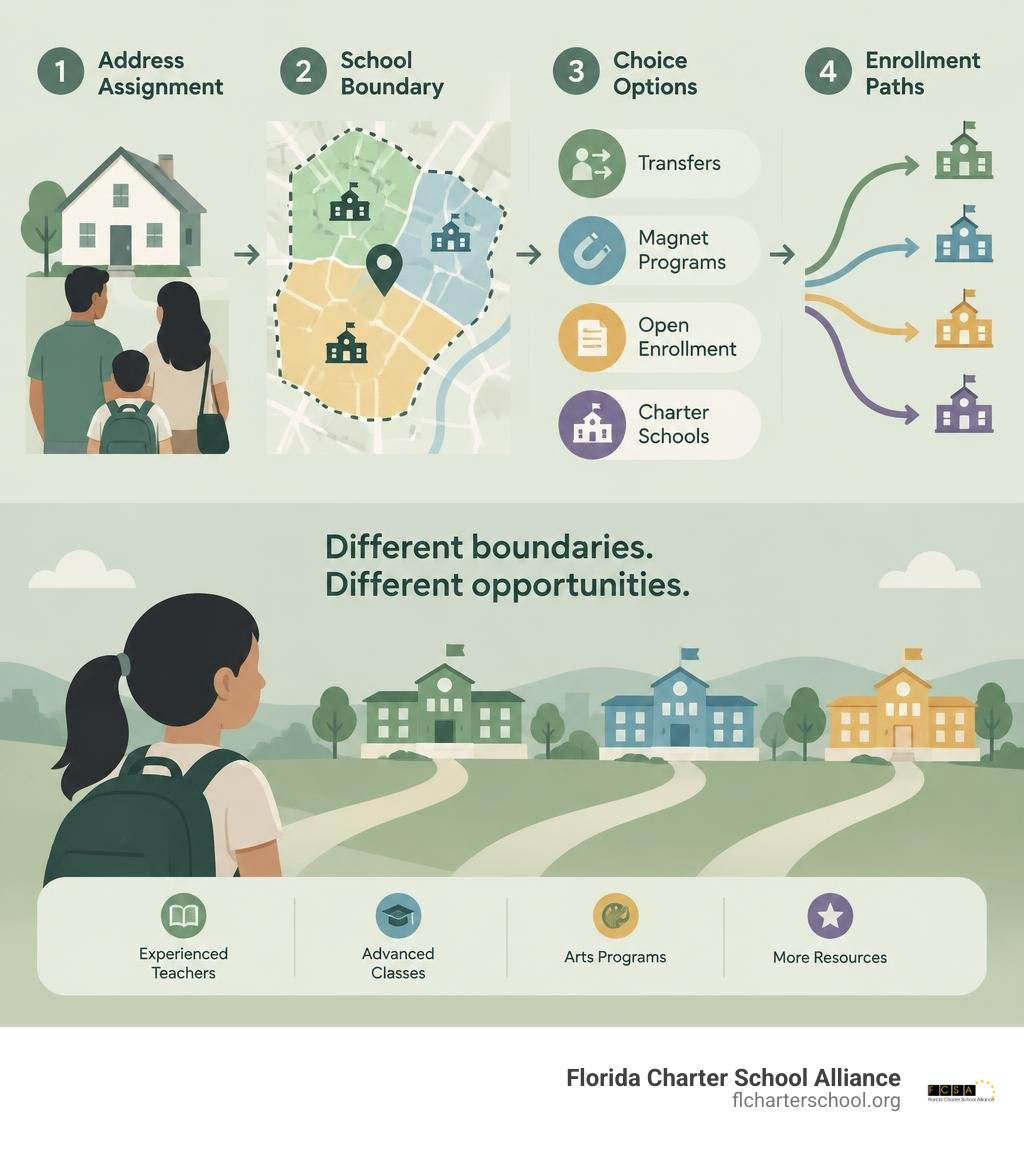
Public school zoning restrictions assign most students to a traditional public school based on their home address. Families can usually find their assigned school through their district’s boundary map, then check whether options such as transfers, magnet programs, open enrollment, or public charter schools are available.
These lines can shape far more than a daily bus route. Attendance boundaries often follow patterns of housing wealth and historic segregation, which can give neighboring students very different access to experienced teachers, advanced classes, arts programs, and other resources that support student achievement.
Research has identified more than 2,000 pairs of neighboring metropolitan schools where crossing one attendance boundary corresponds with a major racial or ethnic shift in the surrounding population. That is why school zoning is both a family issue and an educational opportunity issue: a child’s address should not be the main limit on high-quality education, innovative learning, or school success.
Public charter schools can expand parental choice because they are tuition-free public schools that generally enroll students without traditional neighborhood attendance zones, often using a fair lottery when applications exceed available seats. They are not a complete replacement for stronger district policies, but they can give families another path to student-centered learning and academic excellence.
I am Lynn Norman-Teck, Executive Director of the Florida Charter School Alliance, and I have spent my career advancing public charter school development, policy, and family engagement. My work on public school zoning restrictions focuses on family empowerment, educational access, accountability, and helping students find high-quality options beyond a single assigned address.
The Architecture of Public School Zoning Restrictions and Modern Segregation
School attendance zones were originally conceived as a practical mechanism to manage student populations, coordinate bus routes, and ensure every child had a seat in a neighborhood classroom. Over decades, however, these geographic boundaries evolved into rigid administrative barriers. Today, arbitrary lines drawn on municipal maps frequently determine which children receive access to rigorous coursework, modern learning environments, and experienced educators.
National research highlights that strict school zones are reinforcing inequality across metropolitan communities. Rather than reflecting organic neighborhood shifts, modern boundaries often act as socioeconomic walls. A nationwide analysis by the Urban Institute revealed that nationwide public school segregation between Black and white students has effectively returned to 1968 levels. Across urban and suburban landscapes, more than 2,000 pairs of adjacent public schools exhibit dramatic demographic and economic disparities simply because an invisible boundary separates them.
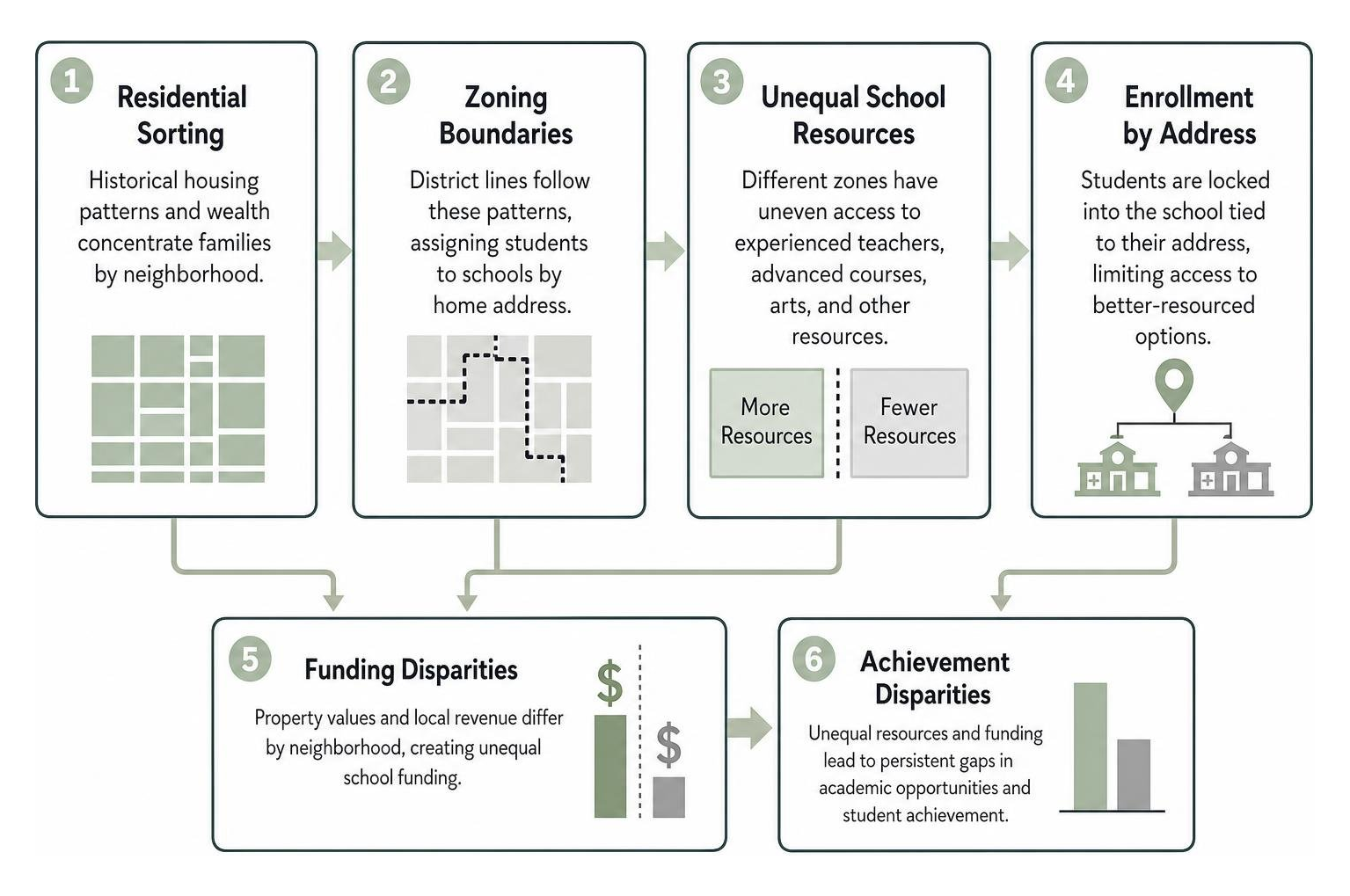
When districts rely on strict geography to allocate educational access, public schooling mirrors the housing market. Families with higher financial means purchase homes inside exclusive attendance zones, effectively buying admission into top-tier public programs. Meanwhile, working-class families are left with limited recourse, locked into under-resourced schools by virtue of their zip code.
Historical Roots: 1930s Redlining Maps and School Attendance Boundaries
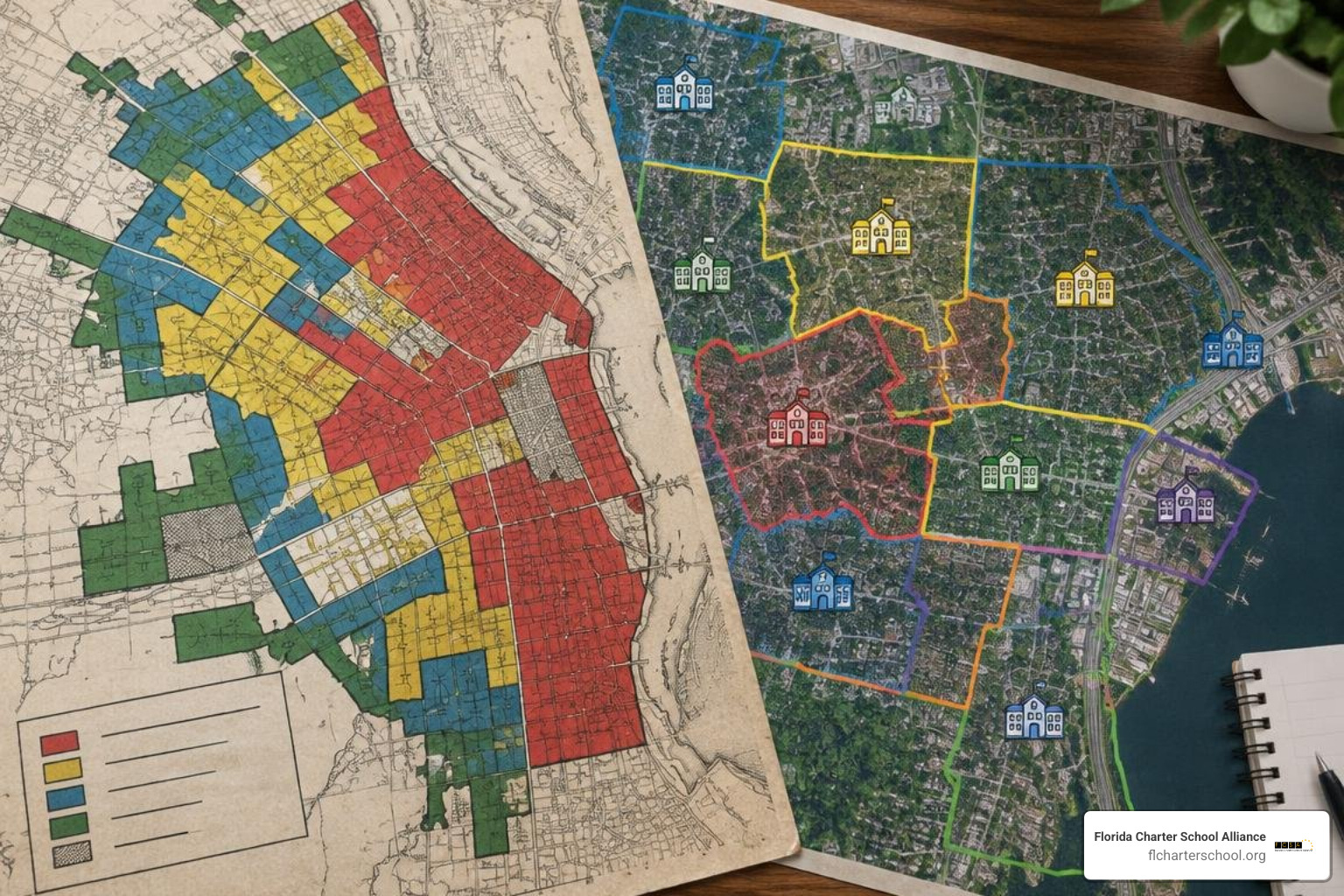
The roots of contemporary school boundary inequities are deeply tied to 20th-century housing policy. During the 1930s, the federal Home Owners’ Loan Corporation (HOLC) created residential security maps that graded neighborhoods based on perceived mortgage risk. Communities with high proportions of racial minorities and lower-income residents were color-coded red—a practice known as redlining—cutting them off from private capital, mortgage insurance, and municipal investment.
Studies examining GIS boundary data reveal an unmistakable correlation: modern public school attendance zones frequently mirror these 1930s redlining maps. The comprehensive research report Dividing Lines demonstrates that current school assignment borders often preserve historical lines of demographic segregation. When restrictive residential covenants and discriminatory zoning fragmented metropolitan areas decades ago, school districts established attendance perimeters around those segregated enclaves.
Because these lines have remained largely untouched or have been adjusted to protect property values, the historical exclusion of low-income families persists in modern public education.
How Public School Zoning Restrictions Disadvantage Low-Income Communities
The practical impact of address-based school assignment falls heaviest on low-income students and communities of color. Across the country, attendance boundaries separate schools with vast disparities in academic achievement and instructional resources.
In metropolitan areas nationwide, studies show that school rules keep herding the poorest kids into the worst schools, concentrating disadvantage and stifling upward mobility. For example, boundary analyses in Missouri demonstrated that attendance boundaries discriminate against low-income students, where 94% to 96% of public school students attend their assigned school based strictly on home address. In St. Louis, a single boundary line separates the St. Louis City School District—where roughly 20% of students achieve grade-level proficiency in reading and math—from the adjacent Clayton School District, where nearly 75% reach proficiency.
These boundaries create compounding disadvantages:
- Disparities in Advanced Coursework: Schools on the underfunded side of a boundary line often lack Advanced Placement (AP), International Baccalaureate (IB), or dual-enrollment pathways.
- Resource Gaps: Lower property wealth correlates with higher teacher turnover, fewer specialized support staff, and deteriorating infrastructure.
- Exclusionary Policies: Districts fiercely protect boundary lines to prevent out-of-zone enrollments from impacting classroom sizes or local tax dynamics.
Families seeking comprehensive pathways to overcome these institutional barriers often explore modern school choice programs, which decouple high-quality education from physical real estate.
Legal Frameworks and Municipal Authority Over School Boundaries
The legal landscape governing school attendance boundaries is shaped by landmark judicial decisions, state education codes, and land-use statutes. In 1954, Brown v. Board of Education dismantled state-sponsored de jure segregation, establishing that separate educational facilities are inherently unequal. However, twenty years later, the U.S. Supreme Court’s ruling in Milliken v. Bradley (1974) drew a sharp legal distinction between internal district policies and inter-district boundaries.
The Milliken decision held that federal courts could not impose cross-district desegregation remedies unless plaintiffs proved that district lines were drawn with deliberate discriminatory intent. This created a powerful legal shelter: suburban districts could maintain rigid borders, insulating their tax bases and schools from neighboring urban districts.
Beyond attendance assignments, courts regularly evaluate how municipal zoning laws impact the physical construction and location of educational facilities:
| Case / Jurisdiction | Core Legal Question | Judicial Standard / Outcome | Practical Impact on Schools |
|---|---|---|---|
| Milliken v. Bradley (1974) | Can federal desegregation orders cross district boundary lines? | Inter-district remedies require proof of intentional multi-district discrimination. | Established legal protection for suburban school boundary lines nationwide. |
| Jim Thorpe Area School District v. Kidder Township (Pa. 1999) | Can a township use land-use zoning to effectively exclude public schools? | Fair share test; statutory preemption under the Public School Code. | Struck down municipal restrictions that limited school construction to just 2% of township land. |
| Independent School Dist. No. 89 v. City of Oklahoma City (Okla. 1986) | Does a school district possess absolute sovereign immunity from city zoning? | Balancing of interests test rather than automatic sovereign immunity. | Required school boards and cities to balance public interest and municipal planning goals. |
The Criminalization of Address Sharing and Strict Residency Enforcement
To maintain geographic exclusivity, some school districts resort to aggressive residency verification. Families who use a grandparent’s address, a lease agreement from a relative, or an unverified mailing address to access high-performing public schools face severe repercussions.
Districts increasingly deploy private investigators, conduct surprise home visits, and monitor morning drop-off lines to uncover “residency fraud.” For instance, in suburban St. Louis, the Hazelwood School District conducted 2,051 residency investigations during the 2022–2023 academic year alone—a massive spike from 148 investigations conducted in 2018–2019.
When violations are identified, the consequences extend beyond simple disenrollment:
- Tuition Clawbacks: Districts frequently bill families tens of thousands of dollars in retroactive non-resident tuition.
- Criminal Prosecution: Parents have faced felony fraud and larceny charges for enrolling children in higher-performing districts using secondary addresses.
- Disciplinary Disruption: Displaced students are abruptly removed from classes, sports teams, and peer support systems.
These punitive measures highlight why family empowerment and transparent educational options are critical. Families exploring public charter school models find an open, tuition-free alternative where enrollment is never criminalized based on street coordinates.
Municipal Land-Use Ordinances and Public School Zoning Restrictions
Municipal zoning codes also dictate where school facilities can physically be built. Local planning commissions, city councils, and county land development regulations maintain significant authority over institutional land use, parking requirements, traffic mitigation, and building heights.
In many communities, local ordinances classify public schools as conditional uses rather than permitted uses. In Jim Thorpe Area School District v. Kidder Township Zoning Hearing Board, Kidder Township restricted school construction to its R-3 zoning district—a classification representing just 1,515 acres, or roughly 2% of the township’s total land. The Carbon County Court of Common Pleas ruled this restriction constitutionally invalid, establishing that municipalities cannot use exclusionary land-use tactics to veto public education infrastructure.
Land-use disputes require school operators and local planning boards to balance community interests, traffic safety, and statutory educational mandates without artificially limiting family access to new campuses.
Breaking the Boundary Barrier: School Choice and Policy Solutions

Dismantling zip-code-based educational inequity requires proactive policy reform. Restrictive attendance zones are not an inevitable feature of public education; they are policy choices that state legislatures and local districts can modernize.
Across the United States, forward-thinking education systems are embracing policies that separate academic access from real estate:
- Inter-District and Intra-District Open Enrollment: Permitting students to transfer to any public school with available capacity, regardless of municipal boundaries.
- Equitable Boundary Adjustments: Utilizing geographic information systems (GIS) to redraw outdated attendance zones, balancing socioeconomic demographics without disrupting travel times.
- Portability of Funding: Ensuring state and local operational dollars follow the student to their school of choice, encouraging districts to welcome transfer students.
- Public Charter School Growth: Expanding independent, high-accountability public schools that serve students across entire counties.
When public policy embraces student-centered mobility, families experience the benefits of school choice empowering their communities, creating dynamic environments that foster student achievement.
Open Enrollment and Charter School Alternatives to Zoned Schools
Public charter schools represent one of the most effective structural solutions to rigid school zoning restrictions. As tuition-free public schools authorized by school districts or state entities, charter schools operate with freedom from traditional attendance zones while maintaining strict academic and financial accountability.
When evaluating educational pathways, understanding how traditional public schools, magnet programs, and charter schools compare illuminates the unique role charters serve:
| Feature / Model | Traditional Zoned Public Schools | Magnet Programs / Specialized Academies | Public Charter Schools |
|---|---|---|---|
| Admissions Criteria | Mandatory assignment based strictly on residential address. | Academic prerequisites, auditions, or targeted lottery tracks. | Open to all students; blind lottery when applications exceed capacity. |
| Geographic Boundaries | Strict neighborhood attendance zones. | District-wide, but seats are often limited by specialized quotas. | Broad enrollment zones encompassing entire districts or multi-district regions. |
| Curricular Model | Standardized district curriculum. | Specialized thematic focus (e.g., STEM, Performing Arts). | Innovative learning models tailored to community needs and academic excellence. |
| Governance | Centralized local school board administration. | Centralized local school board administration. | Independent governing boards focused on student-centered learning. |
| Tuition & Cost | 100% tuition-free public education. | 100% tuition-free public education. | 100% tuition-free public education. |
Parents interested in finding student-centered options can explore practical strategies to locate charter schools that match their child’s specific academic goals. Furthermore, states like Florida lead the nation in flexibility, enabling families to utilize Florida school choice programs and scholarships alongside robust open enrollment systems.
Political Resistance and the Future of Attendance Boundary Reform
Despite the evident inequities created by rigid attendance boundaries, systemic reform frequently encounters fierce local resistance. When school boards initiate comprehensive rezoning plans, pushback often centers around property values, neighborhood identity, and traffic patterns.
Homeowners who paid a premium to purchase real estate within a top-ranked school zone frequently voice concern that redistricting will dilute school prestige or lower home resale values. This dynamic can lead to political pressure on school boards, resulting in boundary compromises that leave historic divides in place.
Overcoming these barriers requires expanding education models that do not depend on divisive redistricting battles. Recognizing that education is not one size fits all allows communities to embrace public charter schools, open enrollment policies, and innovative programs without waiting for years of contentious boundary debates.
Frequently Asked Questions about Public School Zoning Restrictions
Can parents legally bypass public school zoning restrictions?
Yes, families have several legal avenues to bypass assigned attendance zones. Most states allow parents to apply for intra-district or inter-district open enrollment if the receiving school has available capacity. Families can also apply for specialized magnet programs, submit hardship transfer requests based on medical or safety needs, or enroll in tuition-free public charter schools, which do not assign seats based on neighborhood street addresses.
How do attendance zones directly affect school funding and resources?
Attendance zones directly affect resources because traditional public school funding models rely heavily on local property taxes. Neighborhoods with higher home values generate greater local tax revenues and benefit from substantial parent-teacher association (PTA) fundraising. These resources translate directly into lower student-teacher ratios, modern science laboratories, competitive athletic facilities, and a broader array of Advanced Placement (AP) and honors courses.
What is the difference between open enrollment and boundary rezoning?
Boundary rezoning involves a school board permanently redrawing the geographic lines that assign neighborhoods to specific campuses. In contrast, open enrollment allows individual students to transfer across existing zone or district boundaries to attend an open school without altering the physical boundary map itself. While rezoning requires comprehensive political and municipal action, open enrollment provides immediate, flexible parental choice.
Conclusion: Moving Beyond Zip-Code-Based Education
A child’s educational opportunity should never be predetermined by a housing market, a historical map, or a set of administrative zoning restrictions. Decades of data confirm that rigid attendance boundaries too often reinforce economic stratification and limit access to high-performing classrooms.
At the Florida Charter School Alliance, we believe that true educational equity begins with family empowerment and parental choice. Public charter schools offer a proven pathway forward—delivering innovative learning environments, robust accountability, and student-centered learning to families regardless of their address. By embracing open enrollment and expanding high-quality charter options, communities can break down outdated barriers and ensure every student has the opportunity to achieve academic excellence.
If you are evaluating the best educational pathway for your family, explore our guide on choosing between charter and traditional public schools to find the ideal learning environment for your child.