
What You Need to Know About Florida Charter School FAQs
If you’ve been searching for Florida charter school FAQs, here are the quick answers most families want first:
- Are charter schools free? Yes — tuition-free and open to all students.
- Are they public schools? Yes — governed by Florida Statute 1002.33.
- Who can attend? Any student residing in the school district.
- How do I enroll? Contact the school directly or visit to complete a registration packet.
- Are teachers certified? Yes — Florida law requires it.
- Are charter schools accountable? Yes — they receive state grades just like traditional public schools.
- Who oversees them? An independent volunteer board, plus the sponsoring school district.
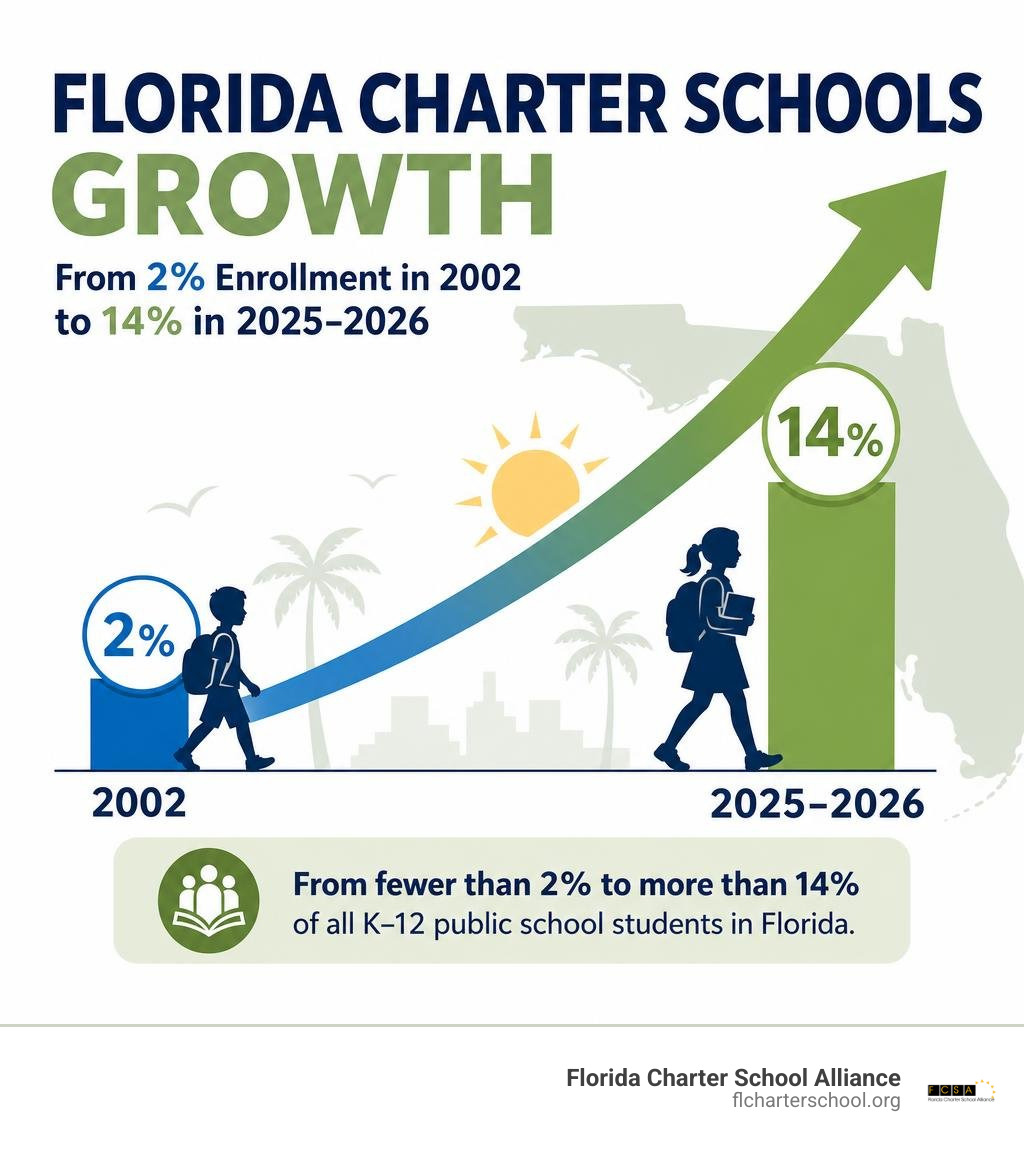
Florida’s charter school sector has grown dramatically — from fewer than 2% of public school students in 2002 to more than 408,400 students enrolled in the 2025–2026 school year. That’s roughly 14% of all K–12 students in Florida.
These aren’t niche schools. If Florida’s charter schools were a single district, they’d be the second-largest school district in the entire state.
Yet for many families — including parents of students in creative and specialized programs — the questions keep coming. How are these schools funded? Who holds them accountable? Can my child with an IEP attend? What happens if the school underperforms?
This guide answers all of that, clearly and completely.
I’m Lynn Norman-Teck, Executive Director of the Florida Charter School Alliance, and I’ve spent my career working at the intersection of charter school policy, community engagement, and public school choice across Florida — the exact territory these Florida charter school FAQs cover. As you read through, you’ll find straightforward, fact-based answers designed to help every family make a confident, informed decision about their child’s education.
Essential Florida Charter School FAQs: Basics and Enrollment

When parents first start exploring public school options, they often find themselves sorting through a mix of myths and facts. Let’s clear up the foundational details of how these schools operate and how you can secure a seat for your child.
Understanding the Basics: Florida Charter School FAQs
To understand the core of the charter movement, it helps to look at what these schools actually are. Public charter schools are tuition-free, non-profit public schools that operate under a performance contract (a “charter”) with a local school district sponsor.
First established in Florida in 1996, charter schools were created to foster educational innovation, encourage diverse learning methods, and provide families with meaningful educational opportunity. We believe that family empowerment begins with having high-quality public options that fit a child’s unique learning style.
Because they operate under a charter, these schools enjoy greater flexibility in curriculum design, staffing, and daily operations than traditional district-run schools. However, this flexibility is not a free pass. It is a direct trade-off: charter schools receive operational autonomy in exchange for strict academic and financial accountability. If you would like to explore the official state-level guidelines, you can read the Florida Department of Education’s Frequently Asked Questions.
For a deeper dive into how these schools are established and run, take a look at our guide About Florida Charter Schools.
Who Can Attend and How to Enroll
We hear this question constantly: Is my child eligible to attend a charter school?
The short answer is yes! All public charter schools in Florida are open to any student residing within the school district in which the school is located. They cannot discriminate or charge tuition, and they must accept students regardless of their academic, artistic, or physical abilities.
Furthermore, thanks to Florida’s controlled open enrollment laws, students can even apply to charter schools outside of their home zip code, provided the school has not reached its student capacity.
The enrollment process itself is straightforward, but it does require a little proactive planning on your part:
- Research and Locate: Start by finding a school that aligns with your child’s needs. You can use our interactive tool to Find a Charter School in your local community.
- Contact the School Directly: Every charter school manages its own admissions timeline and application process.
- Submit an Application: You will need to complete an initial application. If the number of applicants is less than the school’s capacity, your child is accepted.
- The Lottery System: If a charter school receives more applications than it has available seats, Florida law requires the school to conduct a random, unbiased lottery system to distribute the remaining spots.
- Complete the Registration Packet: Once your child is accepted or selected via the lottery, you will complete a formal registration packet to finalize their enrollment.
That some schools are allowed to give enrollment preferences under specific statutory guidelines. For instance, priority may be given to siblings of currently enrolled students, children of the school’s founders or employees, or students living within a designated municipal boundary if the school is a municipal charter.
Academic Excellence and Teacher Standards

Many parents wonder if the flexibility granted to charter schools means they can bypass the state’s educational standards. In reality, the opposite is true. Charter schools are held to incredibly high standards for student achievement.
Accountability and Standards: Florida Charter School FAQs
Let’s put one major misconception to rest: public charter schools are fully accountable for academic results.
Students at Florida charter schools take the exact same state assessments as traditional public school students. They are also subject to the same school grading system administered by the Florida Department of Education.
The academic outcomes speak for themselves. In the 2023–2024 school year, Florida charter schools earned an overall “A” grade as a sector. An impressive 77% of charter schools earned an “A” or “B” grade, consistently outperforming state averages and driving remarkable student success. If you want to celebrate this milestone with us, read our article on how Florida Charter Schools Get an A.
This level of performance isn’t an anomaly. Year after year, these schools demonstrate that giving educators the freedom to innovate leads to higher academic excellence. You can read more about these achievements in our comprehensive report on how Florida Charter Schools Earn Top Marks in 2024-25 Outperforming the State and Driving Student Success.
Teacher Qualifications and Exceptional Student Education (ESE)
A school is only as strong as its educators. That is why Florida public charter schools are required to hire state-certified teachers who meet the exact same certification requirements as traditional public school teachers.
But what about students who need extra support?
We are proud to say that charter schools serve a highly diverse student body, including students with disabilities and English Language Learners (ELL). In fact, in the 2023–2024 school year, 63% of Florida’s charter school students identified as Black or Hispanic, reflecting our deep commitment to educational access and equity.
By law, charter schools must comply with all federal and state special education regulations. If your child has an Individual Education Plan (IEP) or a 504 Plan, the charter school is required to provide the ESE services and accommodations outlined in that plan. The school’s administration and exceptional student education team will work directly with you to ensure your child has the support they need to thrive.
Funding, Governance, and School Operations
To truly understand how public charter schools function, we must look behind the scenes at how they are funded, who makes the decisions, and what happens if a school fails to meet its obligations.
How Florida Charter Schools Are Funded
How are public charter schools funded? This is one of the most common Florida charter school FAQs.
Just like traditional district schools, charter schools receive public funding based on their student enrollment. This money comes from the Florida Education Finance Program (FEFP) and “follows the student” to whichever public school the parent chooses.
However, there is a persistent funding gap that we continue to fight against. Nationwide, public charter schools receive an average of 20% less per-pupil funding than their traditional district counterparts—and in some urban areas, that gap can reach up to 60%. Across 18 major U.S. cities, research shows charter schools receive an average of 33% less total funding, resulting in a local funding gap of approximately $7,491 per student.
Furthermore, charter schools do not automatically receive local property tax revenues for facilities. Instead, they must secure their own buildings. To help cover these costs, eligible charter schools can receive state “capital outlay” funding, but only after meeting strict criteria (such as operating successfully for at least two years and maintaining clean financial audits).
Because we believe every child deserves an equal investment, we continuously advocate to Fund All Public School Students Fairly.
Governance, Oversight, and High-Performing Status
Unlike traditional public schools, which are governed by an elected county-wide school board, each public charter school is governed by its own independent, volunteer board of directors. This board is legally and financially responsible for the school’s success.
The local school district serves as the school’s “sponsor.” The sponsor’s role is to monitor the charter school’s compliance with state laws, financial health, and academic performance. Under 2024 Statutes 1002.33 | Florida House of Representatives, a sponsor has the authority to close a charter school if it fails to meet the academic, operational, or financial standards outlined in its contract.
To learn more about the legal framework that protects both student rights and public funds, check out our resource on Charter School Law.
What is a “High-Performing” Charter School?
Florida law recognizes and rewards schools that consistently deliver outstanding results. A charter school earns the “high-performing” designation from the Commissioner of Education if it meets the following criteria:
- Receives at least two “A” grades and no grade below a “B” in the most recent three years.
- Receives clean, unqualified financial audits with no financial emergency conditions.
High-performing charter schools receive special benefits, such as the ability to expand their grade levels, increase their enrollment by up to 15% annually, and replicate their successful academic models in other school districts across the state.
Resolving Parent Concerns and Accessing Resources
Because charter schools operate with local autonomy, parents have a much more direct line of communication with decision-makers. If you ever have an issue or a question about your child’s education, you do not need to navigate a massive district bureaucracy.
Here is the step-by-step process for resolving any concerns:
- Talk to the Teacher: Most issues can be resolved with a quick, collaborative conversation.
- Meet with the Principal: If the teacher cannot resolve the issue, the school’s principal has the authority to make operational decisions.
- Contact the Parent Liaison: By Florida law, every charter school’s governing board must appoint a dedicated parent liaison to help facilitate communication and resolve disputes. This person’s contact information must be posted prominently on the school’s website.
- Address the Governing Board: Because the board is local, you can attend their public meetings and speak directly to the members.
Comparing Florida Charter Schools and Traditional Public Schools
To help you visualize the differences and similarities between these two public education pathways, we have compiled this straightforward comparison table:
| Feature | Public Charter Schools | Traditional District Schools |
|---|---|---|
| Tuition | Free | Free |
| Admissions | Open to all district residents (lottery if over capacity) | Zoned by neighborhood (with some choice options) |
| Governance | Local, independent non-profit board | Elected county-wide school board |
| Curriculum | Flexible, innovative, and mission-aligned | Standardized district-wide curriculum |
| Teacher Requirements | Must be state-certified or eligible | Must be state-certified |
| Accountability | Held to state standards, school grades, and charter contracts | Held to state standards and school grades |
| Funding Source | Public per-pupil funding (FEFP) | Public per-pupil funding + local tax revenues |
Conclusion
At the Florida Charter School Alliance (FCSA), our mission is to support and advocate for high-quality public charter schools that expand parental choice and drive student achievement. We believe that family empowerment and academic excellence go hand-in-hand. By offering diverse, innovative learning environments, charter schools help prepare Florida’s students for a bright and successful future.
If you have more questions or are ready to take the next step in your child’s educational journey, we invite you to explore our comprehensive Charter School FAQs page or reach out to our team in Tallahassee or South Florida. We are here to support you every step of the way!