
Finding a Florida Charter School for Your Family
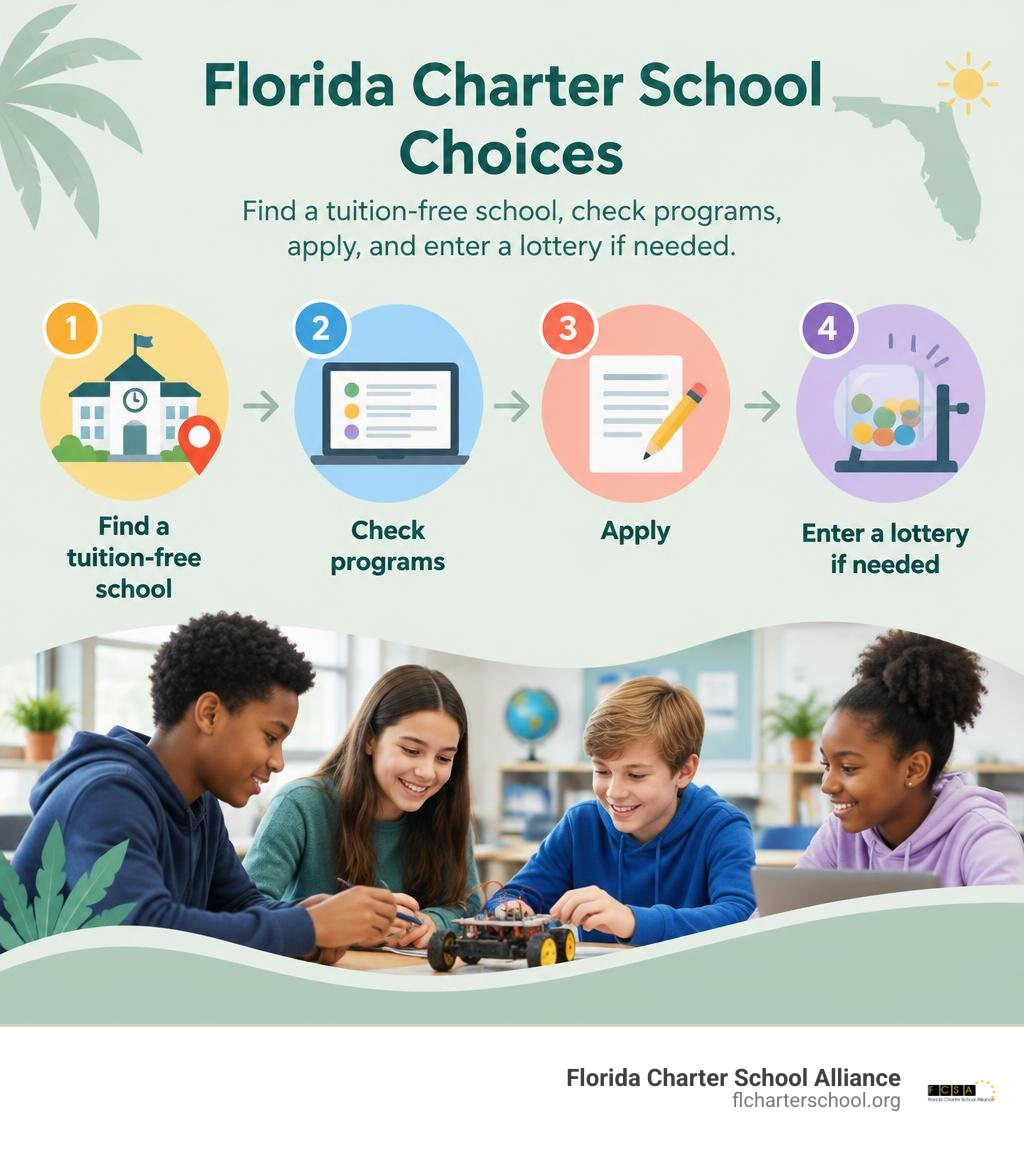
Florida families with low incomes can apply to tuition-free public charter schools. Start by finding schools near you, checking their grade levels and programs, and asking when applications open. If more students apply than a school has seats, admission is generally decided by lottery.
Schools of Hope offer another public charter option in areas served by persistently low-performing schools. This guide looks at how these schools serve students, what the academic results show, and why funding matters for access. For many families seeking a Florida charter school low-income students can attend, these programs represent a proven path to stronger academic outcomes and greater educational opportunity.
I’m Lynn Norman-Teck, executive director of the Florida Charter School Alliance. My work supporting Florida charter school low-income families draws on years of experience in charter school development, policy, and community outreach.
The Impact of Florida Charter School Low-Income Education Programs
Across the Sunshine State, public charter schools provide educational opportunity and student-centered learning environments for families from every background. Florida’s charter sector has grown to 731 charter schools serving 396,684 students in the 2023-24 school year, reaching 732 schools and 406,832 students in 2024-25 across 48 counties. More than 340,000 students attend these institutions, while tens of thousands remain on waiting lists. This strong demand reflects family empowerment in action: parents want high-quality education tailored to their children’s needs.

Charter schools are public, tuition-free, and open to all students. They operate under a performance contract with their local school district, giving educators the flexibility to design innovative learning models in exchange for strict accountability. For children in economically disadvantaged communities, this combination of curricular autonomy and measurable goals helps accelerate academic excellence.
Closing the Achievement Gap in Underserved Communities
Closing the historic achievement gap requires high standards, tailored interventions, and dedicated teachers. Florida ranks first out of 47 states with charter school laws, according to the National Alliance for Public Charter Schools. A major reason for this top ranking is how effectively Florida charter school low-income student support strategies elevate economically disadvantaged learners.
When evaluating academic growth in charter schools vs traditional public schools, research demonstrates that charter students frequently make greater learning gains in foundational subjects like reading and mathematics. Flexible staffing and targeted reading programs enable teachers to adjust instruction quickly for students who enter below grade level.
NAEP and FAST Performance Highlights
National and state assessment data confirm this progress. On the National Assessment of Educational Progress (NAEP), low-income students in Florida charter schools score near the top of statewide averages for eighth-grade reading. When controlling for socioeconomic status, Florida’s charter sector outperforms charter sectors in all other states.
At the state level, students demonstrate strong proficiency gains on the Florida Assessment of Student Thinking (FAST). These milestones mirror strong statewide performance results, demonstrating that high expectations combined with customized instruction yield measurable gains.
Schools of Hope: Expanding Options in Persistently Low-Performing Zones
In 2017, the Florida Legislature established the Schools of Hope program to address chronic educational inequities. The initiative recruits high-performing charter networks to open campuses near persistently low-performing traditional public schools or within federally designated Opportunity Zones.
| Feature | Standard Public Charter School | School of Hope Operator Campus |
|---|---|---|
| Primary Mission | Expand parental choice & innovative learning | Turn around outcomes in low-performing zones |
| Location Requirement | Anywhere within the sponsoring district | Within attendance zone or 5-mile radius of a struggling school |
| Demographic Threshold | Reflects local district demographics | Must serve Title I populations (at least 70% free/reduced lunch) |
| Operator Track Record | Nonprofits or local founding groups | Nationally recognized nonprofit with proven record (>80% college rate) |
| Financing Access | State capital outlay allocations | Priority capital outlay & Revolving Loan Program |
How Hope Operators Support Florida Charter School Low-Income Families
To earn a Hope Operator designation from the State Board of Education, a nonprofit network must operate three or more charter schools, maintain clean audits, demonstrate student achievement exceeding district averages, serve student bodies where over 70% qualify for free or reduced-price lunch, and achieve college attendance rates above 80%.
Approved operators include IDEA Public Schools, Democracy Prep, Somerset Academy, and KIPP. IDEA Public Schools illustrates this impact: of nearly 1,500 graduating seniors in its 2021 cohort, almost 1,100 were the first in their families to attend college.
By expanding access to high-quality Schools of Hope, Florida has paved the way for up to 50 new campuses serving as many as 48,000 students in historically under-resourced neighborhoods.
Legislative Pathways to Streamline School Expansion
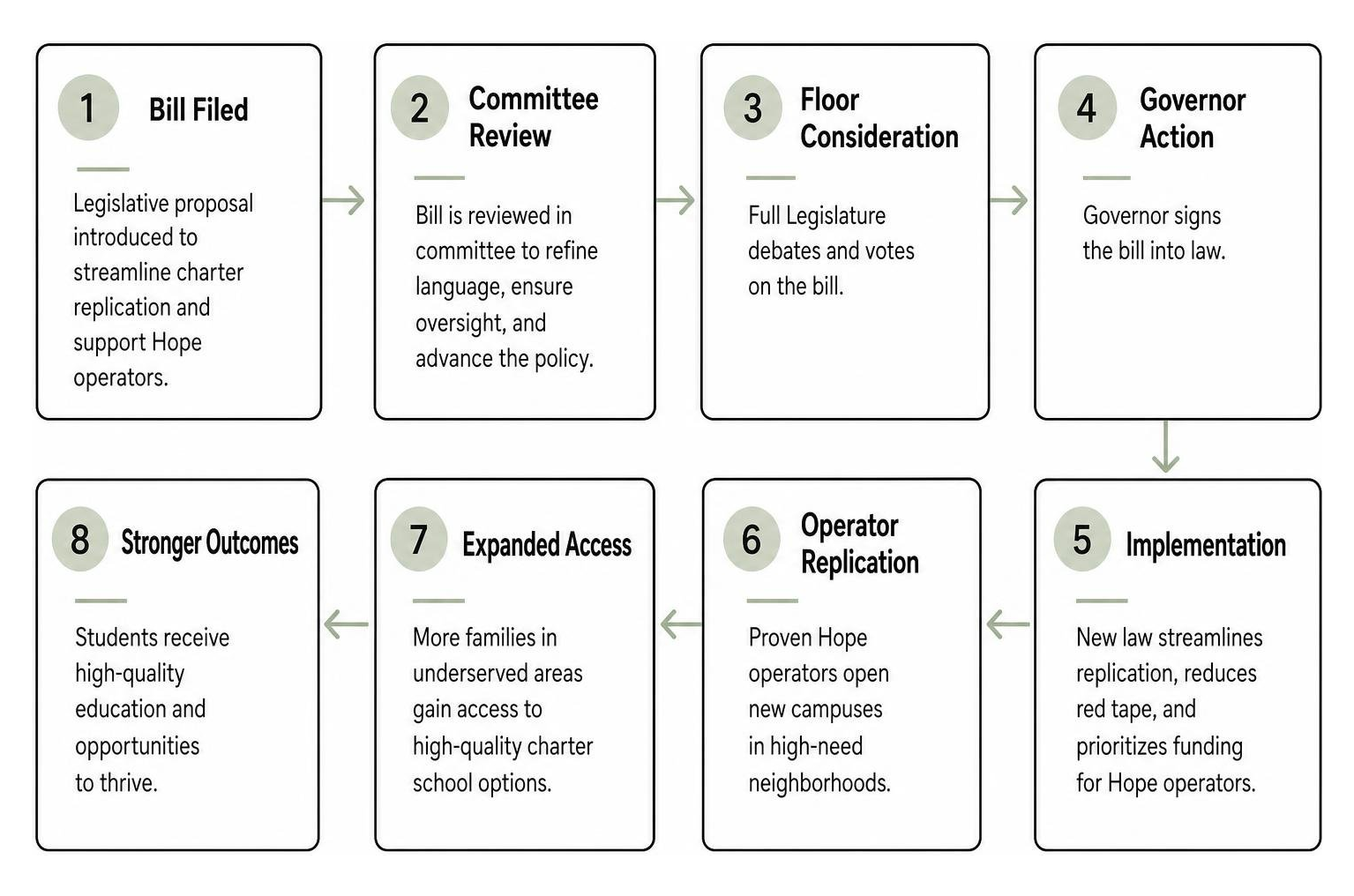
Opening new campuses in high-need neighborhoods requires cutting through administrative delays. Legislative proposals like SB 1622 and HB 1061 seek to streamline charter replication, reduce red tape, and maintain funding commitments for Hope operators. Easing administrative barriers allows proven operators to build classrooms where students need them most.
Case Study: Academic Excellence at RCMA Immokalee Community Academy
RCMA Immokalee Community Academy in rural Collier County shows what happens when educators pair high standards with community-centered support.

Overcoming Rural Obstacles in a Florida Charter School Low-Income Setting
Immokalee is an agricultural community where many families work in seasonal farm labor. At RCMA Immokalee Community Academy, 100% of the 337 enrolled students qualify for free or reduced-price lunch. Despite significant economic challenges, the academy earned an ‘A’ grade from the state for two consecutive years.
State assessment data highlights the school’s achievements:
- 89% of third graders achieved growth and grade-level proficiency in math, outperforming every other public and charter school in Collier County.
- 89% of middle school Algebra students scored proficient or higher on the FAST End-of-Course assessment.
- 73% of middle school students earned proficiency in reading, surpassing both district and state averages.
The school’s audited financial reports show sound fiscal management, with net position increasing by $135,053 to over $1.07 million in FY 2025. This proves that rural charter schools can balance fiscal discipline with academic excellence.
Dual-Language Instruction and Community Wrap-Around Services
RCMA’s success relies on a dual-language curriculum and small 10:1 student-teacher ratios. Because 46% of students are English Language Learners (ESOL), bilingual instruction helps children master foundational literacy in their native language while developing English proficiency.
The school also partners with local organizations, such as the Naples Children and Education Foundation, to provide after-school programs, STEAM clubs, food assistance, and mental health counseling. Meeting these basic needs creates a stable environment where students can focus on learning.
Navigating Funding, Facilities, and Capital Outlay Solutions
Unlike traditional public schools, charter schools cannot raise local property tax bonds to construct classrooms. Securing and maintaining facilities remains one of their greatest operational hurdles, directly affecting long-term student performance and school sustainability.
Capital Outlay Multipliers for High-Need Student Populations
Florida addresses facility disparities through state capital outlay funding formulas. While all eligible public charter schools receive a base per-pupil capital outlay allocation, state law provides weightings for high-need campuses:
- Schools where at least 75% of students qualify for free or reduced-price lunch receive a 1.5× funding multiplier.
- Schools serving at least 25% students with disabilities receive an added weighting.
This 50% funding boost helps schools in low-income neighborhoods pay for leases, modernize labs, and upgrade safety technology.
The Schools of Hope Revolving Loan Program
To reduce start-up costs for operators in low-performing school zones, Florida established the Schools of Hope Revolving Loan Program. Administered by Building Hope, this fund provides low-interest loans covering up to 25% of total project costs for facility purchases, renovations, and equipment. Lowering interest expenses allows schools to dedicate more of their operating budgets directly to classroom instruction.
Frequently Asked Questions About Florida Charter Schools and Low-Income Students
What is the Florida Schools of Hope program?
The Schools of Hope program is a state initiative that encourages proven nonprofit charter networks to open campuses within the attendance zone or a 5-mile radius of persistently low-performing traditional schools or within Opportunity Zones.
Do Florida charter schools charge tuition for low-income students?
No. All Florida charter schools are tuition-free public schools funded by the state. They enroll students via open lotteries and cannot charge tuition or require selective entrance exams.
How do charter school students from low-income backgrounds perform on state assessments?
Low-income students in Florida charter schools consistently score near the top on national eighth-grade NAEP reading tests and demonstrate strong learning gains on the FAST assessment, often outperforming peers in nearby traditional public schools.
Conclusion
Every child in Florida deserves access to an education that prepares them for a bright future, regardless of their zip code. Through public charter schools, Schools of Hope, and community-centered academies like RCMA Immokalee, Florida continues to expand educational access and improve academic outcomes for economically disadvantaged families.
At the Florida Charter School Alliance, we champion policies that protect parental choice, hold schools to high standards, and support dedicated educators across our state. Families and educators can discover more about Florida public charter schools and find quality educational options in their communities.