
How Many Charter Schools Are High Achieving — and Why It Matters for Families
How many charter schools are high achieving is one of the most important questions any parent, educator, or policymaker can ask about American public education today. The answer shapes where families send their children — and what opportunities those children receive.
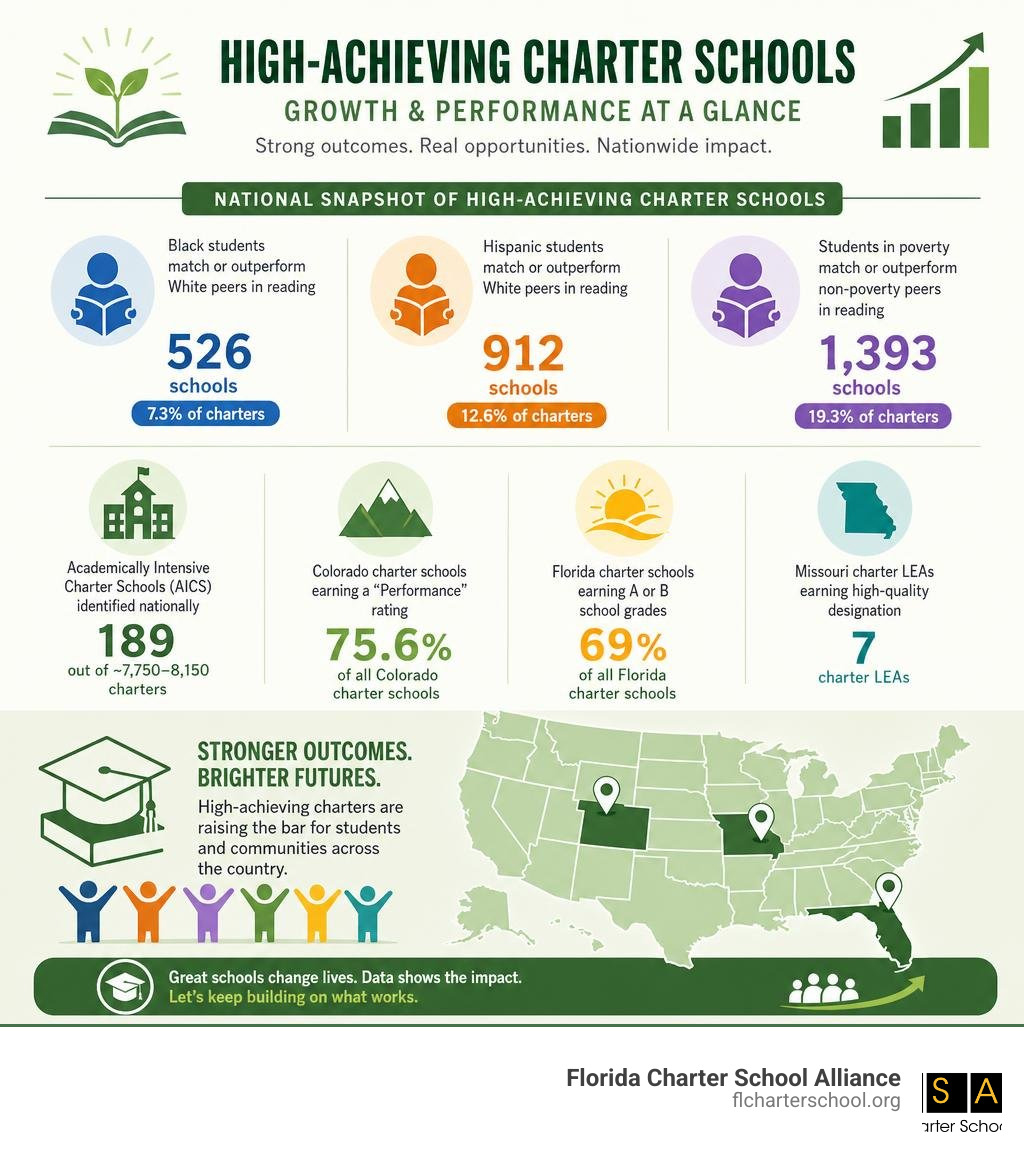
Here is a quick snapshot of high-achieving charter schools across the country:
| Metric | Number / Share |
|---|---|
| Charter schools where Black students match or outperform White peers in reading | 526 schools (7.3% of charters) |
| Charter schools where Hispanic students match or outperform White peers in reading | 912 schools (12.6% of charters) |
| Charter schools where students in poverty match or outperform non-poverty peers in reading | 1,393 schools (19.3% of charters) |
| Academically intensive charter schools (AICS) identified nationally | 189 out of ~7,750–8,150 charters |
| Colorado charter schools earning a “Performance” rating | 75.6% of all Colorado charter schools |
| Florida charter schools earning A or B school grades | 69% of all Florida charter schools |
| Missouri charter LEAs earning high-quality designation | 7 charter LEAs |
The need for more great public schools has never been greater. Across the country, thousands of charter schools are delivering measurably stronger outcomes — especially for students of color, students in poverty, and English Language Learners. Yet the picture is uneven. Quality varies widely by state, by network, and by school. Understanding what separates high-achieving charters from the rest is the first step toward expanding access to them.
I’m Lynn Norman-Teck, Executive Director of the Florida Charter School Alliance, and I’ve spent my career working on public charter school development, policy, and community engagement — including the very question of how many charter schools are high achieving and what it takes to grow more of them. In the sections ahead, I’ll walk you through the data, the policies, and the proven practices that define and drive charter school excellence.
Defining and Quantifying: How Many Charter Schools Are High Achieving?
When parents ask us how many charter schools are high achieving, they are usually looking for a simple number. In reality, “high achieving” can be defined in a few different ways. Some states look at school letter grades or standardized test scores, while researchers often focus on student growth over time or a school’s ability to close long-standing achievement gaps.
To truly understand how many public charter schools are reaching academic excellence, we have to look at both absolute test scores and equitable growth. High accountability standards ensure that charter schools remain transparent and focused on student-centered learning.

A landmark study by the Center for Research on Education Outcomes (CREDO) at Stanford University provides one of the clearest answers to this question by identifying what they call “gap-busting” schools. These are public schools that completely eliminate the academic achievement gap for historically underserved student populations.
According to the policy brief, Identifying Gap-Busting Charter Schools for Educational Equity, thousands of charter schools across the country are independently achieving these gap-busting results. These schools are doing so without national coordination, proving that educational equity is achievable at scale under existing funding levels.
National Data: How Many Charter Schools Are High Achieving Across the United States?
On a national level, the landscape of high-achieving charter schools is incredibly diverse. While many families are familiar with large Charter Management Organizations (CMOs), there is a quiet, rapidly growing subset of schools focused entirely on academic rigor.
A recent peer-reviewed study, An Exploratory Analysis of U.S. Academically Intensive Charter Schools (AICS), identified 189 Academically Intensive Charter Schools (AICS) operating across the United States. These schools are unique because their sole distinguishing feature is academic intensity. Unlike “No Excuses” charter schools, which often emphasize strict behavioral models, AICS focus almost entirely on high intellectual expectations, advanced coursework, and external examinations (like Advanced Placement tests) to align student and teacher incentives.
What makes these academically intensive schools so remarkable is their student demographics. Their student populations closely match those of average charter schools:
- Only 26% of AICS students are White, compared to 29% in other charters.
- Their poverty and minority enrollment rates remain within 2% of standard public charter schools.
- Despite serving similar student populations, AICS consistently outperform both traditional district schools and other charters in English Language Arts (ELA) and math.
Furthermore, this academic advantage actually widened after the COVID-19 pandemic, demonstrating the incredible resilience of high-achieving charter school models.
State-Level Analysis: How Many Charter Schools Are High Achieving in Florida and Other States?
State-by-state data shows that policy environments have a massive impact on the number of high-performing schools. In Florida, where we have fostered a highly accountable and supportive charter sector since 1996, the numbers speak for themselves.
In the 2024–25 school year, Florida was home to 732 charter schools serving over 406,832 students. By 2025, that number grew to 739 schools serving nearly 397,000 students—meaning roughly 13.8% of all Florida public school students now attend a public charter school.
The academic results are outstanding. In 2024, 69% of Florida charter schools earned an “A” or “B” school grade. This standard of academic excellence is why we can proudly say that Florida Charter Schools Get an A.
Other states with strong charter laws also show high concentrations of top-performing schools. For example, according to the Colorado Department of Education’s State of Charter School Report, an impressive 75.60% of Colorado charter schools earned the highest “Performance” rating on the state’s School Performance Framework, compared to 66.53% of non-charter public schools.
Academic Excellence: Comparing High-Performing Charters to Traditional Public Schools
When deciding on the best educational environment for their children, families deserve to see how public charter schools stack up against traditional district schools. The data consistently reveals that high-quality charters are driving student achievement and expanding parental choice by outperforming traditional public schools on several key metrics.
| Performance Metric | Public Charter Schools | Traditional Public Schools |
|---|---|---|
| Florida “A” or “B” Grade Share (2024) | 69% | Comparable or lower depending on district |
| Poverty Student Learning Gains (Math) | +17 days of additional learning / year | Baseline standard |
| Poverty Student Learning Gains (Reading) | +23 days of additional learning / year | Baseline standard |
| Colorado “Performance” Rating Share | 75.60% | 66.53% |
| Florida Graduation Rate (Record High) | Consistently outpaces state averages | State average: 92.2% |
This commitment to academic excellence is reflected in our state’s historical milestones. As highlighted in our update, Florida Sets Highest Graduation Rate in State’s History at 92.2%, Florida’s public charter schools have played a vital role in pushing the state’s graduation rates to new heights, particularly for minority and low-income students.
Causal Impacts and College Enrollment Outcomes
Skeptics of charter school performance sometimes argue that high test scores are simply the result of “cherry-picking” higher-achieving students. However, gold-standard academic research using randomized lottery designs completely debunks this myth.
Because oversubscribed charter schools are legally required to use a random lottery system to admit students, researchers can compare the long-term life outcomes of students who won the lottery (and attended the charter) against those who lost the lottery (and attended traditional public schools).
The results are clear. A rigorous lottery-based study of charter high schools in Los Angeles revealed massive causal benefits for students attending high-quality charters:
- Standardized Test Scores: Attending a high-quality charter increased 11th-grade math scores by 0.29 standard deviations and ELA scores by 0.33 standard deviations.
- College Enrollment: Charter enrollment increased four-year college enrollment by a staggering 19 percentage points.
- College Persistence: Students attending these charters were 11 percentage points more likely to persist into their second year of college, largely driven by increased enrollment in competitive University of California (UC) campuses.
This rigorous data, discussed in our analysis of Charter Schools vs Public Schools: What the Data Actually Shows (2026), proves that high-performing charter schools have a direct, causal impact on a student’s academic trajectory and future economic mobility.
Closing the Achievement Gap for Disadvantaged Students
Perhaps the most compelling argument for expanding public charter school access is their unmatched ability to close the achievement gap for historically disadvantaged students.
According to national CREDO data, charter school students living in poverty achieve stronger academic growth than their traditional public school peers. Specifically, charter students in poverty gain the equivalent of 17 additional days of learning in math and 23 additional days of learning in reading per school year.
We see this success play out beautifully in Florida. Our state’s charter schools are national leaders in closing minority achievement gaps, ensuring that every child—regardless of their ZIP code—has access to a world-class education. You can read more about these encouraging trends in our report, Florida Charter Schools Earn Top Marks in 2024-25 Outperforming the State and Driving Student Success.
Key Practices Driving Success in High-Achieving Charter Schools
What makes these high-performing charter schools so successful? It isn’t magic; it is a deliberate combination of innovative learning practices, high expectations, and a student-centered culture. Because charter schools operate with greater administrative flexibility, they can quickly implement evidence-based strategies that traditional district bureaucracies often struggle to adopt.
The most successful charter schools across the country rely on several core pillars:
- Data-Driven Instruction: Teachers constantly analyze student performance data to customize lesson plans and target specific learning gaps.
- High-Dosage Tutoring: Providing intensive, small-group tutoring during the school day to support students who are falling behind.
- Extended Instructional Time: Many high-achieving charters feature longer school days or extended school years to give students more time to master complex concepts.
- Frequent Teacher Feedback: School leaders regularly observe classrooms and provide actionable coaching to help teachers refine their craft.
The ‘No Excuses’ Model vs. Academically Intensive Approaches
For many years, the dominant model among high-performing urban charter networks was the “No Excuses” model. This approach is characterized by strict behavioral codes, uniform requirements, high-dosage tutoring, and an intense focus on college readiness. While this model has produced incredible test score gains in urban areas, the charter sector has diversified.
Today, we see the rise of Academically Intensive Charter Schools (AICS). Instead of focusing heavily on behavioral compliance, these schools prioritize deep academic engagement and student autonomy. They treat academics as the primary focus of the school experience. For example, schools like the BASIS network utilize cumulative benchmark exams starting in the third grade and encourage students to take multiple AP exams in high school.
This commitment to academic rigor is a major reason why 18 of the Top 100 High Schools in Florida are Charter Schools. These schools prove that public charters are fully capable of competing with the most prestigious private academies in the nation.
Intermediate Student Outcomes and Engagement
The impact of high expectations in charter schools extends far beyond state test scores. High-performing charters excel at boosting intermediate outcomes that prepare students for life after graduation.
For instance, lottery studies show that charter students are 23 percentage points more likely to take calculus in high school. This is a direct result of school cultures that actively encourage students to enroll in advanced coursework.
Furthermore, charter school students report feeling higher levels of teacher support for their college-going aspirations and show greater overall school engagement. To see how our local schools are leading this charge, check out our article on how Florida Charter High Schools Rank Among the Best in the State.
State Policies and Authorizer Accountability: Scaling What Works
A charter school is only as good as the policy environment supporting it. To grow the number of high-achieving charter schools, states must strike a delicate balance: they must offer operational flexibility to encourage innovation, while maintaining strict academic and financial accountability.
According to the National Association of Charter School Authorizers (NACSA), strong state policies should empower charter school authorizers to close low-performing schools while paving a clear path for high-performing ones to expand. You can read more about these policy recommendations at Growing High-Performing Charters – qualitycharters.org.
Policy Frameworks in Florida, Missouri, and Louisiana
Different states have developed unique regulatory pathways to support and replicate high-quality charter schools:
- Florida: Under Florida law, a charter school is designated as “High-Performing” if it receives at least two “A” grades and no grade below “B” during the previous three years, maintains clean financial audits, and avoids financial emergencies. Once designated, these schools receive incredible benefits, including the ability to expand enrollment by 15% annually, establish replication schools in any district statewide, and receive 15-year charter terms. For more details, consult the Frequently Asked Questions – Florida Department of Education.
- Missouri: Charter schools earning an Annual Performance Report (APR) score of 85% or higher for three out of the last four years are designated as high-quality. These schools are eligible for charter renewals of up to ten years and receive expedited pathways for expansion and replication. Currently, seven charter Local Educational Agencies (LEAs) in Missouri hold this distinction.
- Louisiana: High-performing charters that meet or exceed state academic benchmarks for three consecutive years qualify for automatic charter renewal and the unique right to open up to two additional schools in their enrollment boundary without undergoing the standard, lengthy application process.
Accountability Reforms and Sector Improvement
The charter school sector has improved over the last two decades because of a strong commitment to accountability. When a public charter school fails to serve its students academically or manage its finances responsibly, it is closed.
Between 2006 and 2012, authorizers closed at least 300 low-performing charter schools nationwide. While closing a school is always difficult for a community, this accountability mechanism is exactly what drives the entire sector to improve.
We have seen this play out in several states:
- Ohio: In 2015, Ohio implemented a major policy overhaul that increased accountability for charter authorizers. This led to the closure of dozens of low-performing schools, and the state’s overall charter performance went from negative to positive.
- Texas: Following a 2013 law that increased funding while mandating the closure of the lowest-performing charters, CREDO estimates show that charter math learning gains improved from negative 17 days per year to positive 17 days per year.
This relentless focus on quality control is why public charters are disproportionately represented among the nation’s absolute best schools, as detailed in our feature, Punching Above Their Weight: Charter Schools are Disproportionately Represented in U.S. News’s Top 100 Best Public High Schools.
Frequently Asked Questions About Charter School Performance
What criteria define a high-performing charter school?
In Florida, a high-performing charter school is defined by state statute based on three main pillars:
- Academic Performance: The school must earn at least two “A” grades and no grade below “B” in the three most recent school years.
- Financial Viability: The school must receive unqualified (clean) opinions on its annual financial audits and must not meet any of the state’s financial emergency criteria.
- Organizational Compliance: The school must comply with all material terms of its charter contract and state safety regulations.
To see how these rigorous standards keep charter schools highly accountable, read the state’s evaluation: [PDF] Charter School Performance Comparable to Other Public Schools.
How do charter school graduation rates compare to traditional public schools?
Florida’s public charter schools are a major driver behind the state’s rising graduation rates. Charter high schools consistently meet or exceed district graduation averages, especially for minority students and students living in poverty. Because charter schools have the flexibility to design targeted academic interventions, they are highly successful at keeping at-risk students on track to graduate.
You can read more about these positive statewide trends in Florida’s Graduation Rate Continues to Climb.
What benefits do high-performing charter schools receive?
Once a Florida charter school officially earns the “high-performing” designation from the Commissioner of Education, it is unlocked from several administrative hurdles so it can focus on serving more families. These benefits include:
- The right to increase student enrollment by up to 15% once per school year.
- The ability to expand grade levels (e.g., adding a middle school component to an existing elementary school).
- The authority to submit financial statements quarterly rather than monthly, reducing administrative burdens.
- An expedited process to replicate their successful academic model in any school district in Florida.
- The option to secure a long-term, 15-year charter renewal.
This supportive system is highlighted in the State Report Shines Positive Light on Florida Charter School … news release, showing how these flexibilities help successful schools grow.
Conclusion
At the Florida Charter School Alliance, we believe that every single child in Florida deserves access to an education that challenges them, supports them, and prepares them for a bright future. The data surrounding how many charter schools are high achieving proves that when we combine operational flexibility with strong accountability, we create environments where students thrive.
By empowering parents with real choices and offering educators the freedom to innovate, high-performing charter schools are proving that academic excellence is achievable for all students.
If you want to dive deeper into the data, explore local school success stories, or learn how you can support educational choice in your community, we invite you to explore our comprehensive resource on Charter School Achievement. Together, we can continue expanding educational access and empowering families across the Sunshine State.
Ready to learn more about how public charter schools are driving academic excellence in Florida? Visit the Florida Charter School Alliance Achievement Portal to find high-performing schools near you and discover how parental choice is transforming public education.