
Who Really Supports Charter Schools — And Why It Matters for Students
Which political party supports charter schools is a question that no longer has a simple answer — and that complexity has real consequences for millions of students and families.
Here is the short version:
| Party | Current Stance | Key Trend |
|---|---|---|
| Republican | Generally supportive, but shifting toward private vouchers and ESAs | Moving away from charters toward full privatization |
| Democrat | Historically supportive, now increasingly divided | White Democrats pulling back; Black and Hispanic Democrats remain more supportive |
| Neither | Strong bipartisan support has eroded significantly | Charters risk being left in a political no man’s land |
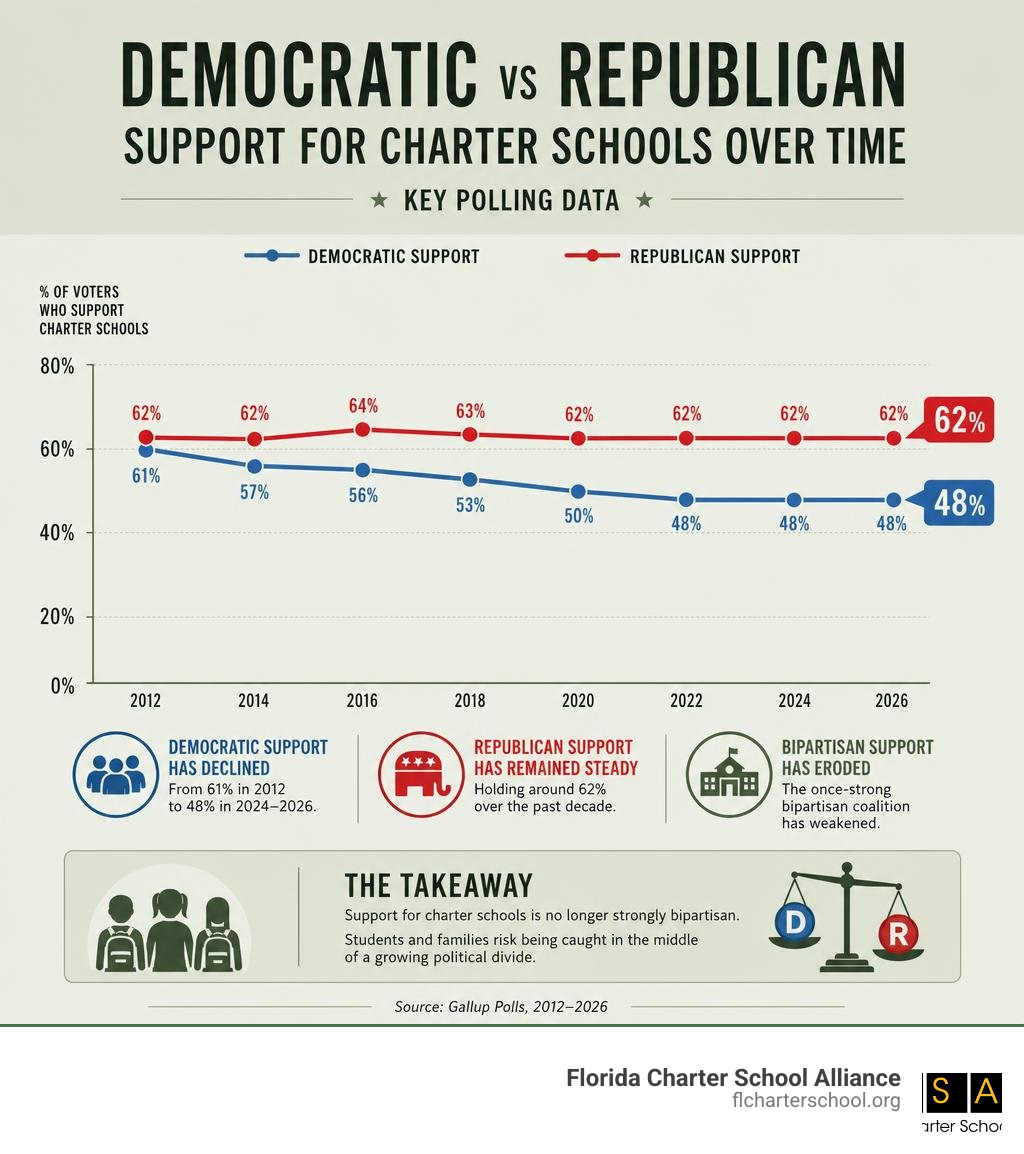
The numbers tell a striking story. Democratic support for charter schools dropped from 61% in 2012 to 48% in recent years. Republican support held steadier at around 62% — but even that support is shifting, as more conservatives now prefer private school vouchers and Education Savings Accounts over public charter schools.
Meanwhile, the students who benefit most from high-quality public charter schools — innovative, tuition-free, accountable schools open to all — are caught in the middle of this political tug-of-war.
I’m Lynn Norman-Teck, Executive Director of the Florida Charter School Alliance, and I’ve spent my career working at the intersection of education policy and public charter school advocacy — the exact space where the question of which political party supports charter schools plays out every day. In the sections below, I’ll walk you through the full picture, from historical party platforms to where things stand in June 2026.
The Historical Evolution of Which Political Party Supports Charter Schools
To understand where we are in June 2026, we have to look back at how we got here. Public charter schools were originally conceived as a bipartisan compromise. The idea was simple: create public schools that operate with more flexibility than traditional district schools in exchange for strict academic and financial accountability.
In the early 1990s, this concept united policymakers across the political spectrum. Democrats saw charter schools as laboratories of educational innovation that could pioneer new teaching methods to help disadvantaged students. Republicans embraced them as a way to introduce competition, parental choice, and free-market efficiency into a monopolistic public system.
According to the Timeline: Party Platforms & Charter Schools, both major party platforms routinely praised charter schools throughout the late 1990s and 2000s. However, the nature of that support has evolved dramatically over the last three decades.
| Year | Democratic Platform Stance | Republican Platform Stance |
|---|---|---|
| 1992 | Supported public school choice; initial interest in charter models. | Strongly advocated for voucher programs and private school choice. |
| 2000 | Called for tripling the number of charter schools nationwide. | Promoted charter schools alongside vouchers as essential tools for school choice. |
| 2008 | Strongly supported public charter schools with accountability. | Supported charter schools and tax-credit scholarships. |
| 2016 | Conditional support; opposed for-profit charters and “destabilization.” | Broad support for all school choice, including vouchers and ESAs. |
| 2026 | Focused on strict federal oversight, funding restrictions, and union alignment. | Increasingly focused on universal private vouchers and Education Savings Accounts (ESAs). |
From Clinton to Obama: When Democrats Led the Charge
It might surprise some modern observers to learn that some of the most influential champions of public charter schools were Democrats. President Bill Clinton signed the first federal charter school funding program into law in 1994, helping to seed a movement that now serves over 3.7 million students nationwide. Clinton even supported legendary civil rights figure Rosa Parks when she petitioned to open a charter academy in Detroit in 1997.
Years later, the Obama administration took this advocacy to new heights. Under President Barack Obama and Education Secretary Arne Duncan, the federal “Race to the Top” initiative incentivized over a dozen states to lift their legislative caps on charter school growth. The Obama administration dramatically increased federal Charter Schools Program (CSP) funding, fueling replication grants that added hundreds of thousands of high-quality classroom seats for low-income students and children of color.
As highlighted in Democrats Can and Should Support Public School Choice | RealClearEducation, this era of Democratic leadership viewed public charter schools as a natural extension of the party’s commitment to civil rights and equal educational access.
The Republican Platform: Consistent Support for Parental Choice
While Democrats focused on public charters as tools for equity within the public system, the Republican Party has consistently supported charter schools as part of a broader vision of parental choice. For decades, GOP platforms have championed the idea that public funds should follow students to whichever educational setting best serves their needs—whether that is a traditional public school, a public charter school, or a private school.
This alignment has made Republicans reliable allies for public charter schools, particularly when it comes to securing equitable funding, facility support, and protection from restrictive local bureaucracy.
Shifting Tides: Why Democratic Support Has Evolved
Despite this rich history, the political ground beneath public charter schools has shifted. Over the last decade, national Democratic support has become increasingly conditional. In many progressive circles, the language of “innovation” has been replaced by rhetoric concerning “privatization” and “underfunding” of traditional districts.
This shift is partly due to the growing complexity of the education landscape. As detailed in How Charter Schools Became Politically Isolated – Progressive.org, many national Democrats have distanced themselves from charters, viewing them as competitors for limited public education funding rather than partners in student achievement.
Racial and Demographic Differences in Which Political Party Supports Charter Schools
One of the most fascinating aspects of which political party supports charter schools is the deep demographic split within the Democratic Party itself. While white progressive voters and party leaders have increasingly soured on charters, Black and Hispanic Democratic voters remain among the school choice movement’s strongest supporters.
Consider these revealing statistics:
- Support for charter schools among Democrats overall dropped from 61% in 2012 to 48% over a five-year period.
- This decline was driven almost entirely by white Democrats, whose support fell from 43% to 27%.
- Meanwhile, Black and Hispanic Democrats maintained much higher levels of support, with each group reporting 47% support for charter schools overall.
- In primary voting demographics, the gap is even wider: 58% of Black Democratic primary voters and 52% of Hispanic Democratic primary voters support charter schools, compared to just 26% of white Democratic primary voters.
- Furthermore, 65% of Black Democratic primary voters reported that expanding charter schools was an important priority.
For families in historically underserved urban communities, charter schools are not an abstract policy debate—they represent a vital educational opportunity and a pathway to family empowerment.
The Influence of Teachers’ Unions and Civil Rights Groups
What explains the widening gap between the white progressive wing of the Democratic Party and the minority communities the party represents? Much of it comes down to political influence.
Teachers’ unions—such as the National Education Association (NEA) and the American Federation of Teachers (AFT)—are among the most powerful constituencies and financial contributors within the Democratic coalition. Because most charter school teachers are not unionized, unions view the expansion of charter schools as a direct threat to their membership and collective bargaining power.
Under pressure from these labor groups, national Democratic platforms have adopted more restrictive stances. Additionally, some civil rights organizations, influenced by union partnerships, have raised concerns about charter school oversight, with the national NAACP even calling for a moratorium on charter expansion in 2016. This has created a complex dynamic where local minority families strongly support charters, while national advocacy groups echo union opposition.
The Rise of Vouchers and ESAs: How the GOP Stance is Changing
While Democrats are wrestling with internal divisions, the Republican stance on school choice is undergoing its own radical transformation. For decades, charter schools were the primary vehicle for GOP-led school choice. Today, however, many Republican lawmakers have shifted their focus to private school vouchers and universal Education Savings Accounts (ESAs).
As explored in A Sharp Turn Right: A New Breed of Charter Schools Delivers the …, this shift represents a move away from public school choice toward full privatization, leaving charter schools in a challenging middle ground.
Are Vouchers and ESAs Overshadowing Public Charter Schools?
With 13 states now operating some form of ESA program, the policy spotlight has shifted. ESAs allow parents to receive public funds directly to pay for private school tuition, homeschooling materials, or private tutoring.
Because ESAs and private vouchers offer fewer regulations and no public accountability requirements, they have become the preferred policy tool for conservative lawmakers. This has led some education analysts to warn that charter schools—which must still adhere to state testing, open enrollment, and public audits—might lose their primary legislative champions on the right.

The Conservative Debate Over Which Political Party Supports Charter Schools
Furthermore, a new debate has emerged within conservative circles regarding the cultural direction of charter schools. Some conservative think tanks, including the Heritage Foundation, have published reports claiming that major charter school networks have undergone “woke capture.”
These critics point to instances where prominent charter management organizations (CMOs) revised historical slogans or adopted Diversity, Equity, and Inclusion (DEI) policies. For example, the KIPP charter network retired its long-standing “Work Hard. Be Nice.” slogan, and other networks issued public apologies for historical disciplinary policies.
According to research in the report [PDF] A New Breed of Charter Schools Delivers the Conservative Agenda, this has led some conservative activists to view traditional public charter schools with suspicion, prompting them to advocate for a “new breed” of classical, conservative charter schools or push families toward private school vouchers instead.
Academic Excellence and Accountability: The Real-World Impact
Amid these political debates, it is easy to lose sight of what actually matters: student achievement. Public charter schools continue to deliver outstanding academic results, particularly for the students who need them most.
In Florida, we see this success story play out every single day. As documented in our report, Florida Charter Schools Earn Top Marks in 2024-25, Outperforming the State and Driving Student Success, Florida’s public charter schools consistently earn high grades, outperforming traditional district schools in student learning gains across multiple demographics.
What the Data Says: CREDO Studies and Student Achievement
Nationally, the most rigorous research on charter school performance comes from the Center for Research on Education Outcomes (CREDO) at Stanford University. CREDO’s longitudinal studies use a lottery-based comparison model to measure actual academic growth.
The findings are clear:
- On average, charter school students gain the equivalent of 16 additional learning days in reading and 6 days in math per school year compared to their traditional public school peers.
- Students enrolled in Charter Management Organizations (CMOs)—which operate networks of schools—experience even greater gains, averaging 27 extra days of learning in reading and 23 days in math.
- These learning gains are most pronounced among low-income students, Black students, and English language learners.
This data proves that when public charter schools are given the flexibility to innovate, they drive academic excellence.
Florida as a Model for High-Quality Public Charter Schools
Florida has long been recognized as a national leader in charter school policy. The Florida Charter School Law establishes a strong framework that balances operational flexibility with rigorous public accountability. Under Florida law, charter schools are tuition-free, public schools open to all students, operating under performance contracts authorized by local school boards or state universities.
To maintain this leadership, we actively monitor and advocate for policies that protect charter school funding equity and operational autonomy. During the Florida Legislative Session 2025 Bills We Are Tracking for FCSA Members, we worked tirelessly to ensure that public charter school students receive the same per-pupil funding and facility support as traditional public school students.
Frequently Asked Questions About Political Support for Charter Schools
Do Democrats support charter schools?
Yes, but that support is increasingly conditional. While many mainstream and moderate Democrats—especially Black and Hispanic leaders—continue to champion public charter schools, the progressive wing of the party often opposes charter expansion. Current national Democratic platforms generally support only non-profit charter schools that operate with high levels of district oversight and do not compete with local district funding.
Why are some Republicans shifting away from charter schools?
Some Republicans are shifting their focus from charter schools to private school vouchers and Education Savings Accounts (ESAs). This is because ESAs allow public funds to be used for private and religious schooling with minimal government regulation, aligning with a conservative preference for full market-based education systems over publicly governed choices.
Are charter schools considered public or private?
Charter schools are 100% public schools. As detailed on Charter schools in Florida – Ballotpedia, they are publicly funded, tuition-free, open to all students through fair lottery admissions, and held to the same state academic standards and financial audit requirements as traditional district schools.
Conclusion: Navigating the Future of Educational Opportunity
As we navigate the political landscape of June 2026, the Florida Charter School Alliance remains focused on what truly matters: expanding educational opportunity and driving student-centered learning. Public charter schools should not be a partisan battleground. They are a proven, highly accountable public education option that empowers families and changes lives.
We invite you to learn more about our ongoing advocacy efforts by reviewing the Florida Charter School Movement Outlines 2026 Legislative Priorities and visiting our main resource page for More info about Florida charter schools. Together, we can keep the focus where it belongs—on student success.