
Why the Best Ideas for Making School Calendars Can Transform Your Classroom
The best ideas for making school calendars range from hands-on art crafts to fully automated digital tools — and the right approach depends on your students’ age, your classroom goals, and how much time you have.
Here’s a quick overview of the most popular options:
| Approach | Best For | Examples |
|---|---|---|
| Hands-on crafts | Preschool & early elementary | Handprint art, watercolor, paper chains |
| Printable templates | K–8 classrooms | Canva, TPT downloads |
| Digital/automated | Middle school, admin | Google Sheets, AI generators |
| Collaborative projects | All ages | Class-built wall calendars, family input |
| Themed seasonal designs | Any grade | Four seasons, cultural holidays |
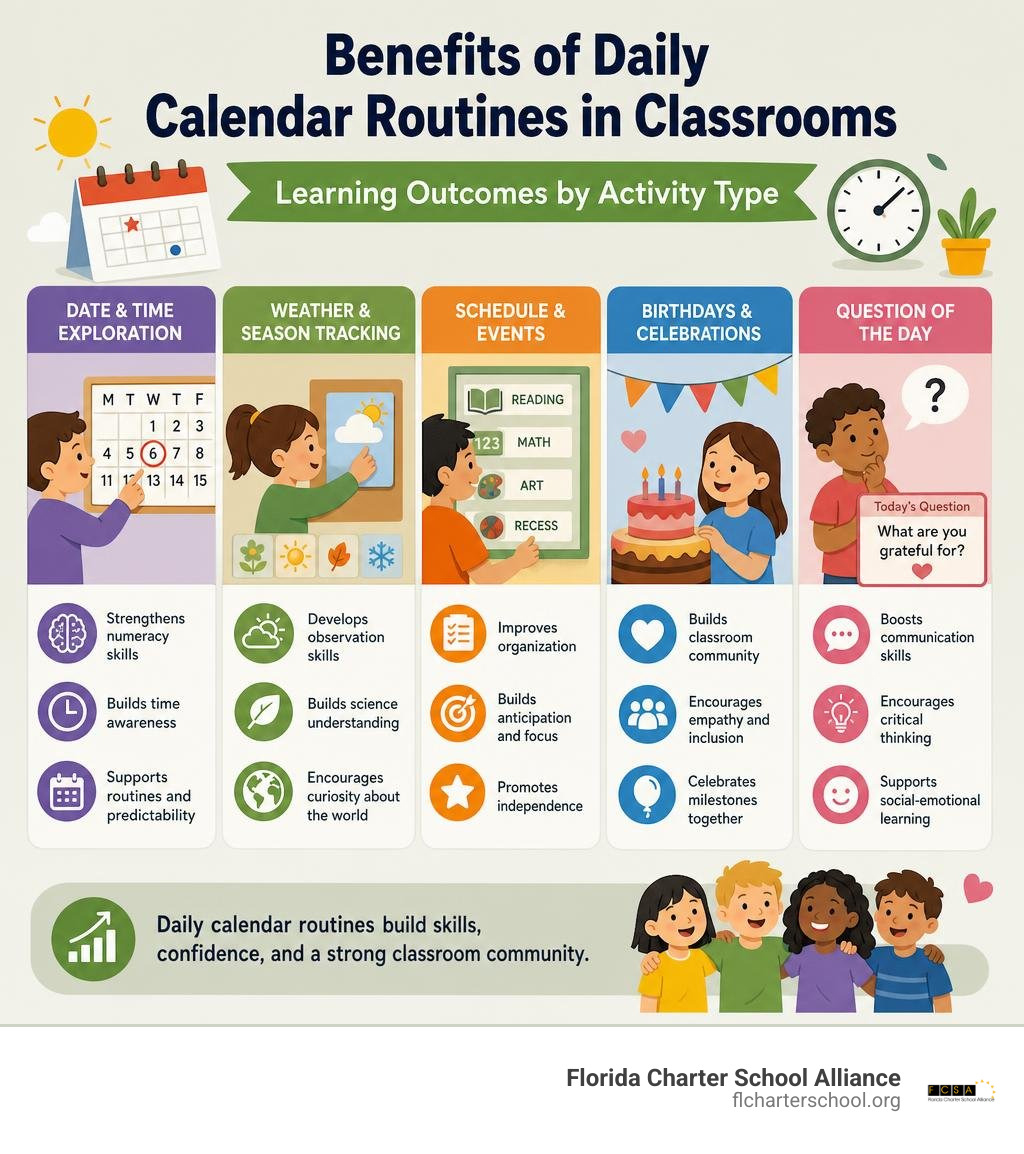
Teachers report using classroom calendars every single day — to teach days of the week, track weather, build math skills, and mark school events. Yet most calendars are dull, static grids that kids tune out after September.
It doesn’t have to be that way.
Whether you’re an arts educator looking to weave creativity into daily routines, or a charter school administrator planning a school-wide academic calendar, there are simple, engaging approaches that work for every budget and classroom.
I’m Lynn Norman-Teck, Executive Director of the Florida Charter School Alliance, and in my work supporting high-quality public charter schools across Florida, I’ve seen how a well-designed, visually engaging school calendar can strengthen school culture and student-centered learning. From helping charter school leaders plan their academic year to sharing ideas for making school calendars that reflect each school’s unique identity, this is a topic close to my heart.
Creative Ideas for Making School Calendars Across Grade Levels
Every age group has different developmental needs. A preschooler needs a highly tactile, physical representation of time, while a middle schooler benefits from organizational structures that support independent planning and academic success. Choosing age-appropriate calendar activities ensures that your students stay engaged and active in their own learning.
If you are looking for visual inspiration, you can explore a wide variety of collaborative projects on the Diy School Year Calendar – Pinterest board, which highlights how educators combine arts and crafts with functional scheduling. Parents and homeschool educators also frequently share their real-world tips in community spaces like the I need Calendar ideas please? – The Well Trained Mind Forum, showing that simplicity and consistency are key to keeping calendar time exciting.
Hands-On Calendar Crafts for Early Learners
For preschoolers and early elementary students, abstract concepts like “next week” or “last month” can be difficult to grasp. Tactile, sensory-rich activities make these concepts concrete.
- Seasonal Paper Chains: Create a visual representation of the school year using color-coded paper chains. Each month can feature a distinct seasonal color scheme. Have a student remove one link daily during morning meetings. This simple act provides a clear, physical demonstration of the passage of time.
- Handprint and Watercolor Art: Turn calendar creation into a keepsake art project. Early learners can paint vibrant watercolor backgrounds using plenty of water to blend shades, then overlay handprints to create seasonal trees (such as green summer leaves, warm autumn foliage, or bare winter branches outlined with metallic silver markers).
- Weather Tracking Stations: Integrate daily weather observation with calendar routines. Use a pocket chart where children place colorful cards representing sunny, cloudy, rainy, or windy days. Over time, students can graph these daily observations to notice seasonal shifts.
These student-centered learning activities not only make the classroom environment more vibrant but also build foundational fine motor skills and observation habits.
Interactive Calendars for Elementary and Middle School Students
As students advance into upper elementary and middle school, calendars shift from basic time-tracking tools to instruments of student achievement, math instruction, and personal organization.
- Mathematical Patterning: Use calendar dates to teach math concepts. Instead of plain numbers, write dates using monthly color or shape patterns (such as ABCABC or AABC). Students must predict the pattern of the next day’s card, strengthening their algebraic thinking and sequencing skills.
- Student-Led Flip Calendars: Assign “Calendar Captain” as a rotating classroom job. The designated student updates a large wall flip calendar each morning, writing out the day, date, month, and year. This simple routine fosters leadership and personal responsibility.
- Personal Academic Planners: In middle school, organization is directly tied to academic excellence. Teach students how to maintain their own physical or digital planners. Help them map out project deadlines, study intervals, and extracurricular activities to build lifelong time-management habits.
By actively involving older students in tracking their own schedules, public charter schools promote accountability and equip students with the self-regulation tools necessary for future academic success.
Designing for Impact: Themes, Learning Objectives, and Inclusivity
A classroom calendar is more than a grid of numbers — it is a reflection of your classroom’s values, curriculum, and community. By intentionally designing your calendar around seasonal themes, cultural milestones, and accessibility, you can turn a basic administrative tool into a powerful vehicle for educational opportunity.
Using curated guides like the 2026–2027 Monthly Calendar Themes for School | HMH can help you align your monthly calendar designs with your broader literacy and science lesson plans.
Integrating Academic Standards and Cultural Awareness
To maximize the educational value of your calendar, integrate academic standards and global citizenship directly into your monthly themes:
- Literacy and Storytelling: Pair each month with a specific literary focus. For example, celebrate School Library Month by featuring student book recommendations on the calendar border, or highlight historical quotes and poetry that match the season.
- Science and Nature: Align calendar themes with seasonal changes and ecological observances. Highlight events like Earth Day, World Turtle Day, or seasonal weather cycles to prompt hands-on science experiments and outdoor exploration.
- Cultural and Historical Milestones: Use the calendar to foster a welcoming, inclusive environment. Mark diverse cultural holidays, international heritage months, and historical milestones. This turns the daily calendar review into a natural opportunity for daily discussions about global history and mutual respect.
Adapting Calendars for Inclusive and Bilingual Classrooms
In high-quality public charter schools, we believe in providing an exceptional education to every student. Calendars should be intentionally designed to accommodate students with diverse learning needs and language backgrounds:
- Visual Schedules: For students with special needs or visual learning preferences, supplement standard calendar grids with clear visual icons. Use simple, high-contrast symbols to represent activities like physical education, art, lunch, or field trips.
- Dual-Language Labels: In bilingual or dual-language classrooms, label days of the week, months, and seasonal transitions in both English and target languages (such as Spanish or Haitian Creole, reflecting our vibrant Florida communities). This simple addition supports vocabulary acquisition and validates students’ cultural identities.
- Tactile Accessibility: Ensure that students with physical or visual impairments can participate in calendar time. Use raised-line numbers, Velcro attachment strips, or braille labels so that every child can independently interact with the classroom display.
Through these intentional adaptations, educators foster family empowerment and ensure that daily classroom routines are accessible to all.
Handmade vs. Digital: Choosing the Right Tools for Your School
When exploring ideas for making school calendars, one of the first decisions you will face is whether to build a physical, handmade calendar or adopt a digital tool. Both approaches have distinct advantages depending on your classroom environment and organizational goals.
| Feature | Handmade & Tactile Calendars | Digital & Automated Calendars |
|---|---|---|
| Best For | Early childhood classrooms, tactile learners, daily group routines | Middle/high school, school-wide admin, parent communications |
| Customization | High creative freedom; uses physical crafts and student artwork | Instant template adjustments; easy to scale and brand |
| Durability | Vulnerable to wear and tear (requires lamination or heavy cardstock) | Infinite durability; stored securely in the cloud |
| Collaboration | Highly collaborative in a physical space; great for group work | Real-time digital editing for multiple teachers or parents |
| Cost | Low cost for basic paper crafts; can accumulate material costs | Free options available; advanced platforms may require subscriptions |
If you are looking for an administrative-grade solution that bridges these two worlds, you can use the Free Academic Calendar Generator | Create School Calendars with AI to instantly generate polished, high-resolution printable designs from simple text prompts.
Digital Ideas for Making School Calendars: Canva vs. Google Sheets
For teachers, administrators, and busy families who prefer clean, easily shareable schedules, digital platforms offer unmatched flexibility:
- Canva for Stunning Visuals: Canva offers over 1 million professionally designed calendar templates. It is an excellent tool for creating visually striking, themed calendars that you can customize with your school’s official colors, logo, and student photography. You can easily share these designs digitally or print them for physical distribution.
- Google Sheets for Automation: If you need a calendar that functions as a dynamic database, Google Sheets is a powerful, free option. You can learn how to build a fully automated grid in the step-by-step guide on How to Make a School Calendar in Google Sheets. By using advanced formulas like SEQUENCE and LET, your calendar grid will automatically update dates when you change the month or year.
- Supercharging with ChatGPT: For those who want to save hours of manual data entry, you can combine spreadsheet formulas with artificial intelligence. The guide on How to Make a School Calendar in Google Sheets Using ChatGPT demonstrates how to prompt ChatGPT to generate a clean CSV table of your school’s academic dates, holidays, and professional development days, which you can import directly into your Google Sheets calendar template.
Tactile and Reusable Materials for Classroom Walls
If you prefer a physical calendar that stands up to daily classroom use, investing in high-quality, reusable materials is essential:
- Heavy-Duty Pocket Charts: A classic choice for primary classrooms, plastic pocket charts allow you to easily swap out printed cards for days, dates, weather, and special events.
- Lamination and Dry-Erase: Print your master calendar design on heavy cardstock and laminate it. This allows you and your students to write on the calendar with dry-erase markers, wipe it clean at the end of each month, and reuse it year after year.
- Magnetic and Felt Boards: Use magnetic whiteboard backings or felt boards to create interactive calendar displays. Students can easily move magnetic numbers or felt seasonal icons to update the board, making the daily calendar routine a highly engaging, hands-on experience.
Fostering Community and Operational Success Through Calendars
At the school-wide level, a calendar is not just a classroom tool — it is a vital operational document that aligns teachers, families, and administrators. A well-crafted calendar supports smooth school operations, ensures regulatory compliance, and builds strong partnerships between the school and home.
To build a truly effective schedule, school leaders must balance academic requirements with the practical needs of families. The experts at Possip offer valuable insights on this balancing act in their guide on Crafting A Strong School Calendar – Possip, which emphasizes the importance of gathering stakeholder feedback before finalizing important dates. Additionally, homeschooling parents and classroom teachers can find structural inspiration in the School Year Calendar Template – by Theresa Copeland, which demonstrates how to create a comprehensive, single-page visual overview of the entire academic year.
Collaborative Ideas for Making School Calendars to Engage Families
A school calendar should serve as a bridge between the classroom and the local community. By designing collaborative calendar projects, you can actively involve families in your school’s daily life:
- Family Contribution Days: Invite parents to share cultural holidays, family traditions, or community events to include on the classroom calendar. This fosters family empowerment and deepens students’ understanding of their peers’ backgrounds.
- Aligning with Community Events: When planning your school year, cross-reference your academic calendar with local community calendars. For example, check the Tallahassee Events Calendar • choosetallahassee.com to align school breaks or field trips with local festivals, educational exhibits, or library programs.
- Coordinating with Local Schools: To minimize scheduling conflicts for families with children in multiple schools, coordinate your major breaks with neighboring institutions. Looking at established schedules like the Calendar – Maclay School in Tallahassee can help you align key vacation dates and professional development days for maximum community convenience.
Practical Tips for Printing and Maintaining Your Calendar
Once your school calendar is designed, follow these practical steps to ensure it remains a clean, professional, and reliable reference throughout the academic year:
- Double-Sided Printing Layouts: If you are printing a multi-page monthly calendar, format your layout for double-sided printing. Pair consecutive months (such as January with December, or February with November) so that when the calendar is hung, the top page displays beautiful student artwork or school photos, while the bottom page displays the functional calendar grid.
- High-Resolution Exports: Always export your digital calendar designs as high-resolution, print-ready PDFs or PNG files to ensure that text remains sharp and legible when printed.
- Use Compliant Planning Tools: For school administrators who need to generate structured, board-compliant calendars, browser-based tools like the Academic Calendar Generator 2026-27 – Free School Calendar Planner | Schoolites offer an easy way to map out instructional terms, exam blocks, parent-teacher conferences, and holidays while keeping a precise count of required school days.
Frequently Asked Questions about School Calendars

How many instructional days are required for school calendars?
The number of required instructional days depends on your state’s education regulations and governing boards. For example, educational boards like CBSE require a minimum of 220 working days, while ICSE mandates 210 days.
In the United States, school districts and public charter schools must follow state-specific instructional hour requirements. For instance, you can review the Calendars (District & Instructional) – Marion County Public Schools page to see how Florida public school districts structure their academic years to meet state mandates while incorporating professional development days and weather makeup days. Public charter schools in Florida maintain the flexibility to design creative, innovative calendars, provided they meet the state’s rigorous standards for instructional hours and academic accountability.
How can I make a school calendar update automatically?
The most efficient way to create an automated, dynamic calendar is by using Google Sheets. By setting up a single “Monthly Calendar” sheet and applying a dynamic SEQUENCE formula, the calendar grid will automatically adjust its dates whenever you change the month or year in your control cells.
To display school events automatically, you can create a separate “Events” tab where you list all your scheduled activities with their corresponding dates. Then, use a FILTER or VLOOKUP formula on your main calendar sheet to automatically pull and display those events next to the correct dates. This setup allows you to update your master event list in one place and see those changes reflected instantly across your visual calendar.
What is the best way to color-code a school calendar?
Effective color-coding turns a cluttered calendar into an easy-to-read reference tool. Assign distinct, high-contrast colors to different categories of events:
- Holidays and School Closures: Use a bright, consistent color (like red or orange) to clearly mark days when there is no school.
- Academic Milestones: Highlight exam blocks, grading periods, and report card releases in a professional tone (like blue or purple).
- Extracurriculars and Community Events: Use warm, welcoming colors (like green or yellow) for school plays, sports matches, and parent-teacher organization meetings.
- Family Calendars: If creating a personal or homeschool calendar, assign a specific color to each family member to easily track overlapping practices, appointments, and birthdays.
Conclusion
A school calendar does not have to be a boring administrative grid. Whether you choose to create a tactile, handprint-themed calendar with your early learners, build a dynamic, automated spreadsheet in Google Sheets, or generate a polished academic calendar using modern AI design tools, the right calendar can bring organization, joy, and a sense of community to your school year.
At the Florida Charter School Alliance, we believe that education is most powerful when it is innovative, student-centered, and deeply collaborative. Public charter schools across Florida leverage this creative flexibility to design unique learning environments that foster student achievement, support parental choice, and build strong partnerships with families.
Are you looking to explore high-quality, innovative educational opportunities for your child? We invite you to Find a Florida Charter School in your community today and discover how our schools are redefining excellence in education. %sep% FCSA