
Florida Families Have More School Choice Than Ever — Here’s What to Know
Florida school choice options give families the power to find the right educational fit for every child. Whether you’re looking for a specialized program, a flexible learning environment, or a school that truly sees your child’s talents, Florida offers more paths than most states.
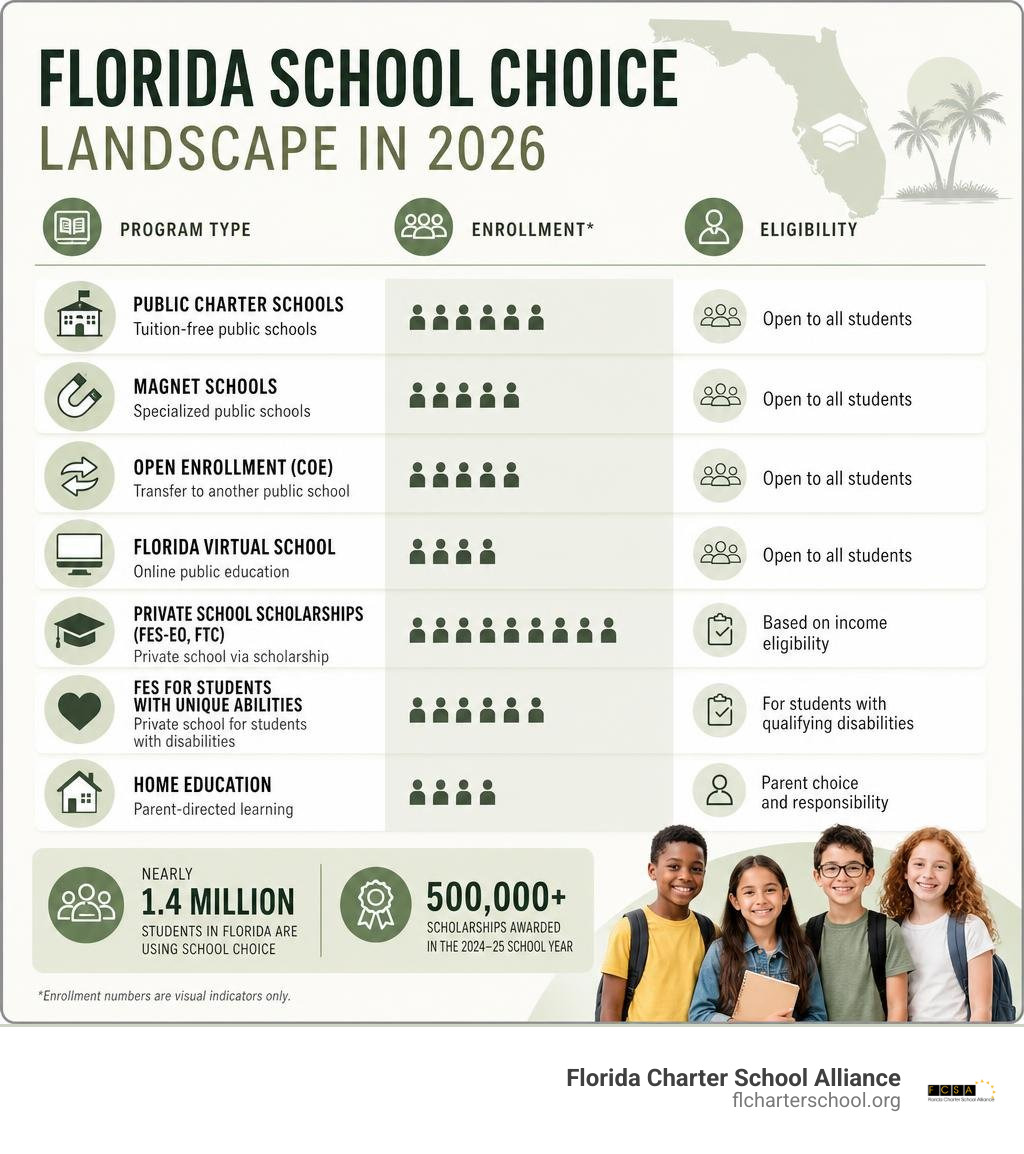
Here is a quick overview of the main options available in 2026:
| School Choice Option | Type | Cost to Families |
|---|---|---|
| Public Charter Schools | Tuition-free public schools | Free |
| Magnet Schools | Specialized public schools | Free |
| Open Enrollment (COE) | Transfer to another public school | Free |
| Florida Virtual School | Online public education | Free |
| Private School Scholarships (FES-EO, FTC) | Private school via scholarship | Covered by scholarship |
| FES for Students with Unique Abilities | Private school for students with disabilities | Covered by scholarship |
| Home Education | Parent-directed learning | Family expense |
Nearly 1.4 million students in Florida are now using some form of school choice. More than 500,000 scholarships were awarded in the 2024-25 school year alone. This is one of the most expansive school choice landscapes in the entire country.
For families in the arts and other specialized fields, this matters deeply. More options mean more chances to find a school that nurtures your child’s unique abilities — including programs built around creative and performing arts.
I’m Lynn Norman-Teck, Executive Director of the Florida Charter School Alliance, and I’ve spent my career advancing Florida school choice options through charter school policy, community engagement, and advocacy for high-quality public education. In this guide, I’ll walk you through every major option so you can make a confident, informed decision for your family.
Understanding Your Florida School Choice Options

When we talk about educational access, we are talking about opening doors that were once closed to many families. In Florida, school success is no longer determined solely by your ZIP code. Thanks to sweeping legislative changes over the last several years—most notably the passage of House Bill 1 in 2023—Florida has transitioned to a universal school choice model. This historic shift removed financial eligibility restrictions and enrollment caps for the state’s primary scholarship programs, sparking a new era of family empowerment.
To fully appreciate the landscape of Florida school choice options, it helps to understand the three primary private school scholarship programs and how they differ:
- Family Empowerment Scholarship for Educational Options (FES-EO): This program is state-funded and functions as an Education Savings Account (ESA). It is available to Florida residents eligible to enroll in kindergarten through 12th grade. While there are no income caps to qualify, the law prioritizes awards based on income, focusing first on families at or below 185% of the federal poverty level, and then those between 185% and 400%.
- Florida Tax Credit Scholarship (FTC): Operating alongside the FES-EO, the FTC is funded by corporate tax contributions. It shares the same universal eligibility and income prioritization rules. For families who prefer to educate their children at home, the FTC also supports the Personalized Education Program (PEP), which provides ESAs to a capped number of home-education students.
- Family Empowerment Scholarship for Students with Unique Abilities (FES-UA): This highly specialized ESA is designed for students aged 3 through grade 12 (or age 22) with diagnosed physical, learning, or cognitive disabilities. It allows parents to direct funding toward a highly customized educational path, including private school tuition, specialized therapies, contracted public school services, and learning materials.
These programs are administered by state-approved Scholarship Funding Organizations (SFOs), such as Step Up For Students and the AAA Scholarship Foundation. The average scholarship value is approximately $8,000.
For families utilizing these scholarships, the funds can cover a variety of approved educational expenses. According to the state’s official guidelines, funds can pay for private school tuition, instructional materials, tutoring, and even specialized electives. There are strict compliance measures in place: for example, parents must agree to the program’s purchasing rules, and students in grades 3 through 10 must take a nationally norm-referenced test or statewide assessment annually to track academic progress.
While these private options are highly popular, they represent just one piece of the puzzle. To help you compare your public and private pathways, we have outlined the core differences in the table below:
| Feature | Public Charter Schools | Magnet Schools | Traditional Open Enrollment (COE) | Private Scholarships (FTC/FES) |
|---|---|---|---|---|
| Tuition Cost | $0 (Tuition-free) | $0 (Tuition-free) | $0 (Tuition-free) | Covered up to scholarship limit |
| Admissions | Open enrollment; lottery if oversubscribed | Application-based; may have academic/audition criteria | Open to any student if school has capacity | Determined by the private school’s policies |
| Curriculum | Innovative, flexible, and student-centered | Specialized themes (STEM, Performing Arts, IB) | Standard district curriculum | Selected by the private school or parent (PEP) |
| Governance | Independent non-profit boards | Local school district | Local school district | Private/Independent |
| Accountability | State grades, financial audits, and charter contracts | District-level oversight and state grades | District-level oversight and state grades | Norm-referenced student testing; SFO audits |
To dive deeper into the state’s official resources and directories, you can visit the Overview of Florida Department of Education choice programs.
Public Charter Schools: High-Quality, Innovative Public Education
Public charter schools have become one of the most popular and successful Florida school choice options. From the 2019-20 school year through the 2022-23 school year, charter school enrollment in Florida grew by an impressive 68,000 students. Today, we have more than 738 charter schools operating across 46 counties, serving over 408,481 students. This means charter schools serve roughly 14.6% of Florida’s entire public school student population.
So, what exactly is a public charter school?
Simply put, charter schools are tuition-free, nonsectarian public schools. They are governed by independent, volunteer non-profit boards rather than local school districts. This structure gives them the flexibility to design innovative learning environments tailored to the specific needs of their communities. However, this flexibility comes with a high level of accountability. Charter schools are held to the exact same academic and financial standards as traditional public schools, and they receive state grades based on student performance. If a charter school fails to meet its academic or financial obligations, its charter contract can be terminated.
This unique combination of freedom and responsibility allows charter schools to foster academic excellence while keeping the focus entirely on student-centered learning. To explore the foundational laws and structure of these institutions, you can Learn more about Florida charter schools.
Public Charter Schools as Premier Florida School Choice Options
When parents look for a school, their primary concern is student achievement. They want to know that their child will be challenged, supported, and prepared for the future. On this front, Florida’s charter schools consistently deliver outstanding results.
Statewide data shows that public charter schools are driving educational innovation and academic excellence. In the state’s annual grading cycles, charter schools regularly earn top marks, frequently outperforming traditional public schools in reading, math, and science proficiency across various student demographics. This success is not accidental; it is the direct result of a system that allows educators to adapt their teaching styles to the children in their classrooms.
Whether a charter school focuses on college preparatory curricula, project-based learning, or specialized career academies, the emphasis remains on high-quality education. To see the latest data on how these schools are leading the state, check out the report on Florida charter school performance and state grades.
How to Find and Apply to Charter Schools
Finding the right charter school for your child is a straightforward process, but it does require a bit of planning. Because charter schools are public schools, they are open to all students residing within the school district. They cannot charge tuition, and they cannot use selective academic admissions criteria.
The application process typically involves these steps:
- Identify Potential Schools: Research the charter schools in your area to find programs that align with your child’s interests and learning style. You can search by location and theme using our online directory to Find a charter school in your district.
- Submit a Charter Application: Fill out an application directly through the specific charter school’s website during their designated enrollment window.
- Participate in the Enrollment Lottery: Because demand for high-quality charter schools is often very high, schools frequently receive more applications than they have seats available. When this happens, Florida law requires the school to conduct a fair, random enrollment lottery to award open seats.
- Accept and Enroll: If your child is selected in the lottery, you will receive an enrollment offer. Be sure to accept the offer and submit the required registration paperwork before the school’s deadline to secure your child’s spot. If your child is not selected initially, they will be placed on a waiting list, and you will be notified if a seat opens up.
Public School Choice: Open Enrollment and Magnet Programs
If you prefer to stay within the traditional public school system but want an option outside your neighborhood zoned school, Florida has excellent mechanisms in place to make that happen. Through public school choice, families can access different environments without paying private tuition.
Controlled Open Enrollment Policies
Controlled Open Enrollment (COE) is a statewide public education delivery system governed by Florida Statute 1002.31. This policy allows parents to transfer their children to any public school in the state—including those outside their home district—provided the receiving school has not reached its capacity.
Key aspects of the COE process include:
- Regular Capacity Updates: School districts and charter schools are legally required to update their school capacity data every 12 weeks and post this information publicly on their websites. This transparency helps parents quickly see which schools have open seats.
- Preferential Treatment: To support families facing unique challenges, the law mandates priority enrollment for specific student groups. This includes dependent children of active-duty military personnel, children relocated due to foster care placements, and children affected by court-ordered custody changes.
- Lottery System: When a school receives more transfer requests than its available capacity allows, it must use a random lottery system to assign seats fairly.
- Extracurricular Eligibility: Students who transfer under COE enjoy immediate eligibility to participate in sports and other extracurricular activities at their new school, ensuring a smooth social transition.
- Transportation Stipends: While parents are generally responsible for transporting their children to a choice school, Florida offers limited, first-come, first-served transportation stipends for K-8 students to help ease the financial burden on commuting families.
To read the exact legal language governing these transfers, you can review the Controlled open enrollment statutory guidelines.
Magnet Schools and Career Academies
Another highly sought-after public option is the magnet school system. Magnet schools are district-run public schools built around specialized curricula and specific academic themes.
These programs are designed to attract students from all over the district, breaking down traditional neighborhood boundaries. Some of the most common magnet themes include:
- STEM Education: Immersive programs focusing on science, technology, engineering, and mathematics, often featuring robotics labs and coding courses.
- Performing and Visual Arts: Schools that integrate creative writing, dance, music, theater, and fine arts directly into the daily academic schedule.
- International Baccalaureate (IB) and Cambridge Academies: Rigorous, globally recognized college-preparatory programs.
- Career Preparation: Programs that partner with local industries to offer hands-on training in fields like aviation, health sciences, cybersecurity, and culinary arts, allowing students to earn professional certifications alongside their high school diplomas.
Frequently Asked Questions About Florida School Choice
Navigating school options can naturally bring up a lot of questions. To help you sort through the details, we have compiled answers to some of the most common questions families ask. For additional guidance, you can also explore our comprehensive Charter school frequently asked questions.
Are charter schools free to attend in Florida?
Yes, absolutely. Public charter schools are 100% tuition-free. They are funded through the Florida Education Finance Program (FEFP), using the same public funding formula applied to traditional, district-run public schools. They are nonsectarian, public institutions open to all students through open enrollment, making them a highly accessible path to educational opportunity.
How do public charter schools compare to traditional public schools?
While both are tuition-free public schools, the primary differences lie in governance, flexibility, and accountability:
- Governance: Traditional schools are managed by elected school boards and district administrators. Charter schools are managed by independent, local governing boards, which keeps decision-making closer to the classroom.
- Innovative Learning: Charter schools have the flexibility to design specialized, student-centered learning models, select their own curricula, and adjust their daily schedules to support academic excellence.
- Accountability: Charter schools face double the accountability. They must meet the same state academic standards as traditional schools, but they must also satisfy the strict financial and operational conditions of their charter contracts. This focus on school success ensures that charter schools remain highly responsive to the families they serve.
How do I apply to a Florida charter school?
Applying to a charter school is a simple process:
- Visit the school’s website to submit a charter application during their open enrollment window.
- If the number of applicants is smaller than the school’s capacity, your child will be admitted directly.
- If the school is oversubscribed, your application will be entered into a random enrollment lottery.
- Keep a close eye on application deadlines, as they vary by school, and make sure to accept your seat promptly if selected.
Conclusion
The wealth of Florida school choice options available in 2026 reflects a deep, statewide commitment to family empowerment and student achievement. Whether you choose a private school scholarship, a specialized magnet program, or a public charter school, the ultimate goal remains the same: giving every child the educational opportunity they need to thrive.
At the Florida Charter School Alliance, we believe that public charter schools represent the very best of this movement—combining innovative learning, rigorous accountability, and tuition-free access to academic excellence. We are proud to advocate for high-quality public education options that support our state’s families and educators.
As you take the next steps in your educational journey, we invite you to Read why school choice has put Florida schools head and shoulders above the rest and discover how these programs are shaping a brighter future for students across the Sunshine State.